
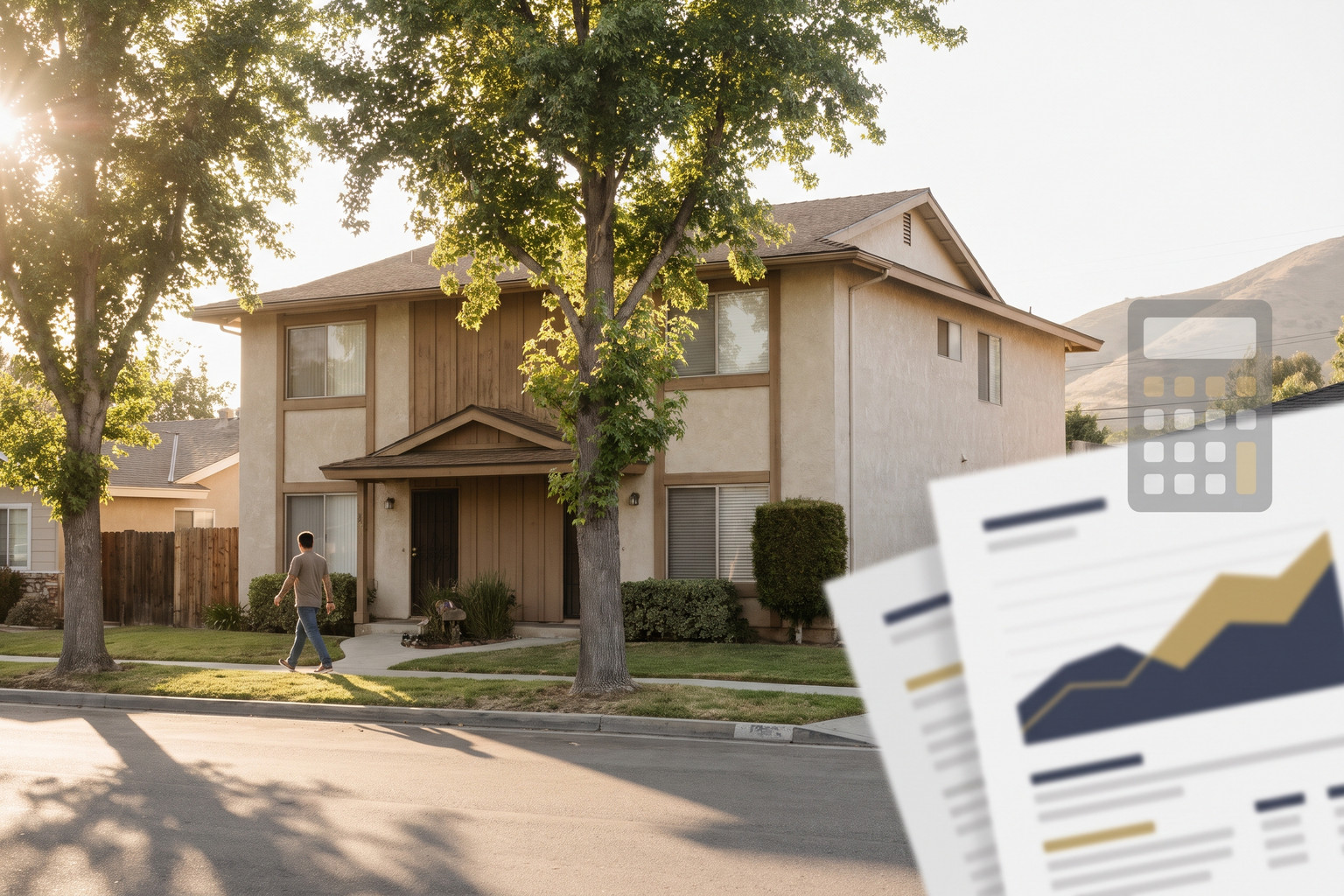
Chino sits in one of the few corners of Southern California where a working rental portfolio still pencils out. Single family homes off Central Avenue, small multifamily near the Preserve, and agricultural-adjacent parcels on the south end all produce real cash flow. But cash flow and taxable income are two very different numbers, and most owners here never close the gap. If you are searching for a real estate CPA Chino CA rental owners actually rely on, the question is not who can file your Schedule E. It is who can prove, line by line, why your depreciation, your repairs, and your hours are defensible. Working with experienced tax preparation services in Chino starts with that standard, not with a software login.
Quick Answer
A real estate CPA in Chino should do three things a general preparer will not: allocate your purchase price between land and building using defensible evidence, determine whether your losses are deductible this year or suspended under the passive activity rules, and build a contemporaneous records file that survives an IRS examination. For a $720,000 Chino duplex, a correct land allocation alone can shift $4,000 to $7,000 of annual depreciation. Over a ten-year hold, that is real money, and it is decided in the first ninety days of ownership.
This information is current as of 11/13/2026. Tax laws change frequently. Verify updates with the IRS or FTB if reading this later.
Why Chino Rental Owners Overpay: The Four Failure Points
Across the Inland Empire, the same four mistakes show up on return after return. None of them are exotic. All of them are expensive.
1. Land Allocation Copied From the County Assessor
Land is not depreciable. Buildings are. So the split between the two on your purchase price determines your annual deduction for the next 27.5 years. Most preparers grab the San Bernardino County assessed values, calculate a ratio, and move on.
That shortcut costs money in Chino specifically. Assessor ratios here frequently assign 40 to 50 percent of value to land because of lot sizes and the agricultural history of the area. A supported appraisal-based allocation often lands closer to 25 to 30 percent for improved residential property.
Run the math on a $720,000 purchase:
| Allocation Method | Land Value | Depreciable Basis | Annual Depreciation (27.5 yr) |
|---|---|---|---|
| Assessor ratio at 45% | $324,000 | $396,000 | $14,400 |
| Appraisal-supported at 28% | $201,600 | $518,400 | $18,851 |
| Annual difference | – | $122,400 | $4,451 |
At a combined federal and California marginal rate near 42 percent, that is roughly $1,869 per year in tax, or about $18,690 across a ten-year hold. From one allocation decision. The IRS does not require you to use assessor values; it requires a reasonable method supported by evidence. See IRS Publication 527 on residential rental property.
2. Treating Every Improvement as a Repair (or Vice Versa)
Owners guess at this constantly. A $9,400 roof replacement gets expensed. A $600 faucet repair gets capitalized over 27.5 years. Both are wrong, and both create exposure.
The tangible property regulations give you actual safe harbors. The de minimis safe harbor lets you expense items up to $2,500 per invoice or item if you have a written capitalization policy in place before the year begins. The small taxpayer safe harbor allows expensing of repairs and improvements on a building with unadjusted basis under $1 million, capped at the lesser of $10,000 or 2 percent of basis.
Most Chino owners qualify for at least one of these. Almost none have the written policy on file, which means they cannot use the first one. That document takes twenty minutes to produce and has to exist before January 1.
3. Ignoring the Passive Activity Loss Wall
You can generate a $26,000 paper loss and deduct exactly zero of it. Under IRC Section 469, rental activity is passive by default. Passive losses offset passive income only, unless you fit an exception.
The two doors out:
- The $25,000 active participation allowance. Available if you actively participate (approving tenants, setting rents, authorizing repairs) and your modified AGI is under $100,000. It phases out completely at $150,000.
- Real estate professional status. Requires more than 750 hours and more than half your total personal service time in real property trades or businesses, with material participation in the rentals.
Here is the Chino-specific problem. A dual-income household with two professionals clears $150,000 of MAGI easily. The $25,000 allowance is gone. And neither spouse has a prayer of hitting real estate professional status while working full time elsewhere. Those losses suspend and carry forward until you have passive income or sell the property in a fully taxable disposition.
That is not a failure. But it changes strategy completely. If losses suspend anyway, accelerating depreciation through a cost segregation study buys you nothing this year. The planning shifts to basis management, timing of disposition, and grouping elections.
4. No Contemporaneous Hour Log
If you are claiming real estate professional status or the short-term rental exception, your hour log is the entire case. The Tax Court has rejected reconstructed logs repeatedly. “Ballpark guesstimates” prepared after an audit notice do not carry weight.
A usable log records the date, the activity, the property, and the time, entered contemporaneously. Calendar entries work. A simple spreadsheet updated weekly works. A document created the week before your exam does not.
What a Real Estate CPA Chino CA Owners Hire Should Actually Deliver
Pricing a return by form count tells you nothing. Here is the evidence test to run on any firm before you sign.
| Question to Ask | Weak Answer | Strong Answer |
|---|---|---|
| How do you set land allocation? | “We use the county assessor.” | “Appraisal, insurance replacement cost, or a documented comparable land analysis, with the method in your file.” |
| Will my losses be deductible? | “We’ll see at filing.” | “Here is your projected MAGI and passive status before year-end.” |
| Do I need cost segregation? | “It always saves money.” | “Only if you can use the loss. Let’s test that first.” |
| What records do you need? | “Send your 1099s.” | “A documented request list by category, delivered in November.” |
| What happens if I get a notice? | “We’ll refer you out.” | “We represent you and our workpapers support every position.” |
Our Chino tax preparation team works with rental owners who want positions documented at the time of the transaction, not reverse-engineered in March. If you want to see how we approach depreciation-heavy portfolios elsewhere in Southern California, our breakdown of building a rental owner’s tax preparation file covers the same discipline applied in Los Angeles County.
KDA Case Study: Chino Duplex Owner Recovers $21,400 in Missed Depreciation
A married couple in Chino, both W-2 earners with combined wages around $196,000, bought a duplex near Riverside Drive in 2021 for $685,000. Their prior preparer used the San Bernardino County assessor ratio, which assigned 47 percent of value to land. That left a depreciable basis of $363,050 and annual depreciation of $13,202.
They came to KDA in 2026 after their refund kept shrinking while rents climbed. Two problems surfaced immediately. First, the land allocation was indefensibly high. We commissioned a retrospective appraisal that supported a 29 percent land allocation, raising depreciable basis to $486,350 and annual depreciation to $17,685. Second, they had capitalized $11,800 of genuine repairs across four years, including a water heater, two HVAC service calls, and interior paint between tenants, all of which should have been expensed.
We filed Form 3115 to change their accounting method for depreciation and claimed a Section 481(a) adjustment capturing the understated depreciation from prior years. Combined with the reclassified repairs, the catch-up deduction totaled $21,400 in the current year. Because their MAGI exceeded $150,000, the $25,000 allowance was unavailable, so a portion suspended. But $13,900 offset passive income from a second property they owned, producing $5,838 in actual tax reduction, with the remainder carrying forward.
They paid $3,250 for the engagement, including the appraisal coordination and Form 3115 preparation. First-year return was 1.8x, with the corrected depreciation schedule producing an additional $4,483 in deductions every year going forward.
Ready to see how we can help you? Explore more success stories on our case studies page to discover proven strategies that have saved our clients thousands in taxes.
Does Cost Segregation Make Sense for a Chino Property?
Short answer: only if you can use the loss it creates. A cost segregation study reclassifies components of your building into 5, 7, and 15-year property, accelerating depreciation dramatically. On a $720,000 Chino duplex, a study might move $130,000 to $170,000 into shorter lives.
Yes, if:
- You have other passive income the accelerated loss can offset
- One spouse qualifies as a real estate professional with material participation
- The property is a short-term rental with average stays of seven days or less and you materially participate
- Your building basis exceeds roughly $500,000, making the study fee worth it
No, if:
- Your MAGI exceeds $150,000 and you have no passive income
- You plan to sell within two to three years, since depreciation recapture claws much of it back
- Study fees of $4,000 to $9,000 exceed the present value of the deferral
Key Takeaway: Cost segregation is a timing tool, not a savings tool. If the loss suspends, you paid $6,000 for a deduction you cannot touch. Test usability first. Our analysis of cost segregation feasibility for rental owners walks through that test in detail.
California-Specific Rules Chino Owners Cannot Ignore
California does not conform to federal law in several places that hit rental owners directly.
No Bonus Depreciation
California has never conformed to federal bonus depreciation. Whatever you accelerate federally, you depreciate normally for state purposes. That means two depreciation schedules, two sets of basis tracking, and a permanent book-tax difference. If your preparer runs one schedule and plugs the state return, your California basis is wrong and will stay wrong until you sell.
Section 179 Limits Differ
California caps Section 179 expensing far below the federal limit, at $25,000 with a $200,000 investment phase-out. Federal limits are multiples of that. Plan accordingly.
LLC Fees on Rental Entities
If you hold Chino property in an LLC, you owe the $800 annual franchise tax plus the gross receipts fee under Revenue and Taxation Code Section 17942. That fee is based on total California gross receipts, meaning gross rents, not profit:
| California Gross Receipts | Annual LLC Fee | Plus Franchise Tax | Total |
|---|---|---|---|
| Under $250,000 | $0 | $800 | $800 |
| $250,000 to $499,999 | $900 | $800 | $1,700 |
| $500,000 to $999,999 | $2,500 | $800 | $3,300 |
| $1,000,000 to $4,999,999 | $6,000 | $800 | $6,800 |
A four-property Chino portfolio grossing $268,000 in rents owes $1,700 annually just to exist as a single LLC. Splitting into separate LLCs may reduce the fee tier but multiplies the $800 franchise tax. Run the math before you form anything. Review current requirements with the California Franchise Tax Board and file Form 568 by the deadline. If entity structure is on your mind, our California entity decision guide breaks down the tradeoffs.
Property Tax and Proposition 19
Transferring Chino rental property to children no longer preserves the low Proposition 13 assessed value unless the child makes it a primary residence, and even then only up to a limit. Proposition 19 eliminated the broad parent-child exclusion for investment property as of February 2021. A duplex assessed at $210,000 that would reassess to $780,000 generates roughly $6,300 in additional annual property tax. That changes succession planning entirely.
Step-by-Step: Building Your 2026 Chino Rental Documentation File
- Pull your closing statement for each property. You need the final settlement statement, not the estimate. Allocate every line item: purchase price, loan fees, title charges, prepaid items. Loan costs amortize over the loan term; title and escrow fees add to basis. Time required: 30 minutes per property.
- Document your land allocation. If you used the assessor ratio, get an alternative supported figure. Options include a retrospective appraisal, insurance replacement cost, or comparable vacant land sales in Chino. Keep the supporting document permanently. Time required: 2 to 4 weeks if ordering an appraisal.
- Separate repairs from improvements using the BAR test from the tangible property regulations. Does it Better the property, Adapt it to a new use, or Restore it? If none apply, it is a repair. Build a schedule by property, by date, with vendor invoices attached.
- Adopt a written capitalization policy before January 1 to use the de minimis safe harbor at $2,500 per item. This is a one-page document signed and dated. Without it, you lose the safe harbor entirely.
- Log your hours contemporaneously if you are pursuing real estate professional status or material participation on a short-term rental. Weekly entries. Date, property, activity, hours. No reconstruction.
- Reconcile rents to deposits. Every dollar of rental income should trace to a bank deposit. Security deposits held are not income; forfeited deposits are. Separate them in your books.
- Project your MAGI before December 15. This determines whether your $25,000 allowance survives. If you are hovering near $150,000, a retirement contribution or deferred bonus may preserve thousands in deductions.
What Happens If You Get This Wrong?
The consequences are not abstract.
Understated depreciation. The IRS calculates gain on sale using depreciation “allowed or allowable.” If you were entitled to $18,851 per year and only claimed $14,400, you still face recapture on the full allowable amount at sale. You lose the deduction and pay the recapture. Worst of both.
Disallowed repairs. If an examiner reclassifies $38,000 of expensed improvements, you face tax on the disallowed amount plus interest, and potentially a 20 percent accuracy-related penalty under IRC Section 6662.
Rejected hour logs. Losing real estate professional status in an exam can disallow six figures of deductions across open years. The FTB typically follows with its own adjustment.
Missed Form 568. California assesses penalties for late LLC filings separate from the fee itself, and the FTB is aggressive about collection.
If a notice already arrived, understand how the agency actually communicates before responding. Our guide on verifying IRS contact methods covers the verification steps that prevent costly mistakes. For representation, see our audit representation services.
Special Situations Most Preparers Skip
You Converted Your Former Chino Residence to a Rental
Your depreciable basis is the lesser of adjusted cost basis or fair market value at conversion. In a market where Chino values climbed substantially, that frequently means your basis is your original purchase price plus improvements, not today’s value. Owners routinely overstate this and create recapture exposure. Document the conversion date and the FMV determination.
You Own With a Partner or Sibling
Co-ownership that rises to a partnership requires Form 1065 and K-1s. Simple co-ownership with separate expense payment may not. The distinction matters because a missed partnership return carries penalties of $245 per partner per month. Our walkthrough on partnership filing requirements explains where the line sits.
You Are Running a Short-Term Rental
If average guest stay is seven days or less, the activity is not a rental under Section 469 regulations. It is a trade or business. Material participation rules apply instead, and 100 hours with more than anyone else may be enough. That is a far lower bar than 750 hours. Chino’s proximity to the Ontario airport and the fairgrounds makes this relevant for some owners. Also confirm transient occupancy tax obligations with the City of Chino.
You Are Planning a 1031 Exchange
Identification within 45 days, closing within 180. Strict. California also imposes clawback reporting under Form 3840 if you exchange California property for out-of-state replacement property, requiring annual filing until you recognize the deferred gain. Miss that filing and California can assess the deferred tax immediately.
Ready to Reduce Your Tax Bill?
KDA Inc. specializes in strategic tax planning for business owners, S Corps, LLCs, and high-net-worth individuals. Book a personalized consultation and walk away with a clear plan.
Frequently Asked Questions
Can I deduct mileage driving to my Chino rental?
Yes, for trips with a rental business purpose: showings, repairs, inspections, tenant meetings. The 2026 standard mileage rate applies. Log date, destination, purpose, and miles. Commuting between your home and a property you manage from home is generally deductible as the home is your principal place of business for the activity, but keep that documented.
Is my property management fee deductible?
Yes, fully, in the year paid. It goes on Schedule E as management fees. Same for leasing commissions, though large upfront leasing fees on long leases may need amortization.
Do I report security deposits as income?
Not when received if you intend to return them. Report as income in the year you keep any portion, and deduct the repair the deposit covered. Last month’s rent collected upfront is income immediately.
What if I never claimed depreciation at all?
File Form 3115 to change your accounting method and take the full catch-up as a Section 481(a) adjustment in the current year. You generally cannot amend more than three years back to fix it, but Form 3115 captures the entire missed amount. This is one of the highest-value corrections available to long-term owners.
How long should I keep rental records?
Income and expense records for at least three years after filing. But basis records, closing statements, improvement invoices, and depreciation schedules should be kept for the entire ownership period plus three years after sale. Those documents determine your gain.
Does California tax my rental income differently than federal?
The income is taxed at California rates, but the calculation differs because of depreciation nonconformity, different Section 179 limits, and no bonus depreciation. Your California taxable rental income is almost always higher than federal.
Can I deduct a loss when I sell at a loss?
Rental property is Section 1231 property. A loss on sale is generally an ordinary loss, fully deductible, and selling in a fully taxable disposition also releases all suspended passive losses for that activity.
Where to Start Before Year-End
Three moves matter most between now and December 31. Project your MAGI to see whether your $25,000 allowance is in play. Adopt your written capitalization policy so the de minimis safe harbor is available for 2027. And pull your depreciation schedule to verify the land allocation your preparer used, because that number drives every future year.
If you want to model how additional retirement contributions could pull your income under the passive loss threshold, run your numbers through this retirement savings calculator before you finalize December payroll or contributions.
Ready to work with a tax professional who understands Chino rental owners? Explore our Chino tax services or book a consultation below. You can also review our full real estate tax preparation offering.
Book Your Rental Portfolio Review
If your Chino property is producing cash but your tax bill keeps climbing, the problem is almost always in the depreciation schedule or the passive loss analysis, and both are fixable. Bring us your closing statements and your last two returns. We will tell you exactly what is being left on the table and what it is worth to correct it. Click here to book your consultation now.



