
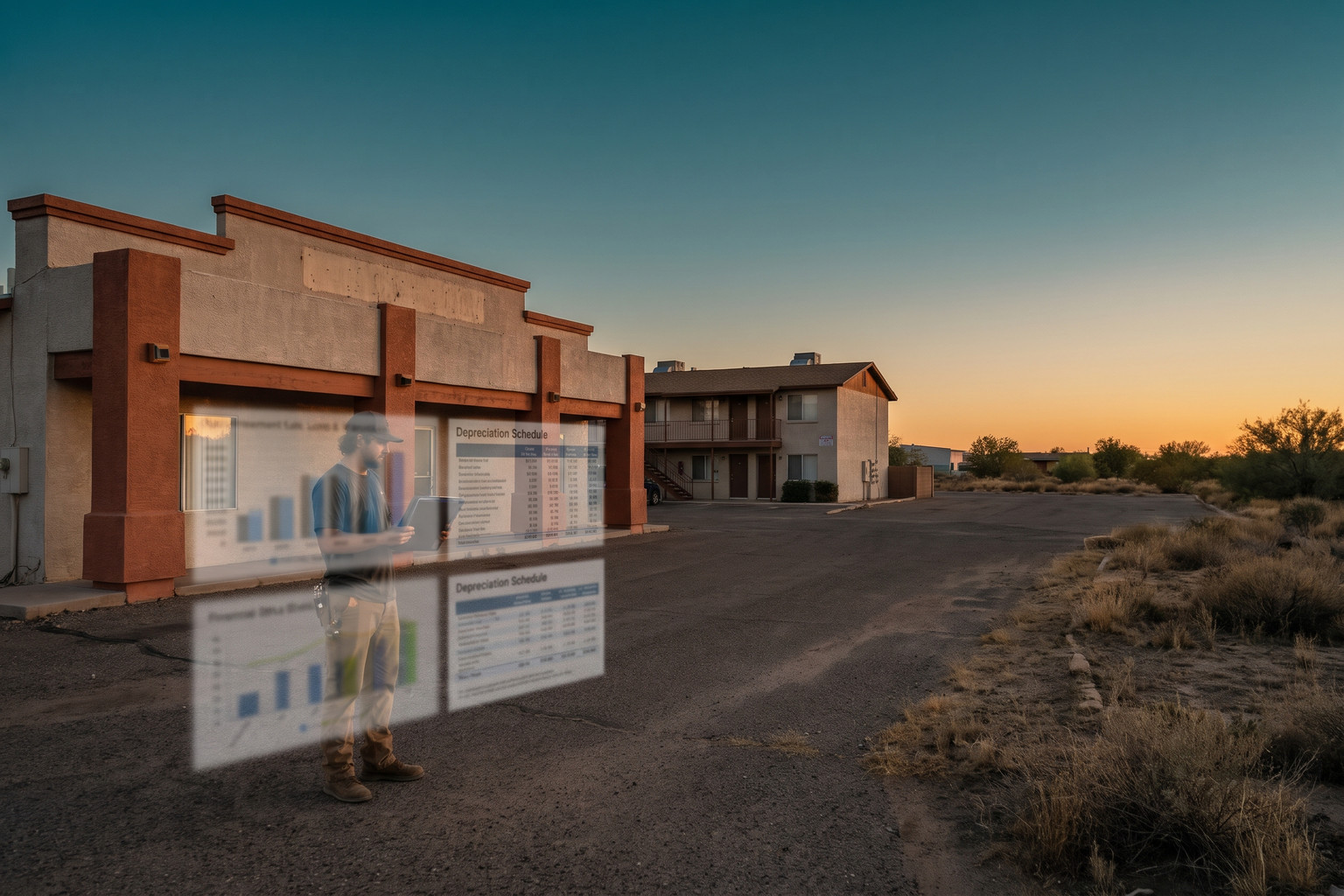
Quick Answer
If you are asking how much does it cost to maximize bonus depreciation in Arizona, the honest range for 2026 is $2,500 to $15,000 in professional fees for a cost segregation study on a typical single property, plus $500 to $2,500 in tax preparation work to apply the results correctly. On a $900,000 Phoenix rental with roughly $225,000 in reclassified short-life assets, a $5,500 study commonly returns $70,000 to $85,000 in first-year deductions. The cost is never the real question. Whether you can actually use the deduction this year is.
That is the part most property owners get backwards. They shop the study fee, pick the cheapest provider, get a beautiful report, and then discover their losses are suspended under the passive activity rules and will sit unused for six years. The fee was not the mistake. The sequencing was.
What You Are Actually Buying When You Maximize Bonus Depreciation in Arizona
Bonus depreciation lets you deduct a large percentage of qualifying property in the year it is placed in service rather than spreading it across 27.5 or 39 years. The One Big Beautiful Bill Act restored 100 percent bonus depreciation for qualified property acquired and placed in service after January 19, 2025, which is why 2026 conversations sound different from the ones investors were having in 2023 and 2024 when the rate was phasing down.
But bonus depreciation does not apply to a building. A residential rental structure is 27.5-year property. A commercial building is 39-year property. Neither qualifies. What qualifies is the personal property and land improvements buried inside that purchase price: the appliances, the carpet, the specialty electrical, the parking lot, the landscaping, the fencing, the pool equipment.
Those components are 5-year, 7-year, and 15-year property. They qualify for bonus. The problem is that your closing statement does not break them out. It shows one number for the building and one for the land. A cost segregation study is the engineering analysis that separates them.
So when you price out how much does it cost to maximize bonus depreciation in Arizona, you are pricing three distinct services that often get bundled and mislabeled:
- The engineering study itself – the site analysis, the construction cost estimating, the component classification, and the audit-defense documentation package
- The tax application work – applying the study results to your return, handling the Form 3115 if you are catching up on a prior-year property, and modeling the passive loss consequences
- The strategic qualification work – determining before you spend a dollar whether you can actually use the deduction
Most providers sell you the first one and leave you to figure out the other two.
2026 Cost Ranges by Property Type and Study Method
Arizona pricing tracks national pricing closely, with a modest discount in Phoenix and Tucson metro areas because of provider density and a modest premium for rural properties in places like Camp Verde, Kearny, or Florence where site visits require travel.
| Study Type | Typical Property Value | 2026 Fee Range | Audit Durability |
|---|---|---|---|
| Software-only / DIY platform | Under $500,000 | $450 to $1,800 | Weak |
| Desktop study (no site visit) | $300,000 to $1M | $2,000 to $4,500 | Moderate |
| Full engineering study, residential rental | $500,000 to $2M | $4,000 to $8,500 | Strong |
| Full engineering study, commercial | $1M to $5M | $7,000 to $15,000 | Strong |
| Multi-property portfolio (per property) | Varies | $3,000 to $6,000 | Strong |
| Form 3115 catch-up filing | Any | $750 to $2,500 add-on | Required for prior years |
Key Takeaway: A full engineering study on a $900,000 Arizona rental runs about $5,500 in 2026. If a provider quotes you $900 for the same property, you are buying a spreadsheet, not a defensible allocation.
Why the Cheap Study Is Usually the Expensive One
The IRS published its Cost Segregation Audit Techniques Guide precisely because allocations get abused. The guide identifies the “detailed engineering approach from actual cost records” as the most reliable method and treats rule-of-thumb percentage allocations with open suspicion.
A software tool that assigns 22 percent of every property to 5-year assets because that is the average is a rule of thumb wearing a report cover. When an examiner asks how the provider arrived at $31,400 for the specialty electrical, there has to be an actual answer. On the cheap studies, there is not one.
Here is the math that matters. A $1,200 software study that gets 60 percent disallowed on exam costs you the $1,200, the disallowed deduction, accuracy-related penalties under section 6662 potentially running 20 percent of the underpayment, and interest. A $5,500 engineering study that holds costs you $5,500. The spread between the two fees is $4,300. The spread between the two outcomes can be $40,000.
KDA Case Study: Arizona Real Estate Investor Turns a $6,200 Study Into $23,800
A client we will call Marcus came to us in late 2025. He is a 48-year-old software architect earning $310,000 in W-2 wages in Scottsdale, and his wife Dana left her marketing role in 2024 to manage their growing rental portfolio full time. They owned four properties: two long-term rentals in Mesa, a Tucson duplex, and a newly acquired $1.1 million short-term rental in Sedona placed in service in June 2025.
Marcus had already gotten a quote. A national provider offered a $2,400 desktop study on the Sedona property and told him he would see “around $200,000” in accelerated deductions. He wanted to know if that was a good deal.
It was the wrong question, and we told him so. The real issue was that Marcus is a W-2 earner with high income. Rental losses are passive by default. Without a qualifying path, that $200,000 deduction would have been suspended under section 469, carried forward, and done absolutely nothing for his 2025 or 2026 tax bill. He would have paid $2,400 for a deduction he could not touch.
What we did instead: Dana already met the material participation threshold on the Sedona property, and the average guest stay was 4.6 nights. That put the property outside the definition of a rental activity entirely under the section 469 regulations, meaning the losses were nonpassive without needing real estate professional status. We documented her hours with a contemporaneous log, commissioned a full engineering study at $6,200, and timed the placed-in-service date verification carefully.
The study reclassified $268,000 into 5-, 7-, and 15-year property. With 100 percent bonus depreciation available, the first-year deduction came to $268,000 against Marcus’s wage income. Federal and Arizona tax savings totaled $23,800 in year one. Against $6,200 in study fees and $1,850 in strategic tax work, that is a 2.95x first-year return, with substantial additional savings in years two through five.
Ready to see how we can help you? Explore more success stories on our case studies page to discover proven strategies that have saved our clients thousands in taxes.
The Qualification Test You Must Pass Before You Spend a Dollar
This is the section competitors leave out, and it is the single most expensive omission in the industry. Before you ask how much does it cost to maximize bonus depreciation in Arizona, answer whether the deduction will be usable.
Decision Framework: Can You Actually Use the Loss This Year?
Yes, the loss is usable now if:
- The property is a short-term rental with an average guest stay of 7 days or less, and you materially participate in it
- You or your spouse qualify as a real estate professional under section 469(c)(7) and materially participate in the rental
- Your modified AGI is under $100,000 and you actively participate, giving you up to the $25,000 special allowance
- You have sufficient passive income from other sources to absorb the loss
- The property is used in a trade or business you materially participate in, such as your own operating company’s building
No, the loss will be suspended if:
- You are a high-income W-2 earner with a long-term rental and no REPS qualification
- Your modified AGI exceeds $150,000 and the $25,000 allowance is fully phased out
- Nobody in the household meets the 750-hour and more-than-half-of-personal-services tests
- You have no other passive income to offset
The real estate professional rules require more than 750 hours in real property trades or businesses and more than half of all personal services performed during the year in those activities. A full-time software architect cannot meet the second prong. Full stop. The IRS has won this argument repeatedly, and the IRS Publication 925 guidance on passive activity and at-risk rules spells out both tests clearly.
Key Takeaway: A suspended loss is not lost forever, but a deduction you cannot use until 2032 is worth a fraction of one you use in 2026. Run the qualification test before you run the study.
The Arizona Conformity Question Nobody Answers
Here is where Arizona investors get a genuinely better deal than California investors, and almost nobody explains it.
Arizona uses federal adjusted gross income as the starting point for individual returns and conforms to the Internal Revenue Code on a rolling or annually updated basis depending on the provision. Historically Arizona has required an addback for a portion of federal bonus depreciation on corporate returns while permitting a subtraction over subsequent years, and the state has adopted various conformity positions on section 179 limits. Verify the current year conformity statute with the Arizona Department of Revenue before you model state savings.
Compare that to California, which flatly does not conform to federal bonus depreciation and caps section 179 at $25,000 with a $200,000 investment phaseout. A California investor running the identical study gets the full federal benefit and then has to maintain an entirely separate state depreciation schedule for the life of the asset. Arizona investors generally face a simpler reconciliation.
Arizona also runs a flat 2.5 percent individual income tax rate. That is the lowest flat rate among states that impose an income tax, and it changes the arithmetic of acceleration. When your state rate is 2.5 percent instead of 13.3 percent, the state-side value of a deduction is smaller, which means the federal benefit carries almost all the weight in your ROI calculation. Do not let a provider pad your projected savings with a state number that does not exist.
Step-by-Step: How to Price and Execute a Study Correctly
- Run the qualification screen first – Before contacting any provider, confirm which passive activity path you are on. This takes one conversation with a strategist and costs a fraction of a wasted study. Timeline: one week.
- Pull your acquisition documents – You need the settlement statement, the purchase agreement, the appraisal with its land allocation, any construction or renovation invoices, and the depreciation schedule from your prior return. Timeline: two to three days.
- Request quotes from three engineering firms – Ask each one specifically whether the fee includes a site visit, whether a licensed engineer signs the report, and whether audit support is included or billed separately. Timeline: one week.
- Verify the placed-in-service date – The property must be ready and available for its intended use. For a rental, that generally means listed and available, not merely purchased. This date controls which bonus percentage applies. Timeline: same day.
- Model the deduction against your actual tax position – Project the first-year deduction, the suspended loss risk, and the depreciation recapture exposure at sale. Run the numbers through a federal tax calculator to see where the deduction actually lands in your bracket. Timeline: one week.
- Commission the study – Full engineering studies typically take four to eight weeks from engagement to delivered report. Build that into your December 31 planning. Timeline: four to eight weeks.
- Apply the results on the return – For a current-year property, the study feeds directly into Form 4562. For a property placed in service in a prior year, you file Form 3115 to claim the catch-up adjustment under section 481(a). Timeline: with your return.
What Happens If You Get This Wrong
Three failure modes account for most of the damage we see.
Failure One: The Suspended Loss Surprise
You spend $6,000, generate a $190,000 deduction, and watch it get suspended on Form 8582. You have paid real money for a future benefit with no defined date. If you later sell the property in a fully taxable disposition, the suspended losses free up. If you 1031 exchange instead, they ride along for years longer.
Failure Two: The Recapture Blindside
Accelerated depreciation is a timing benefit, not a permanent one. When you sell, section 1245 recapture on the personal property components is taxed as ordinary income at rates up to 37 percent, while section 1250 unrecaptured gain on the building runs at 25 percent. If you accelerate $268,000 into 5-year property and sell in year four, a large slice comes back as ordinary income.
This does not make cost segregation a bad idea. Time value of money is real, and a dollar deducted in 2026 at a 37 percent marginal rate beats a dollar deducted in 2041. But if your plan is to sell in 36 months, the math tightens considerably. We walk through similar acceleration tradeoffs in our breakdown of how cost segregation and bonus depreciation interact.
Failure Three: The Undocumented Hours Claim
Material participation and real estate professional status both live or die on contemporaneous records. A log reconstructed the week before an audit is worth very little. Tax Court opinions on this point are consistent and unkind. Log hours as you work them, note the property and the task, and keep it in a system you actually maintain.
Key Takeaway: The study fee is the smallest risk in this transaction. Suspended losses, recapture timing, and documentation gaps carry the real dollars.
Special Situations Most Providers Will Not Discuss
Properties You Bought Years Ago
You do not have to amend prior returns. Form 3115 lets you claim the entire cumulative catch-up depreciation in the current year as a section 481(a) adjustment. A Tucson fourplex bought in 2019 with no study can generate a six-figure current-year deduction in 2026. The filing adds $750 to $2,500 to your cost, and it is almost always worth it on a property over $600,000.
Partial Asset Dispositions
When you replace a roof, the old roof is still sitting on your depreciation schedule. A partial asset disposition election lets you write off the remaining basis of the removed component in the year of replacement. Cost segregation gives you the component-level basis numbers that make this election possible. Most owners never claim it because nobody told them it exists.
Short-Term Rentals in Sedona, Flagstaff, and Scottsdale
Arizona’s vacation rental markets create the single cleanest path to usable acceleration for high-income W-2 earners. Average stay of seven days or less removes the activity from the rental definition. Material participation then makes losses nonpassive. The 100-hour significant participation test or the 500-hour test both work. The documentation standard is strict but achievable. Our analysis of the short-term rental qualification standard covers the hour tests in full.
Properties Held in an S Corporation
Rental real estate generally does not belong inside an S Corp. Pulling appreciated property out of a corporation triggers gain as if you sold it at fair market value. If your Arizona rentals are sitting in an S Corp, address the structure before you spend money accelerating depreciation inside it.
Ready to Reduce Your Tax Bill?
KDA Inc. specializes in strategic tax planning for business owners, S Corps, LLCs, and high-net-worth individuals. Book a personalized consultation and walk away with a clear plan.
Frequently Asked Questions
Is a cost segregation study tax deductible?
Yes. The fee is an ordinary and necessary business expense deductible against your rental or business income in the year paid, subject to the same passive activity limits as your other rental expenses.
What is the minimum property value that justifies a study?
Our working threshold is $400,000 in depreciable basis, excluding land. Below that, the fee relative to benefit gets thin unless the property has unusual component density such as a renovated short-term rental with heavy furnishings and site work.
Can I do a cost segregation study myself?
You can, and the IRS will evaluate your allocation on its merits. The practical problem is that you are unlikely to produce construction cost estimating that survives scrutiny, and the audit techniques guide explicitly favors engineering-based methodology performed by qualified professionals.
How long does the study take?
Four to eight weeks for a full engineering study including a site visit. Desktop studies run two to four weeks. Start by October if you want results applied to a December 31 placed-in-service decision.
Does Arizona allow 100 percent bonus depreciation?
Arizona’s conformity position differs by entity type and tax year. Individual returns starting from federal AGI generally pick up federal depreciation, while corporate filers have historically faced addback and subtraction mechanics. Confirm the current statute for your filing year before relying on state savings projections.
What if I already filed without a study?
File Form 3115 with your current-year return and claim the cumulative catch-up as a section 481(a) adjustment. No amended returns required, and the automatic change procedures generally apply.
Do I need a new study if I refinance?
No. A refinance does not change your basis or your depreciation schedule. Only an acquisition, a substantial improvement, or a change in use triggers a new analysis.
How does this interact with the section 179 deduction?
Section 179 has a dollar cap and a business income limitation; bonus depreciation does not. For most rental property owners, bonus is the cleaner tool. Section 179 also cannot create a loss, which defeats the purpose for most acceleration strategies.
Putting a Real Number on Your Situation
Here is the arithmetic for three common Arizona scenarios in 2026.
| Scenario | Property Basis | Study Fee | Reclassified Assets | Year-One Tax Savings | ROI |
|---|---|---|---|---|---|
| Mesa long-term rental, REPS spouse | $620,000 | $4,800 | $142,000 | $11,900 | 2.5x |
| Sedona short-term rental, material participation | $1,100,000 | $6,200 | $268,000 | $23,800 | 2.9x |
| Tucson commercial building, operating business | $2,400,000 | $11,500 | $505,000 | $41,200 | 3.6x |
Notice that ROI improves with property size. Study fees do not scale linearly with value, which means larger properties produce better returns on the fee. Notice also that every one of these scenarios passes the qualification test. Strip that out and all three ROIs go to zero for the current year.
If you are weighing the depreciation question alongside broader entity and income decisions, our guide to how rental income is actually taxed lays out the full calculation sequence that sits underneath these numbers.
Arizona investors have real structural advantages here: a 2.5 percent flat state rate, generally friendlier conformity than California, and strong short-term rental markets in Sedona, Flagstaff, and Scottsdale that create legitimate nonpassive paths. What they do not have is a shortcut around the qualification analysis.
Before you pay for a study, know whether the deduction lands. Explore our cost segregation services and our full bonus depreciation guide to see the framework we use, or book a session below and we will run your numbers first.
This information is current as of 11/27/2026. Tax laws change frequently. Verify updates with the IRS or the Arizona Department of Revenue if reading this later.
Book Your Bonus Depreciation Feasibility Review
Do not buy a cost segregation study until someone tells you whether you can use the deduction. We will review your property basis, your passive activity position, your material participation hours, and your projected hold period, then give you a straight answer on whether a study pays for itself in 2026 or just produces a suspended loss you cannot touch. If the numbers do not work, we will tell you that too. Book your feasibility review now and find out what your Arizona property is actually worth in deductions this year.



