
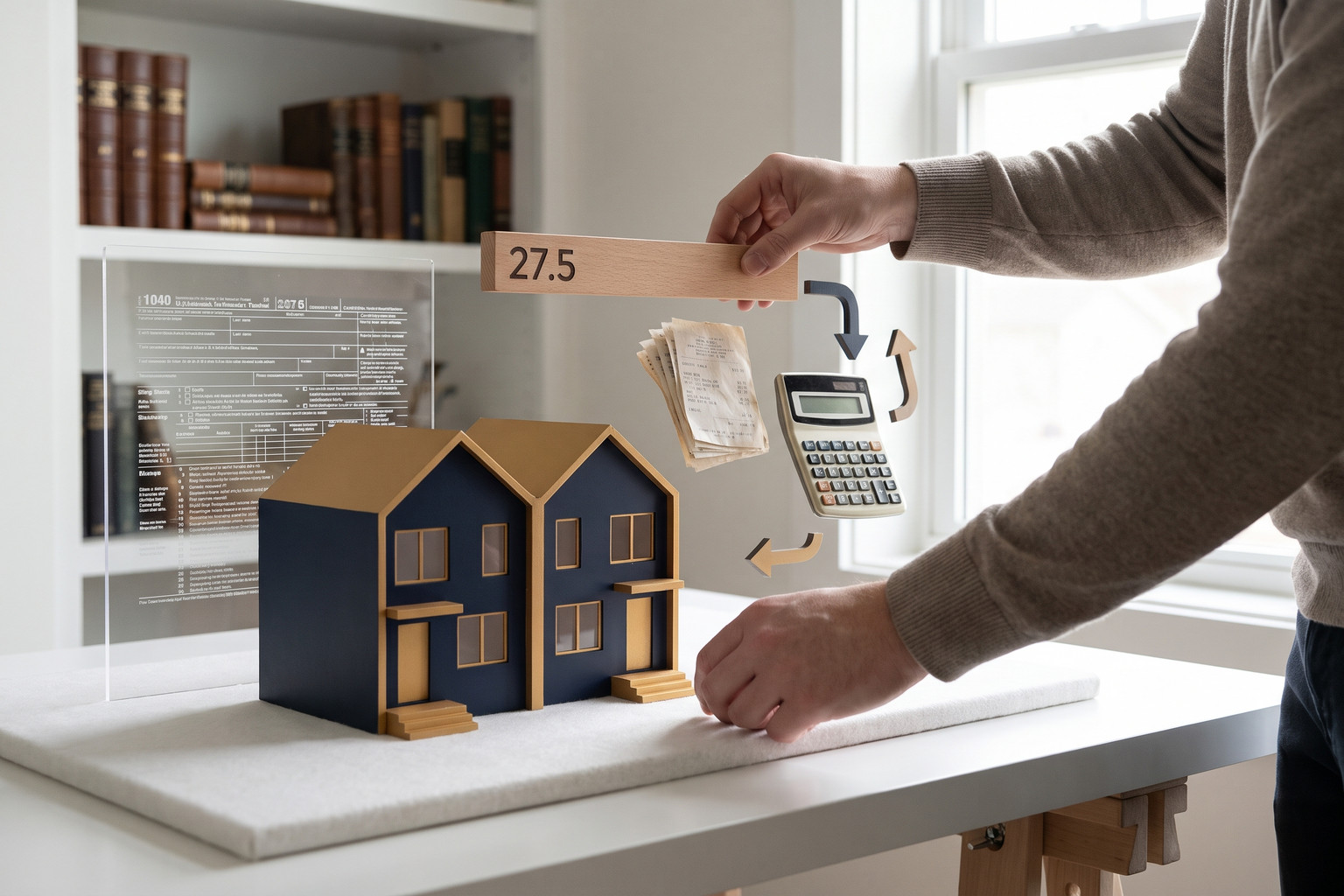
Most landlords discover the rules the hard way: a $2,400-a-month duplex throws off $28,800 in rent, the owner reports all of it as income, and writes a check for taxes on money that was never actually profit. The turn is this. Rental income is almost never taxed on what hits your bank account. It is taxed on what is left after a long list of deductions most owners never fully claim, and one of those deductions is a paper expense that costs you nothing out of pocket.
Quick Answer
How do you pay taxes on rental income? You report gross rents and deduct operating expenses plus depreciation on Schedule E, then carry the net result to your Form 1040, where it is taxed at your ordinary income rate. Rental profit is not subject to the 15.3 percent self-employment tax in most cases, and if your net result is a loss, special passive activity rules decide whether you can use it this year.
How Do You Pay Taxes on Rental Income: The Four-Step Calculation
There is no separate rental tax return and no separate rental tax rate. The process is a four-step calculation that feeds into the return you already file.
- Total your gross rental income – Every dollar received during the year, including advance rent, forfeited security deposits, and tenant-paid expenses. Takes 20 minutes with clean books.
- Subtract operating expenses – Mortgage interest, property tax, insurance, repairs, management fees, utilities, legal, and travel to the property.
- Subtract depreciation – The building portion of your basis divided over 27.5 years for residential rentals. This is the big one owners skip.
- Carry the net figure to Form 1040 – Profit is added to your other income and taxed at your marginal bracket. A loss is tested against the passive activity rules before it reduces anything.
Key Takeaway: Taxable rental income equals gross rents minus operating expenses minus depreciation, and that last item routinely erases $8,000 to $15,000 of apparent profit on a single property.
What Counts as Rental Income
The IRS definition is broader than most owners assume. Advance rent is taxable in the year received, not the year it applies to. If a tenant pays January 2027 rent in December 2026, it belongs on your 2026 return. A security deposit you intend to return is not income, but the moment you keep any portion for damages or unpaid rent, that portion becomes taxable. If a tenant pays your water bill in exchange for reduced rent, the value of that payment is rental income and the water bill is a deductible expense. See IRS Publication 527 for the full definition of reportable rental receipts.
Where the Numbers Actually Go
Schedule E is the form where rental activity lives. It is titled Supplemental Income and Loss, and it has room for three properties per page. Each property gets its own column with separate lines for rents received and each category of expense. The bottom line from Schedule E flows to Schedule 1 of your Form 1040, then to your total income. Own four or more properties? You attach additional Schedule E pages rather than combining them, because the IRS wants property-level detail.
The Deduction List Most Owners Only Half Use
Here is where the question of how do you pay taxes on rental income becomes a question of how little you can legally pay. The operating expense list is long, and underclaiming is far more common than overclaiming.
Fully Deductible in the Year Paid
- Mortgage interest on the rental loan
- Property taxes and special assessments for services
- Landlord insurance and umbrella coverage allocated to the property
- Repairs that keep the property in operating condition
- Property management fees and leasing commissions
- HOA dues
- Utilities you pay rather than the tenant
- Advertising and tenant screening costs
- Legal and professional fees, including tax preparation for the rental portion
- Mileage to and from the property for management activity
- Supplies, tools, and small equipment
Repair Versus Improvement: The Line That Decides Your Timing
A repair restores the property to working order and is deducted immediately. An improvement adds value, extends useful life, or adapts the property to a new use, and it must be capitalized and depreciated. Patching a section of roof is a repair. Replacing the entire roof is an improvement. Fixing a broken dishwasher is a repair. Gutting the kitchen is an improvement.
This distinction is worth real money in timing. A $7,000 repair deducted fully at a 32 percent marginal rate saves $2,240 this year. The same $7,000 treated as an improvement and depreciated over 27.5 years saves roughly $81 per year. Same dollars, radically different cash flow.
Pro Tip: The de minimis safe harbor election lets you expense items costing $2,500 or less per invoice line rather than capitalizing them. Make the election annually with your return and keep invoices itemized so each appliance or fixture stands on its own line.
Depreciation: The Paper Expense That Does the Heavy Lifting
Depreciation is the annual deduction for the wearing out of your building. You cannot depreciate land, only the structure. Residential rental property is depreciated over 27.5 years using straight-line method; commercial is 39 years.
The math on a typical property: purchase price $520,000, land allocation 22 percent based on the county assessor’s split, building basis $405,600. Divide by 27.5 and you get $14,749 of annual depreciation. That deduction alone wipes out most of the net cash flow on a mid-sized rental, often turning a $12,000 cash profit into a $2,700 taxable loss.
Investors evaluating a sale alongside their rental math should also understand how capital gains tax is calculated step by step, because the depreciation you claim each year affects the gain you report at exit.
KDA Case Study: The Duplex Owner Who Was Paying Tax on Phantom Profit
Marcus, a 44-year-old W-2 software manager earning $186,000, bought a duplex in 2021 for $585,000 and self-prepared his returns for three years. He reported $43,200 in gross rents and deducted mortgage interest, insurance, property tax, and repairs. What he never claimed was depreciation, because he assumed it only applied if he sold the property. He was reporting roughly $11,800 of rental profit annually and paying about $3,776 in federal tax on it at his 32 percent marginal rate.
When he came to KDA, we ran the land-to-building allocation using his county assessment, established a building basis of $462,000, and calculated $16,800 in annual depreciation he had missed. We filed Form 3115 to claim the cumulative missed depreciation of $50,400 as a Section 481(a) adjustment in the current year rather than amending three separate returns. We also reclassified $6,200 of what he had capitalized as improvements into deductible repairs under the safe harbor.
Result: a $50,400 catch-up deduction plus the corrected current-year treatment reduced his federal tax by $17,344 in year one, with ongoing annual savings of roughly $5,376 from properly claimed depreciation going forward. He paid $4,200 for the Form 3115 work and the return. First-year ROI was 4.1x, with recurring savings every year after.
Ready to see how we can help you? Explore more success stories on our case studies page to discover proven strategies that have saved our clients thousands in taxes.
Passive Loss Rules: Why Your Deduction May Be Parked Instead of Used
Rental activity is passive by default under Section 469. Passive losses can only offset passive income, not your W-2 wages or business profit, unless you fit one of two exceptions.
The $25,000 Active Participation Allowance
If you actively participate in managing the rental, meaning you approve tenants, set rents, and authorize repairs, you may deduct up to $25,000 of rental losses against ordinary income. The allowance phases out between $100,000 and $150,000 of modified adjusted gross income, dropping 50 cents for every dollar above $100,000. At $125,000 MAGI you get $12,500. At $150,000 you get nothing.
Real Estate Professional Status
If you spend more than 750 hours and more than half your total working time in real property trades or businesses, and you materially participate in your rentals, the losses become non-passive and fully deductible. This is a high bar and a documented one. The IRS wins most of these cases because taxpayers cannot produce contemporaneous time logs.
Suspended Losses Are Not Lost
Losses you cannot use are suspended and carried forward indefinitely. They release when you have passive income to absorb them, or in full when you dispose of the property in a fully taxable sale to an unrelated party.
| Situation | Loss Treatment | Annual Limit |
|---|---|---|
| MAGI under $100,000, active participation | Offsets ordinary income | $25,000 |
| MAGI $125,000, active participation | Partial offset | $12,500 |
| MAGI over $150,000, no REPS | Suspended, carried forward | $0 |
| Real estate professional, material participation | Fully deductible | No limit |
| Short-term rental, average stay 7 days or less | Not automatically passive | Depends on participation |
Red Flags and Mistakes That Draw IRS Attention
Red Flag Alert: Claiming zero personal use on a property in a vacation market while deducting full expenses invites scrutiny. If you or family members use the property more than 14 days or 10 percent of rental days, whichever is greater, your expenses must be allocated between personal and rental use. Keep a usage calendar.
The second common error is deducting the full mortgage payment. Only the interest portion is deductible. Principal is a balance sheet item, not an expense. Owners who deduct the whole payment are overstating expenses by thousands annually.
Third, personal labor is never deductible. You cannot pay yourself for painting the unit and write it off. Materials, yes. Your time, no.
What Happens If You Skip Depreciation Entirely?
This is the trap that catches self-preparers. When you sell, the IRS calculates depreciation recapture on depreciation allowed or allowable. You owe recapture tax at up to 25 percent on the depreciation you could have taken, whether or not you actually took it. Skip $14,000 a year for eight years and you face recapture on $112,000 you never deducted. That is a $28,000 tax bill on a benefit you never received. Form 3115 is the fix, and it works without amending prior returns.
California-Specific Considerations for 2026
California conforms broadly to federal rental income rules but diverges in ways that matter. The state does not conform to federal bonus depreciation, so accelerated write-offs from a cost segregation study produce a much smaller California benefit than federal. You will carry separate federal and state depreciation schedules.
California also taxes capital gains and depreciation recapture as ordinary income at rates reaching 13.3 percent, with no preferential long-term rate. An investor selling a property with $90,000 of accumulated depreciation faces federal recapture at 25 percent plus California tax at their marginal rate on the same amount.
Out-of-state owners with California property must file Form 540NR and report California-source rental income regardless of residency. If you own California rentals through an LLC, the $800 annual franchise tax applies along with the gross receipts fee once income crosses $250,000. Owners untangling these layers should review how California stacks its business tax obligations before choosing a holding structure.
Coordinating depreciation schedules, entity structure, and timing is exactly where proactive tax planning separates owners who keep their cash flow from those who hand it back every April.
Decision Framework: Should You Hold Rentals in an LLC?
Yes, form an LLC, if:
- You hold two or more properties with meaningful equity
- You want liability separation from personal assets
- Your combined equity exceeds $300,000
- You have partners or outside capital
No, hold personally, if:
- You own one property with modest equity
- You are in California and the $800 minimum tax outweighs the benefit
- Your lender will not permit a title transfer
- Strong umbrella insurance already covers your exposure
Bottom Line: A single-member LLC is disregarded for tax purposes, so it changes your liability profile, not your tax calculation. The rental income still lands on Schedule E.
Ready to Reduce Your Tax Bill?
KDA Inc. specializes in strategic tax planning for business owners, S Corps, LLCs, and high-net-worth individuals. Book a personalized consultation and walk away with a clear plan.
Frequently Asked Questions
Do I pay self-employment tax on rental income?
Generally no. Rental income reported on Schedule E is not subject to the 15.3 percent self-employment tax. The exception is when you provide substantial services beyond basic property maintenance, such as daily cleaning, meals, or concierge service typical of a hotel. That activity moves to Schedule C and becomes subject to self-employment tax.
What if my rental loses money every year?
Losses are not a problem as long as the activity is operated for profit. The IRS may challenge sustained losses as a hobby, but rentals with market-rate rents, written leases, and documented management activity rarely fail that test. Your losses are either deducted now under the $25,000 allowance or suspended and carried forward until you have passive income or sell.
Do I report rental income if I rent to a family member below market rate?
Yes, you report the income. But if you charge below fair market rent, the IRS may treat the property as personal use, which limits your deductions to the amount of rental income received. No loss is allowed. Charge market rent and document comparable listings if you rent to relatives.
How do I handle a property that was vacant part of the year?
Vacancy does not disqualify your deductions as long as the property was available for rent and you were actively seeking tenants. Keep listing records and advertising receipts. Expenses during a genuine vacancy period remain fully deductible. A property taken off the market for personal use is treated differently and must be allocated.
Here is the line worth remembering: rental income is taxed on profit, and profit is a number you build with documentation, not a number the bank statement hands you.
This information is current as of 11/25/2026. Tax laws change frequently. Verify updates with the IRS or FTB if reading this later.
Book Your Rental Property Tax Strategy Session
If you own rental property and have never had someone verify your depreciation schedule, your repair-versus-improvement classifications, or your passive loss carryforwards, there is a strong chance you are paying tax on profit that does not exist. We will review your Schedule E line by line, quantify what you have missed, and build the filing strategy to recover it. Click here to book your consultation now.



