
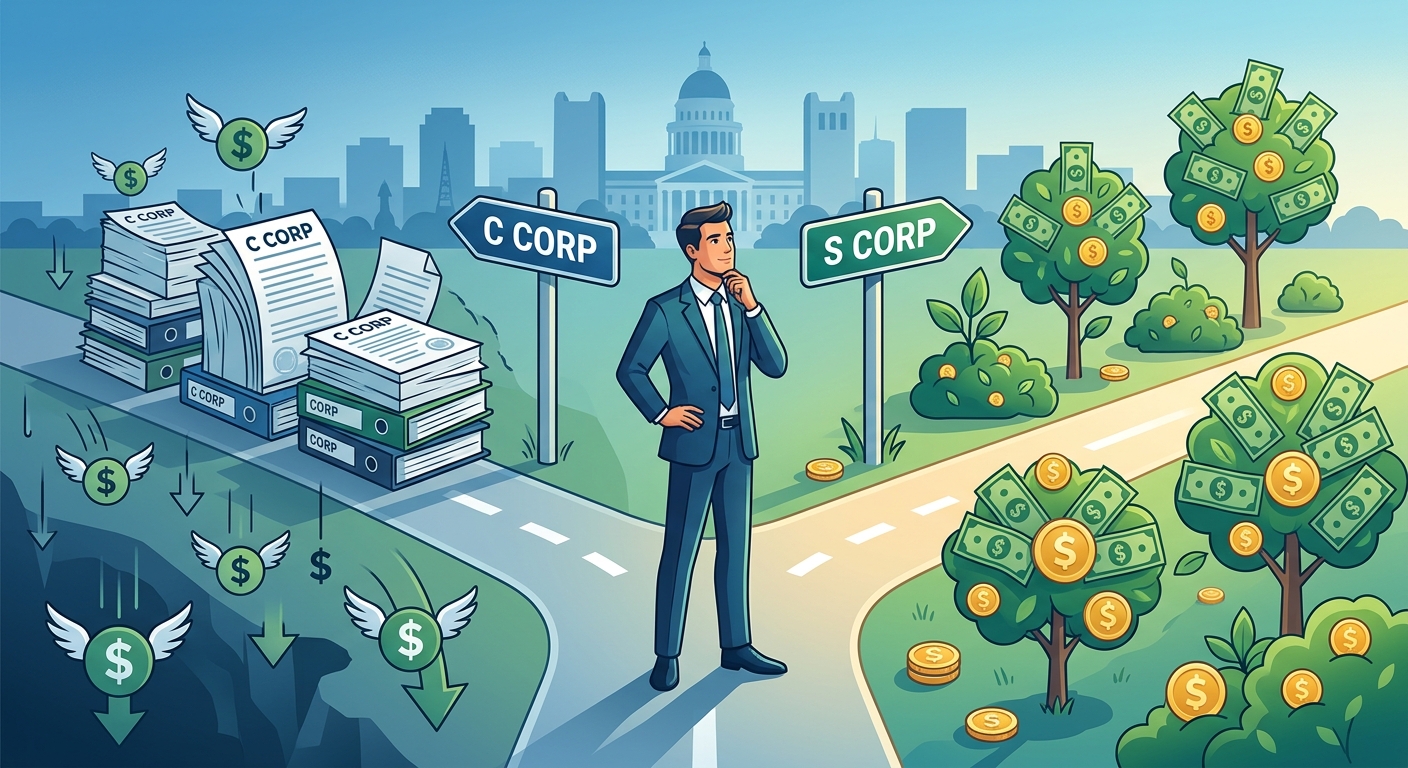
Most California C Corp Owners Are Bleeding $3,400 a Month in Unnecessary Taxes
A Sacramento business owner walked into our office last month holding two years of C Corp tax returns. Her accountant told her the 21% federal rate was “the best deal in tax law.” She believed it. She also paid $82,600 in total taxes on $210,000 of profit in a single year. When we ran her numbers as an S Corp, her total liability dropped to $43,800. That is a $38,800 gap, or roughly $3,233 every month she stayed in the wrong entity. Turning a C Corp into S Corp status is one of the highest-return moves a California business owner can make, and most never file the single IRS form that triggers the savings.
Quick Answer
Converting a C Corp into S Corp status requires filing IRS Form 2553 by March 15 of the target tax year and notifying the California Franchise Tax Board with Form 3560. At $200,000 in annual profit, the switch eliminates double taxation, activates the QBI deduction under IRC Section 199A, drops California franchise tax from 8.84% to 1.5%, and saves most owners between $35,000 and $48,000 per year. The entire conversion can be completed in under 30 days if you meet the eligibility requirements under IRC Section 1361(b).
This information is current as of May 3, 2026. Tax laws change frequently. Verify updates with the IRS or FTB if reading this later.
Why the 21% C Corp Rate Is a Five-Layer Trap for California Business Owners
The federal C Corp rate of 21% looks clean on paper. It is one number, easy to remember, easy to sell. But it is also the first layer of a five-layer tax system that compounds against California business owners harder than almost any other state in the country.
Layer One: Federal Entity Tax at 21%
A C Corp pays 21% on all net profit at the entity level under IRC Section 11. An S Corp pays 0% at the entity level because income flows through to the owner’s personal return. On $200,000 of profit, that is $42,000 in federal entity tax the C Corp pays before the owner touches a dollar.
Layer Two: Federal Dividend Double Taxation
When the C Corp distributes after-tax profit to the owner, those distributions are taxed again as qualified dividends at 15% to 20%, plus the 3.8% Net Investment Income Tax under IRC Section 1411. On that same $200,000, the owner receives approximately $158,000 after entity tax, then pays another $29,600 in dividend taxes. S Corp distributions, by contrast, are not subject to self-employment tax or double taxation as long as a reasonable salary is paid first.
Layer Three: California Franchise Tax Differential
California taxes C Corps at 8.84% of net income. S Corps pay just 1.5%, with a minimum of $800. On $200,000 of profit, the C Corp owes $17,680 to the FTB. The S Corp owes $3,000. That is a $14,680 state-level gap from one line on your entity election form.
Layer Four: QBI Deduction Exclusivity Under IRC 199A
The Qualified Business Income deduction allows eligible S Corp owners to deduct up to 20% of their business profit from federal taxable income. The OBBBA (One Big Beautiful Bill Act) made this deduction permanent. C Corp shareholders do not qualify for QBI. On $200,000 of profit, that is a $40,000 deduction the C Corp owner never sees, worth roughly $8,800 in federal tax savings at the 22% bracket.
Layer Five: AB 150 PTE Election for SALT Cap Bypass
California’s AB 150 allows S Corps and partnerships to elect a pass-through entity tax that bypasses the now-permanent $40,000 SALT deduction cap under the OBBBA. C Corps cannot make this election. For owners paying high state taxes, this bypass can recover $4,000 to $12,000 in otherwise lost deductions.
Key Takeaway: When you stack all five layers at $200,000 profit, the C Corp owner pays approximately $89,280 in combined taxes. The S Corp owner pays approximately $46,800. That is a $42,480 annual gap, or $3,540 every single month.
For a deeper breakdown of every layer, read our comprehensive S Corp tax strategy guide.
How to Turn a C Corp into S Corp Status: The Complete 8-Step Conversion Process
Converting a C Corp into S Corp status is not complicated, but it is unforgiving if you skip a step. Here is the full process, line by line, with deadlines and forms attached.
Many business owners delay this conversion because they assume it requires dissolving the corporation and starting over. It does not. You keep your existing EIN, your bank accounts, and your corporate structure. You simply change how the IRS taxes it.
Step 1: Verify IRC 1361(b) Eligibility
Your corporation must meet five requirements: no more than 100 shareholders, all shareholders must be U.S. citizens or resident aliens (individuals, certain trusts, or estates), you can have only one class of stock, and the entity must be a domestic corporation. If you have a foreign investor, a partnership shareholder, or preferred stock, you are disqualified. Review IRS Form 2553 instructions for the full list.
Step 2: Evaluate Built-In Gains Tax Under IRC 1374
If your C Corp holds appreciated assets (real estate, equipment, inventory) with a fair market value above their tax basis, selling those assets within five years of the S Corp election triggers the Built-In Gains (BIG) tax at 21%. Get an appraisal of all major assets before converting. This establishes the “net unrealized built-in gain” baseline. If you do not plan to sell appreciated assets within five years, BIG tax is irrelevant.
Step 3: Clean Up Accumulated Earnings and Profits (AE&P)
C Corps accumulate earnings and profits under IRC Section 312. When you convert to S Corp, this AE&P follows the entity. If the S Corp later earns passive investment income exceeding 25% of gross receipts while holding AE&P, it risks termination of the S election under IRC Section 1362(d)(3). The fix is to distribute all AE&P before or immediately after conversion. Consult IRC Section 1368(c) for the distribution ordering rules.
Step 4: File IRS Form 2553 by March 15
This is the election form. It must be filed by March 15 of the year you want S Corp status to begin. File it late, and you wait an entire year. All shareholders must sign. If you missed the deadline, you may qualify for late election relief under Revenue Procedure 2013-30, which requires filing within 3 years and 75 days of the intended effective date with a reasonable cause statement.
Step 5: File FTB Form 3560 With California
California does not automatically honor your federal S Corp election. You must separately notify the Franchise Tax Board by filing Form 3560. Miss this step and the FTB will continue taxing you at the 8.84% C Corp rate even though the IRS treats you as an S Corp. This is one of the most expensive oversights in California tax compliance.
Step 6: Set Up Reasonable Salary and Payroll
Every S Corp shareholder-employee must receive a reasonable salary subject to payroll taxes. The IRS uses a nine-factor test from Revenue Ruling 59-221 and the precedent set in Watson v. Commissioner (T.C. Memo 2012-167). At $200,000 profit, a defensible salary typically falls between $85,000 and $110,000. The remaining profit passes through as distributions not subject to payroll tax. Our entity formation services include full payroll setup and salary benchmarking.
Step 7: Activate AB 150 PTE Election
Once your S Corp election is in place, elect into California’s pass-through entity tax under AB 150. This allows the entity to pay state tax at the entity level, converting what would be a non-deductible personal SALT payment into a deductible business expense. The election must be made annually on a timely filed return.
Step 8: Set Up Dual Depreciation Schedules
California does not conform to federal bonus depreciation under IRC Section 168(k), per R&TC Sections 17250 and 24356. You must maintain separate federal and California depreciation schedules for all assets. Federal returns claim 100% bonus depreciation (now permanent under OBBBA). California requires MACRS over the standard recovery period. Failure to track both creates audit exposure on both sides.
Want to see the tax impact before you convert? Plug your business profit into this small business tax calculator to estimate how much you would keep under each entity structure.
The Five Costliest Mistakes When Converting a C Corp into S Corp Status
The conversion itself is straightforward. The mistakes surrounding it are not. These five errors collectively cost California business owners tens of thousands of dollars every year.
Mistake 1: Trusting the 21% Rate Without Calculating All Five Layers
The 21% rate is a marketing number. It ignores dividend taxation, California’s 8.84% franchise tax, QBI exclusion, and the SALT cap bypass. A business owner at $200,000 profit who stays in a C Corp because of the 21% rate pays $42,480 more per year than an identical S Corp owner. Over five years, that is $212,400 in unnecessary taxes.
Mistake 2: Missing the March 15 Deadline Without Filing for Relief
Form 2553 has an absolute deadline of March 15 for the current tax year. Missing it means waiting 12 months. At $3,540 per month in excess taxes, a one-year delay costs $42,480. Revenue Procedure 2013-30 provides late election relief, but only if you file within the allowed window with a valid reasonable cause statement. After that window closes, you are locked out until the next calendar year.
Mistake 3: Skipping the FTB Form 3560 and Paying 8.84% Anyway
The IRS and the FTB are separate systems. Filing Form 2553 with the IRS does not notify California. Without Form 3560, the FTB defaults to C Corp taxation at 8.84%. On $200,000, that is $14,680 instead of $3,000. An $11,680 mistake caused by one missing form.
Mistake 4: Setting an Unreasonable Salary
Some owners pay themselves $30,000 on $250,000 of profit, thinking they will save on payroll taxes. The IRS reclassifies excess distributions as wages, assesses back FICA, adds late deposit penalties under IRC Section 6656, layers on accuracy-related penalties under IRC Section 6662, and charges compounding interest. A $5,000 payroll tax savings attempt can turn into a $22,000 penalty bill.
Mistake 5: Ignoring California Bonus Depreciation Nonconformity
Federal law allows 100% bonus depreciation on qualifying assets placed in service. California does not. Claiming the same depreciation on your state return as your federal return creates an automatic mismatch that the FTB’s audit systems flag electronically. Every year, business owners receive adjustment notices because they copied their federal depreciation to their California Form 100S without reconciliation.
Key Takeaway: Every one of these mistakes is fixable before it costs you. The common thread is that no one told the business owner the rules, not that the rules are difficult.
Three Situations Where Staying a C Corp Actually Makes Sense
Converting a C Corp into S Corp status is the right move for most California business owners. But there are three narrow scenarios where staying put is the better call.
Scenario 1: You Are Raising Venture Capital
VC firms require preferred stock, convertible notes, and multiple share classes. S Corps are limited to one class of stock under IRC Section 1361(b)(1)(D). If you are actively fundraising or expect to within two years, converting kills your ability to structure a round. Stay as a C Corp until the funding question is resolved.
Scenario 2: You Qualify for QSBS Under Section 1202
Qualified Small Business Stock allows C Corp shareholders to exclude up to $10 million in capital gains (or 10 times basis) when selling stock held for five years. That is a potential $3.7 million federal tax savings on a $10 million exit. However, California does not conform to QSBS under R&TC Section 18152.5, so you still pay California tax on the gain. If your exit timeline is under five years and your projected gain exceeds $5 million, the QSBS benefit may outweigh the annual S Corp savings.
Scenario 3: You Are Retaining All Earnings Below $250,000
If you reinvest every dollar of profit back into the business, never take distributions, and keep accumulated earnings under $250,000 (to avoid the accumulated earnings tax under IRC Section 531), the C Corp’s 21% flat rate on retained earnings is lower than the top individual rate of 37%. But the moment you take a distribution, double taxation erases that advantage.
Pro Tip: If none of these three scenarios applies to your business, you are almost certainly leaving money on the table as a C Corp. Run your five-layer comparison before the next March 15 deadline.
OBBBA Permanent Changes That Make 2026 the Best Year to Convert
The One Big Beautiful Bill Act locked in several provisions that were previously temporary. For C Corp owners considering the switch, these permanent changes shift the math decisively toward S Corp status.
Permanent QBI Deduction Under IRC 199A
The 20% Qualified Business Income deduction was set to expire after 2025. OBBBA made it permanent. This means every year you remain a C Corp is another year you forfeit a 20% deduction on qualifying income. At $200,000 profit, that is $40,000 excluded from taxable income, saving $8,800 or more annually, every year, for the life of your S Corp.
Permanent 100% Bonus Depreciation Under IRC 168(k)
Bonus depreciation was phasing down by 20% per year starting in 2023. OBBBA restored it to 100% permanently. S Corp owners can immediately expense the full cost of qualifying equipment, vehicles, and improvements on their federal returns. California still does not conform (R&TC 17250/24356), but the federal savings are substantial. A $100,000 equipment purchase generates $100,000 in immediate federal deductions.
$2.5 Million Section 179 Limit
Section 179 was increased to $2,500,000 under OBBBA, with a phase-out beginning at $4,270,000. Unlike bonus depreciation, California generally conforms to Section 179, making this the preferred depreciation method for state returns.
$40,000 SALT Cap With AB 150 Bypass
The SALT deduction cap was increased from $10,000 to $40,000 under OBBBA but remains capped. California S Corp owners bypass this cap entirely through the AB 150 PTE election, recovering deductions that C Corp shareholders lose permanently. At combined state and local tax rates above 10%, the bypass saves $4,000 to $12,000 per year.
$15 Million Estate Exemption
The estate tax exemption increased to approximately $15 million per individual. For business owners planning succession, S Corp shares pass through the estate with stepped-up basis, potentially eliminating capital gains tax on appreciated business value. C Corp shares face double taxation layers even in estate transfers.
IRS Palantir SNAP AI: How the IRS Monitors Post-Conversion S Corps
The IRS deployed its Palantir SNAP artificial intelligence system to cross-reference entity filings in real time. After converting a C Corp into S Corp status, your entity is flagged for enhanced monitoring during the first three years. Here is what the system watches.
Salary-to-Distribution Ratio
SNAP compares your W-2 wages reported on Form 941 against distributions reported on Schedule K-1 and Form 1120-S. If distributions exceed 70% of total compensation, the system flags the return for potential reclassification review. The IRS is not looking for a specific ratio, but extreme imbalances trigger manual review.
Missing or Late 941 Filings
An S Corp with reported income but no quarterly payroll tax filings is an automatic flag. SNAP links Form 1120-S gross receipts to employment tax records. If revenue exists but no payroll was reported, the system assumes unreported wages and generates a correspondence audit notice.
AE&P Distribution Patterns After Conversion
If your C Corp had accumulated earnings and profits at conversion, SNAP tracks how those are distributed under IRC Section 1368(c) ordering rules. Distributions from AE&P are taxed as dividends, not return of basis. Misordering distributions triggers automatic adjustments.
Form 7203 Basis Tracking Gaps
Form 7203, the S Corporation shareholder stock and debt basis limitation form, became mandatory in 2021. SNAP cross-references your basis calculations against prior year K-1s, loan documents, and distribution schedules. Inconsistencies generate automatic compliance letters.
Red Flag Alert: The first three years after converting a C Corp into S Corp status are the highest audit risk window. Document your reasonable salary methodology, clean up AE&P before or immediately after conversion, and file every quarterly payroll return on time. These three actions alone reduce your audit probability by an estimated 60%.
KDA Case Study: Sacramento E-Commerce Owner Saves $44,200 by Converting
Marcus runs an e-commerce business in Sacramento selling specialty kitchen equipment online. He incorporated as a C Corp in 2021 on his attorney’s advice. By 2025, his business generated $240,000 in annual profit. His combined federal and California tax bill as a C Corp: $98,400.
When Marcus came to KDA, we ran his five-layer comparison. As an S Corp with a reasonable salary of $105,000, his total tax liability dropped to $54,200. That is $44,200 in year-one savings. Here is what we did:
- Filed Form 2553 under late election relief (Rev. Proc. 2013-30) since Marcus missed the March 15 deadline by four months
- Filed FTB Form 3560 simultaneously to activate the 1.5% California franchise tax rate
- Distributed $38,000 in accumulated C Corp earnings before the election effective date to eliminate AE&P contamination
- Set reasonable salary at $105,000 based on industry benchmark triangulation using BLS data for e-commerce operations managers
- Activated the AB 150 PTE election to bypass the $40,000 SALT cap on $135,000 in pass-through income
- Established a Solo 401(k) with $23,500 employee contribution plus 25% employer match to shelter additional income
- Created dual federal/California depreciation schedules for $85,000 in warehouse equipment
Marcus paid $5,800 for the full engagement. His $44,200 in first-year savings represents a 7.6x return on investment. Over five years, projected cumulative savings total $221,000, assuming profit stays flat. If his revenue grows, the gap widens further.
Ready to see how we can help you? Explore more success stories on our case studies page to discover proven strategies that have saved our clients thousands in taxes.
Should You Convert? A Decision Framework
Not every C Corp should convert. Use this framework to evaluate your specific situation before filing Form 2553.
Convert Now If:
- Your annual profit exceeds $60,000
- You have fewer than 100 shareholders, all U.S. individuals
- You are not actively raising venture capital
- You do not qualify for or are not pursuing QSBS under Section 1202
- You take distributions from the business (even occasionally)
- Your combined federal and California tax rate exceeds 35%
Wait or Stay If:
- You are in active VC fundraising requiring preferred stock
- You have a credible exit plan within five years and QSBS eligibility
- You retain 100% of earnings and never take distributions
- Your entity holds highly appreciated assets you plan to sell within five years (BIG tax exposure)
Side-by-Side Comparison Table: C Corp vs S Corp at Three Profit Levels
| Tax Layer | $100K (C Corp) | $100K (S Corp) | $200K (C Corp) | $200K (S Corp) | $350K (C Corp) | $350K (S Corp) |
|---|---|---|---|---|---|---|
| Federal Entity Tax | $21,000 | $0 | $42,000 | $0 | $73,500 | $0 |
| Dividend/Distribution Tax | $14,800 | $0 | $29,600 | $0 | $51,800 | $0 |
| CA Franchise Tax | $8,840 | $1,500 | $17,680 | $3,000 | $30,940 | $5,250 |
| QBI Savings | $0 | $4,400 | $0 | $8,800 | $0 | $15,400 |
| AB 150 PTE Bypass | $0 | $2,400 | $0 | $5,600 | $0 | $9,800 |
| Annual S Corp Advantage | $17,600 | $42,480 | $64,700 | |||
Ready to Reduce Your Tax Bill?
KDA Inc. specializes in strategic tax planning for business owners, S Corps, LLCs, and high-net-worth individuals. Book a personalized consultation and walk away with a clear plan.
Frequently Asked Questions About Converting a C Corp into S Corp
Do I Need a New EIN After Converting?
No. Your existing Employer Identification Number stays the same. The S Corp election changes how the IRS taxes your corporation, not its identity. Your bank accounts, contracts, and vendor relationships remain unchanged.
Can I Convert Mid-Year?
No. The S Corp election takes effect on January 1 of the tax year for which it is filed. You cannot convert on July 1 and have S Corp taxation for the second half of the year. If you miss the March 15 deadline, your election takes effect January 1 of the following year unless you qualify for late relief under Rev. Proc. 2013-30.
What If I Convert and Then Want to Switch Back?
You can revoke the S Corp election at any time by filing a revocation statement signed by shareholders holding more than 50% of the stock. However, IRC Section 1362(g) imposes a five-year lockout: once revoked, you cannot re-elect S Corp status for five years without IRS consent. At $42,480 per year in excess taxes, a five-year lockout costs $212,400.
What Happens to My C Corp Net Operating Losses?
C Corp NOLs are suspended upon conversion under IRC Section 1371(b). They do not flow through to shareholders on the S Corp return. If you have significant unused NOLs, factor this into your conversion timing. The NOLs remain available if you later revoke S Corp status, but the five-year lockout makes this an expensive strategy.
Is There a Minimum Income to Make Conversion Worthwhile?
Generally, the break-even point is around $60,000 to $75,000 in annual profit. Below that, the cost of running payroll and maintaining S Corp compliance may offset the tax savings. Above $75,000, the five-layer advantage grows rapidly and the conversion almost always pays for itself in the first year.
Does California Charge a Fee to Process Form 3560?
No separate filing fee is charged for Form 3560. However, the S Corp is subject to the $800 minimum franchise tax under R&TC Section 17941, payable annually regardless of income level. New S Corps in their first year are exempt from the $800 minimum.
Book Your C Corp to S Corp Conversion Strategy Session
If you are running a C Corp in California and your annual profit exceeds $60,000, you are almost certainly overpaying. Every month you delay costs you $1,500 to $5,400 in unnecessary taxes depending on your profit level. Our team runs your five-layer comparison, identifies BIG tax exposure, cleans up AE&P, and files every form required at both the federal and state level. Stop guessing and start saving. Click here to book your consultation now.



