
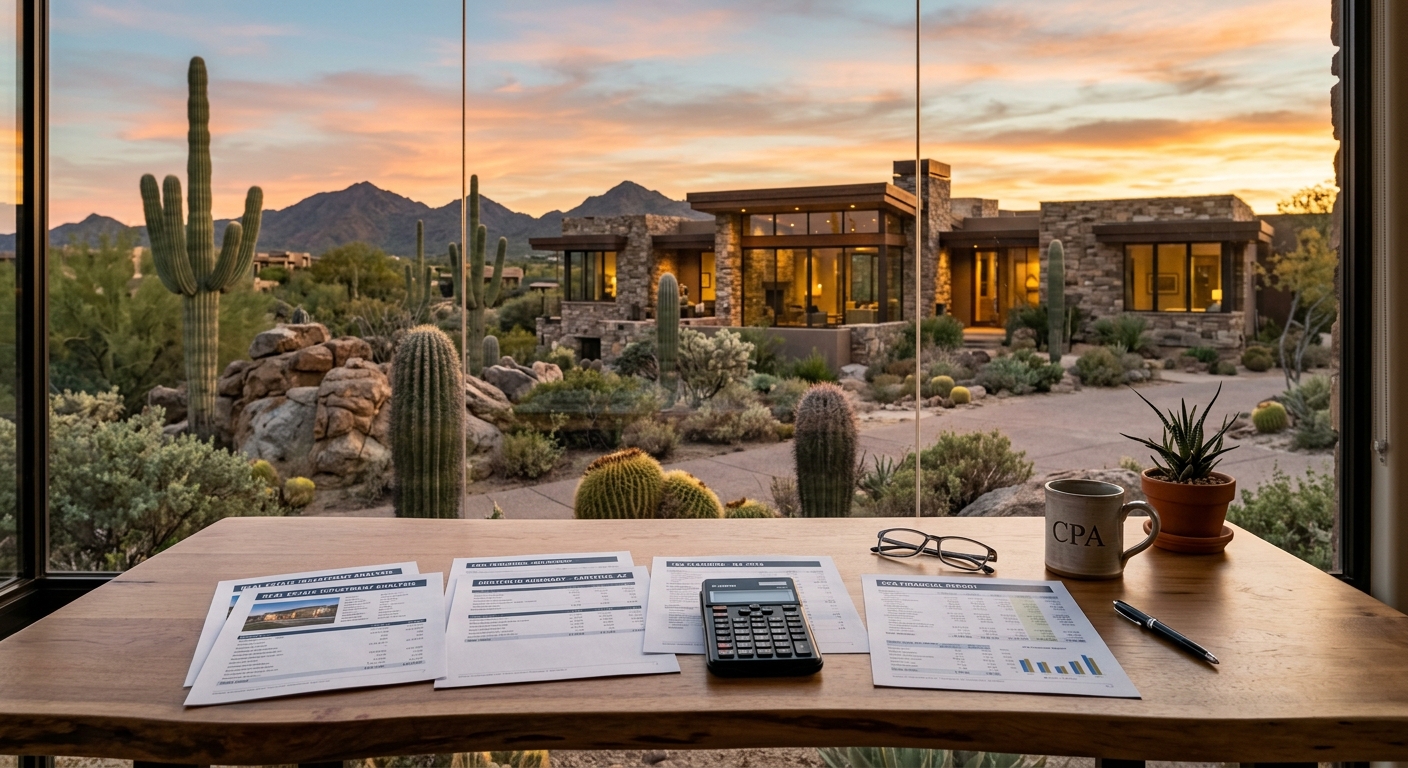
Why Carefree, Arizona Real Estate Investors Need a Specialized CPA
If you own rental property in Carefree, Arizona, or you are thinking about buying your first investment property in this upscale Sonoran Desert community, the question you should be asking yourself is not whether you need a CPA. The question is whether you need the right one. Finding a real estate CPA near me Carefree Arizona is one of the most impactful financial decisions a property investor can make, and it is a decision that separates investors who build generational wealth from those who quietly overpay the IRS year after year.
Carefree is not your average Arizona town. It sits in the northeast corner of the Phoenix metro, surrounded by protected desert preserve, million-dollar custom homes, and a growing rental market fueled by luxury short-term stays and retiree relocations. The tax landscape here is equally unique. If you are searching for professional tax services in Carefree, you need a CPA who understands both the Arizona-specific rules and the federal real estate tax code inside and out.
This guide covers everything Carefree real estate investors need to know about working with a specialized CPA, including the deductions most investors miss, the compliance traps that trigger audits, and the long-term tax planning strategies that can save you tens of thousands of dollars over the life of your portfolio.
Quick Answer
A real estate CPA near me in Carefree, Arizona is a tax professional who specializes in property investment taxation, including depreciation strategies, 1031 exchanges, cost segregation studies, passive activity rules, and Arizona-specific compliance. Working with one can save a typical Carefree investor $7,000 to $25,000 or more per year in taxes compared to using a generalist preparer.
What Makes a Real Estate CPA Different from a General Tax Preparer
Most CPAs can file your personal return. They can handle your W-2 income, your standard deduction, and your retirement contributions. But real estate investing creates an entirely different layer of tax complexity that general preparers are not trained to handle.
A real estate CPA near me Carefree Arizona understands the interplay between active income, passive income, and portfolio income. They know how to classify your rental activities correctly under IRC Section 469. They know when the Real Estate Professional Status (REPS) election applies and when it does not. And they know how to structure your depreciation schedules so you are capturing every dollar of tax savings the law allows.
Here is a practical way to think about it. Say you own two rental properties in Carefree worth a combined $1.8 million. A generalist might depreciate those properties using straight-line residential depreciation over 27.5 years. That gives you roughly $52,364 per year in depreciation deductions. Not bad.
But a specialized real estate CPA would run a cost segregation study and reclassify $360,000 of those assets into 5-year, 7-year, and 15-year categories. With bonus depreciation still available (though phasing down), you could potentially front-load $180,000 or more in deductions in the first year alone. That is the difference between saving $13,000 on your taxes and saving $45,000 or more.
Key Services a Real Estate CPA Provides
- Depreciation optimization including cost segregation analysis
- 1031 exchange planning and timeline compliance
- Passive activity loss management under IRC Section 469
- Real Estate Professional Status qualification and documentation
- Entity structuring for liability protection and tax efficiency
- Capital gains planning for buy-and-hold vs. flip strategies
- Quarterly estimated tax calculations for rental income
- Audit defense and IRS correspondence management
Why Carefree, Arizona Creates Unique Tax Opportunities
Carefree is one of the most desirable real estate markets in Arizona. The town is known for its upscale residential properties, resort-style living, and proximity to both Scottsdale amenities and untouched desert landscapes. For investors, this translates into a specific set of tax considerations that generic advice simply does not cover.
Arizona has no state income tax on the first $250,000 of income for married couples filing jointly (the flat tax rate is 2.5% as of 2026). This already makes the state attractive compared to high-tax states like California, where top marginal rates hit 13.3%. But the real advantage for Carefree investors is in the combination of Arizona’s favorable tax structure with federal real estate provisions.
Our Carefree tax preparation team works with investors who hold luxury short-term rental properties, long-term residential rentals, and mixed-use desert parcels. Each of these property types carries its own compliance requirements and deduction opportunities.
Short-Term Rental Tax Considerations in Carefree
Carefree has seen a surge in short-term vacation rentals, particularly high-end properties listed on platforms like Airbnb and VRBO. If you operate a short-term rental, your tax treatment may differ significantly from a traditional landlord.
Under the IRS rules, if the average guest stay is 7 days or less, your rental is classified as a short-term rental. This matters because short-term rentals can qualify as an active trade or business under certain circumstances, which means your losses may not be limited by the passive activity rules. For Carefree investors earning $200,000 or more in W-2 or business income, this distinction can unlock tens of thousands in tax deductions that would otherwise be suspended.
A specialized real estate CPA near me Carefree Arizona will document your material participation hours, help you meet the 100-hour or 500-hour thresholds depending on your situation, and ensure your Schedule E or Schedule C is filed correctly. Getting this wrong can cost you big. Getting it right can change your entire financial picture.
Arizona Transaction Privilege Tax
Arizona applies a Transaction Privilege Tax (TPT) to short-term rentals. In Maricopa County, the combined state and local TPT rate for short-term rentals can reach 12% or more depending on the jurisdiction. Carefree property owners must register with the Arizona Department of Revenue and remit TPT on all rental income from stays under 30 days. Failing to register or file can result in penalties and back-tax assessments. Your CPA should be handling this compliance as part of your overall tax strategy, not leaving it to you to figure out on your own.
KDA Case Study: Carefree Investor Saves $18,400 with Cost Segregation
A Carefree real estate investor came to KDA with a portfolio of three rental properties valued at $2.4 million. He had been using a local generalist CPA for five years and was depreciating all three properties using standard 27.5-year straight-line residential schedules. His annual depreciation deduction was approximately $69,800 across all three properties.
KDA’s real estate tax team recommended a cost segregation study on the two highest-value properties. The study reclassified $412,000 of building components into accelerated depreciation categories, including landscaping, appliances, flooring, cabinetry, and site improvements. With the remaining bonus depreciation available for 2026, the investor was able to claim an additional $148,000 in first-year deductions.
The result: a federal tax savings of $18,400 in the first year alone, with continued accelerated deductions carrying forward. The cost segregation study cost $5,200 for both properties. That is a 3.5x return on investment in year one, with additional savings compounding over the next four years.
KDA also restructured the investor’s entity setup, moving one property into an LLC taxed as an S Corp and consolidating the other two under a single LLC for liability protection. The restructuring saved an additional $4,200 in self-employment taxes annually.
Ready to see how we can help you? Explore more success stories on our case studies page to discover proven strategies that have saved our clients thousands in taxes.
The 7 Deductions Most Carefree Real Estate Investors Miss
Even experienced investors leave money on the table. Here are the deductions a real estate CPA near me Carefree Arizona will make sure you capture.
1. Travel Expenses to Manage Properties
If you live outside Carefree but own rental property there, your travel costs to inspect, manage, or maintain those properties are deductible. This includes airfare, mileage, hotel stays, and meals during the trip. The key requirement is that the primary purpose of the trip must be related to your rental activity. A specialized CPA will help you document these trips properly so they withstand IRS scrutiny.
2. Home Office Deduction for Rental Management
If you manage your Carefree rentals from a home office, you can deduct a proportionate share of your home expenses, including mortgage interest, utilities, insurance, and repairs. Many investors do not realize this deduction applies to landlords who actively manage their properties, not just traditional business owners.
3. Professional Service Fees
Legal fees, CPA fees, property management fees, and real estate attorney costs related to your rental activities are fully deductible. If you paid $3,500 for a tax planning consultation, that entire amount comes off your rental income.
4. Insurance Premiums Beyond Basic Coverage
Most investors deduct their standard landlord insurance. But many miss the deduction for umbrella policies, flood insurance, earthquake coverage, and short-term rental specific policies. In Carefree, where property values are high and natural desert hazards exist, these premiums add up quickly.
5. Loan Origination Points and Refinancing Costs
When you refinance a rental property, the loan origination points must be amortized over the life of the loan. Many investors either miss this deduction entirely or try to deduct it all in year one, which triggers an IRS mismatch. A real estate CPA handles this correctly from the start. You can also estimate the impact of your mortgage interest using this mortgage interest calculator to see how refinancing affects your annual deduction.
6. Depreciation on Appliances and Furnishings
If you furnish your Carefree rental with appliances, furniture, or fixtures, those items are depreciable over 5 or 7 years, not 27.5 years. A generalist CPA often lumps everything into the building depreciation schedule. A specialist breaks it out and accelerates your deductions.
7. Casualty and Theft Loss Documentation
Arizona’s desert climate can cause unexpected property damage from monsoon flooding, dust storms, or wildlife intrusion. If your rental property sustains damage that insurance does not fully cover, you may be able to claim a casualty loss deduction. The documentation requirements are strict (see IRS Publication 547), and a specialized CPA ensures you meet every threshold.
How to Choose the Right Real Estate CPA in Carefree
Not every CPA who says they handle real estate actually specializes in it. Here is a decision framework to help you evaluate whether a CPA is the right fit for your Carefree investment portfolio.
Should You Work with This CPA? A Quick Decision Guide
Yes, if:
- They have handled 50 or more real estate investor returns per year
- They can explain cost segregation, REPS, and 1031 exchanges without looking anything up
- They proactively recommend tax strategies, not just file what you give them
- They have experience with Arizona TPT compliance for short-term rentals
- They offer year-round tax planning, not just annual filing
No, if:
- They handle mostly W-2 returns and small business Schedule Cs
- They have never performed or coordinated a cost segregation study
- They cannot explain the difference between active, passive, and portfolio income
- They charge by the form count rather than by the complexity of your portfolio
- They only contact you once a year during tax season
Questions to Ask Before Hiring
- How many real estate investor clients do you work with? Look for at least 30 to 50 active clients.
- Do you coordinate cost segregation studies? The answer should be an immediate yes with details on their engineering partner.
- How do you handle 1031 exchange timelines? They should know the 45-day identification and 180-day closing rules by heart.
- What is your approach to Real Estate Professional Status? They should ask about your hours, not just your income.
- Do you offer proactive tax planning or just annual filing? The right answer is both, with quarterly check-ins for active investors.
Real Estate CPA Near Me Carefree Arizona: Federal and State Tax Strategies
Working with a qualified real estate CPA near me Carefree Arizona means getting access to layered strategies that account for both federal and Arizona state tax rules. Here are the most impactful strategies for 2026.
1031 Exchange Planning
A 1031 exchange allows you to defer capital gains taxes when you sell one investment property and purchase another of equal or greater value. For Carefree investors sitting on appreciated desert properties, this can mean deferring $50,000 to $150,000 or more in capital gains taxes on a single transaction. The IRS requires strict compliance with identification and closing timelines (see IRS Publication 544). Your CPA should be quarterbacking this process alongside your qualified intermediary.
If you are weighing the tax impact of selling a property outright versus exchanging it, you can run a preliminary estimate through this capital gains tax calculator before sitting down with your CPA for a detailed analysis.
Qualified Business Income Deduction
Under IRC Section 199A, rental real estate income may qualify for the 20% Qualified Business Income (QBI) deduction if the activity rises to the level of a trade or business. For a Carefree investor earning $120,000 in net rental income, the QBI deduction could be worth $24,000, reducing taxable income significantly. The IRS safe harbor requires at least 250 hours of rental services per year with contemporaneous records (see IRS QBI guidance).
Entity Structuring for Liability and Tax Optimization
Many Carefree investors hold properties in their personal name. This exposes personal assets to liability from tenant lawsuits, slip-and-fall claims, and contractor disputes. A real estate CPA, working with a qualified attorney, can help you restructure into LLCs or a series LLC arrangement that provides both liability protection and tax efficiency. KDA’s entity formation services help investors get this right from the beginning.
Bonus Depreciation Phase-Down Planning
Bonus depreciation is phasing down. For 2026, the rate is 40% (down from 60% in 2025 and 80% in 2024). By 2027, it drops to 20%. If you are planning a major purchase or renovation in Carefree, timing matters. A real estate CPA will model out whether it makes sense to accelerate purchases into 2026 to capture the higher bonus rate or spread them out depending on your income level and marginal tax bracket.
| Tax Year | Bonus Depreciation Rate | Strategy Implication |
|---|---|---|
| 2024 | 60% | Aggressive front-loading window |
| 2025 | 60% | OBBBA extension maintained 60% |
| 2026 | 40% | Still valuable for cost seg assets |
| 2027 | 20% | Diminishing returns, plan ahead |
Common Audit Triggers for Carefree Real Estate Investors
The IRS does not audit randomly. Certain patterns on your return raise flags. Here are the most common triggers for real estate investors in Carefree and across Arizona.
Claiming Real Estate Professional Status Incorrectly
REPS is one of the most powerful tax elections for investors, but it is also one of the most audited. You must spend more than 750 hours in real estate activities and more time in real estate than any other profession. If you have a full-time W-2 job and claim REPS on the side, expect questions. Your CPA should help you maintain a contemporaneous hour log that will hold up under examination.
Excessive Repair Deductions
The IRS draws a clear line between repairs (deductible immediately) and improvements (must be capitalized and depreciated). Replacing a broken faucet is a repair. Renovating an entire bathroom is an improvement. Carefree investors with high-end properties often make significant upgrades that must be capitalized, not expensed. A specialized CPA applies the tangible property regulations correctly every time.
Unreported Rental Income from Short-Term Platforms
Starting in 2025, platforms like Airbnb and VRBO must report gross rental income to the IRS on Form 1099-K if it exceeds $2,500. If your return shows less rental income than what the platform reported, you will get a CP2000 notice. KDA’s audit representation team handles these notices regularly, but the better strategy is making sure your CPA reconciles platform income before filing.
Special Situations and Edge Cases for Carefree Investors
Out-of-State Investors Owning Carefree Property
If you live in California, New York, or another high-tax state but own rental property in Carefree, you may owe Arizona income tax on the rental income. Arizona’s 2.5% flat tax applies to non-resident rental income. Your CPA must file an Arizona non-resident return (Form 140NR) and coordinate credits on your home state return to avoid double taxation.
Converting a Vacation Home to a Rental
Many Carefree homeowners use their property as a vacation home before converting it to a full-time rental. The tax basis for depreciation is the lesser of your adjusted basis or the fair market value at the time of conversion. If property values have dropped since purchase, your depreciable basis is lower. A real estate CPA near me Carefree Arizona will get this calculation right, which affects your depreciation deductions for the next 27.5 years.
Installment Sales and Seller Financing
Some Carefree investors sell properties using seller financing. Under IRC Section 453, you can spread the capital gains tax over the installment period rather than paying it all in the year of sale. This can be particularly valuable for investors in higher tax brackets who want to manage their taxable income. The rules are complex, and getting the installment sale election wrong can accelerate the entire gain into one year.
Ready to Reduce Your Tax Bill?
KDA Inc. specializes in strategic tax planning for business owners, S Corps, LLCs, and high-net-worth individuals. Book a personalized consultation and walk away with a clear plan.
Frequently Asked Questions
How much does a real estate CPA cost in Carefree, Arizona?
Fees vary based on portfolio complexity. Expect to pay $1,500 to $5,000 per year for a CPA who specializes in real estate investment taxation. For investors with 3 or more properties, cost segregation coordination, and entity management, fees may reach $7,000 to $10,000. The savings typically outweigh the cost by a factor of 3x to 5x.
Can I deduct property management fees on my taxes?
Yes. Property management fees are a deductible expense on Schedule E and reduce your net rental income. If you pay a Carefree property manager 8% to 10% of gross rents, that entire amount is deductible.
Do I need a CPA if I only own one rental property?
Even a single rental property generates depreciation, repair, insurance, and mortgage interest deductions that a generalist may not optimize. If your property is worth $500,000 or more, the tax savings from proper depreciation alone justify working with a specialist.
What records should I keep for my Carefree rental property?
Keep receipts for all repairs, maintenance, and improvements. Maintain a mileage log for property-related travel. Save all closing documents, loan statements, and insurance policies. Document rental income including platform payouts, security deposits, and lease agreements. Your CPA will tell you exactly what to keep and for how long.
Is short-term rental income taxed differently than long-term rental income?
Potentially yes. Short-term rentals with average stays of 7 days or less may be treated as active business income rather than passive rental income. This changes how losses are treated, whether self-employment tax applies, and which deductions are available. The classification depends on your level of material participation and the specific facts of your rental operation.
How does Arizona’s flat tax affect my rental income?
Arizona imposes a flat 2.5% individual income tax rate. For rental income, this means your state tax burden is relatively low compared to states like California (up to 13.3%) or New York (up to 10.9%). Combined with federal strategies like cost segregation and 1031 exchanges, Carefree investors can keep a significantly higher percentage of their rental profits.
What Happens If You Skip the Specialist?
Here is what typically happens when Carefree real estate investors use a generalist CPA or try to file on their own:
- They miss $15,000 to $40,000 in accelerated depreciation deductions
- They overpay self-employment tax by not structuring entities correctly
- They fail to document material participation hours and lose access to loss deductions
- They botch 1031 exchange timelines and trigger $50,000+ capital gains bills
- They miss Arizona TPT filing requirements and face penalties
- They do not plan ahead for bonus depreciation phase-downs
The cost of a specialized real estate CPA is almost always a fraction of what you save. For Carefree investors with portfolios above $1 million, the math is not even close.
This information is current as of 6/2/2026. Tax laws change frequently. Verify updates with the IRS or FTB if reading this later.
Ready to work with a tax professional who understands Carefree investors? Explore our Carefree, AZ tax services or book a consultation below.
Book Your Real Estate Tax Strategy Session
If you own rental property in Carefree, Arizona and you are not sure whether your depreciation strategy, entity structure, or 1031 exchange plan is optimized, stop guessing and get a clear answer. Book a personalized consultation with our real estate tax team and find out exactly how much you could be saving. Click here to book your consultation now.



