
This information is current as of 3/5/2026. Tax laws change frequently. Verify updates with the IRS if reading this later.
The Hard Truth: Procrastination Slashes Profits—Here’s How You Can Change That
Every December, thousands of business owners find themselves in panic mode—frantically collecting receipts, searching for lost invoices, and fearing they’ll miss out on crucial deductions. If you wait until tax season to get organized, you’re already losing money. The IRS isn’t generous with late filers or poor record-keepers, and the biggest tax-saving opportunities all hinge on how you wrap up your year now.
Quick Answer
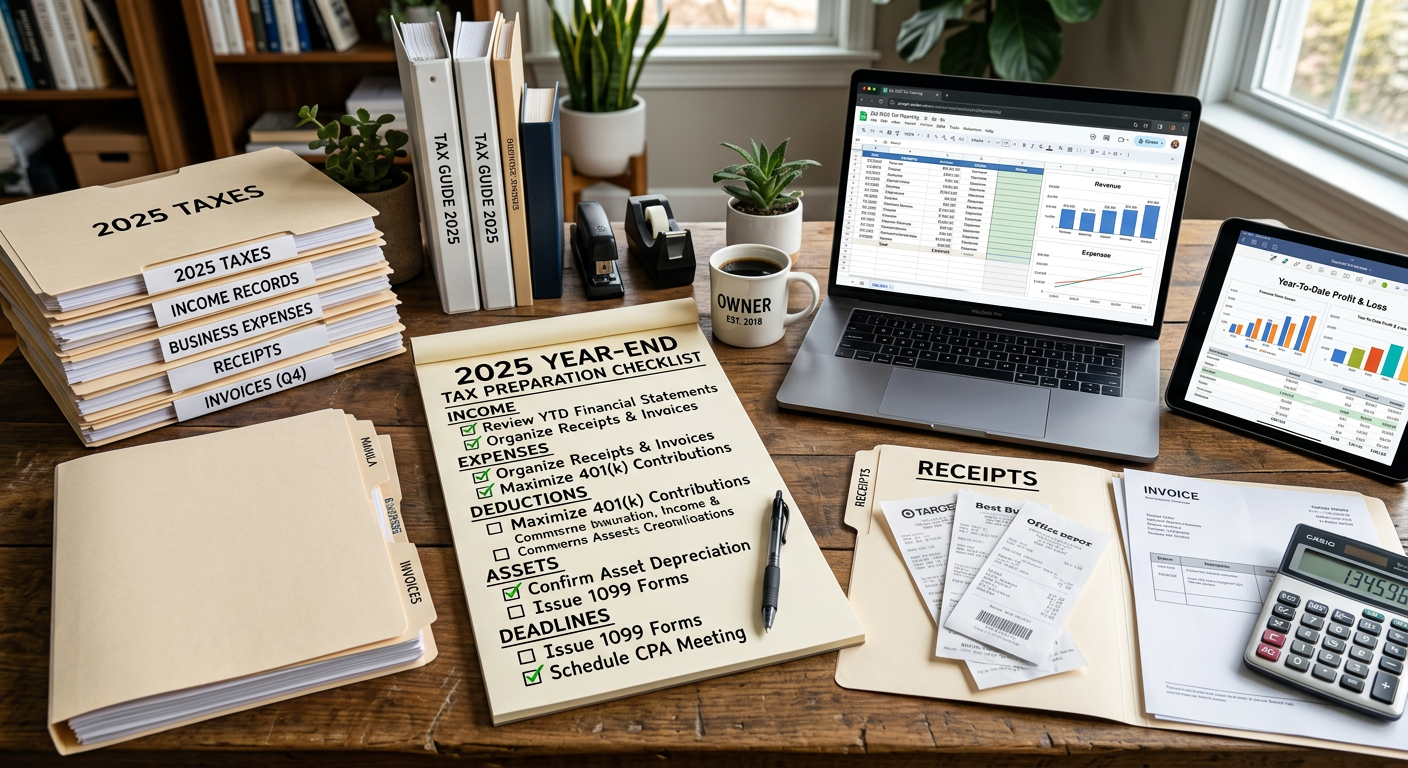
If you want to minimize your business tax liability and avoid unnecessary IRS penalties for the 2025 tax year, use this year-end checklist: organize digital and physical records, reconcile every bank and payment account, confirm all expenses are properly categorized, boost retirement contributions, check estimated taxes paid, and book a strategy session with a qualified tax pro before December 31st.
Step 1: Bookkeeping Hygiene—Reconciling Every Account the Right Way
Unmatched deposits, ambiguous Venmo charges, and uncategorized expenses are audit magnets and deduction killers. For every account—checking, credit card, PayPal, Venmo, and merchant services—you must ensure:
- Every deposit has a corresponding invoice
- All expenses are categorized by type (Supplies vs. Meals vs. Advertising, etc.)
- No duplicate or personal charges mixed in
Small errors add up. One undocumented expense a week is $2,600 of lost deductions in a $50-a-week scenario—every year. The IRS expects clear, complete records, and banks can close accounts retroactively if they discover mishandled transactions.
How to Reconcile Like a Pro
- Download all bank, credit card, and payment app statements through December 31.
- Use accounting software (QuickBooks, Xero, or Wave) to match deposits and expenses against statements.
- Flag any unmatched items and resolve them before year-end.
- Destroy receipts for unqualified or personal expenses—don’t muddy your books!
💡 Pro Tip:
Set a recurring monthly calendar reminder to reconcile, not just at year-end. The cleaner your books each month, the easier this process is at tax time—and the more deductions you preserve.
Step 2: Digital Document Mastery—Beyond the Shoebox
The IRS accepts digital documents, but you need more than a folder of jpegs. For 2025, best practice is:
- Create a master folder titled “2025 Taxes” on a backed-up cloud drive.
- Subfolders: Invoices, Receipts, Asset Purchases, Payroll, Loans, Retirement, and Tax Correspondence.
- Scan and upload all physical receipts immediately—most phone cameras suffice.
- Rename files using this format: Type-Date-Amount (“Meals-2025-11-02-$84.50”).
Having organized digital documentation is your single best audit defense. The IRS allows scanned files in lieu of paper (IRS recordkeeping guidance)—but you must be able to retrieve any file in seconds if asked. Businesses who can’t do this lose out: In 2023, over 34% of denied deductions in audits came from poor receipt documentation.
How to Organize for Maximum Savings
- Invest in a scanner or dedicated app—tools like Expensify or QuickBooks allow receipt uploads direct to transactions.
- Set monthly reminders to categorize and label files. Waiting until March guarantees errors.
Step 3: Year-End Estimated Taxes—Plug the Leaks Before the Penalties Hit
Did you pay enough throughout the year? The penalty for underpayment hits business owners who miscalculate their quarterly taxes—especially after large, late-year revenue increases. For 2025, check your year-to-date profit and use the IRS’s safe harbor rule: pay either 100% of last year’s taxes or 90% of the current year’s expected bill, whichever is less (IRS Estimated Tax guidance).
Scenario: Lisa, a single-member LLC owner, made $85,000 in profit in 2025 and withheld only $12,000 in estimated tax—but her projected liability was $16,000. She’s now facing a $400 underpayment penalty in April, plus interest on the balance. This could have been avoided with a pre-year-end checkup!
What If I Missed a Payment?
You’re not out of luck. Make a “catch-up” payment as soon as possible through the IRS Direct Pay portal. Even a late December payment reduces your penalty for 2025 filings.
Step 4: Retirement Contributions—The Deduction You Can Still Maximize by Dec 31
Boosting your 401(k), SEP IRA, or Solo 401(k) before December 31 can dramatically lower taxable business income. For 2025, the elective deferral limit for 401(k)s is $23,000, and SEP IRAs allow 25% of eligible compensation (up to $69,000). Each dollar you contribute is a dollar shielded from taxes this year, but most plans don’t allow retroactive contributions after year-end.
Scenario: Marcus, a real estate agent with $120,000 in 1099 earnings, deposits $10,000 into his Solo 401(k) before December 31. That single move reduces his tax bill by $2,400 if he’s in a 24% bracket—money he keeps, not the IRS.
Can You Deduct Retirement Contributions If You’re an S Corp Owner?
Yes, but only employer contributions before the tax filing deadline count for the current tax year. Ask your tax strategist about optimal profit splits for the best impact.
Step 5: Grab Unclaimed Credits & Meet With a Tax Strategist—The True 6-Figure Saver’s Move
The most overlooked money: credits you don’t claim. Are you eligible for the Research & Development credit, Work Opportunity Credit, California’s small business hiring credit, or clean vehicle credits? You won’t know without a proactive review—these credits can reduce tax owed dollar-for-dollar. In 2025, the ERC is gone, but smaller state credits could yield 4- to 5-figure savings.
The right tax advisor can review your 2025 data—before year-end—and uncover deductions you didn’t know you missed, adjust your entity structure for 2026, or spot errors that trigger audits or penalties. Business owners who skipped this step in 2023 paid, on average, $6,200 more in taxes than those who had a pre-year-end consult, per IRS small business taxpayer data.
Why Most Business Owners Miss These Credits
Ignoring changes or assuming your tax pro is “on it” is a standard $5,000+ mistake. Meet and review your eligibility for credits before December 31. Waiting until after January 1 means many credits and proactive moves are lost forever.
🔴 Red Flag Alert: The Biggest Mistake Small Business Owners Make
Most business owners dump their statements on a tax preparer in February and hope for the best. But the IRS penalizes those who can’t verify income or document deductions. Incomplete or rushed records are the top trigger for audits in 2025. Clean, monthly-bookkept records are your first defense and biggest tax-savings lever—don’t treat this like an afterthought.
Ready to Reduce Your Tax Bill?
KDA Inc. specializes in strategic tax planning for business owners, S Corps, LLCs, and high-net-worth individuals. Book a personalized consultation and walk away with a clear plan.
FAQs Small Business Owners Ask at Year-End
What If I Still Have Unmatched Statements or Receipts?
Do your best to match each transaction now—even estimated explanations are better than leaving things blank for your preparer. The IRS accepts “best available records” if your intent is clear and you’re consistent.
Can I Deduct Home Office Expenses?
Yes. For 2025, you can claim a portion of home expenses based on the square footage used regularly and exclusively for your business. The IRS simplified option lets you deduct $5 per square foot, up to 300 square feet (maximum $1,500 deduction). Read more about business deductions at our tax planning services page.
How Can I Track Mileage for My Business Vehicle?
Use a mileage tracking app or logbook. You’ll need the date, purpose, and miles driven for each trip. For more audit-proofing, see our Business Expense Blueprint.
Social-Share Mic Drop
The IRS isn’t hiding these write-offs—you just weren’t taught where to look before December 31.
Book Your Personalized Year-End Tax Review Today
Ready to stop fearing April and start keeping more of your money? Book a one-on-one tax strategy session now—walk away with at least 3 actionable moves to save thousands for 2025. Click here to book your session and secure your savings.
This information is current as of 3/5/2026. Tax laws change frequently. Verify updates with the IRS if reading this later.


