
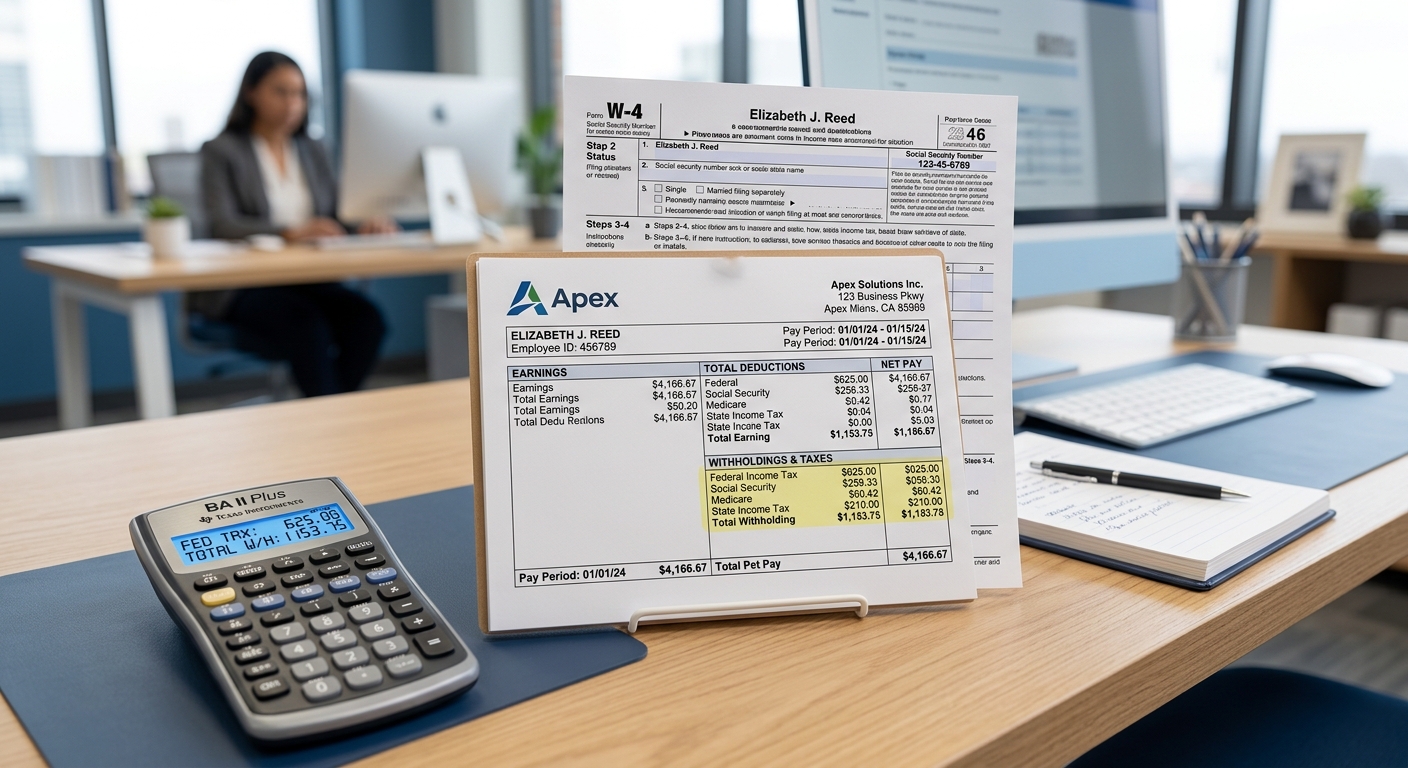
What Are Withheld Taxes? The Truth Behind Your Missing Paycheck Dollars
You just got your paycheck. The salary amount looks right on paper, but the number that hits your bank account is thousands of dollars less. You scan the pay stub and see a line item labeled “Federal Tax Withheld” that swallowed $680 this pay period alone. Another line says “FICA” and took $230. Then there’s “State Tax Withheld” for another $290. Where did all that money actually go, and are you ever getting it back?
Here’s what most W-2 employees don’t realize: withheld taxes meaning refers to the pre-payment system where your employer sends a portion of your gross wages directly to the IRS and state tax agencies before you ever see a dime. This isn’t theft. It’s a federally mandated prepayment system designed to prevent year-end tax shocks and ensure steady revenue collection. But here’s the kicker: most people are having way too much withheld because they filled out their W-4 form wrong five years ago and never looked at it again.
Quick Answer
Withheld taxes are mandatory deductions taken from your paycheck by your employer and sent directly to federal and state tax authorities as prepayment toward your annual tax bill. Your withholding amount is determined by the information you provide on IRS Form W-4, including filing status, dependents, and additional income. If you overpay through withholding, you get a refund. If you underpay, you owe at tax time.
How Withholding Actually Works (And Why Your W-4 Controls Everything)
Every time you get paid, your employer uses a formula provided by the IRS to calculate how much to withhold from your gross wages. This calculation is based entirely on what you told them when you filled out Form W-4. The form asks about your marital status, number of dependents, whether you have multiple jobs, and if you want extra withholding taken out.
Here’s the basic withholding structure for 2026:
- Federal Income Tax: Withheld based on your W-4 elections and current tax brackets (10% to 37% depending on income level)
- Social Security Tax (FICA): 6.2% of wages up to $168,600 wage base limit
- Medicare Tax (FICA): 1.45% of all wages, plus an additional 0.9% on wages over $200,000 for single filers
- State Income Tax: Varies by state; California residents pay 1% to 13.3% depending on income
- State Disability Insurance (SDI): California charges 1.1% of wages up to $153,164 in 2026
Your employer is legally required to withhold these taxes under the Federal Insurance Contributions Act and federal income tax withholding rules established in IRS Publication 15. They send your withheld amounts to the IRS weekly, monthly, or semi-weekly depending on their payroll size. You never touch this money. It goes straight from your employer’s payroll account to the U.S. Treasury.
The Form W-4: Your Withholding Control Panel
The 2020 redesign of Form W-4 eliminated allowances and replaced them with a five-step system. Most people skip Steps 2 through 4 and wonder why their withholding is wrong. Here’s what each step actually does:
Step 1: Enter your personal information and filing status (Single, Married Filing Jointly, Head of Household)
Step 2: Account for multiple jobs or a working spouse using the IRS multiple jobs worksheet
Step 3: Claim dependents (each qualifying child under 17 reduces withholding by roughly $2,000 annually)
Step 4: Make other adjustments including additional income from investments, extra withholding requests, or deductions beyond the standard deduction
Step 5: Sign the form
If you filled out your W-4 when you were single with no kids and you’re now married with two dependents, your employer is still withholding as if you’re single. That means you’re massively overpaying throughout the year and giving the government an interest-free loan.
What Happens to Your Withheld Taxes After They Leave Your Paycheck
Once your employer withholds taxes from your paycheck, the money enters the federal and state tax collection systems. Your employer reports these withholdings quarterly using Form 941 (Employer’s Quarterly Federal Tax Return) and annually on your Form W-2. The IRS matches the W-2 data against your individual tax return when you file.
Here’s the lifecycle of your withheld taxes:
- Withholding occurs: Your employer calculates and removes taxes from your gross pay based on your W-4
- Immediate deposit: Withheld amounts are deposited into federal and state accounts within 1-3 business days
- Quarterly reporting: Your employer files Form 941 showing total wages paid and taxes withheld
- Annual W-2 issuance: By January 31, you receive Form W-2 showing your total annual wages and withholdings
- Tax return reconciliation: When you file your 1040, the IRS compares your actual tax liability to what was withheld
- Refund or balance due: You get money back if you overpaid, or you owe if you underpaid
This system creates a continuous revenue stream for the federal government. According to IRS data, withholding accounts for approximately 70% of all federal tax revenue collected annually. The remaining 30% comes from quarterly estimated tax payments from self-employed individuals and investors.
The Difference Between Withholding and Your Actual Tax Bill
This is where most confusion happens. Withholding is a prepayment estimate. Your actual tax liability is calculated when you file your return based on your real income, deductions, and credits for the year. These two numbers are almost never exactly equal.
Example: Sarah is a software engineer earning $95,000 annually. Her employer withholds $14,250 in federal income tax throughout 2025 based on her W-4 elections. When she files her 2025 tax return in April 2026, her actual tax liability is $11,890 after claiming the standard deduction and retirement contributions. The IRS owes her a $2,360 refund because she overpaid through withholding.
Conversely, if Sarah had significant investment income, rental property income, or a side consulting business, her actual tax liability might be $18,200. She would owe $3,950 at filing time because her W-4 withholding didn’t account for this additional income.
The Five Biggest Withholding Mistakes Costing Taxpayers Thousands
After reviewing hundreds of client tax situations, these are the most common withholding errors we see:
1. Using Your Original W-4 From 2015 Despite Major Life Changes
You got married. You had two kids. You bought a house. You started maxing out your 401(k). Your employer is still withholding as if you’re a single renter with no dependents because you never updated your W-4. Result: The IRS holds $4,000 to $6,000 of your money interest-free for 12 months.
2. Claiming Zero Dependents “To Get a Bigger Refund”
This is backwards financial planning. A tax refund is not free money. It’s your own money that you overpaid throughout the year. By deliberately overwithholding, you’re reducing your monthly cash flow by $300 to $500 that could be going into a high-yield savings account, paying down credit card debt at 23% interest, or funding your Roth IRA.
3. Not Accounting for Dual-Income Households
Both spouses work full-time jobs. Each employer withholds based on the assumption that their paycheck is the only household income. Neither W-4 accounts for combined income pushing the couple into higher tax brackets. Result: $2,500 balance due at tax time because withholding was based on two $60,000 incomes taxed at lower rates instead of one combined $120,000 income taxed at higher marginal rates.
4. Ignoring Income Not Subject to Withholding
You earned $12,000 from freelance consulting. You sold stock and realized $8,500 in capital gains. You collected $15,000 in rental income. None of this income has withholding. If you don’t adjust your W-4 to withhold extra from your W-2 job or make quarterly estimated payments, you’ll owe thousands in April plus potential underpayment penalties.
5. Misunderstanding Tax Credits vs. Withholding Adjustments
Tax credits like the Child Tax Credit ($2,000 per qualifying child) reduce your tax liability, not your withholding. You need to actively reduce your withholding by updating your W-4 Step 3 to claim dependents. Otherwise, you overpay all year and get a big refund instead of keeping that money in your paycheck monthly.
How to Fix Your Withholding in Three Strategic Moves
Optimizing your withholding means breaking even or owing a small amount at tax time instead of getting a large refund. Here’s how to make that happen:
Step 1: Run the IRS Tax Withholding Estimator (5 Minutes)
Go to IRS.gov Tax Withholding Estimator and input your most recent pay stub, last year’s tax return, and information about any side income or deductions you expect this year. The tool will calculate your projected tax liability and tell you exactly how to fill out a new W-4.
You’ll need:
- Your most recent pay stub showing year-to-date wages and withholding
- Your spouse’s pay stub if married filing jointly
- Your 2025 tax return (Form 1040)
- Estimated amounts for any non-wage income (interest, dividends, capital gains, rental income, side business profit)
- Expected deductions beyond the standard deduction (mortgage interest, property taxes capped at $10,000, charitable contributions)
Step 2: Submit a New W-4 to Your Employer
Download Form W-4 from IRS.gov or request it from your HR department. Fill it out using the results from the Tax Withholding Estimator. Submit it to your payroll department. Your new withholding amount will take effect within 1-3 pay periods.
You can change your W-4 as many times as you want throughout the year. There’s no penalty for adjusting withholding. The IRS recommends checking your withholding whenever you have a major life change: marriage, divorce, birth of a child, home purchase, large raise, or new side income source.
Step 3: Check Your First Paycheck After the Change
Once your new W-4 processes, verify that your withholding amount changed. Look at the federal income tax withheld line on your pay stub. It should match the estimator’s recommendation. If it doesn’t, contact HR immediately. Payroll errors are common, especially if you have multiple adjustments.
For California residents, you’ll also need to submit Form DE 4 (Employee’s Withholding Allowance Certificate) to adjust state withholding. The process is similar to the federal W-4 but uses different calculations based on California’s progressive tax brackets.
Special Withholding Rules for Side Hustles, Bonuses, and Investment Income
Not all income has the same withholding treatment. Here’s what you need to know:
Bonuses and Supplemental Wages
When your employer pays you a bonus, commission, or other supplemental wage, they have two withholding options:
Flat Rate Method: Withhold a flat 22% for federal income tax (37% if supplemental wages exceed $1 million annually). This is the most common method.
Aggregate Method: Combine your bonus with regular wages and withhold based on your W-4 settings as if it were a normal paycheck.
If you’re in the 12% or 22% tax bracket, the flat rate method typically overwithhholds. If you’re in the 32%, 35%, or 37% brackets, it may underwithhold. You can use the bonus tax calculator to estimate the actual tax impact of your year-end bonus.
1099 Income and Self-Employment Earnings
Freelance income, consulting fees, side business profit, and other 1099 income has zero withholding. You’re responsible for paying both the employee and employer portions of Social Security and Medicare taxes (15.3% self-employment tax) plus income tax.
You have two options to stay compliant:
- Increase W-4 withholding: If you have a W-2 job, increase your federal withholding by adding extra dollars to Line 4(c) on your W-4 to cover your self-employment tax liability
- Make quarterly estimated payments: File Form 1040-ES and pay estimated taxes four times per year (April 15, June 15, September 15, January 15)
Example: Marcus works full-time as a project manager earning $78,000 and runs a weekend consulting business that nets $18,000 annually. His self-employment tax on the side business is $2,543. His income tax on that $18,000 (at 22% marginal rate) is roughly $3,960. Total additional tax: $6,503. He increases his W-4 withholding by $250 per paycheck ($6,500 annually) to cover this liability and avoid quarterly estimated payments.
Investment Income: Dividends, Interest, and Capital Gains
Investment income has no withholding unless you specifically request it. You can ask your brokerage to withhold a percentage of distributions using Form W-4V, but most investors don’t bother. Instead, they either increase W-4 withholding from their job or make quarterly estimated payments.
Capital gains from selling stocks, rental properties, or other assets are taxed at 0%, 15%, or 20% depending on your income level, but there’s no automatic withholding when you sell. If you realize a $45,000 gain from selling stock, you’ll owe roughly $6,750 in tax (at 15% rate) with no withholding to offset it.
Withheld Taxes and California-Specific Considerations
California has its own withholding system separate from federal requirements. The state uses Form DE 4 instead of Form W-4, and the calculations are based on California’s 10 income tax brackets ranging from 1% to 13.3%.
Key California withholding issues:
- State Disability Insurance (SDI): California withholds 1.1% of wages up to $153,164 in 2026 for temporary disability and paid family leave programs
- Higher marginal rates: If you earn over $61,215 (single) or $122,430 (married filing jointly), you’re in California’s 9.3% bracket, requiring significantly more state withholding than most other states
- No local income tax: Unlike New York City or San Francisco employees, California residents don’t face additional city or county income tax withholding
- Mandatory withholding on stock options: California requires supplemental wage withholding of 10.23% on stock option exercises and RSU vesting regardless of federal treatment
If you work remotely for an out-of-state employer while living in California, your employer may not be withholding California state tax. You’re still liable for California tax on all income earned while residing in the state, which means you’ll owe a large balance in April unless you make quarterly estimated payments to the California Franchise Tax Board.
When Withholding Goes Wrong: Penalties and How to Avoid Them
The IRS doesn’t care whether you pay through withholding or estimated payments, but they do care that you pay enough throughout the year. If you underpay, you’ll face underpayment penalties calculated using Form 2210.
The Safe Harbor Rules
You avoid underpayment penalties if you meet any of these safe harbor requirements:
- Your total tax due is less than $1,000 after subtracting withholding and credits
- You paid at least 90% of your current year tax liability through withholding and estimated payments
- You paid 100% of last year’s tax liability (110% if your adjusted gross income exceeded $150,000)
Example: Jordan’s 2025 tax liability was $18,500. In 2026, he expects his tax bill to jump to $24,000 due to a promotion and side business growth. As long as Jordan’s withholding and estimated payments total at least $18,500 (100% of prior year tax), he avoids penalties even though he’ll owe $5,500 when he files his 2026 return in April 2027.
This is the strategy high-income earners and business owners use to avoid quarterly estimated payments while staying penalty-free.
Red Flag Alert: Owing More Than $10,000 at Tax Time
If you consistently owe large amounts at filing, the IRS may issue a notice requiring you to make quarterly estimated payments or increase withholding. Owing more than $1,000 two years in a row typically triggers automated IRS notices requesting withholding adjustments.
The penalty rate for underpayment is tied to the federal short-term rate plus 3 percentage points, compounded daily. For 2026, that’s roughly 8% annually. On a $6,000 underpayment discovered in April, you might pay $240 in penalties even if you pay the balance in full when you file.
KDA Case Study: W-2 Employee with Side Business
Jennifer is a marketing director at a tech company earning $105,000 annually with standard W-4 withholding as a single filer. In 2024, she launched a side consulting business that netted $28,000. She didn’t adjust her W-4 or make estimated payments, assuming her job withholding would cover everything.
When she filed her 2024 return in April 2025, she owed $7,800 to the IRS plus $340 in underpayment penalties. Her W-2 withholding covered her $105,000 salary, but nothing was withheld on her $28,000 in self-employment income.
What KDA did: We calculated her total 2025 tax liability including self-employment tax, then increased her W-4 withholding by $320 per paycheck. We also restructured her consulting business as an S Corp, allowing her to pay herself a reasonable salary of $18,000 and take the remaining $10,000 as distributions not subject to self-employment tax.
Result: Jennifer saved $2,600 in self-employment tax in year one. Her withholding now covers her full tax liability with no balance due and no estimated payments required. She paid KDA $2,800 for entity formation and tax planning, generating a 0.93x first-year return with compounding savings in future years.
Ready to see how we can help you? Explore more success stories on our case studies page to discover proven strategies that have saved our clients thousands in taxes.
Ready to Reduce Your Tax Bill?
KDA Inc. specializes in strategic tax planning for business owners, S Corps, LLCs, and high-net-worth individuals. Book a personalized consultation and walk away with a clear plan.
Frequently Asked Questions About Withheld Taxes
Can I Stop My Employer From Withholding Taxes?
No. Employers are legally required to withhold FICA taxes (Social Security and Medicare) from every paycheck. You can reduce or eliminate federal and state income tax withholding by claiming exempt status on your W-4, but you only qualify if you had no tax liability last year and expect none this year. This typically only applies to very low-income workers or dependents with minimal earnings.
Claiming exempt when you don’t qualify is tax fraud and triggers IRS penalties plus interest on the underpaid amount.
How Long Does It Take to Get Withheld Taxes Back as a Refund?
If you file electronically and choose direct deposit, the IRS issues most refunds within 21 days of accepting your return. Paper returns take 6-8 weeks. If your return includes Earned Income Tax Credit or Additional Child Tax Credit claims, the IRS holds refunds until mid-February by law to prevent fraud.
You can track your refund status using the IRS “Where’s My Refund?” tool at IRS.gov/refunds starting 24 hours after e-filing.
What Happens If My Employer Doesn’t Send My Withheld Taxes to the IRS?
If your employer withholds taxes but fails to deposit them with the IRS, they’re guilty of tax fraud and face criminal penalties. You are not personally liable for your employer’s failure to remit withheld amounts. The IRS will credit you for withholding shown on your Form W-2 even if your employer never paid it.
However, you should report suspected payroll tax fraud to the IRS using Form 3949-A (Information Referral). The IRS Criminal Investigation Division investigates employers who pocket employee withholding.
Do I Pay Taxes on My Tax Refund?
No. Federal and state tax refunds are not taxable income. You already paid tax on the wages that created the withholding, so getting a refund is simply receiving your own money back. However, if you received a refund of state income taxes and you itemized deductions in the prior year, a portion of your state refund may be taxable income in the following year.
Can I Change My Withholding Mid-Year?
Yes. You can submit a new Form W-4 to your employer any time your situation changes. Common triggers for mid-year adjustments include marriage, divorce, birth of a child, buying a home, starting a side business, or receiving a significant raise. Your employer must implement the new withholding within 30 days of receiving your updated W-4.
The Bottom Line on Withheld Taxes
Understanding what withheld taxes are and how they work is the foundation of smart tax planning. Most people treat withholding as something that just happens to them instead of a strategic tool they can optimize. The difference between good withholding strategy and leaving your W-4 on autopilot is the difference between managing your cash flow strategically and giving the government a $3,000 to $5,000 interest-free loan every year.
Your goal should be simple: break even at tax time or owe a small amount (under $1,000) while staying within safe harbor rules. This gives you maximum monthly cash flow while avoiding penalties. Review your withholding annually, adjust your W-4 after major life events, and use the IRS Tax Withholding Estimator to validate your numbers.
If you have multiple income sources, investment income, or a side business, your withholding strategy becomes more complex and the stakes get higher. One miscalculation can cost you thousands in underpayment penalties or tie up tens of thousands in unnecessary overwithholding.
This information is current as of 4/21/2026. Tax laws change frequently. Verify updates with the IRS or FTB if reading this later.
Stop Guessing With Your Withholding Strategy
If you’re tired of owing thousands at tax time or watching massive refunds prove you’ve been overpaying all year, it’s time for a real withholding strategy. KDA’s tax planning team analyzes your complete income picture, calculates your optimal withholding, and shows you exactly how to adjust your W-4 to keep more money working for you monthly. Book your personalized tax strategy session now and take control of your cash flow.



