
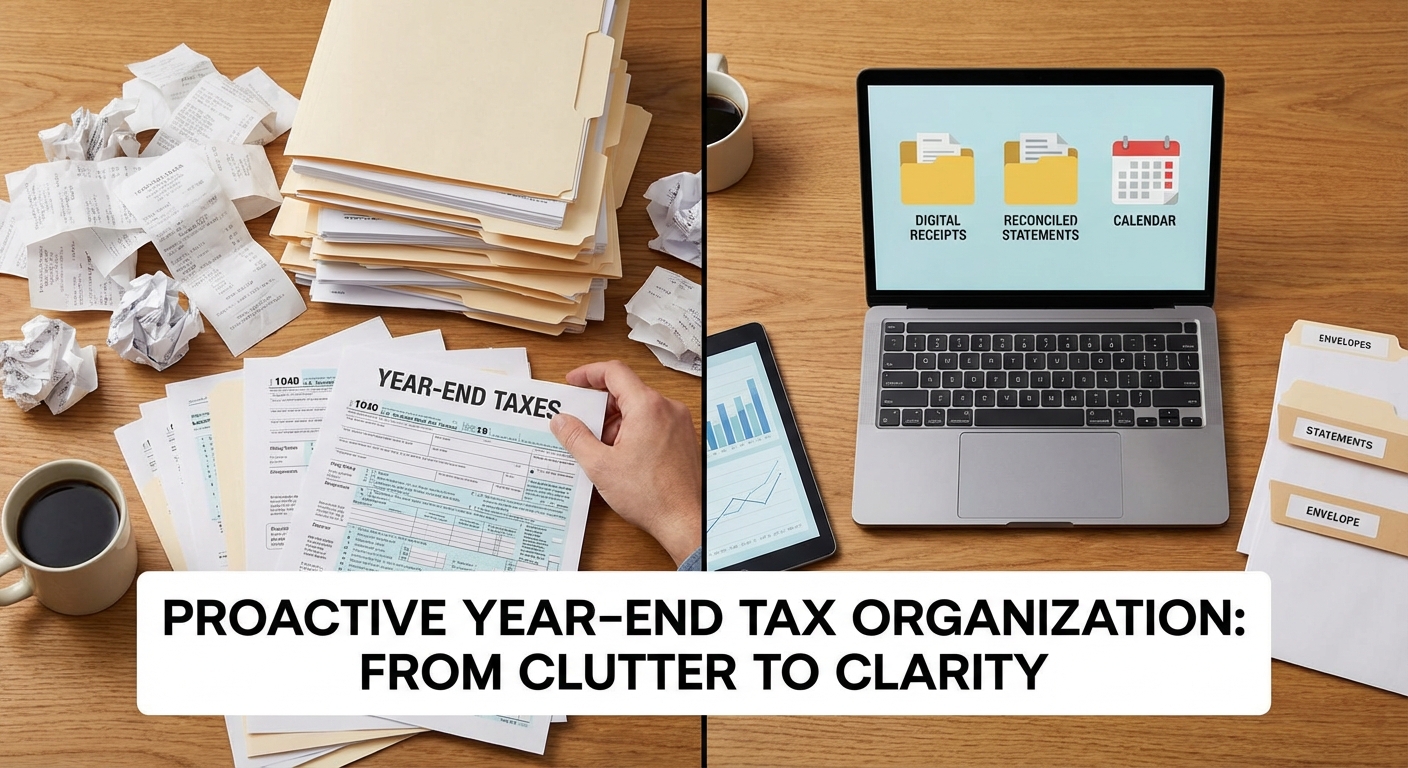
Why Tax Stress is Optional: The Proactive Year-End Playbook Every Business Owner Needs
Meta Description: Stop the annual tax panic. See how a proactive year-end tax organization system eliminates stress, reduces audit risk, and can rescue thousands in missed deductions for 2025.
If you wait until March to “deal with taxes,” you’re volunteering for financial chaos. The tax panic is so predictable—and so preventable—that calling it a business hazard is an understatement. Every February, small business owners scramble: receipts missing, QuickBooks in shambles, 1099s late, the deadline a freight train. But what if you could make those nightmares optional?
Proactive Year-End Tax Organization is the difference between choosing tax outcomes and reacting to them. When your books are closed, reconciled, and documented before December 31, you control deduction timing, retirement contributions, and expense acceleration—rather than letting the IRS dictate the result. The IRS doesn’t reward good intentions in March; it rewards documented action taken before year-end cutoffs. This is how high-performing owners legally reduce tax without increasing audit exposure.
Quick Answer
You can eliminate tax stress by proactively organizing your financials before year-end, closing your books early, reconciling every account, and digitizing your documentation. This approach not only unlocks tax savings but also removes audit risks and working-in-the-dark surprises.
What most owners miss is that Proactive Year-End Tax Organization creates a planning window the IRS fully allows—but does not advertise. Once accounts are reconciled and profit is known, you can deploy Section 179 purchases, adjust estimated payments, and fund retirement plans with precision. Waiting until February eliminates these options entirely. In tax strategy, timing—not effort—drives results.
Why Most Business Owners Panic—and How to Shut It Down
Picture this: It’s March 15, your tax preparer is chasing you for receipts you can’t find, half your payment processor statements are still unreconciled, and you’re praying the IRS doesn’t look too closely. This isn’t bad luck; it’s the direct result of deferred action.
- Receipts Vanish: Up to 40% of small business owners lose deductible receipts every year because they still rely on paper or scattered emails.
- Late 1099s = Reporting Gaps: Unfiled, missing, or late 1099s trigger avoidable underreporting audits—especially for owners who use subcontractors.
- QuickBooks “Crime Scenes”: When income doesn’t match invoices, that’s an audit magnet. The IRS expects every dollar in your account statements to have a story.
None of this is an act of fate. Every bit is solvable with a few CEO-grade systems, and the impact goes far beyond peace of mind; the average business owner loses $3,200/year to chaos-induced missed deductions.

5 CEO Moves That Make Tax Panic Optional
1. Close Your Books Early—and Gain the Tax Planning Power Window
This is where Proactive Year-End Tax Organization pays for itself. Early closure transforms bookkeeping from compliance into forecasting—allowing your CPA to model marginal tax rates, identify overpayment risk, and deploy deductions intentionally. The IRS permits this planning because it’s based on finalized data, not estimates. Owners who close late don’t miss deductions because they’re careless—they miss them because the window is already shut.
The real power isn’t in what you earn, but what you can shelter, defer, or accelerate before December 31. Closing your books by mid-January (not March) gives your tax strategist weeks to optimize deductions. For example, if you close early and your books reveal surplus profits, you have time to:
- Prepay Q1 rent (deductible for this year)
- Max Out Section 179 equipment purchases—deduct up to $1,220,000 in 2025 for qualifying equipment
- Contribute to solo 401(k) or SEP plans (significant tax deferral)
Jane, an S Corp owner who implemented early closure last year, reduced her 2024 bill by $10,750 by making $30,000 in equipment acquisitions before the cutoff, then maxing out her SEP IRA. All documented and defensible.
2. Digital Document Domination: No More Missing Receipts
The IRS does not care about your shoebox or Dropbox chaos. Start now:
- Create a digital folder called 2025 TAXES. Move ALL receipts, W-9s, Form 1099s, and bank statements there immediately upon receipt.
- Demand digital W-9s from contractors before paying for services—no W-9, no check.
- Every expense document gets named and dated before upload. For recurring vendors, use subfolders by vendor or category.
IRS Publication 583 spells it out: No documentation, no deduction—no matter how legit the expense.
3. Full Account Reconciliation: Every Dollar Tells a Story
Reconciling is non-negotiable. Every checking, credit, Stripe, PayPal, and Venmo line must match your official books—before the year ends. Why? Unreconciled bank or credit card accounts are the #1 trigger for business tax audits. The IRS now uses automated cross-matching tools (see the IRS “BSA” program) to flag discrepancies as small as $50.
- Monthly reconciliation is easier: Do it every month, not just once a year.
- Verify each deposit has a matching invoice. In 2023, missing/duplicate deposits triggered 13,000+ audits nationwide.
- Personal expenses? Purge them now. If it’s not a business charge, clean it out and keep it off next year’s books too.
4. Pre-Year-End Purchases: Don’t Leave Deductions for Dead
The easiest year-end win is to accelerate tax-deductible spending. If you’ll need a laptop, vehicle, software, or supplies early next year—buy it now. You get the deduction for 2025, rather than waiting another 12 months. For businesses on cash basis accounting, this is pure opportunity. For example:
- Buy $4,000 in software before December 31 = $880 savings at 22% tax bracket
- Replace an outdated vehicle: Section 179 allows up to $28,900 deduction for a qualifying SUV
But beware: fraudulently backdating expenses or “stuffing” at year-end is a red flag and can attract an audit. Only record expenses actually paid by year-end.
5. Set a Timeline for Bookkeeping and Tax Document Submission
Piles don’t disappear on their own. Block time on your calendar now for each step:
- Bank reconciliation: December 10
- Final receipt upload: December 15
- Submit books to your tax strategist: January 5
- Prep and file missing 1099s/W-2s: January 15
By implementing deadlines, you move from fire-fighter to financial CEO. Your accountant can spot errors months earlier, and you keep the full menu of deductions before IRS deadlines close by late January.
Red Flag Alert: The Mistake That Will Get You Audited
Mixing business and personal expenses is audit kryptonite. The IRS knows exactly what to look for. If you use your business account for non-business transactions—Netflix, groceries, personal utilities—you lose deductibility, and you may end up with both disallowed expenses and an audit ticket. Simple fix:
- Have a separate business bank and credit card. No exceptions.
- Review every transaction. Purge or reclassify personal items immediately.
💡 Pro Tip: Use Calendar Reminders and Automations
Set calendar repeats and use bank feed automations to download statements, scan receipts, and track invoices—this one step can cut bookkeeping hours by 60%.
Will This Trigger an Audit?
If you reconcile your accounts monthly, keep clean digital records, and separate business/personal finances, you’re far less likely to face an IRS audit. Audit triggers increase with unaccounted deposits, personal expenses, late/missing 1099s, and sloppy digital records. See IRS audit guidance.
FAQs: What If My Books Are a Mess Right Now?
Can I still claim deductions if I don’t have perfect records?
Yes, but only for expenses you can substantiate. If you reconstruct records now, digitize visible receipts, and create explanatory notations, the IRS may allow those deductions (see Publication 583).
What if my 1099s are late?
File whatever you can, then issue corrected documents ASAP. Missing 1099s can result in fines per form, but voluntary correction can reduce penalties.
Fast Tax Fact
IRS studies show that early book closers claim an average of $3,200 more in business deductions than those who wait until March or April.
Ready to Take Control?
Year-end tax stress is the default for the unprepared. But CEO-level preparation is a choice—one that starts with organized action, not wishful thinking.
This information is current as of 12/18/2025. Tax laws change frequently. Verify updates with the IRS or FTB if reading this later.
Book Your Financial Peace of Mind Strategy Session
Big savings, zero chaos. Book a proactive tax review with our strategist team—walk away with 3 customized deductions you’d never spot solo, and a year-end playbook for a painless, profitable tax season. Book your strategy session now.


