
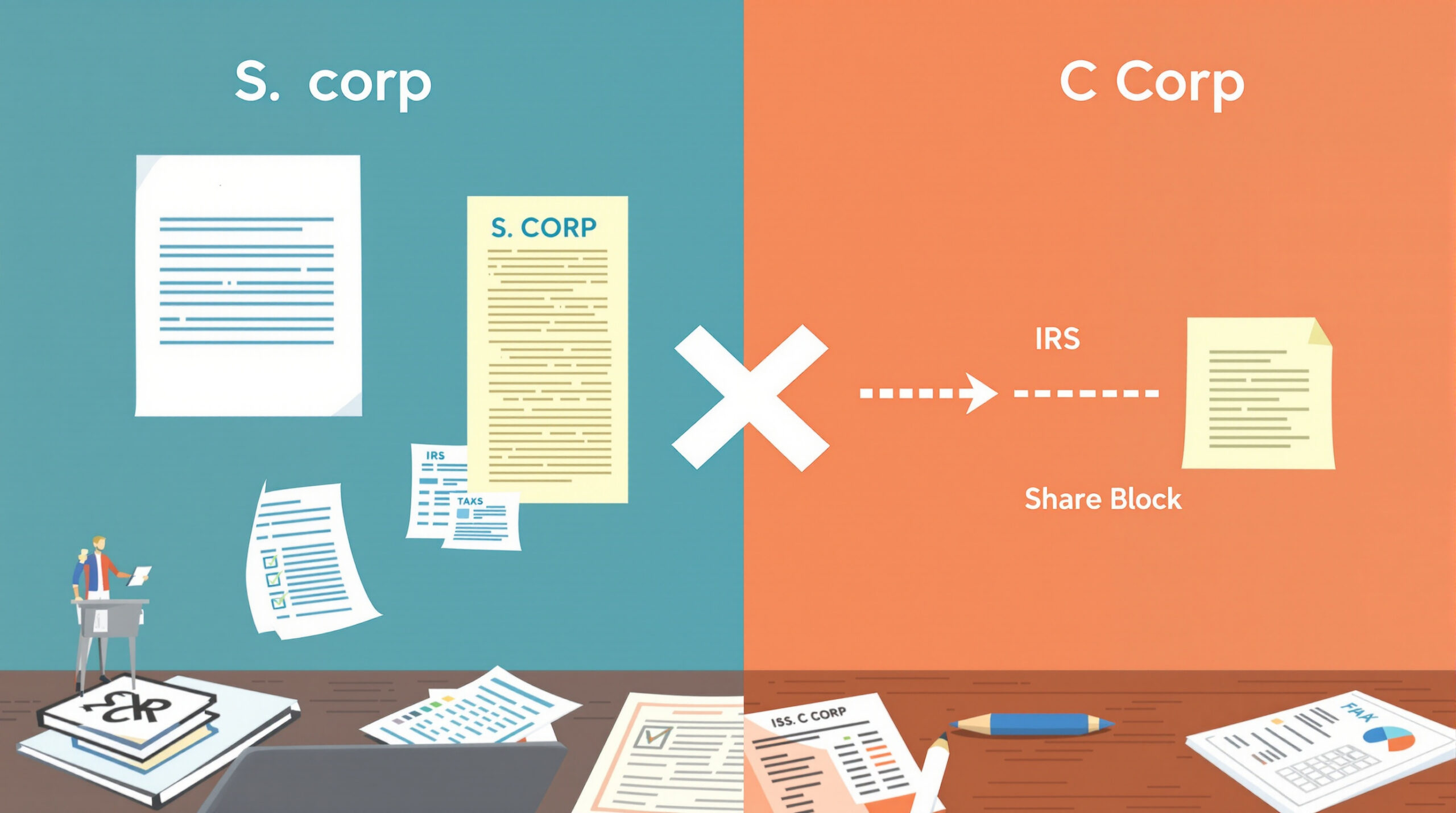
Why S Corps and C Corp Shareholders Don’t Mix — The Eligibility Rule That Triggers IRS Trouble
Picture this: an ambitious business owner structures a new venture as an S Corp, ready to lock in tax savings and payroll flexibility. But, in an attempt to streamline holdings, a C Corp is made a shareholder in the S Corp. Months later, the IRS invalidates the S Corp’s status retroactively. This is not rare — and it’s a classic five-figure tax trap hiding in plain sight.
Quick Fact: S Corps are strictly limited in who can be a shareholder, and a C Corp cannot legally own shares in an S Corp. If this rule is broken, the IRS will terminate S Corp status and tax you as a C Corp — often retroactively.
For the 2025 tax year, ignoring this rule could mean paying double taxes, triggering audit flags, and unraveling your entire business structure. Here’s a breakdown of why this rule exists, how it works, and the safer (and more profitable) ways to structure your business for legal, IRS-backed savings.
This information is current as of 11/18/2025. Tax laws change frequently. Verify updates with the IRS or FTB if reading this later.
Can an S Corp Have a C Corp Shareholder? The Fast Answer
No. Under IRS rules for 2025, an S Corporation cannot have a C Corporation as a shareholder. S Corps are restricted to eligible shareholders: US citizens or resident individuals, certain trusts or estates, and some qualified nonprofit entities. Any corporation that is not an S Corp (meaning, any C Corp) is strictly ineligible to own S Corp stock.
What happens if this rule is violated? All S Corp tax benefits vanish. The IRS “blows up” the S Corp election, retroactively converts the entity back into a C Corp, and can levy steep penalties, back taxes, and interest (see IRS Form 2553 instructions).
Why the IRS Cares and What’s at Stake for Owners
The S Corp structure is designed for small, closely held entities — the premise is pass-through taxation and flexibility for individuals, not for large or institutional investors. If a C Corp becomes a shareholder, the IRS will argue your company is circumventing these restrictions to hide profits or avoid double tax. The penalty? Often years of backdated C Corp taxes and automatic disqualification of S Corp savings, instantly costing $25,000 or more for a single year if profits are strong.
Here’s a real-world example: Sarah and Mike own an S Corp marketing firm that brings in $400,000/year in net profit. They sell 20% to a C Corp (unaware of the rule). The IRS discovers this during a routine audit three years later. Not only does the entity face triple-layered taxes on $1.2M in profit, but there are also penalties and interest stacking by the month. Most owners don’t survive this hit without a drastic business overhaul—or bankruptcy.
Wondering who can own an S Corp? The list is short and specific. Only:
- US citizens or resident individual taxpayers
- Certain grantor or testamentary trusts (with IRS approval)
- Qualified Subchapter S trusts (QSSTs)
- Estates (for a limited time after death of shareholder)
- Certain tax-exempt organizations (like 501(c)(3)s)
Corporations, LLCs, and partnerships (unless they elect S Corp) are all out. Don’t skip the shareholder eligibility test — the stakes are too high, and even a momentary lapse (like a C Corp inheriting shares via a will) can eliminate years of savings.
KDA Case Study: S Corp Shareholder Failure Leads to $65,000 in Surprise Taxes
In 2024, a Southern California consulting firm (S Corp, $1M revenues) brought in a new partner by having the partner’s C Corp purchase 30% interest—intending to keep legal liability with the C Corp. Within two years, an IRS audit flagged their shareholder roster. The S Corp election was revoked, and the business was assessed as if it were a C Corp for those years. KDA was engaged post-audit to untangle the mess. We worked with legal counsel to restructure all shareholders and petitioned for penalty relief, but even after mitigating strategies and using IRS Form 2553 late election procedures, the company paid an additional $65,000 in federal and state corporate taxes, plus $12,000 in penalties and interest. The partner had to buy in as an individual, with the C Corp investment unwound in a taxable event. The ROI of KDA’s intervention: avoided an additional $40,000 in penalties—but this fix can’t undo all damage once C Corp ownership exists.
Ready to see how we can help you? Explore more success stories on our case studies page to discover proven strategies that have saved our clients thousands in taxes.

Who Actually Owns Your S Corp: The Shareholder Eligibility Audit
Most S Corp owners think their shareholder roster is clear—but indirect ownership changes and entity roll-ups can put you in hot water. The IRS looks through ownership layers. Here’s what you need to check, especially if you’ve ever:
- Transferred shares to a trust, holding company, or via family estate
- Allowed a partnership or LLC to buy or inherit shares
- Agreed to stock options or “phantom equity” plans held by business entities
Every time a business entity (other than an S Corp) acquires S Corp stock, it is a bad event. Even a temporary transfer—for instance, if a C Corp steps into a shareholder’s shoes during probate—can cost you S Corp status for the entire tax year. This is one reason why top-tier tax counsel reviews S Corp shareholder lists at least annually.
For a complete breakdown of S Corp strategies, see our comprehensive S Corp tax guide.
Red Flag: Why Accountants Sometimes Miss This Trap
Many tax preparers and business lawyers assume any “owner” or “investor” is eligible as long as they are on the S Corp’s books. They forget that IRS rules are shareholder-type specific—not just about the name on the stock certificate, but the actual legal form of the shareholder. This mistake often occurs during business expansions, multi-entity “groups,” and family successions. Pro Tip: Before you accept funding or transfer equity, get a third-party S Corp eligibility audit. It can save you far more than it costs.
Workaround: What If I Need Corporate or Trust Ownership?
If you have a need for trust, gifting, or business-entity ownership, there are two compliant ways to retain S Corp benefits:
- Use a “Qualified Subchapter S Trust” (QSST) — this trust can own S Corp stock after filing Form 2553 and 8869, with restrictions.
- Allow ownership via an S Corp, but never a C Corp or partnership.
Even then, trusts and estates must follow strict IRS rules — consult IRS Publication 559, and ensure filings are current. Any deviation can still terminate your S status retroactively. For businesses that need true corporate ownership, a C Corp or LLC taxed as a partnership may be a better fit—but you sacrifice the S Corp tax advantages.
Pro Tip: The IRS does not always notify you immediately if your S Corp becomes ineligible. They can audit years later and revoke your S Corp status retroactively. Don’t assume silence equals safety.
FAQ: Can My LLC or Other Entity Be an S Corp Shareholder?
Short answer: No. Only other S Corps, certain trusts, and individuals can own shares legally. LLCs and partnerships are not eligible. If you want entity-level ownership, consider electing S Corp treatment for the entity, if qualified, or restructure to allow individuals to hold the stock directly.
FAQ: What If a C Corp Temporarily Holds My Shares?
Even a single day with a C Corp as a shareholder can be fatal for S Corp status. The IRS rule is “once ineligible, always ineligible”—at least for that tax year. If the error is caught quickly, and the S Corp petitions immediately with the IRS using a “late election relief” request, you may be able to save S status, but the window is short and the process is complex (see Revenue Procedure 2013-30).
FAQ: How Can I Confirm My Shareholder Structure Is IRS-Proof?
Conduct an S Corp eligibility review annually, with sign-off by a tax attorney or advanced advisor. Confirm every owner is a US citizen, resident, or eligible trust or estate per IRS rules. Have all shareholders sign affidavits confirming eligibility. Update IRS Form 2553 records after share transfers, even if minor. If any changes are unclear, request a ruling from the IRS before proceeding.
What to Do If You Discover an Error
The best move: act immediately. If you realize that a C Corp (or another ineligible shareholder) has acquired S Corp stock, contact your CPA and file for relief with the IRS before the next tax return deadline. If the window is missed, expect retroactive conversion and back taxes.
Summary: S Corp Shareholders Must Pass the Test Each Year
Making the wrong move on S Corp shareholders can cost you S Corp status, create five- or six-figure tax liabilities, and unravel your entity’s IRS compliance. Double-check every shareholder type annually — do not rely solely on state filings or cap table spreadsheets. The right structure is worth $25,000 or more a year in savings, but the wrong move could mean years of unnecessary double taxation.
The IRS isn’t hiding these ownership rules—most firms are just too casual in applying them. When in doubt, get a professional S Corp eligibility check before you accept a new shareholder or move equity between entities. Even a single missed detail can unravel years of tax strategy.
Book Your Entity Structure Audit
If you manage an S Corp or expect ownership changes this year, don’t gamble with eligibility. Our team specializes in S Corp audits, compliance reviews, and IRS-safe restructuring for business owners and high-net-worth clients. Don’t let a missed rule erase years of tax planning — get clarity today. Book your entity structure assessment now and protect your S Corp savings before the IRS comes knocking.



