
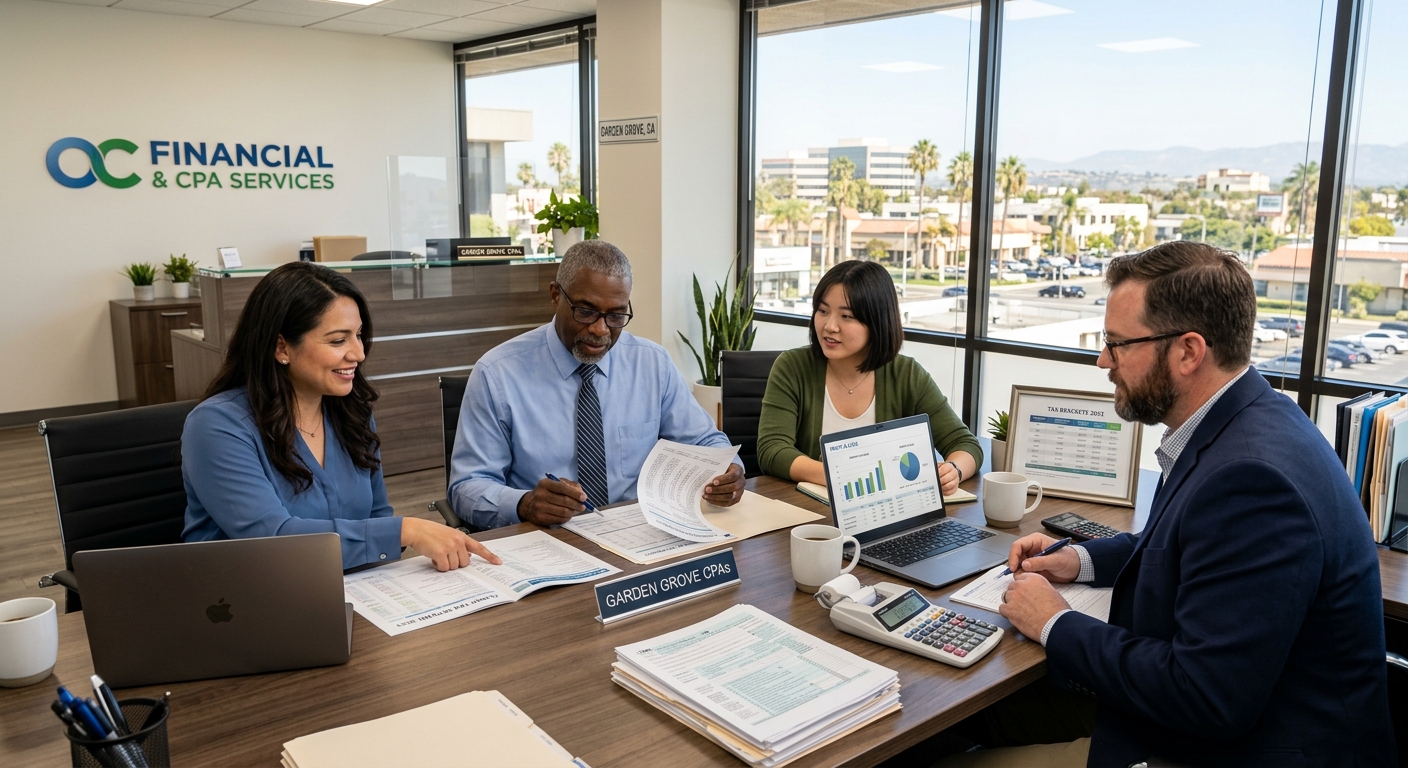
Most people in Garden Grove don’t think about their CPA until April rolls around. By then, they’ve already missed half the moves that could have saved them real money. That’s the difference between hiring a tax preparer and working with a CPA firm Garden Grove CA residents can actually rely on for year-round strategy. If you’re looking for professional tax services in Garden Grove, the decision you make now could save you thousands over the next decade.
Garden Grove sits in the heart of Orange County, surrounded by one of the most expensive and tax-complex regions in the country. California already stacks the deck against taxpayers with a top marginal state income tax rate of 13.3%. Layer on federal obligations, self-employment tax, LLC fees, and local business licensing costs, and you’ve got a situation where every dollar of tax strategy matters.
This guide breaks down exactly what a qualified CPA firm does differently from a seasonal tax shop, why it matters for Garden Grove residents specifically, and how to make the smartest choice for your finances in 2026 and beyond.
Quick Answer
A CPA firm in Garden Grove, CA provides licensed, year-round tax preparation, planning, and compliance services tailored to California residents. Unlike seasonal preparers, CPAs offer strategic guidance on entity structuring, deduction optimization, IRS representation, and state-specific rules that can save W-2 earners, freelancers, and business owners anywhere from $2,000 to $25,000 or more per year in unnecessary tax payments.
What Makes a CPA Firm Different from a Tax Preparer
This distinction matters more than most people realize. A tax preparer files your return. A CPA firm builds a strategy around your entire financial picture.
Here’s the breakdown:
| Factor | Seasonal Tax Preparer | Licensed CPA Firm |
|---|---|---|
| Licensing | PTIN holder only | State-licensed CPA with continuing education |
| Availability | January through April | Year-round advisory |
| IRS Representation | Limited or none | Full audit representation rights |
| Entity Strategy | Rarely offered | LLC, S Corp, partnership structuring |
| Tax Planning | Reactive (after the fact) | Proactive (before year-end) |
| California-Specific Expertise | Generic software prompts | Deep knowledge of FTB rules, AB5, LLC fees |
The average Garden Grove taxpayer who switches from a seasonal preparer to a CPA firm in Garden Grove CA sees a meaningful shift in their refund or tax liability within the first year. That’s not marketing talk. That’s math.
A W-2 earner making $95,000 who hasn’t been itemizing properly, hasn’t explored HSA contributions, and hasn’t reviewed their withholding since 2021 is almost certainly overpaying. A CPA catches those gaps. A software program doesn’t ask you the right questions.
Why Garden Grove Residents Face Unique Tax Challenges
Garden Grove isn’t just another city in California. It has a specific demographic and economic profile that creates distinct tax situations.
High Concentration of Small Business Owners
Garden Grove has a thriving small business community, particularly in food service, retail, construction, and professional services. Many of these owners operate as sole proprietors or single-member LLCs, which means they’re paying self-employment tax on every dollar of net profit. That’s 15.3% on top of federal and state income tax. For a business owner netting $120,000, that’s over $18,000 in self-employment tax alone.
A CPA firm evaluates whether an S Corp election makes sense. In many cases, restructuring from a sole proprietorship to an S Corp can save between $5,000 and $12,000 per year in self-employment taxes. But the election has to be done correctly, with reasonable compensation established and payroll set up properly. Mess that up and the IRS reclassifies your distributions as wages anyway.
Mixed-Income Households
Many Garden Grove households include one W-2 earner and one self-employed individual. This combination creates filing complexity that seasonal preparers frequently handle incorrectly. The W-2 income affects estimated tax payments, the self-employment income triggers Schedule SE, and the combined AGI determines eligibility for credits like the Earned Income Tax Credit or education-related deductions.
Rental Property Investors
Orange County’s real estate market is one of the most active in California. Garden Grove homeowners who rent out a room, a converted garage (ADU), or own an investment property need to understand Schedule E reporting, depreciation recapture, and passive activity loss rules. A CPA firm in Garden Grove CA handles these situations daily and knows how to maximize depreciation deductions under MACRS while staying compliant with California’s conformity rules.
KDA Case Study: Garden Grove Restaurant Owner Cuts Tax Bill by $9,400
Maria ran a popular Vietnamese restaurant in Garden Grove for six years. She operated as a sole proprietor, filing Schedule C, and paying her taxes through a chain tax prep shop every spring. Her net income averaged $135,000 per year. She was paying roughly $20,600 in self-employment taxes and another $28,000 in combined federal and state income taxes.
When she came to KDA, we immediately identified two problems. First, she had never been advised to elect S Corp status, which meant she was paying self-employment tax on her entire net income. Second, she was missing several legitimate deductions: commercial kitchen equipment depreciation, vehicle mileage for supplier runs, and a portion of her home office where she did all bookkeeping and ordering.
We restructured her business as an S Corp, set a reasonable salary of $65,000, and ran the remaining $70,000 as distributions. That alone saved her $10,710 in self-employment tax. After accounting for payroll processing costs of about $1,800 per year and our advisory fee of $3,500, her net savings in year one were $9,410. Her ROI was 2.7x in the first year, and the savings compound every year she maintains the structure.
We also helped her set up a solo 401(k), allowing her to defer up to $23,000 in 2026 (plus employer contributions), further reducing her taxable income by an additional $15,000 to $20,000 annually.
Ready to see how we can help you? Explore more success stories on our case studies page to discover proven strategies that have saved our clients thousands in taxes.
The 7 Services a CPA Firm in Garden Grove CA Should Provide
Not every CPA firm offers the same level of service. Here’s what to look for when choosing a firm, and what separates a good CPA from one that just runs the numbers.
1. Year-Round Tax Planning
Tax planning isn’t something that happens in January. It starts mid-year with income projections, estimated tax payment adjustments, and strategic timing of deductions. A CPA firm in Garden Grove CA should be reaching out to you in September, not waiting for your W-2 in February.
For example, if you’re a freelancer on pace to earn $100,000 by December, your CPA should be recommending a tax planning session in October to discuss retirement contributions, estimated payments, and whether to accelerate or defer income.
2. Business Entity Structuring
Choosing the right entity type isn’t a one-time decision. As your income grows, your entity should evolve. A sole proprietorship might make sense when you’re earning $40,000. At $80,000, an LLC taxed as an S Corp often becomes the better choice. Your CPA should be reviewing this annually.
3. Bookkeeping and Payroll
If your books are a mess, your tax return is a guess. A CPA firm that offers bookkeeping and payroll services can maintain clean records throughout the year, making tax season efficient and accurate. This also protects you in the event of an audit, because organized records are your best defense.
4. IRS and FTB Representation
If you receive a notice from the IRS or the California Franchise Tax Board, you need someone who can respond on your behalf. CPAs have unlimited representation rights before the IRS, unlike most preparers. This matters because FTB notices are increasingly common in California, particularly around LLC annual fees (the $800 minimum franchise tax) and estimated tax penalties.
5. Real Estate Tax Strategy
Garden Grove property owners need a CPA who understands real estate tax preparation, including Section 1031 exchanges, cost segregation studies, and how California’s Proposition 19 affects property tax transfers. If you’re over 55 and considering selling your home, you could transfer your property tax base to a new residence anywhere in California. But you need proper documentation and timing. A local CPA firm in Garden Grove CA walks you through every step.
6. Retirement Planning Integration
Your tax strategy and retirement strategy should be connected. A CPA who understands SEP IRAs, solo 401(k) plans, and Roth conversion ladders can help you build wealth while reducing your current tax burden. For a self-employed Garden Grove resident earning $150,000, maxing out a SEP IRA at 25% of net self-employment income could shelter over $30,000 from taxes. Use our retirement savings calculator to see how additional contributions grow over time.
7. Multi-State and International Tax Compliance
Garden Grove’s diverse population includes many residents with international income, foreign bank accounts, or family businesses spanning multiple countries. FBAR reporting (FinCEN Form 114) is required if your foreign accounts exceed $10,000 at any point during the year. The penalty for failing to file can reach $12,909 per account, per year, for non-willful violations. A CPA firm familiar with FBAR requirements is essential.
How Much Does a CPA Firm in Garden Grove CA Cost?
Let’s talk numbers, because cost is usually the first objection people raise. And it’s the wrong objection.
Here’s a rough breakdown of what CPA services typically cost in the Orange County area:
| Service | Typical Cost Range | What You Get |
|---|---|---|
| Individual Tax Return (W-2 only) | $300 to $600 | Federal + CA state filing, deduction review |
| Self-Employed / Schedule C | $500 to $1,200 | Business income, deductions, SE tax calculation |
| S Corp Return (Form 1120S) | $1,000 to $2,500 | Corporate return + K-1 + personal return |
| Tax Planning Session | $500 to $1,500 | Mid-year strategy, estimated payments, projections |
| Bookkeeping (Monthly) | $300 to $800/month | Reconciliation, categorization, reporting |
| IRS Audit Representation | $2,000 to $5,000+ | Full representation, document prep, resolution |
Now compare that to the cost of not having a CPA. If you’re overpaying by $5,000 a year in taxes because nobody told you about the QBI deduction, or because your entity structure is wrong, or because you’re not tracking deductible expenses, that’s $5,000 you never get back. Over five years, that’s $25,000 lost. The CPA pays for themselves many times over.
Do You Need a CPA If You Just Have a W-2?
Yes. And here’s why most W-2 earners in Garden Grove are leaving money on the table.
The standard deduction for 2026 is projected to be around $15,000 for single filers and $30,000 for married filing jointly. Many people assume that means itemizing isn’t worth it. But a CPA doesn’t just look at Schedule A. They look at the full picture:
- HSA contributions: If your employer offers a high-deductible health plan, you can contribute up to $4,300 (individual) or $8,550 (family) in 2026 and deduct every dollar above the line.
- Student loan interest: Up to $2,500 deductible if your MAGI is under the threshold.
- Educator expenses: Teachers in the Garden Grove Unified School District can deduct up to $300 in unreimbursed classroom expenses.
- Retirement contributions: Traditional IRA contributions up to $7,000 ($8,000 if you’re 50 or older) can reduce your taxable income.
- Withholding optimization: Many W-2 earners have incorrect withholding, leading to either a large refund (meaning the government held your money interest-free) or an unexpected tax bill. A CPA adjusts your W-4 so you keep more of each paycheck.
A Garden Grove family earning $140,000 combined with two kids, a mortgage, and an HSA could realistically reduce their tax liability by $3,000 to $5,000 per year just by getting their deductions and credits right. That’s not creative accounting. That’s using the tax code the way it was designed.
How to Evaluate a CPA Firm in Garden Grove CA
Not all CPA firms are created equal. Here’s a practical checklist for evaluating your options. Our Garden Grove tax professionals meet every one of these criteria, and we encourage you to hold any firm you consider to the same standard.
Credentials and Licensing
Verify the CPA is licensed with the California Board of Accountancy. You can check any CPA’s license status through the California Department of Consumer Affairs license lookup tool. An active license means they’ve met education requirements, passed the CPA exam, and maintain continuing education credits.
Industry Experience
Ask what types of clients the firm serves. A CPA who primarily handles corporate audits might not be the best fit for a freelance graphic designer. Look for firms with experience serving small business owners, self-employed professionals, W-2 earners with side income, and real estate investors. That breadth of experience matters in Garden Grove, where the client base is diverse.
Technology and Communication
Does the firm use a secure client portal? Can you upload documents electronically? Do they offer virtual consultations? In 2026, there’s no excuse for a CPA firm that still requires you to drop off a manila folder and wait three weeks. Modern firms use encrypted portals, cloud-based accounting software, and scheduled video calls to keep you informed and engaged.
Proactive Planning vs. Reactive Filing
Here’s the simplest test: Does the CPA contact you mid-year, or do they only reach out when your return is ready for signature? A firm that practices proactive planning will schedule a mid-year check-in, adjust your estimated payments, and recommend year-end strategies. A reactive firm just plugs numbers into software.
California-Specific Tax Rules Garden Grove Residents Must Know
California doesn’t conform to every federal tax provision, and that disconnect catches people off guard. Here are the most important California-specific rules a CPA firm in Garden Grove CA should be advising you on:
No State Deduction for SALT
The federal SALT deduction cap of $10,000 limits how much you can deduct for state and local taxes on your federal return. But California doesn’t have an equivalent provision. Your CPA needs to calculate your tax liability on both levels to optimize your overall position.
California LLC Fees
Every LLC registered in California pays an $800 annual franchise tax, regardless of income. If your LLC earns over $250,000 in gross revenue, you owe an additional fee ranging from $900 to $11,790. This catches new business owners by surprise when they form an LLC and don’t realize the annual cost (see FTB LLC information).
AB5 and Worker Classification
California’s AB5 law uses the ABC test to determine whether a worker is an employee or independent contractor. If you’re a Garden Grove business owner using 1099 contractors, getting this classification wrong can trigger back taxes, penalties, and interest from both the EDD and the FTB. A qualified CPA firm reviews your contractor relationships and ensures compliance.
California Conformity Gaps
California doesn’t conform to several federal provisions, including the qualified opportunity zone exclusion under IRC Section 1400Z-2 and certain federal bonus depreciation rules. If you claimed a federal deduction that California doesn’t recognize, you’ll owe additional state tax. Your CPA handles the California adjustments on Schedule CA (540) to prevent surprise bills from the FTB.
5 Red Flags That Mean You Need a New CPA
Already working with a CPA? Here’s how to tell if they’re actually delivering value:
- They never ask about your business structure. If your CPA hasn’t discussed whether your LLC should be taxed as an S Corp, they’re not doing strategic work.
- Your return looks exactly the same every year. If nothing changes on your return despite life events (new home, new business, new child), someone isn’t paying attention.
- They can’t explain your tax bill. If you ask “why do I owe this much?” and the answer is vague, that’s a problem. A good CPA walks you through the math.
- You’ve never received a mid-year call. Tax planning happens before December 31, not after. If your CPA only surfaces in January, you’re getting filing services, not advisory services.
- They missed obvious deductions. Home office, vehicle expenses, retirement contributions, health insurance premiums for self-employed individuals. If these are absent from your return and they apply to you, your CPA dropped the ball.
Ready to Reduce Your Tax Bill?
KDA Inc. specializes in strategic tax planning for business owners, S Corps, LLCs, and high-net-worth individuals. Book a personalized consultation and walk away with a clear plan.
Frequently Asked Questions About CPA Firms in Garden Grove
How do I find a reputable CPA firm in Garden Grove CA?
Start with the California Board of Accountancy’s license verification tool. Check online reviews, ask for referrals from other business owners, and schedule a consultation before committing. A good CPA firm will offer an initial meeting to understand your situation before quoting fees.
Can a CPA help me if I’m behind on taxes?
Absolutely. CPAs can file back returns, negotiate installment agreements with the IRS, and help you apply for penalty abatement if you qualify. The key is to act before the IRS escalates collection actions. Ignoring notices makes everything worse and more expensive.
Is it worth hiring a CPA for a small side hustle?
If your side income exceeds $5,000 per year, yes. At that level, you’re dealing with self-employment tax, quarterly estimated payments, and potential deductions that most people miss. A CPA ensures you’re not overpaying and that your records are audit-ready.
What’s the difference between a CPA and an enrolled agent?
Both can represent you before the IRS. CPAs hold state-issued licenses and typically have broader financial expertise (auditing, financial statements, advisory). Enrolled agents are federally authorized tax practitioners who specialize in tax matters. For comprehensive financial and tax strategy, a CPA firm generally offers a wider range of services.
When should I start working with a CPA?
Ideally, mid-year. Starting a CPA relationship in July or August gives your new firm time to review your prior returns, identify missed opportunities, and implement strategies before year-end. Waiting until January limits what can be done for the current tax year.
Does a CPA firm handle California state taxes differently?
Yes. California has its own tax forms, filing requirements, and conformity rules that differ from federal law. A qualified CPA firm in Garden Grove CA files both your federal and California returns, handles Schedule CA adjustments, and ensures compliance with FTB-specific requirements that out-of-state preparers might miss.
Should You Choose a Local CPA or a National Firm?
There are advantages to both, but for Garden Grove residents, working with a local or regional firm has measurable benefits:
- California-specific expertise: National firms rotate staff and may not have deep California knowledge. A local firm deals with FTB rules, Proposition 19, and AB5 classifications every single day.
- Personalized attention: At a national firm, you’re often assigned to a junior associate. At a local CPA firm, you typically work directly with the partner or senior CPA who knows your history.
- Accessibility: Need to drop off documents or have a face-to-face meeting? A firm in the Garden Grove or greater Orange County area makes that possible without a 90-minute drive.
- Community understanding: A local CPA understands the Garden Grove business landscape, the industries that drive the local economy, and the unique challenges residents face.
Ready to work with a tax professional who understands Garden Grove taxpayers? Visit our Garden Grove tax services page or book a consultation below.
This information is current as of 6/5/2026. Tax laws change frequently. Verify updates with the IRS or FTB if reading this later.
Book Your Garden Grove Tax Strategy Session
Whether you’re a W-2 earner, a small business owner, a freelancer, or a real estate investor in Garden Grove, the right CPA firm changes your financial trajectory. Stop overpaying, stop guessing, and start working with a team that builds strategy around your specific situation. Click here to book your personalized tax consultation now.



