
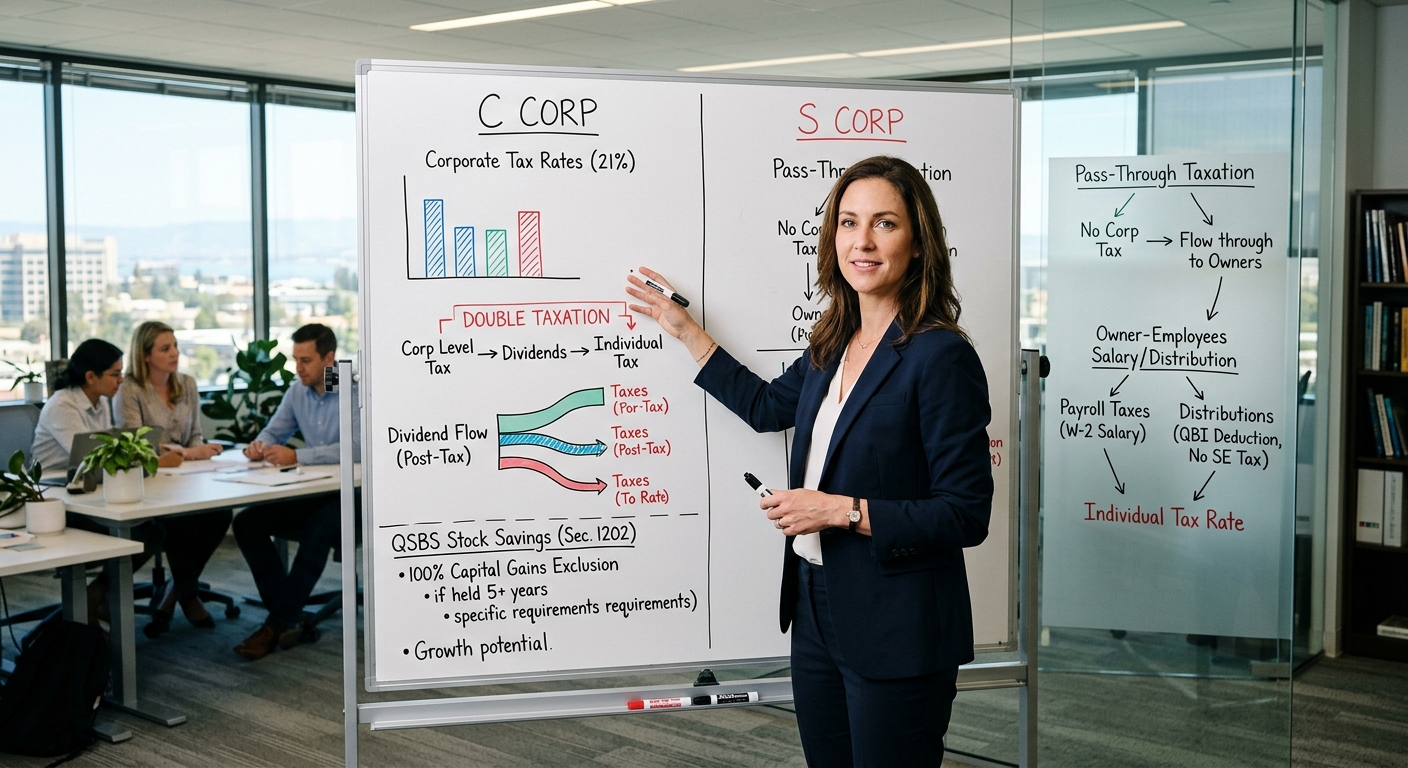
Ask ten accountants which entity saves the most tax and nine of them will reflexively say the S Corp. That reflex costs founders millions of dollars every year. The truth about why C corp is better than S corp in specific situations is one of the most misunderstood topics in small business tax planning, and the myth that pass-through status always wins is exactly why smart founders overpay or, worse, structure themselves out of the single largest tax break in the code.
This is not a pitch to convert every business to a C corp. It is a clear breakdown of the six situations where the C corporation genuinely beats the S corporation, backed by real numbers, real IRS rules, and real client outcomes. If you run a growing company, plan to raise capital, or expect to sell one day, the entity choice you made in year one may be quietly draining your future wealth. Let us look at where the C corp actually wins.
Quick Answer: When Is a C Corp Better Than an S Corp?
A C corp is better than an S corp when you plan to reinvest profits rather than distribute them, when you want to sell qualifying stock tax-free under the QSBS rules, when you need to raise venture capital or bring on foreign or institutional investors, when you offer robust fringe benefits, or when your profit sits in the sweet spot where the flat 21 percent corporate rate beats your personal marginal rate. The S corp shines for owner-operators who pull most of the cash out each year. The C corp shines for builders who leave money in and plan a big exit.
Why C Corp Is Better Than S Corp for Reinvesting Profits
The single most powerful reason to choose a C corporation is the flat 21 percent federal corporate rate under the Tax Cuts and Jobs Act. An S corp passes every dollar of profit straight to your personal return, where it can be taxed as high as 37 percent federally before you add California, which stacks its own 13.3 percent top rate on top. If you are not pulling that money out, you are handing the government a premium to leave your cash trapped in a pass-through.
Consider a software company earning $600,000 in net profit that the founders want to reinvest in engineering hires and product development. As an S corp, that $600,000 flows to the owners personally and gets taxed at their top marginal rate regardless of whether they touch a dollar of it. At a combined federal and California rate near 45 percent, that is roughly $270,000 gone before reinvestment.
As a C corp, the same $600,000 is taxed at 21 percent federally plus California’s 8.84 percent corporate rate, leaving far more capital inside the business to compound. The company keeps roughly $178,000 more in year one to fund growth. That is real money that builds enterprise value instead of funding a personal tax bill on income you never spent.
The Reinvestment Math That Changes the Decision
- S corp treatment: profit taxed at personal rates up to 37 percent federal plus state, whether or not distributed.
- C corp treatment: profit taxed at flat 21 percent federal, cash stays inside to compound.
- The trap: pass-through owners often pay tax on phantom income they cannot spend because it is locked in growth.
Key Takeaway: If you leave more than half your profit in the business to grow it, the C corp almost always wins on year-over-year retained capital. Many growth-stage business owners discover this only after years of overpaying as an S corp.
The QSBS Advantage No S Corp Can Touch
Here is the rule that makes seasoned advisors quietly steer serious founders toward the C corp: Qualified Small Business Stock under Section 1202. QSBS (in plain English: shares in a qualifying C corporation held long enough to unlock a massive capital gains exclusion) can let you sell your company and pay zero federal capital gains tax on millions of dollars of gain.
To qualify, the stock must be issued by a domestic C corporation, the company must have gross assets under a defined threshold when the stock is issued, and you generally must hold the shares for the required holding period. When you meet the rules, you can exclude a huge portion of your gain from federal tax, subject to a per-issuer cap. S corp stock does not qualify for Section 1202. Full stop. This is the exclusion that no pass-through can ever offer.
What QSBS Looks Like in Real Dollars
Imagine a founder who builds a company from scratch as a C corp and sells her shares for a $9 million gain after meeting the holding period. Under the QSBS exclusion, she may pay nothing in federal capital gains tax on qualifying gain up to the statutory cap. Compare that to a 20 percent federal capital gains rate plus the net investment income tax, and you are looking at a potential seven-figure difference at exit.
No S corp owner gets this benefit. If your realistic future includes selling the business, the entity you choose today decides whether QSBS is even on the table years from now. You cannot bolt it on at the last minute because the holding period clock starts when the C corp stock is issued. Founders who plan to build and sell should read the official guidance on qualified small business stock before locking in an S election they may regret.
Pro Tip: If a nine or ten-figure exit is even remotely on your horizon, the QSBS conversation belongs at the top of your entity planning, not as an afterthought.
KDA Case Study: Tech Founder Saves Millions With C Corp Structure
Ravi came to us as a self-taught founder running a fast-growing SaaS company through an S corp because a generalist accountant told him pass-through was always the smart move. His company was throwing off roughly $700,000 in annual profit, almost all of which he was reinvesting into engineering and infrastructure. He was paying personal income tax on nearly every dollar of that retained profit at a combined rate close to 45 percent, even though he was spending very little of it personally.
Worse, he had already fielded early acquisition interest. Because his shares were S corp stock, he had zero access to the QSBS exclusion, which meant a future exit would be fully taxed at capital gains rates plus the net investment income tax. He was structurally locked out of the single biggest tax break available to founders.
We modeled a conversion to a C corp, reset his QSBS holding period, restructured a reasonable owner salary, and shifted his reinvested profit into the flat 21 percent corporate bracket. In the first year alone he retained roughly $150,000 more in the business for growth. More importantly, we put him on the path to potentially exclude millions in gain at exit. He invested about $12,000 in planning and restructuring and is positioned for a multi-million dollar tax outcome down the road, an ROI that is difficult to overstate.
Ready to see how we can help you? Explore more success stories on our case studies page to discover proven strategies that have saved our clients thousands in taxes.
Why C Corp Is Better Than S Corp When You Raise Capital
If your growth plan involves outside money, the C corp is not just better, it is often mandatory. Venture capital funds, institutional investors, and most sophisticated angels will not invest in an S corp, and for good reason. An S corp is legally capped at one class of stock and a limited number of shareholders, all of whom must be U.S. individuals or certain trusts. Those restrictions collide head-on with how modern fundraising works.
The Structural Limits That Kill S Corp Fundraising
- One class of stock: S corps cannot issue preferred shares, which is exactly what investors demand for liquidation preferences and control rights.
- Shareholder cap: the limited shareholder count makes broad capital raises impossible.
- No entity or foreign owners: venture funds, corporations, and non-resident investors are all disqualified as S corp shareholders.
A C corp has none of these handcuffs. It can issue multiple classes of stock, take on unlimited shareholders, and welcome foreign and institutional capital. This is why virtually every startup that plans to raise a priced round converts to or starts as a Delaware C corp. If you try to raise on an S corp, the first thing any competent investor’s counsel does is force a conversion, and doing it under deal pressure is expensive and rushed. Founders exploring their options should review our entity formation services before they take a single outside dollar.
The Fringe Benefit Edge Most Owners Never Hear About
Here is a quiet advantage competitors rarely explain: C corporations can deduct a broader range of fringe benefits for owner-employees than S corps can. In an S corp, any shareholder who owns more than two percent of the company is treated much like a partner for benefit purposes, which strips away the tax-free treatment of several perks.
In a C corp, the owner is a genuine employee, which opens the door to deductible, tax-advantaged benefits that a more-than-two-percent S corp shareholder simply cannot enjoy the same way.
Benefits That Work Better in a C Corp
- Health and medical reimbursement structures that can be fully deductible to the company and tax-free to the owner-employee.
- Certain group-term life and disability coverage handled more favorably at the corporate level.
- Broader retirement and benefit planning flexibility when the owner is a true W-2 employee of the corporation.
For a profitable owner who wants to run significant benefits through the business, these deductions add up quickly. A five-figure annual benefit package that is fully deductible at the corporate level, rather than partially clawed back under the S corp two-percent rule, is a meaningful ongoing saving. This is the kind of layered planning that a strong tax planning strategy uncovers and a generic tax preparer misses entirely.
When the Flat 21 Percent Rate Beats Your Personal Bracket
For high-income owners, the math on marginal rates alone can favor the C corp. An S corp owner in the top federal bracket pays 37 percent on the last dollars of business income. A C corp pays a flat 21 percent federally on corporate profit. When you are retaining earnings rather than distributing them, that 16-point spread is enormous.
The classic objection is double taxation: the C corp pays 21 percent, then shareholders pay tax again on dividends. That objection only bites when you actually pay dividends. For a founder who reinvests, pays a reasonable salary, and defers distributions until a QSBS-eligible sale, the second layer of tax may never materialize the way the textbook warns.
Reading the Double Taxation Trap Correctly
Double taxation is real, but it is a choice, not a certainty. If you strip out most profit as an owner salary and reinvest the rest, the corporate-level 21 percent may be the only tax that ever gets paid on retained earnings before exit. The founders who get burned by double taxation are usually those who treat a C corp like a personal piggy bank and pull cash out as dividends. Structure the compensation and distribution strategy correctly and the double-tax bogeyman largely disappears.
Key Takeaway: The flat 21 percent rate is a weapon for reinvestors and high earners. It becomes a liability only if you drain the company through dividends.
C Corp vs S Corp: Side-by-Side Comparison
| Factor | C Corp | S Corp |
|---|---|---|
| Federal tax on retained profit | Flat 21 percent | Up to 37 percent personal |
| QSBS Section 1202 exclusion | Available | Never available |
| Classes of stock | Multiple allowed | One class only |
| Foreign and entity owners | Allowed | Prohibited |
| Venture capital ready | Yes | No |
| Owner fringe benefits | Broadly deductible | Limited over 2 percent owners |
| Best for | Reinvestors, fundraisers, future sellers | Owner-operators taking cash out |
Should You Elect C Corp Status? A Decision Framework
Choose a C corp if:
- You reinvest most of your profit rather than distributing it.
- You plan to raise venture or institutional capital.
- A significant future sale is realistic and QSBS could apply.
- You want to bring on foreign or entity investors.
- You want to run substantial deductible fringe benefits through the business.
Stay an S corp if:
- You pull most of the cash out each year to live on.
- You want to avoid any double-taxation risk entirely.
- Your profit sits in the modest range where self-employment tax savings on distributions matter most.
- You have no fundraising or big-exit plans.
What Happens If You Choose Wrong?
Choosing the wrong entity is not a rounding error. An S corp owner who was destined to sell loses QSBS forever because the holding period never started on qualifying C corp stock. A C corp owner who drains cash as dividends every year pays the double tax the S corp would have avoided. And a founder who raises capital on an S corp faces a rushed, costly conversion under deal pressure that eats into valuation and legal budgets.
The good news is that most of these traps are avoidable with early planning. Conversions are possible in both directions, but each has timing rules, built-in gains considerations, and holding-period consequences that require a strategist, not a form filer.
California-Specific Considerations
California does not care how good your federal strategy is if you ignore the state layer. California imposes an 8.84 percent corporate franchise tax on C corps and an entity-level 1.5 percent tax on S corps, plus the annual minimum franchise tax. California also does not conform to the federal QSBS exclusion in the same way, so a founder who excludes gain federally may still owe California tax on that same gain. This is a critical detail that generic online calculators miss entirely and that surprises founders at exit.
For the 2026 tax year, any entity decision made by a California business must weigh both the federal advantages and the state-level cost. The flat 21 percent federal win can be partially offset by California’s treatment, which is exactly why the analysis has to be run on your actual numbers rather than a national rule of thumb. Verify current rules with the California Franchise Tax Board and the IRS before acting.
This information is current as of 7/27/2026. Tax laws change frequently. Verify updates with the IRS or FTB if reading this later.
Ready to Reduce Your Tax Bill?
KDA Inc. specializes in strategic tax planning for business owners, S Corps, LLCs, and high-net-worth individuals. Book a personalized consultation and walk away with a clear plan.
Frequently Asked Questions
Can I convert my S corp to a C corp?
Yes. You can revoke your S election and become a C corp, but the QSBS holding period starts fresh on the C corp stock, and there are timing rules around the effective date. This is worth modeling carefully because the switch is not instantaneous in its tax effects.
Does a C corp always mean double taxation?
No. Double taxation only occurs when the C corp pays dividends. If you reinvest profits and take a reasonable salary instead of dividends, the only tax may be the 21 percent corporate rate until you sell.
Is QSBS really tax-free?
For qualifying stock held the required period, a large portion of federal capital gain can be excluded up to a per-issuer cap. State treatment varies, and California in particular may not conform, so plan for the state layer.
How much profit makes a C corp worth it?
There is no single number, but the more profit you reinvest and the more likely a future sale becomes, the stronger the C corp case gets. High reinvestment plus a realistic exit is the classic C corp profile.
The Bottom Line
The blanket claim that S corps always win is lazy advice that costs founders real wealth. The C corp beats the S corp when you reinvest profits, when you chase the QSBS exclusion, when you raise capital, when you load up on fringe benefits, and when the flat 21 percent rate beats your personal bracket. The IRS did not hide these advantages. Most founders were simply never shown how to use them.
Stop Guessing and Get Your Entity Structure Right
If you are reinvesting profits, eyeing a future sale, or planning to raise capital, the wrong entity could be quietly costing you six or seven figures over the life of your business. Let us run your actual numbers, model the C corp versus S corp outcome, and map the QSBS path before it is too late to start the clock. Book your entity strategy session now and walk away knowing exactly which structure builds the most wealth for you.



