
Every year, the IRS collects billions in penalties from taxpayers who missed a single date. Not because they refused to pay, but because they misunderstood when the clock actually started. If you are asking when are late taxes due 2026, the honest answer is more layered than a single calendar box, and getting it wrong can cost you hundreds or thousands in avoidable penalties and interest.
Here is the contrarian truth most people miss: filing late and paying late are two completely different failures, with two completely different penalty structures. Understanding that split is where the real money is saved. This guide breaks down exactly what happens after a deadline passes, how the penalties stack, and what a savvy taxpayer, whether you own rental property, run an LLC, or collect a W-2, can do to stop the bleeding fast.
Quick Answer: When Are Late Taxes Due in 2026?
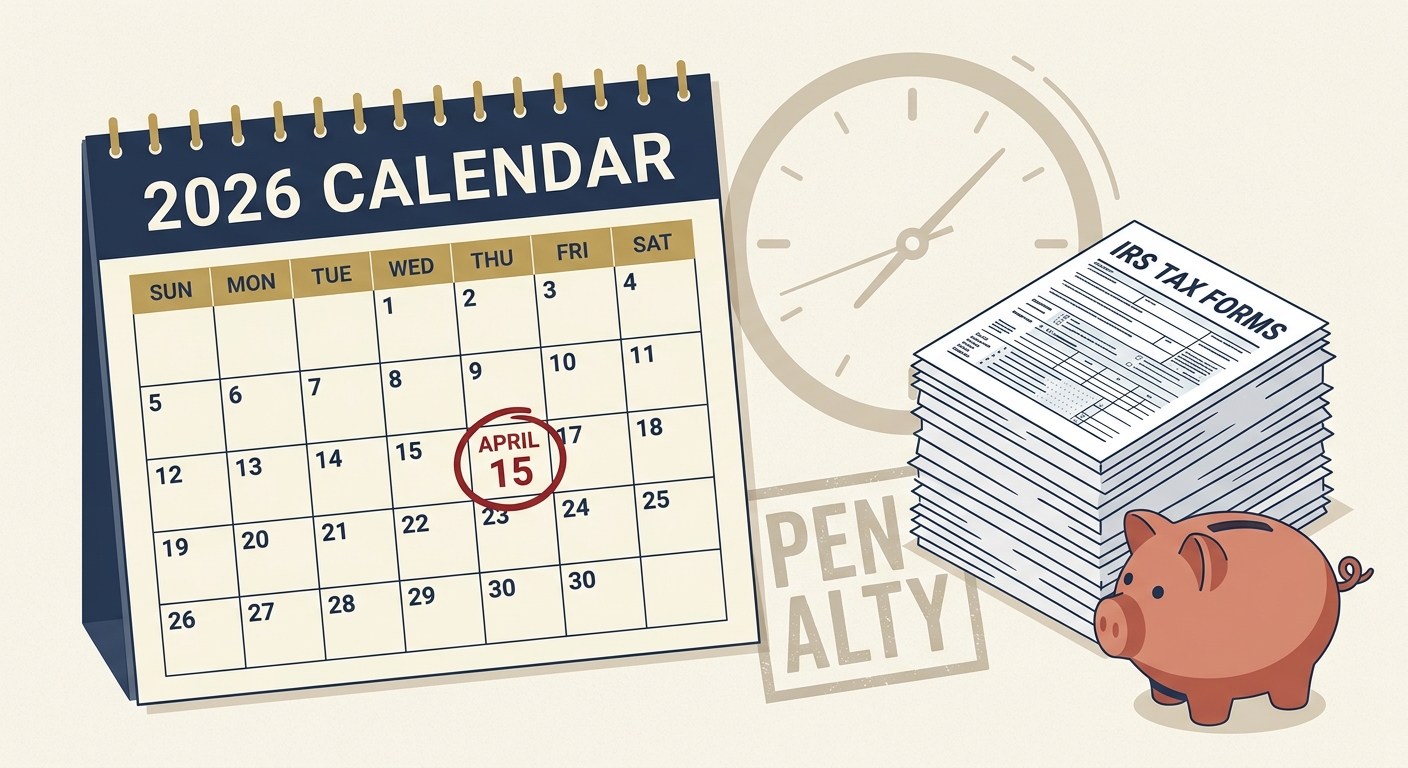
For the 2025 tax year, federal returns are due April 15, 2026. If you miss that date, your taxes are technically “late” the very next day, April 16, 2026. If you filed an extension, your return is due October 15, 2026, but any tax owed was still due on April 15, 2026. In California, the Franchise Tax Board (FTB) follows the same April 15 deadline, with an automatic extension to October 15 for filing only, not for payment.
Key Takeaway: An extension gives you more time to file paperwork, never more time to pay. The moment April 15, 2026, passes with a balance owed, interest and penalties begin accruing on the unpaid amount.
The Two Deadlines Everyone Confuses
The single biggest reason taxpayers overpay in penalties is that they treat “the tax deadline” as one event. It is actually two.
The Filing Deadline
This is the date your return must be submitted. For 2025 returns, that is April 15, 2026. If you request an extension using Form 4868 (the Application for Automatic Extension of Time to File), you push your filing deadline to October 15, 2026. The extension is automatic and free. You do not need a reason, and the IRS almost never denies it.
The Payment Deadline
This is the date your tax bill must be paid, and it does not move. Even with a valid extension, your payment is due April 15, 2026. This is the trap. Taxpayers file Form 4868, feel relieved, and assume they have until October to settle up. They do not. Interest and a failure-to-pay penalty start ticking on April 16.
Think of it like a restaurant. The extension lets you stay at the table longer, but the bill was due when the meal ended. Sitting there does not pause what you owe.
Pro Tip: If you cannot pay in full by April 15, 2026, still file on time or file the extension, and pay whatever you can. The failure-to-file penalty is ten times larger than the failure-to-pay penalty, so filing is the priority even when your wallet is thin.
How Late Tax Penalties Actually Stack in 2026
Understanding the math behind late penalties is what separates people who lose thousands from people who lose almost nothing. There are two penalties plus interest, and they behave differently.
Failure-to-File Penalty
This is the expensive one. The failure-to-file penalty is 5% of the unpaid tax for each month or part of a month your return is late, capped at 25% of the unpaid balance. If your return is more than 60 days late, the minimum penalty is the smaller of $510 (adjusted for inflation) or 100% of the tax due. You can review the current figures on the official IRS Failure to File Penalty page.
Failure-to-Pay Penalty
This is the smaller one. The failure-to-pay penalty is 0.5% of the unpaid tax per month, also capped at 25%. When both penalties apply in the same month, the failure-to-file penalty is reduced by the failure-to-pay penalty, so the combined rate is 5% per month, not 5.5%.
Interest
On top of both penalties, the IRS charges interest on unpaid tax. The rate is the federal short-term rate plus 3%, adjusted quarterly. Interest compounds daily, and unlike penalties, interest is almost never waived.
Comparison: Filing Late vs Paying Late
| Factor | File Late | Pay Late |
|---|---|---|
| Monthly rate | 5% of unpaid tax | 0.5% of unpaid tax |
| Maximum cap | 25% of balance | 25% of balance |
| Minimum penalty | Up to $510 if 60+ days late | None |
| Interest applies | Yes | Yes |
Key Takeaway: Filing late is ten times more expensive per month than paying late. Always file, even if you cannot pay a dime.
KDA Case Study: The Real Estate Investor Who Assumed the Extension Covered Everything
Marcus, a real estate investor in Sacramento, owns four rental units generating roughly $180,000 in gross rental income annually. In April 2025, buried in a 1031 exchange and a refinance, he filed Form 4868 and mentally checked out until October. He owed $22,000 in federal tax for the prior year but paid nothing at filing, assuming his extension covered the payment too.
By the time he sat down with us in September, the failure-to-pay penalty and daily-compounding interest had quietly added up to over $1,400, and it was still climbing. Worse, because his Schedule E depreciation had been calculated incorrectly by his previous preparer, he was actually overpaying on the underlying liability.
Our team did three things. First, we filed his return immediately to stop any risk of a failure-to-file exposure. Second, we corrected his depreciation schedule and captured a missed cost segregation opportunity, which reduced his actual liability by $9,600. Third, we filed a first-time penalty abatement request, which the IRS granted, wiping out the accrued penalty. Net result: Marcus saved roughly $11,000 between the corrected liability and the abated penalty. He paid us $3,200 for the engagement, a first-year return of about 3.4x.
Investors juggling depreciation, passive income, and multiple properties face exactly these traps, which is why specialized tax help for real estate investors pays for itself. If you want to model your own numbers before a deadline, run them through the federal tax calculator to see where you stand.
Ready to see how we can help you? Explore more success stories on our case studies page to discover proven strategies that have saved our clients thousands in taxes.
What Happens If You Miss the 2026 Deadline Entirely?
Missing the deadline is not the disaster most people imagine, but ignoring it afterward can be. Here is what unfolds if you do nothing.
Weeks 1 to 8
Penalties and interest accrue quietly. The IRS does not immediately send an agent. Instead, the system logs your unpaid balance and begins the meter. This is the cheapest window to fix things because the penalties are still small.
Months 2 to 6
You will receive a CP14 notice, the first official balance-due letter, followed by escalating reminders. Each notice adds urgency but no new penalty tiers beyond what is already accruing. This is still very fixable.
Months 6 and Beyond
If ignored long enough, the IRS can file a Substitute for Return on your behalf, which excludes every deduction and credit you would normally claim, inflating your liability dramatically. Eventually, liens and levies become possible. For anyone facing letters at this stage, professional tax planning support can restructure the situation before it reaches enforced collection.
Special Situations and Edge Cases
A few scenarios change the standard timeline. If you are owed a refund, there is no failure-to-file or failure-to-pay penalty, because penalties are calculated as a percentage of unpaid tax, and you owe nothing. However, you have only three years to claim that refund before it is forfeited to the Treasury permanently.
Members of the military serving in a combat zone, taxpayers in federally declared disaster areas, and Americans living abroad may qualify for automatic deadline extensions. California residents affected by wildfires or floods often receive FTB relief that mirrors federal postponements.
How to Reduce or Eliminate Late Tax Penalties
Most taxpayers do not realize that penalties are frequently negotiable. Interest rarely is, but penalties often can be reduced or removed entirely with the right approach.
Step-by-Step: How to Request Penalty Relief
- File and pay first – Get your return submitted and pay as much as possible. Relief is easier to obtain once the underlying issue is resolved.
- Check first-time abatement eligibility – If you had no penalties in the prior three years and are current on filings, you likely qualify for automatic first-time penalty abatement.
- Gather reasonable cause documentation – Serious illness, natural disaster, or reliance on incorrect professional advice can support a reasonable-cause request.
- Call the IRS or submit Form 843 – Request abatement by phone for simple cases or file Form 843, the Claim for Refund and Request for Abatement, for a formal written request.
- Set up a payment plan if needed – An installment agreement stops aggressive collection and can reduce the failure-to-pay rate.
Payment Plan Options
The IRS offers short-term plans (up to 180 days, no setup fee) and long-term installment agreements. Enrolling in a direct-debit installment agreement can cut the failure-to-pay penalty rate in half, from 0.5% to 0.25% per month, for the months the agreement is active. You can review options directly on the IRS Online Payment Agreement page.
Red Flag Alert: Do not use a high-interest credit card or predatory “tax relief” company that charges thousands upfront and promises to erase your debt. Most legitimate relief comes through IRS programs you can access yourself or with a qualified advisor. If a company guarantees pennies-on-the-dollar settlements before reviewing your finances, walk away.
Estimated Taxes and the Quarterly Deadline Trap
For 1099 contractors, LLC owners, and investors with significant passive income, the April deadline is not the only date that matters. If you expect to owe $1,000 or more and do not have taxes withheld, the IRS expects quarterly estimated payments.
2026 Quarterly Estimated Tax Deadlines
| Quarter | Income Period | Due Date |
|---|---|---|
| Q1 2026 | Jan 1 to Mar 31 | April 15, 2026 |
| Q2 2026 | Apr 1 to May 31 | June 15, 2026 |
| Q3 2026 | Jun 1 to Aug 31 | September 15, 2026 |
| Q4 2026 | Sep 1 to Dec 31 | January 15, 2027 |
Missing a quarterly payment triggers a separate underpayment penalty, calculated using the same interest-based formula. For a landlord collecting rent with no withholding, skipping estimates can quietly build a four-figure penalty by year-end.
California-Specific Considerations
California’s FTB imposes its own penalty structure that often surprises taxpayers. The state’s late-filing penalty can reach 25% of the unpaid tax, and California charges a mandatory estimated tax penalty even on modest underpayments. High earners in California should also note the state’s requirement to pay a larger share of estimated taxes earlier in the year than the federal system requires. For 2025 returns filed in 2026, verify all state-specific figures directly with the FTB, since California periodically adjusts its rates independently of federal law.
Key Takeaway: If you earn 1099, rental, or business income, mark all four quarterly dates now. Waiting until April 2026 to settle a full year of untaxed income almost guarantees a penalty.
New 2026 Rules That Affect Your Filing
Several federal changes take effect for payments made after December 31, 2025, and they matter for anyone tracking deadlines and reporting obligations.
The dollar threshold for Forms 1099-MISC and 1099-NEC rose from $600 to $2,000 for payments made after December 31, 2025. This means fewer small payments trigger a 1099, but it does not change your obligation to report all income, even amounts under the threshold. The Section 179 expensing limit increased to $2.5 million with a $4 million investment cap, a meaningful shift for business owners and real estate investors planning equipment or property improvements.
For high-net-worth families, the estate and gift tax exclusion is set at $15 million for decedents dying and gifts made after December 31, 2025, adjusted for inflation thereafter. Whether you are handling a business return or a rental portfolio, these changes reinforce why deadline planning and strategy should happen well before April, not after.
Ready to Reduce Your Tax Bill?
KDA Inc. specializes in strategic tax planning for business owners, S Corps, LLCs, and high-net-worth individuals. Book a personalized consultation and walk away with a clear plan.
Frequently Asked Questions
Do I still owe a penalty if I am getting a refund?
No. Both the failure-to-file and failure-to-pay penalties are calculated as a percentage of unpaid tax. If you are due a refund, there is no unpaid tax, so no penalty applies. Be aware, though, that you must claim your refund within three years of the original deadline or you lose it forever.
Can I get more time to pay, not just to file?
Yes, through a payment plan. While an extension only postpones filing, an IRS installment agreement or short-term payment plan gives you structured time to pay. Enrolling in a direct-debit long-term agreement can also cut your failure-to-pay penalty rate in half for the months it is active.
What if I cannot afford to pay anything by April 15, 2026?
File anyway, or file an extension, then pay what you can. The failure-to-file penalty is 5% per month versus 0.5% for failure-to-pay, so filing on time is always the priority. From there, request a payment plan and, if eligible, first-time penalty abatement to minimize the damage.
The Bottom Line
Knowing exactly when are late taxes due 2026 is only half the battle. The other half is understanding that an extension buys time to file, never time to pay, and that the failure-to-file penalty dwarfs the failure-to-pay penalty by a factor of ten. Whether you are a landlord juggling rental income, a business owner tracking Section 179 purchases, or a W-2 earner with a side hustle, the smartest move is to act before the deadline, not after the notices arrive.
Missing a tax deadline is a mistake. Ignoring it afterward is a decision, and that decision is what turns a small penalty into a large one.
Book Your Tax Strategy Session
If you are staring down a deadline you cannot meet, or you have already missed one and the notices are piling up, do not let penalties compound another day. Our strategy team can file fast, pursue penalty abatement, and build a plan that keeps you ahead of every 2026 deadline. Click here to book your consultation now.
This information is current as of 7/17/2026. Tax laws change frequently. Verify updates with the IRS or FTB if reading this later.



