
Quick Answer: What’s the Difference Between S-Corp and C-Corp for California Owners?
A Sacramento marketing agency owner called us last year convinced her C Corp was saving her money because of the “low” 21% federal rate. After we ran a five-layer California tax analysis, she discovered her C Corp was costing her $41,800 more per year than an S Corp would. She filed Form 2553 within two weeks.
If you have ever searched what’s the difference between s-corp and c-corp, you already sense something is off about the advice floating around online. Most articles give you a surface-level comparison. They mention double taxation, they bring up pass-through income, and they move on. None of them show you the actual dollar gap at your income level in California, where the state tax code makes the difference between these two entities even wider than the federal rules suggest.
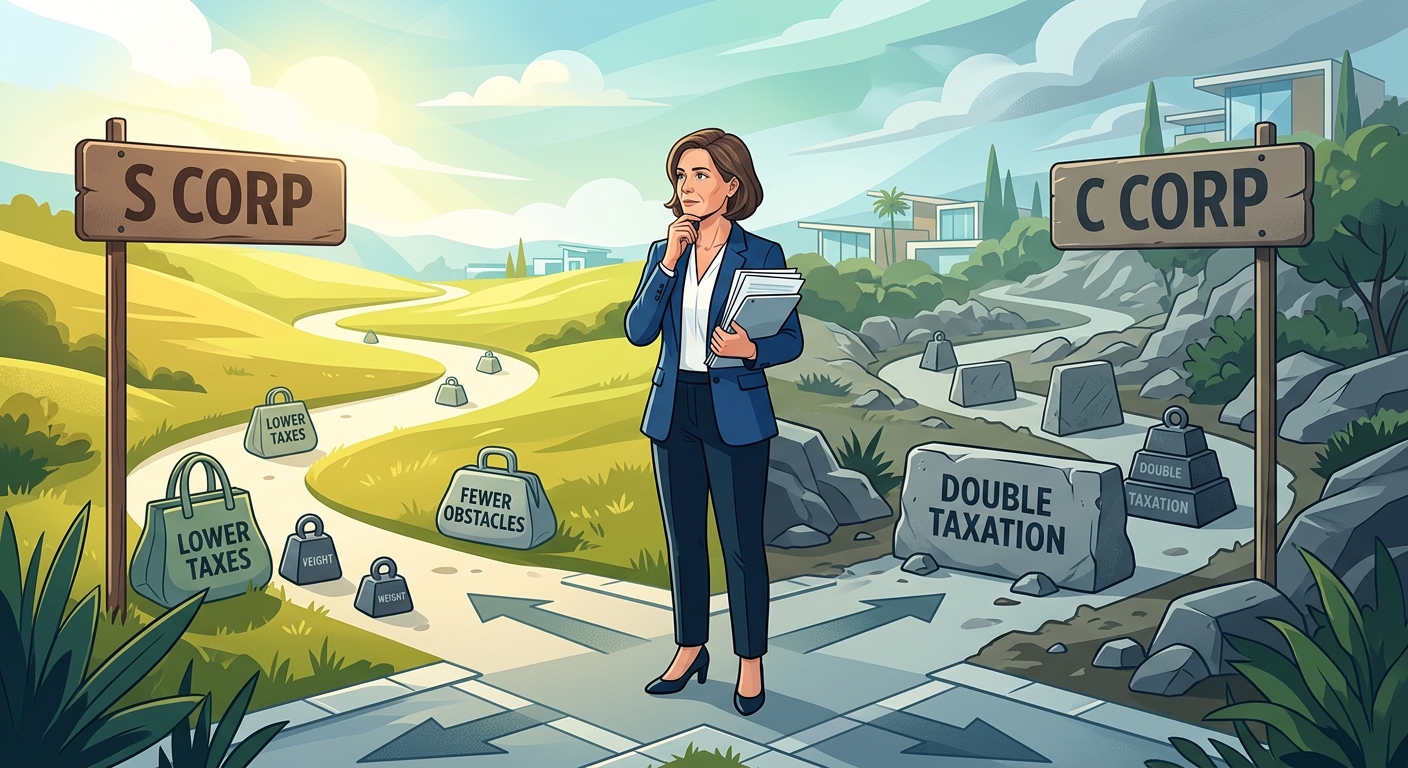
Here is the short version: An S Corp passes business profit directly to your personal return, where you pay tax once. A C Corp pays its own federal tax at 21%, and then you pay tax again when you take money out as dividends. In California, that double layer creates an effective tax rate above 46% on C Corp profits versus roughly 27% through an S Corp at $200,000 in profit. That gap is not theoretical. It is the difference between keeping $146,000 and keeping $105,400 on the same $200,000.
This information is current as of May 4, 2026. Tax laws change frequently. Verify updates with the IRS or FTB if reading this later.
The Five Tax Layers That Define What’s the Difference Between S-Corp and C-Corp
Most comparisons between S Corps and C Corps stop at the federal level. That is a mistake, especially in California. The real gap between these two structures shows up across five separate tax layers, and ignoring any one of them leads to the wrong entity choice.
Layer 1: Federal Entity-Level Tax
A C Corp pays a flat 21% federal income tax on its own profits under IRC Section 11. That means on $200,000 in profit, $42,000 goes to the IRS before you touch a dime. An S Corp pays zero entity-level federal tax. The profit flows through to your personal return on Schedule K-1, and you pay individual rates on it. At $200,000, that is $42,000 you never owe in the first place.
Layer 2: Federal Double Taxation on Dividends
After the C Corp pays its 21% tax, you still need to get the remaining $158,000 into your pocket. The IRS taxes those distributions again as qualified dividends at 15% to 20%, plus the 3.8% Net Investment Income Tax under IRC Section 1411. On $158,000 in dividends at the 15% rate plus NIIT, that is another $29,692 in federal tax. With an S Corp, there is no second layer. You already paid on the full amount once.
Layer 3: California Franchise Tax Rate Differential
California taxes C Corps at 8.84% of net income. On $200,000, that is $17,680 to the Franchise Tax Board. S Corps in California pay just 1.5% of net income, which comes to $3,000 on the same profit. That single layer creates a $14,680 state tax difference before you even factor in the personal income tax on the dividend side for C Corp shareholders.
Layer 4: QBI Deduction Exclusivity Under IRC 199A
The Qualified Business Income deduction under IRC Section 199A lets S Corp owners deduct up to 20% of their business income from their taxable income. On $200,000 in S Corp profit, that is a $40,000 deduction, saving roughly $8,800 to $14,800 depending on your marginal rate. The One Big Beautiful Bill Act made this deduction permanent. C Corp shareholders get zero QBI deduction. The law explicitly excludes C Corp income from eligibility.
Layer 5: AB 150 Pass-Through Entity Tax Election
California’s AB 150 allows S Corps (and other pass-through entities) to pay a 9.3% entity-level state tax and receive a dollar-for-dollar credit against the shareholders’ personal California income tax. This effectively bypasses the $40,000 SALT deduction cap under OBBBA. For many business owners earning over $150,000, this saves $3,000 to $8,000 annually. C Corps cannot use AB 150 because they are not pass-through entities.
When you stack all five layers, the S Corp advantage ranges from $17,600 at $100,000 in profit to $64,700 at $350,000 in profit for a typical California business owner.
Side-by-Side Tax Comparison: S Corp vs C Corp at Three Income Levels
Numbers cut through confusion faster than explanations. Here is what the difference between S-Corp and C-Corp actually costs at three common California business income levels.
| Tax Factor | $100K Profit | $200K Profit | $350K Profit |
|---|---|---|---|
| C Corp Federal Tax (21%) | $21,000 | $42,000 | $73,500 |
| C Corp CA Franchise Tax (8.84%) | $8,840 | $17,680 | $30,940 |
| C Corp Dividend Tax (15% + 3.8% NIIT) | $13,186 | $26,372 | $46,151 |
| C Corp Total Tax | $43,026 | $86,052 | $150,591 |
| S Corp Federal Individual Tax | $14,768 | $33,576 | $66,752 |
| S Corp CA Tax (1.5% + personal) | $8,408 | $16,816 | $24,448 |
| S Corp QBI Savings | -$2,200 | -$8,800 | -$14,800 |
| S Corp AB 150 SALT Bypass Savings | -$1,200 | -$3,400 | -$7,200 |
| S Corp Total Tax | $19,776 | $38,192 | $69,200 |
| Annual S Corp Advantage | $23,250 | $47,860 | $81,391 |
At $200,000 in profit, choosing the wrong entity structure costs nearly $4,000 every single month. Over five years, that is $239,300 in unnecessary taxes. If you want to see exactly how the math works at your specific income level, run your numbers through this small business tax calculator.
Five Costliest Mistakes California Owners Make When Choosing Between S Corp and C Corp
Understanding what’s the difference between s-corp and c-corp on paper is one thing. Avoiding the traps that destroy the advantage is another. These five mistakes cost California business owners tens of thousands of dollars every year.
Mistake 1: Believing the 21% C Corp Rate Is a Bargain
The 21% rate applies only at the entity level. Once you add state tax at 8.84% and dividend taxes at 18.8%, the effective rate on C Corp profits in California hits 46.9% or higher. The 21% is a marketing number, not your actual tax burden. Our entity formation team walks every client through the full five-layer picture before recommending any structure.
Mistake 2: Letting an Attorney Default You Into a C Corp
Many attorneys file C Corp articles of incorporation because it is the simplest default. They are not thinking about your tax liability, they are thinking about your legal structure. The IRS treats every corporation as a C Corp unless you actively file Form 2553 to elect S Corp status. If nobody files that form, you are stuck paying double taxation until you fix it.
Mistake 3: Missing the March 15 Form 2553 Deadline
IRS Form 2553 must be filed by March 15 of the tax year you want S Corp treatment to begin (or within 75 days of forming a new entity). Miss this deadline, and you wait an entire year. At $200,000 profit, that one missed deadline costs $47,860. Late election relief under Revenue Procedure 2013-30 exists, but it requires a valid reasonable cause statement and is not guaranteed.
Mistake 4: Setting an Unreasonable Salary
S Corp owners must pay themselves a “reasonable salary” before taking distributions. Pay too little, and the IRS reclassifies your distributions as wages, tacking on back payroll taxes, penalties, and interest. The landmark case Watson v. Commissioner (T.C. Memo 2012-167) established that the IRS will aggressively challenge salaries that are artificially low relative to services performed. Use the IRS nine-factor test from Revenue Ruling 59-221 to document your salary, and adjust it annually.
Mistake 5: Ignoring California Depreciation Nonconformity
California does not conform to federal bonus depreciation under R&TC Sections 17250 and 24356. If you claim 100% bonus depreciation on your federal S Corp return, you must maintain a separate California depreciation schedule. Many owners file one set of numbers for both, triggering FTB adjustments and penalties. This is not optional. Every S Corp in California needs dual depreciation tracking from day one.
Key Takeaway: The entity choice itself is only the first decision. How you implement the S Corp determines whether you capture the full tax savings or create new compliance risks.
Three Situations Where a C Corp Still Wins Over an S Corp
S Corps win for the vast majority of California small business owners. But there are three narrow scenarios where a C Corp delivers better results. Recognizing these prevents you from making the opposite mistake.
Scenario 1: Venture Capital Funding with Multiple Investor Classes
S Corps can only have one class of stock under IRC Section 1361(b)(1)(D). Venture capital deals almost always require preferred stock with different rights. If you plan to raise VC money, an S Corp election will disqualify you from most term sheets. Stay as a C Corp until after your funding rounds, then evaluate conversion if your cap table simplifies.
Scenario 2: QSBS Section 1202 Exclusion on Sale
Qualified Small Business Stock under IRC Section 1202 allows founders to exclude up to $10 million (or 10 times their basis) in capital gains when selling C Corp stock held for five or more years. At the federal level, that exclusion can eliminate $2 million or more in capital gains tax. However, California does not conform to QSBS under R&TC Section 18152.5, so state tax still applies. If your exit strategy involves selling your company for $5 million or more within 5 to 10 years, QSBS eligibility is worth preserving.
Scenario 3: Full Earnings Retention Below $250,000
If your business retains all its profits (paying no dividends) and net income stays below $250,000, the accumulated earnings tax under IRC Section 531 does not kick in. In this narrow window, the C Corp’s 21% flat rate plus 8.84% California rate totals 29.84%, which can be lower than the top individual rates an S Corp owner would pay on pass-through income. This works only if you never need to take the money out. The moment you withdraw it, double taxation returns.
For a deeper dive into every angle of S Corp tax strategy, see our comprehensive California S Corp tax guide.
OBBBA Permanent Changes That Widen the S Corp vs C Corp Gap in 2026
The One Big Beautiful Bill Act locked in several provisions that make the S Corp advantage larger and more permanent than ever. If you have been waiting to decide between entity types, these changes should accelerate your timeline.
Permanent QBI Deduction Under IRC 199A
Before OBBBA, the QBI deduction was scheduled to expire after 2025. Now it is permanent. Every dollar of qualified S Corp income gets a 20% deduction for as long as the law stands. At $200,000 in profit, that is $8,800 in annual savings that C Corp owners can never access. Over a 10-year business lifespan, permanent QBI means $88,000 in additional tax savings for S Corp owners compared to an identical C Corp.
Permanent 100% Bonus Depreciation Under IRC 168(k)
OBBBA restored and made permanent 100% first-year bonus depreciation on qualifying assets. For S Corps, this means you can write off the full cost of equipment, vehicles, and other qualifying property in the year of purchase. Remember, California does not conform, so you still need to use regular MACRS depreciation on your state return and track the difference with dual depreciation schedules.
Increased Section 179 Limit to $2,500,000
The Section 179 expensing limit is now $2,500,000 with a phase-out threshold of $4,270,000. Unlike bonus depreciation, Section 179 is recognized by California when properly elected. This gives S Corp owners a compliant path to accelerate deductions at both the federal and state level without creating nonconformity headaches.
$40,000 SALT Cap with AB 150 Bypass
OBBBA set the state and local tax deduction cap at $40,000 (up from $10,000 under TCJA). For S Corp owners, California’s AB 150 PTE election bypasses this cap entirely. The entity pays state tax and the shareholder gets a dollar-for-dollar credit. C Corp shareholders cannot use this strategy because C Corps are not pass-through entities.
$15 Million Estate Exemption with Stepped-Up Basis
The estate exemption is now $15 million per person, and stepped-up basis remains intact. S Corp shares passed to heirs receive a step-up in basis, potentially eliminating capital gains on decades of appreciation. C Corp shares also get stepped-up basis, but the underlying assets inside the corporation do not, creating phantom gain traps for heirs who sell corporate assets.
KDA Case Study: Digital Marketing Firm Owner Saves $43,200 After S Corp Election
Rachel, a solo digital marketing firm owner in Sacramento, had operated as a C Corp for three years on her attorney’s recommendation. Her annual profit was $225,000. She came to KDA after a friend mentioned she was overpaying on taxes.
When we ran her five-layer analysis, the numbers were clear. Her C Corp effective tax rate was 47.1%, meaning she was keeping only $119,025 of her $225,000 in profit. Under an S Corp structure, her effective rate would drop to 27.8%, letting her keep $162,225.
We filed Form 2553 under the late election relief provisions of Rev. Proc. 2013-30, submitted FTB Form 3560 to notify California, set her reasonable salary at $98,000 based on the IRS nine-factor analysis and local marketing director compensation benchmarks, activated AB 150 PTE for SALT cap bypass, opened a Solo 401(k) with a $23,500 employee deferral plus $24,500 employer contribution, and established dual depreciation schedules for her $28,000 in computer and video equipment.
Year one results: $43,200 saved. Her KDA engagement cost $5,800, producing a 7.4x first-year ROI. Over five years, the projected savings total $216,000, assuming stable profit levels and no further tax law changes.
Rachel’s biggest regret was not making the switch sooner. Every year she operated as a C Corp, she was losing roughly $3,600 per month to unnecessary double taxation.
Ready to see how we can help you? Explore more success stories on our case studies page to discover proven strategies that have saved our clients thousands in taxes.
Eight Steps to Convert from C Corp to S Corp in California
If you have decided the S Corp structure fits your situation, here is the exact process to make the switch. Do not skip any step.
- Verify IRC 1361(b) Eligibility: Confirm your corporation has 100 or fewer shareholders, only eligible shareholders (individuals, certain trusts, estates), one class of stock, and is a domestic corporation. If any condition fails, you cannot elect S Corp status.
- Evaluate Built-In Gains Tax Under IRC 1374: If your C Corp holds appreciated assets, those gains may be subject to a Built-In Gains tax at 21% if sold within five years of converting. Get a professional appraisal of all assets before filing. You can hold appreciated assets through the five-year recognition period to avoid BIG tax entirely.
- Clean Up Accumulated Earnings and Profits (AE&P): C Corps carry AE&P under IRC Section 312. After converting, AE&P creates a contamination risk under IRC 1368(c). If your S Corp earns more than 25% of gross receipts from passive investment income while carrying AE&P, your S Corp status can be terminated under IRC 1362(d)(3). Distribute AE&P before or immediately after conversion.
- File IRS Form 2553 by March 15: This is the S Corp election form. All shareholders must sign. File by March 15 for the current tax year, or within 75 days of a new entity’s formation. Keep a copy of the IRS acceptance letter.
- File FTB Form 3560 with California: California requires its own S Corp election notification. This is a separate filing from the IRS form. Missing it means California does not recognize your S Corp status, and you continue paying the 8.84% C Corp rate at the state level.
- Set Up Reasonable Salary and Payroll: Register with the California Employment Development Department (EDD). Set your salary using the IRS nine-factor test. File quarterly Form 941 with the IRS and DE 9 with EDD. Include California SDI at 1.1% and Employment Training Tax in your payroll calculations.
- Activate AB 150 PTE Election: File the AB 150 pass-through entity tax election to bypass the $40,000 SALT cap. The S Corp pays 9.3% at the entity level, and you receive a dollar-for-dollar credit on your personal California return. This must be elected annually.
- Establish Dual Depreciation Schedules: Set up separate federal and California depreciation records for all assets. Federal allows 100% bonus depreciation. California requires regular MACRS schedules. Track the difference on California Form 3885A.
Pro Tip: If you missed the March 15 deadline, you may still qualify for late election relief under Rev. Proc. 2013-30. The IRS grants relief when the failure was due to reasonable cause, the entity intended to be treated as an S Corp, and the request is filed within 3 years and 75 days of the intended effective date.
IRS Enforcement: What Palantir SNAP AI Flags on S Corp and C Corp Returns
The IRS now uses Palantir’s SNAP AI system to cross-reference entity filings in ways that were impossible five years ago. Here is what triggers scrutiny for both entity types.
S Corp Red Flags
- Salary-to-Distribution Ratio Below 40%: If your W-2 salary is less than 40% of your total S Corp compensation (salary plus distributions), SNAP AI flags the return for potential unreasonable salary.
- Missing or Late Form 941 Filings: Quarterly payroll tax returns that do not match W-2 and Form 1120-S officer compensation trigger automatic review.
- Form 7203 Basis Tracking Gaps: Shareholders must track their stock and debt basis on Form 7203. Missing forms create audit triggers, especially when claiming losses or receiving distributions.
C Corp Red Flags
- Excessive Officer Compensation: If W-2 compensation exceeds industry benchmarks significantly, the IRS may reclassify the excess as a constructive dividend, adding double taxation.
- Personal Expenses Through the Entity: SNAP AI cross-references corporate deductions against officer personal assets. Travel, vehicles, and entertainment that appear personal trigger automatic notices.
- Retained Earnings Approaching $250,000: The accumulated earnings tax under IRC Section 531 applies when a C Corp retains earnings beyond reasonable business needs. SNAP AI monitors balance sheet changes year over year.
Key Takeaway: Both S Corps and C Corps face IRS scrutiny. The difference is that S Corp compliance issues are generally fixable (adjust salary, file missing forms), while C Corp structural disadvantages like double taxation are baked into the entity type itself.
What If You Are Currently an LLC? Choosing Between S Corp and C Corp Election
If you operate as a default LLC, you are currently paying self-employment tax on your entire net income, which is 15.3% on the first $168,600 (2026 threshold) and 2.9% plus 0.9% Additional Medicare Tax above that. That creates a massive tax burden that both S Corp and C Corp elections can reduce, but in very different ways.
An LLC electing S Corp status files Form 2553 directly. There is no need to dissolve and reform. Your EIN stays the same. You start running payroll on a reasonable salary and take the rest as distributions, which are exempt from self-employment tax. At $200,000 profit with a $95,000 salary, you save approximately $9,815 in payroll taxes compared to default LLC status, plus you gain QBI deduction access and AB 150 eligibility.
An LLC electing C Corp status files Form 8832 to change its tax classification. This creates the double taxation structure described throughout this article. Unless you specifically need VC-compatible stock classes, QSBS eligibility, or full retention below $250,000, there is no tax advantage to electing C Corp treatment over S Corp treatment for a California LLC.
The minimum income threshold where S Corp election starts making financial sense for an LLC is generally $60,000 to $75,000 in annual net profit. Below that level, the payroll administration costs and additional compliance requirements may outweigh the tax savings.
Ready to Reduce Your Tax Bill?
KDA Inc. specializes in strategic tax planning for business owners, S Corps, LLCs, and high-net-worth individuals. Book a personalized consultation and walk away with a clear plan.
Frequently Asked Questions
Can I Switch from S Corp to C Corp and Back Again?
You can revoke your S Corp election and revert to C Corp status at any time. However, IRC Section 1362(g) imposes a five-year lockout. Once you revoke, you cannot re-elect S Corp status for five tax years without IRS consent. At $200,000 profit, five years as a C Corp costs $239,300 more than S Corp status. Do not revoke unless you are absolutely certain.
Does My Business Need a New EIN After Converting?
No. Converting from C Corp to S Corp (or electing S Corp treatment for an LLC) does not change your EIN. You keep the same employer identification number, bank accounts, and contracts. The change is purely a tax classification change, not a new entity formation.
What Is the Minimum Income Where an S Corp Makes Sense?
For most California business owners, the break-even point is around $60,000 to $75,000 in annual net profit. Below that threshold, the payroll costs, additional compliance, and tax preparation fees can offset the tax savings. Above $75,000, the S Corp advantage grows rapidly.
Does California Tax S Corps and C Corps Differently?
Yes. California taxes C Corps at 8.84% of net income and S Corps at 1.5% of net income. Both owe a minimum $800 franchise tax under R&TC Section 17941. The difference at $200,000 profit is $14,680 in state tax alone, before considering the AB 150 PTE election benefits available only to S Corps.
Is the QBI Deduction Really Permanent Now?
Yes. The One Big Beautiful Bill Act made the IRC Section 199A QBI deduction permanent. It no longer has a sunset date. S Corp owners can plan around this deduction for the foreseeable future. C Corp income remains excluded from QBI eligibility permanently as well.
What Happens If the IRS Rejects My Form 2553?
The most common rejection reason is missing shareholder signatures. The IRS will send a notice explaining the deficiency. You typically have 60 days to correct and resubmit. If you filed on time and the rejection is due to a correctable error, your effective date is preserved. If the rejection stands, you remain a C Corp for the entire tax year and must wait until the next filing window.
The Real Cost of Waiting to Choose the Right Entity
Every month you operate under the wrong entity structure, you lose money you cannot recover. There is no amended return that gives back years of double taxation. There is no retroactive S Corp election that reaches back three or four years.
At $200,000 in annual profit, the wrong choice costs approximately $3,988 per month. Over just 18 months of delay, that is $71,784 gone permanently. The consultation to fix this takes less than an hour. The Form 2553 takes less than a day to prepare. The payoff lasts for the entire remaining life of your business.
“The IRS does not punish you for choosing the right entity structure. It punishes you for never making the choice at all.”
Book Your S Corp vs C Corp Strategy Session
If you are running a California business through a C Corp and wondering whether you are overpaying, the answer is almost certainly yes. If you are an LLC owner who has never evaluated S Corp election, you are leaving five layers of tax savings unclaimed. Stop guessing and get a personalized five-layer analysis that shows your exact savings at your income level. Click here to book your consultation now.



