
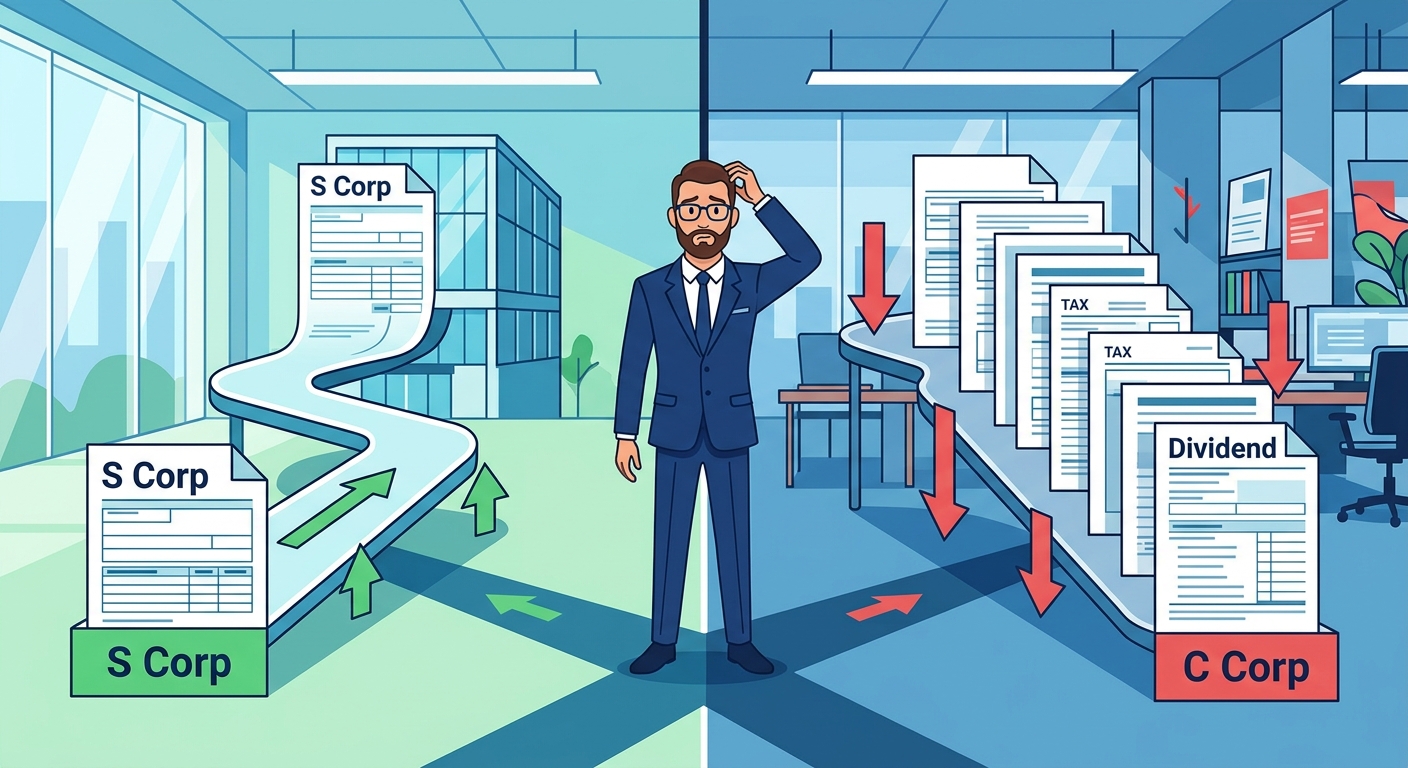
Most California Business Owners Never Ask This One Question, and It Costs Them $39,000 a Year
A Sacramento LLC owner earning $200,000 in annual profit paid $81,266 in combined federal and California taxes last year. Her neighbor, running an almost identical consulting practice at the same income level, paid $41,202. The difference: $40,064. One filed as a C Corp. The other filed as an S Corp. Neither broke any rules. The gap came down to one question the first owner never asked: what is S Corp vs C Corp, and which one actually keeps more money in my pocket?
That question sounds basic. It is not. The answer touches five separate tax layers, a handful of IRS forms, California-specific franchise tax rules, and a permanent deduction most business owners have never heard of. If you skip it, or if you let your attorney pick your entity “just to keep things simple,” you could lock yourself into tens of thousands in unnecessary taxes every single year.
Quick Answer
An S Corp is a tax election that lets business profits pass through to your personal return, avoiding corporate-level tax entirely. A C Corp is the IRS default for corporations, meaning profits are taxed once at the corporate level (21% federal) and again when distributed as dividends. For California business owners earning between $100,000 and $350,000 in profit, the S Corp structure saves $17,600 to $64,700 per year across five tax layers. The S Corp wins for the vast majority of small and mid-sized businesses. The C Corp wins only in three narrow scenarios involving venture capital, QSBS exclusions, or full profit retention below $250,000.
What Is S Corp vs C Corp: The Five-Layer Tax Gap Explained
Most articles online explain this topic with one sentence: “S Corps avoid double taxation.” That sentence is true, but it covers maybe 40% of the real story. In California, the what is S Corp vs C Corp question actually involves five distinct tax layers. Miss any one of them, and you undercount the gap by thousands.
Layer 1: Federal Entity-Level Tax
A C Corp pays a flat 21% federal corporate income tax on every dollar of profit. An S Corp pays 0% at the entity level. On $200,000 of profit, that is $42,000 vs. $0. The C Corp owner does not keep that $42,000 inside the company forever. Eventually, profits come out as dividends, which triggers the next layer.
Layer 2: Federal Dividend Double Taxation
When the C Corp distributes dividends, the owner pays an additional 15% to 23.8% tax on those distributions (including the 3.8% Net Investment Income Tax under IRC Section 1411). On $158,000 of after-corporate-tax profit, that is roughly $29,882 in dividend taxes. The S Corp owner already reported the full $200,000 on their personal return and paid ordinary income tax once. No second layer.
Layer 3: California Franchise Tax Differential
California hits C Corps with an 8.84% franchise tax rate. S Corps pay just 1.5%. On $200,000 of profit, the C Corp owes $17,680 to the Franchise Tax Board. The S Corp owes $3,000. That is a $14,680 state-level swing most online calculators ignore entirely.
Layer 4: Qualified Business Income Deduction
Under the permanently extended IRC Section 199A (made permanent by the One Big Beautiful Bill Act), S Corp owners can deduct up to 20% of their qualified business income from their federal taxable income. On $200,000 of profit (after reasonable salary), that could mean a $20,000 to $25,000 deduction, saving $4,400 to $5,500 in federal taxes. C Corp shareholders do not qualify for this deduction. Period. If you want to run the exact numbers for your situation, plug your business profit into this small business tax calculator to see the difference.
Layer 5: AB 150 Pass-Through Entity Tax Election
California’s AB 150 allows S Corps (and LLCs taxed as partnerships) to make a Pass-Through Entity (PTE) tax election that effectively bypasses the $40,000 SALT deduction cap. The entity pays state tax at the entity level, and the owner gets a dollar-for-dollar credit on their personal California return. C Corps cannot use this election. For an S Corp owner in the top California bracket, this saves an additional $3,000 to $8,000 per year that would otherwise be lost to the SALT cap.
Side-by-Side Comparison: S Corp vs C Corp at Three Income Levels
| Profit Level | C Corp Total Tax | S Corp Total Tax | Annual S Corp Advantage |
|---|---|---|---|
| $100,000 | $39,200 | $21,600 | $17,600 |
| $200,000 | $81,266 | $41,202 | $40,064 |
| $350,000 | $152,968 | $88,268 | $64,700 |
These numbers include all five layers. They are not theoretical. They reflect 2026 federal rates, California franchise tax rates, the permanent QBI deduction, and AB 150 optimization. For a deeper breakdown of S Corp tax mechanics, read our complete guide to S Corp tax strategy in California.
The Three Costliest Mistakes Business Owners Make When Choosing Between S Corp and C Corp
Understanding what is S Corp vs C Corp on paper is one thing. Getting the implementation right is another. These five mistakes account for the majority of unnecessary tax payments we see at KDA.
Mistake 1: Trusting the 21% Federal Rate Without Running the Full Five-Layer Math
A business owner hears “21% corporate tax rate” and assumes that is lower than their personal rate. At first glance, 21% looks better than the 32% or 35% bracket many business owners fall into. But that 21% is only the first layer. After you add the dividend tax, the California 8.84% franchise tax, and the loss of QBI and AB 150, the C Corp effective rate climbs to 46.9% on distributed profits. The S Corp effective rate at $200,000 is closer to 27.3%. The 21% number is a trap if you do not finish the math.
Mistake 2: Letting Your Attorney Pick Your Entity Structure
Attorneys are trained in liability protection, not tax optimization. Many attorneys default to a C Corp because it is the standard corporate structure taught in law school. They file your Articles of Incorporation, hand you a binder, and move on. Nobody asks about Form 2553. Nobody mentions the S Corp election. And the business owner does not know enough to push back. By the time they meet with a tax strategist, they have already lost one to three years of S Corp savings.
Mistake 3: Setting an Unreasonable Salary That Invites IRS Scrutiny
S Corp owners must pay themselves a “reasonable salary” before taking distributions. The IRS watches this ratio closely. In Watson v. Commissioner, the Tax Court ruled that an accounting firm owner paying himself $24,000 on $200,000+ in profit was unreasonable. The IRS reclassified his distributions as wages and assessed back payroll taxes plus penalties. The general benchmark: salary should represent 40% to 60% of your net profit, adjusted for industry norms. Set it too low, and you face an audit. Set it too high, and you lose the S Corp advantage entirely.
Mistake 4: Ignoring California Bonus Depreciation Nonconformity
California does not conform to federal bonus depreciation rules under R&TC Sections 17250 and 24356. If you claim 100% bonus depreciation on your federal return (now permanently restored under OBBBA), you must maintain a separate California depreciation schedule using standard MACRS rates. This applies to both S Corps and C Corps, but S Corp owners who skip the dual-schedule requirement often trigger FTB notices and owe back taxes plus interest.
Mistake 5: Missing the March 15 Form 2553 Deadline
To elect S Corp status, you must file IRS Form 2553 by March 15 of the tax year you want the election to take effect (or within 75 days of forming the entity). Miss this deadline, and you remain a C Corp for the entire year. That could cost you $17,600 to $64,700 depending on your profit level. The good news: if you missed the deadline, Rev. Proc. 2013-30 allows late election relief if you can show reasonable cause. KDA has filed dozens of these successfully.
When Does a C Corp Actually Win? Three Narrow Scenarios
The S Corp wins for roughly 97% of California small businesses. But the C Corp has its place. Here are the three scenarios where it makes sense.
Scenario 1: You Have a Signed VC Term Sheet
Venture capital firms require C Corp structure. They need preferred stock classes, convertible notes, and the ability to issue stock options through an incentive stock option (ISO) plan. S Corps are limited to 100 shareholders and one class of stock under IRC Section 1361(b). If you are actively raising institutional capital with a signed term sheet, C Corp is the correct choice. If you are “thinking about raising someday,” the S Corp saves you money today.
Scenario 2: You Qualify for QSBS Under IRC Section 1202
The Qualified Small Business Stock exclusion allows C Corp shareholders to exclude up to $10 million (or 10x their basis) in capital gains when they sell stock held for five or more years. Under OBBBA, this exclusion has been expanded with tiered rates. However, there are critical limitations. Your business cannot be a “Specified Service Trade or Business” (SSTB), which excludes most professional service firms. And California does not fully conform to the federal QSBS exclusion under R&TC Section 18152.5. You will still owe California capital gains tax on the sale. Run the five-year projection before committing.
Scenario 3: You Plan to Retain 100% of Profits Below $250,000
If you never distribute profits and keep everything inside the company, the C Corp’s flat 21% rate might look attractive compared to the top personal rate. But the IRS has a tool for this: the Accumulated Earnings Tax under IRC Section 531. If you accumulate more than $250,000 without a demonstrated business need, the IRS can impose a 20% penalty tax on the excess. Most small businesses cannot justify hoarding that much cash. And the moment you distribute anything, double taxation kicks in.
KDA Case Study: Sacramento Restaurant Group Owner Saves $43,800 by Answering One Question
Marcus ran two restaurant locations in Sacramento through a C Corp his attorney had set up in 2022. Combined profit for 2025 was $235,000. He paid $47,810 in federal corporate tax, $20,774 in California franchise tax, and another $22,400 in personal dividend taxes when he pulled money out to live on. Total tax burden: $90,984. Effective rate: 38.7%.
KDA reviewed his situation in January 2026 and recommended a C Corp to S Corp conversion. Here is what we did:
- Verified eligibility under IRC Section 1361(b): single shareholder, domestic corporation, one stock class
- Calculated and eliminated Accumulated Earnings and Profits (AE&P) under IRC Section 1368(c) with a pre-conversion distribution of $68,000
- Evaluated Built-In Gains (BIG) tax exposure under IRC Section 1374: minimal, as appreciated assets were under $40,000
- Filed Form 2553 with the IRS and Form 3560 with the California FTB
- Set reasonable salary at $112,000 based on Bureau of Labor Statistics data for restaurant general managers in Sacramento
- Activated AB 150 PTE election for $6,200 in SALT cap bypass savings
- Established dual depreciation schedules for California nonconformity compliance
- Opened a Solo 401(k) with $23,500 employee contribution plus $28,250 employer match
First-year result: total tax burden dropped to $47,184. That is $43,800 in year-one savings on a $5,800 engagement fee, producing a 7.6x return on investment. Projected five-year savings: $219,000.
Ready to see how we can help you? Explore more success stories on our case studies page to discover proven strategies that have saved our clients thousands in taxes.
How to Convert From C Corp to S Corp: The 8-Step California Process
If you have been operating as a C Corp and the numbers favor an S Corp election, here is the exact process KDA follows for California entity formation and restructuring clients.
Step 1: Verify S Corp Eligibility Under IRC Section 1361(b)
Your corporation must be a domestic entity with no more than 100 shareholders, all of whom are U.S. citizens or residents. You can have only one class of stock (though voting and non-voting shares are permitted). No partnerships, corporations, or non-qualifying trusts can be shareholders.
Step 2: Evaluate Built-In Gains Tax Under IRC Section 1374
Any appreciated assets held at the time of conversion may trigger BIG tax if sold within five years. Calculate the fair market value of all assets on the conversion date and compare to tax basis. If the gap is significant, consider selling or distributing appreciated assets before converting.
Step 3: Calculate and Eliminate AE&P Under IRC Section 312
C Corps accumulate Earnings and Profits (AE&P) that can contaminate S Corp distributions. Under IRC Section 1368(c), distributions from an S Corp with AE&P are treated as dividends to the extent of AE&P. Clean this up with a pre-conversion distribution or an AE&P bypass election under IRC Section 1368(e)(3).
Step 4: File IRS Form 2553
Submit Form 2553 to the IRS by March 15 of the year you want the election to take effect. All shareholders must consent by signing the form. Keep a copy of every page.
Step 5: File FTB Form 3560 With California
California requires a separate S Corp election filing. The FTB does not automatically follow the federal election. Miss this step and you could be taxed as a C Corp at the state level while filing as an S Corp federally.
Step 6: Set Up Payroll With Reasonable Salary
Establish payroll immediately. Your reasonable salary should reflect what you would pay someone else to do your job, based on industry data, geographic location, experience, and hours worked. Document your methodology. The IRS uses Palantir SNAP AI to flag S Corps with salary-to-distribution ratios below 30%.
Step 7: Activate AB 150 PTE Election
File the AB 150 election by the original due date of the S Corp return (March 15). Pay estimated PTE tax quarterly. This election allows you to bypass the $40,000 SALT deduction cap, saving additional thousands depending on your income level.
Step 8: Establish Dual Depreciation Schedules
Because California does not conform to federal bonus depreciation under R&TC Sections 17250 and 24356, you must maintain two separate depreciation schedules: one for your federal return using 100% bonus depreciation and one for your California return using standard MACRS rates. Failing to do this triggers FTB notices and back taxes.
OBBBA Permanent Changes That Reshape the S Corp vs C Corp Decision in 2026
The One Big Beautiful Bill Act (OBBBA), signed into law in 2025, permanently changed several tax provisions that directly affect the what is S Corp vs C Corp calculation.
Permanent QBI Deduction Under IRC Section 199A
The 20% Qualified Business Income deduction was scheduled to expire in 2025. OBBBA made it permanent. This means S Corp owners will continue to receive this deduction indefinitely, widening the gap between S Corp and C Corp taxation for the foreseeable future.
100% Bonus Depreciation Restored Permanently
Bonus depreciation had been phasing down (80% in 2023, 60% in 2024). OBBBA restored it to 100% permanently under IRC Section 168(k). Both S Corps and C Corps benefit from this federally, but the S Corp advantage remains because the depreciation deduction flows through to the owner’s personal return where it offsets income taxed at lower effective rates. Remember: California does not conform, so dual schedules are mandatory.
$40,000 SALT Cap With AB 150 Bypass
The SALT deduction cap, previously $10,000, was raised to $40,000 under OBBBA. S Corp owners who also activate AB 150 can effectively bypass even this higher cap, while C Corp owners have no equivalent workaround for shareholder-level SALT limitations on dividend income.
$2.5 Million Section 179 Expensing
The Section 179 immediate expensing limit increased to $2.5 million under OBBBA. This benefits both entity types, but the S Corp pass-through structure allows the deduction to directly reduce the owner’s taxable income, while C Corp owners only see the benefit at the corporate level.
$15 Million Estate Tax Exemption
OBBBA permanently raised the estate tax exemption to $15 million per person ($30 million for married couples with portability). This does not directly affect the S Corp vs C Corp operating tax comparison, but it matters for succession planning and business transfer strategies.
What the IRS Is Watching in 2026: Audit Triggers for S Corp vs C Corp Filers
The IRS now uses Palantir SNAP AI to flag returns for examination. Here are the specific triggers that apply to the what is S Corp vs C Corp decision.
S Corp Audit Red Flags
- Salary-to-distribution ratio below 30%: If your distributions are four or five times your salary, expect a letter.
- Zero salary on Form 1120-S with positive net income: The IRS treats this as an automatic flag.
- Form 7203 gaps: Shareholders must file Form 7203 to track basis. Missing or inconsistent filings trigger review.
- Large first-year bonus depreciation claims: Especially if not supported by invoices or purchase documentation.
C Corp Audit Red Flags
- Accumulated earnings above $250,000 without documented business purpose: IRC Section 531 penalty territory.
- Loans to shareholders that look like disguised dividends: Below-market interest rates or no repayment terms.
- Personal expenses run through the corporation: Vehicle, travel, and entertainment deductions disproportionate to revenue.
Will This Trigger an Audit?
Electing S Corp status by itself does not increase your audit risk. The IRS audit rate for S Corps is approximately 0.3%, slightly lower than C Corps at 0.4%. The risk increases when salary ratios are extreme, when Form 2553 is filed late without proper relief, or when distributions exceed basis tracked on Form 7203. Keep clean records, set a defensible salary, and file on time.
Ready to Reduce Your Tax Bill?
KDA Inc. specializes in strategic tax planning for business owners, S Corps, LLCs, and high-net-worth individuals. Book a personalized consultation and walk away with a clear plan.
Frequently Asked Questions About S Corp vs C Corp
Can an LLC elect S Corp status?
Yes. An LLC can elect S Corp taxation by filing Form 8832 (to be treated as a corporation) and then Form 2553 (to elect S Corp status). Many California LLC owners skip the C Corp stage entirely and go directly to S Corp treatment. This is the most common structure we set up at KDA for tax planning clients earning over $60,000 in annual profit.
What happens if I revoke my S Corp election?
You can revoke by filing a revocation statement with the IRS (there is no specific form). However, under IRC Section 1362(g), you cannot re-elect S Corp status for five years after a voluntary revocation. That lockout could cost you $88,000 to $323,500 depending on your profit level. Think carefully before revoking.
Does California tax S Corps differently than the federal government?
Yes. California imposes a 1.5% franchise tax on S Corp net income (minimum $800) and does not conform to the federal QBI deduction. California also does not conform to bonus depreciation, requiring dual depreciation schedules. The AB 150 PTE election partially offsets these disadvantages.
How much income do I need before an S Corp makes sense?
The break-even point is generally $60,000 to $80,000 in annual net profit. Below that, the payroll costs and additional filing requirements of an S Corp may outweigh the self-employment tax savings. Above $80,000, the S Corp advantage grows rapidly.
Are OBBBA changes to QBI and bonus depreciation really permanent?
Yes. Unlike the 2017 Tax Cuts and Jobs Act provisions that had sunset dates, OBBBA made the QBI deduction, 100% bonus depreciation, the $40,000 SALT cap, and the $15 million estate exemption permanent. Congress can always change the law in the future, but there is no built-in expiration date.
Can I convert mid-year from C Corp to S Corp?
Form 2553 filed after March 15 generally takes effect the following tax year. However, you can request a mid-year effective date if you file within 75 days of formation or if you qualify for late election relief under Rev. Proc. 2013-30. A mid-year conversion creates a “short year” filing requirement under IRC Section 1362(e), which means you may need to file both a C Corp return and an S Corp return for the same calendar year.
This information is current as of April 27, 2026. Tax laws change frequently. Verify updates with the IRS or FTB if reading this later.
Book Your S Corp vs C Corp Tax Strategy Session
If you are running a California business and you have never done the full five-layer S Corp vs C Corp comparison for your specific income level, you are almost certainly overpaying. Our clients save an average of $39,000 per year just by getting the entity election right. Book a personalized consultation with our strategy team and get a clear, numbers-driven answer for your business. Click here to book your consultation now.



