
Vermont residents are facing one of the most complex tax filing seasons in recent memory. While **Vermont income tax rates 2026** remain progressive, new federal deductions from the One Big Beautiful Bill Act (OBBBA) are creating confusion about what applies at the state level and what doesn’t. The result? Thousands of Vermont taxpayers are either overpaying or missing legitimate savings because they don’t understand how state and federal rules interact.
If you’re filing taxes in Vermont this year, you need to know exactly how the 2026 brackets work, which new federal deductions Vermont honors, and where the state diverges from federal treatment. This guide breaks down everything you need to file correctly and keep more of your money.
Quick Answer: Vermont Income Tax Rates 2026
Vermont income tax rates 2026 use a progressive bracket system with rates ranging from 3.35% to 8.75% depending on your income level. The standard deduction is $12,500 for single filers and $25,000 for joint filers. Vermont residents must file a state return if their gross income exceeds $10,000 (single) or $20,000 (joint). While Vermont conforms to many federal tax rules, it does not automatically adopt all new OBBBA deductions, creating critical compliance gaps you must navigate.
Vermont’s 2026 Tax Bracket Structure
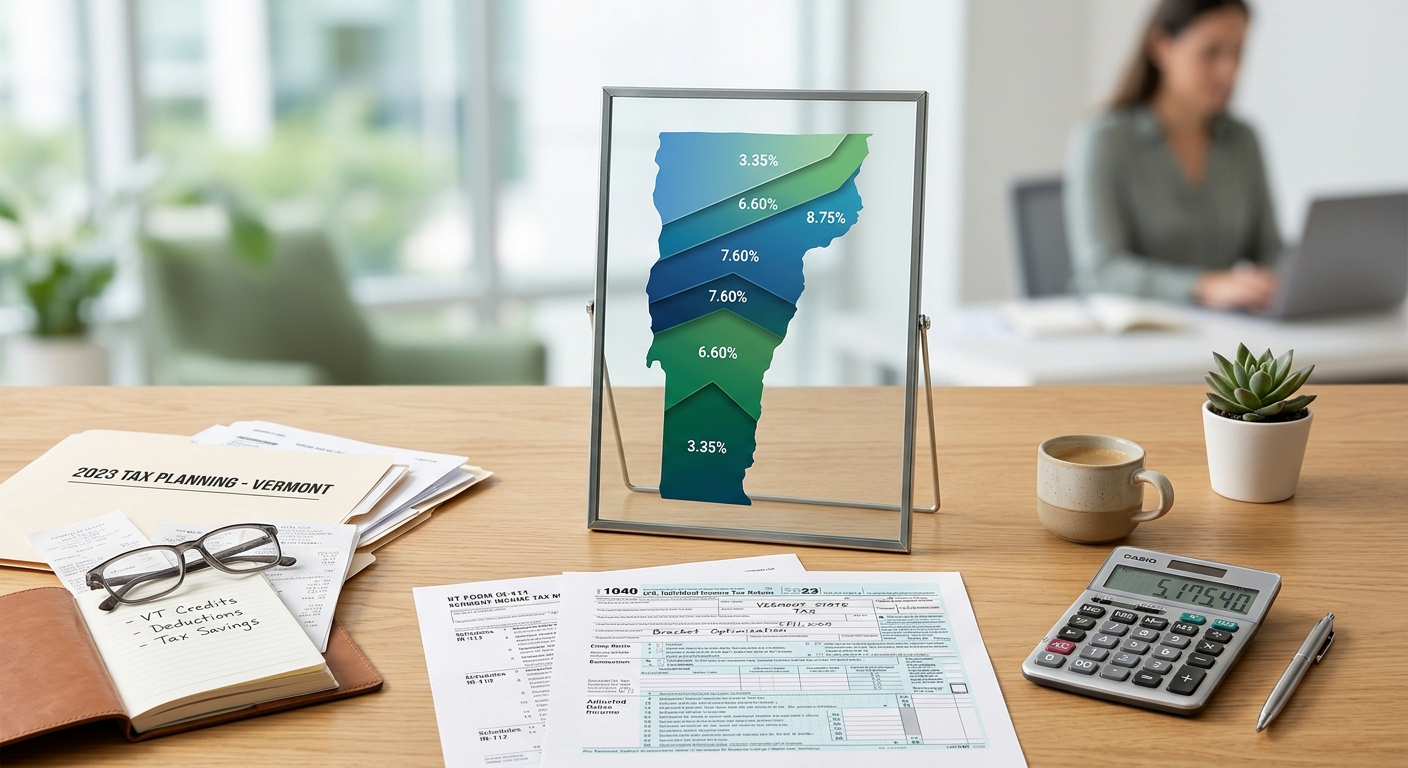
Vermont uses a five-tier progressive income tax system for 2026. Unlike flat-tax states, your effective tax rate depends on where your income falls across multiple brackets.
2026 Vermont Tax Brackets (Single Filers)
- 3.35% on taxable income up to $42,150
- 6.60% on income between $42,151 and $102,200
- 7.60% on income between $102,201 and $213,150
- 8.75% on income over $213,150
2026 Vermont Tax Brackets (Married Filing Jointly)
- 3.35% on taxable income up to $70,450
- 6.60% on income between $70,451 and $170,050
- 7.60% on income between $170,051 and $259,500
- 8.75% on income over $259,500
Key Takeaway: Vermont’s top marginal rate of 8.75% kicks in at relatively modest income levels compared to states like California. A married couple earning $275,000 will pay the top rate on only $15,500 of their income, not the entire amount.
Standard Deduction and Filing Requirements
Vermont’s standard deduction for 2026 mirrors the federal amounts, which simplifies planning for most taxpayers.
2026 Vermont Standard Deduction Amounts
- Single filers: $12,500
- Married filing jointly: $25,000
- Married filing separately: $12,500
- Head of household: $18,750
Who Must File a Vermont Tax Return?
You must file a Vermont income tax return for 2026 if you are a Vermont resident and your gross income exceeds:
- $10,000 for single filers
- $20,000 for married filing jointly
- Any amount if you owe Vermont income tax after credits
Part-year residents and non-residents with Vermont-source income also have filing obligations based on their Vermont-sourced earnings.
Pro Tip: Even if you’re below the filing threshold, file anyway if you had Vermont tax withheld from your paycheck. You might be entitled to a refund.
How Vermont Treats New 2026 Federal Deductions
The One Big Beautiful Bill Act created several new federal deductions for 2026, but Vermont’s conformity rules mean not all of them reduce your Vermont tax bill. Here’s what Vermont does and doesn’t honor.
Federal Deductions Vermont Does NOT Automatically Adopt
No Tax on Tips (Federal): The federal government now excludes qualified tips from taxable income. Vermont has not passed conforming legislation, which means tips that are tax-free federally may still be taxable on your Vermont return. If you received $8,000 in tips that were excluded federally, you may owe Vermont tax on that full amount at your marginal rate.
No Tax on Overtime (Federal): Federal law now allows up to $12,500 ($25,000 joint) of overtime pay to be deducted. Vermont does not conform to this deduction. If you claimed a $10,000 overtime deduction federally, add it back on your Vermont return. At Vermont’s 6.60% bracket, that’s an extra $660 in Vermont tax.
Car Loan Interest Deduction (Federal): The new federal deduction for up to $10,000 in vehicle loan interest (for U.S.-assembled vehicles purchased after 2024) is not recognized by Vermont. If you deducted $7,500 federally, expect to add it back for Vermont purposes.
Federal Provisions Vermont DOES Honor
Senior Deduction: Vermont allows the new federal additional deduction for taxpayers age 65 and older. Single filers get an additional $6,000 deduction, and married couples filing jointly receive $12,000 if both spouses qualify. This directly reduces Vermont taxable income.
SALT Cap Increase: Vermont conforms to the federal increase in the state and local tax (SALT) deduction cap from $10,000 to $40,000 for taxpayers with modified adjusted gross income under $500,000. This benefits Vermont homeowners with high property taxes who itemize.
Retirement Contribution Limits: Vermont follows federal rules for 401(k), IRA, and HSA contribution limits, including the new catch-up contribution amounts for ages 60-63 ($11,250 for 401(k) plans).
Navigating these state-federal differences is where most Vermont taxpayers leave money on the table or make costly errors. If you need help ensuring your Vermont return reflects the correct treatment of these new deductions, explore our tax planning services designed for multi-state compliance.
KDA Case Study: Vermont Small Business Owner
Client Profile: Sarah M., a self-employed graphic designer in Burlington, Vermont, earned $95,000 in net self-employment income in 2025. She worked significant overtime hours on client projects and received $18,000 in what she classified as “overtime” income.
The Problem: Sarah’s tax software automatically applied the new federal overtime deduction of $12,500, reducing her federal taxable income to $82,500. She assumed Vermont would honor the same deduction and didn’t add it back on her state return.
What KDA Did: We identified the Vermont non-conformity issue during a pre-filing review. We recalculated her Vermont tax liability by adding back the $12,500 overtime deduction, which increased her Vermont taxable income to $95,000. We also maximized her SEP IRA contribution (25% of net self-employment income, up to $23,750), which reduced both federal and Vermont taxable income. Finally, we identified $4,200 in overlooked business expenses that further reduced her tax base.
The Result: Instead of facing a $825 Vermont tax underpayment penalty (plus interest), Sarah paid the correct amount upfront. The SEP IRA contribution and recovered deductions saved her $6,100 in combined federal and state taxes. She paid us $1,800 for tax prep and planning.
First-Year ROI: 3.4x return on investment, plus she avoided IRS and Vermont Department of Taxes notices.
Ready to see how we can help you? Explore more success stories on our case studies page to discover proven strategies that have saved our clients thousands in taxes.
Vermont Tax Credits Worth Claiming
Vermont offers several state-specific tax credits that can directly reduce your tax bill. Unlike deductions, which reduce taxable income, credits reduce the tax you owe dollar-for-dollar.
Earned Income Tax Credit (EITC)
Vermont’s EITC is 37% of the federal credit. If you qualified for a $3,000 federal EITC, your Vermont credit is $1,110. The credit is refundable, meaning you can receive it even if you owe no Vermont tax.
Child and Dependent Care Credit
Vermont offers a credit for child and dependent care expenses. The credit ranges from 24% to 75% of qualifying expenses (up to $3,000 for one child, $6,000 for two or more), depending on your adjusted gross income. Lower-income families receive a higher percentage.
Renter Rebate (Property Tax Credit)
If you rent your primary residence in Vermont, you may qualify for a rebate if your household income is below $57,000. The rebate is based on the property taxes your landlord pays, which are passed through to you via rent. The maximum rebate is $8,000 for qualifying renters.
Higher Education Investment Plan Credit
Contributions to Vermont’s 529 college savings plan (VHEIP) qualify for a state tax credit of 10% of contributions, up to $250 per beneficiary ($500 for joint filers). If you contribute $2,500 to your child’s 529 plan, you receive a $250 credit that directly reduces your Vermont tax.
Red Flag Alert: Many Vermont taxpayers claim the renter rebate without understanding the income phase-out rules. If your household income exceeds $57,000, you’re ineligible regardless of how much rent you pay. Claiming it anyway can trigger a Vermont Department of Taxes audit.
Special Situations and Edge Cases
Part-Year Residents
If you moved to or from Vermont during 2025, you must file as a part-year resident. You’ll pay Vermont tax only on income earned while you were a Vermont resident, plus any Vermont-source income (like rental property income from a Vermont property) earned after you moved.
Vermont uses a two-part calculation: First, compute tax as if you were a full-year resident. Second, multiply that tax by the percentage of your income that’s Vermont-sourced. This prevents double taxation but requires meticulous record-keeping of income by state.
Remote Workers
If you live in Vermont but work remotely for an out-of-state employer, your wages are Vermont-source income and fully taxable to Vermont. If your employer withheld taxes for another state (like New York or Massachusetts), you may be entitled to a credit for taxes paid to other states on your Vermont return.
Pro Tip: Vermont does not have reciprocal tax agreements with neighboring states. If you live in Vermont and commute to New Hampshire (which has no income tax), you’ll pay Vermont tax on those wages without offset.
Social Security Taxation
Vermont is one of the few states that fully taxes Social Security benefits if your federal adjusted gross income exceeds certain thresholds. For 2026, Social Security is taxable in Vermont if your federal AGI exceeds $60,000 (joint filers) or $50,000 (single filers). This catches many retirees by surprise.
How to Calculate Your Vermont Tax Bill
Here’s a step-by-step example showing exactly how Vermont income tax works for a typical taxpayer.
Example: Single Filer, $75,000 Gross Income
- Start with Federal Adjusted Gross Income (AGI): $75,000
- Subtract Vermont Standard Deduction: $75,000 – $12,500 = $62,500 Vermont taxable income
- Apply Vermont Tax Brackets:
- First $42,150 taxed at 3.35% = $1,412
- Remaining $20,350 ($62,500 – $42,150) taxed at 6.60% = $1,343
- Total Vermont Tax Before Credits: $1,412 + $1,343 = $2,755
- Subtract Credits (if any): Assume $500 in child care credit = $2,255 final tax
- Compare to Withholding: If $2,400 was withheld, you’ll receive a $145 refund
Key Takeaway: Your effective Vermont tax rate in this scenario is 3.01% ($2,255 ÷ $75,000), well below the marginal rate of 6.60% because only a portion of income is taxed at the higher bracket.
Vermont vs. Federal: Common Mistakes to Avoid
Mistake 1: Assuming Vermont Matches Federal Treatment
Vermont’s tax code is based on federal law but includes dozens of modifications. The biggest errors come from assuming that because something is deductible federally, it’s also deductible in Vermont. Always check Vermont’s specific conformity rules, especially for new federal provisions.
Mistake 2: Missing the Add-Back Requirements
If you claimed the federal overtime deduction, tip exclusion, or car loan interest deduction, you must add those amounts back on Vermont Schedule IN-112 (Vermont Income Modifications). Failure to do so understates your Vermont tax and can result in penalties of 5% per month (up to 25%) plus interest.
Mistake 3: Not Filing When You Should
Vermont’s $10,000 filing threshold is low. If you had any Vermont tax withheld and your income was below the threshold, you must still file to claim your refund. The Vermont Department of Taxes does not automatically issue refunds without a filed return.
Mistake 4: Incorrectly Claiming Renter Rebate
The renter rebate has strict eligibility rules tied to income, household composition, and residency. Claiming it when you’re ineligible is one of the most common triggers for Vermont Department of Taxes audits. If your income exceeds $57,000 or you own your home, don’t claim it.
What Happens If You Miss the Vermont Tax Deadline?
Vermont’s tax deadline mirrors the federal deadline: April 15, 2026. If you file or pay late, here’s what you’ll face.
Late Filing Penalty
Vermont charges 5% of the unpaid tax for each month your return is late, up to a maximum of 25%. If you owe $2,000 and file three months late, you’ll pay an additional $300 in penalties ($2,000 × 5% × 3 months).
Late Payment Penalty
If you file on time but don’t pay, Vermont charges 0.5% per month on the unpaid balance (up to 25%). This is separate from the late filing penalty. If you owe $2,000 and pay six months late, you’ll owe $60 in late payment penalties ($2,000 × 0.5% × 6 months).
Interest on Unpaid Tax
Vermont charges interest on unpaid tax at a rate set quarterly (currently around 6% annually, compounded daily). This accrues from the original due date until you pay in full.
Pro Tip: If you can’t pay your Vermont tax bill in full by April 15, file your return anyway and pay as much as you can. This stops the late filing penalty and minimizes the late payment penalty and interest. Vermont offers payment plans for balances over $500.
Vermont Tax Planning Strategies for 2026
Maximize Retirement Contributions
Vermont follows federal retirement contribution limits. For 2026, you can contribute up to $23,500 to a 401(k) ($31,000 if age 50+, or $34,750 if age 60-63). IRA contributions are $7,000 ($8,000 if 50+). These contributions reduce both federal and Vermont taxable income. A married couple in Vermont’s 7.60% bracket saving $46,000 in a 401(k) will save $3,496 in Vermont taxes alone.
Bunch Itemized Deductions
With Vermont’s $25,000 standard deduction (joint filers), bunching charitable contributions, medical expenses, and state/local taxes into alternating years can push you over the threshold to itemize. In high-deduction years, you itemize. In low-deduction years, you take the standard deduction. This strategy can save $1,500-$3,000 annually for taxpayers near the itemization threshold.
Harvest Capital Losses
Vermont follows federal capital gains treatment. You can deduct up to $3,000 in net capital losses annually against ordinary income. If you’re holding losing positions in taxable brokerage accounts, sell them before year-end to offset gains or reduce taxable income. At Vermont’s 6.60% rate, a $3,000 loss saves $198 in Vermont taxes plus federal savings.
Contribute to 529 Plans
Vermont’s 10% tax credit for VHEIP contributions (up to $2,500 contribution for $250 credit) is free money. If you’re saving for a child’s college expenses anyway, routing it through Vermont’s 529 plan gives you an immediate return. A family contributing $5,000 annually receives $500 in credits, which compounds over 10-15 years of college savings.
Ready to Reduce Your Tax Bill?
KDA Inc. specializes in strategic tax planning for business owners, S Corps, LLCs, and high-net-worth individuals. Book a personalized consultation and walk away with a clear plan.
Frequently Asked Questions
Does Vermont tax Social Security income?
Yes, Vermont taxes Social Security benefits if your federal adjusted gross income exceeds $60,000 (joint) or $50,000 (single). The taxable portion matches what’s taxable federally. Unlike states that exempt Social Security entirely, Vermont treats it as ordinary income once you cross the threshold.
Can I deduct my federal income tax on my Vermont return?
No. Vermont does not allow a deduction for federal income taxes paid. The state and local tax (SALT) deduction on your federal return covers state income taxes paid, but there’s no reciprocal deduction at the state level for federal taxes.
How does Vermont treat unemployment income?
Vermont fully taxes unemployment compensation. If you received $15,000 in unemployment benefits in 2025, the entire amount is added to your Vermont taxable income. Unlike the temporary federal exclusion during COVID, there is no Vermont exclusion for unemployment income in 2026.
Do I need to file a Vermont return if I only have investment income?
Yes, if your gross income (including dividends, interest, and capital gains) exceeds $10,000 (single) or $20,000 (joint). Investment income is treated the same as wage income for Vermont filing threshold purposes. If you had Vermont tax withheld from a retirement account distribution, file to claim your refund even if you’re below the threshold.
Vermont Tax Compliance Deadlines for 2026
- April 15, 2026: Vermont individual income tax return due (Form IN-111)
- April 15, 2026: Final payment of 2025 tax due
- April 15, 2026: First quarter 2026 estimated tax payment due (if required)
- October 15, 2026: Extended filing deadline (if extension filed by April 15)
- January 15, 2027: Fourth quarter 2026 estimated tax payment due
This information is current as of 4/8/2026. Tax laws change frequently. Verify updates with the IRS or Vermont Department of Taxes if reading this later.
Get Expert Help With Your Vermont Tax Return
Vermont’s tax rules are complicated enough on their own. Add in the new federal OBBBA deductions, state non-conformity issues, and multi-state income scenarios, and you’re looking at a filing minefield. One missed add-back or overlooked credit can cost you thousands or trigger an audit.
If you’re a Vermont taxpayer dealing with business income, rental properties, retirement distributions, or multi-state tax issues, you need a strategy that addresses both federal and state exposure. Our team specializes in state-federal tax coordination for complex returns and ensures you’re paying the legal minimum without triggering compliance issues. Click here to book your Vermont tax strategy session now.


