
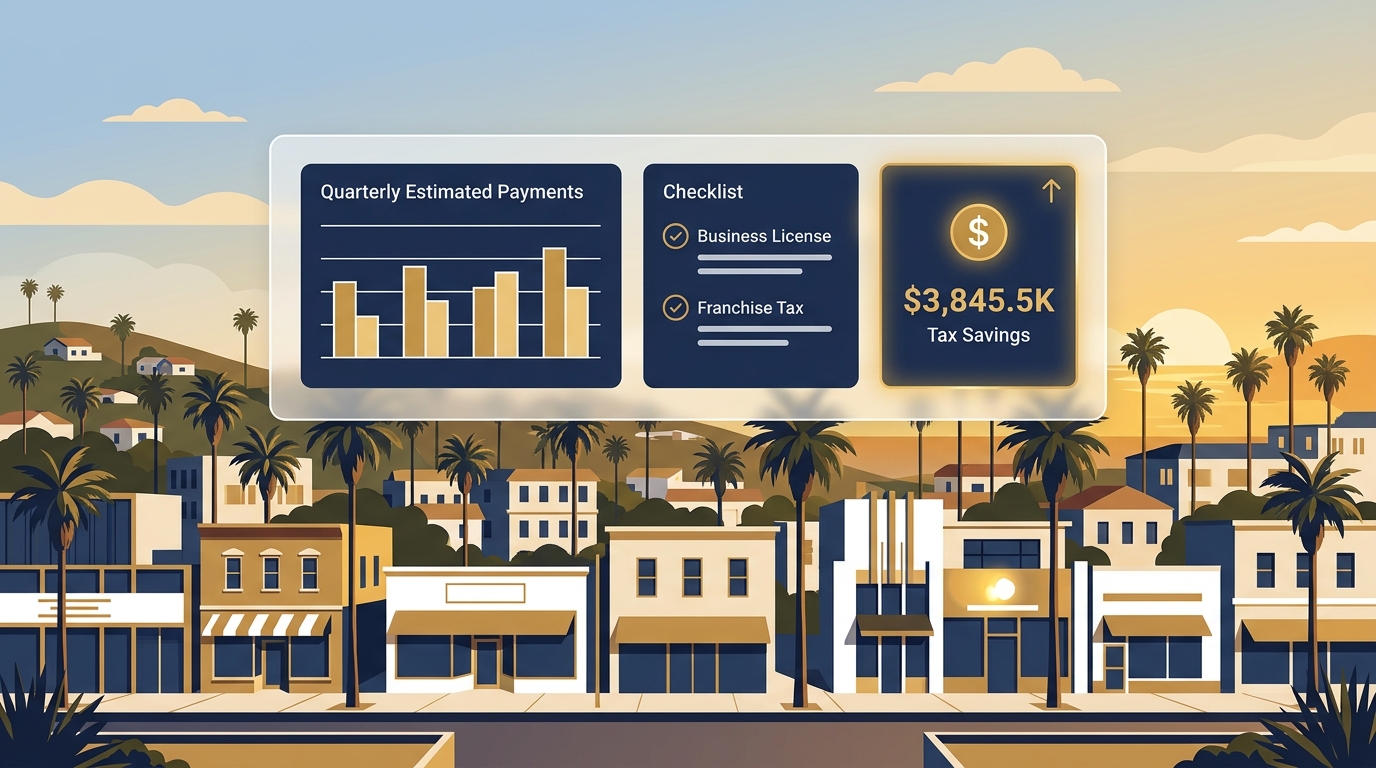
Most Torrance business owners think they only have two tax problems: the IRS and the Franchise Tax Board. Then a letter arrives from the City of Torrance Business License Division asking for three years of unreported gross receipts, and they discover there was a third layer sitting quietly underneath the whole time. The penalty notice usually lands in the same week as an FTB balance due.
Here is the turn. Torrance tax exposure is one of the most fixable problems in the South Bay, because almost all of it comes from stacking errors rather than aggressive positions. Business owners are not getting caught doing something wrong. They are getting caught not knowing that three separate taxing authorities each want a slightly different version of the same number. Once you map those three layers correctly, the compliance risk drops and the planning opportunities show up almost immediately.
Quick Answer
Torrance business owners face three separate tax obligations: federal income tax through the IRS, California state tax through the Franchise Tax Board including the $800 minimum franchise fee, and a City of Torrance business license tax based on gross receipts. A typical Torrance LLC generating $600,000 in revenue pays the $800 FTB minimum plus a $2,500 LLC gross receipts fee plus a city business license tax, and most owners miss at least one of the three.
What Torrance Tax Actually Means for a Local Business
Torrance tax is not a single tax. It is shorthand for the layered obligation that hits any business operating inside the City of Torrance in Los Angeles County. Understanding the layers is the entire game.
Layer One: Federal
The IRS taxes your net profit. If you operate as a single member LLC, that profit flows to Schedule C of your Form 1040 and gets hit with both income tax and self employment tax at 15.3% on the first $176,100 of net earnings for 2025, then 2.9% Medicare above that. If you elected S Corporation status, only your W-2 wages carry payroll tax and the remaining distribution avoids self employment tax entirely.
Layer Two: California Franchise Tax Board
Every LLC registered or doing business in California owes an $800 annual minimum franchise tax regardless of profitability. You could lose $40,000 and still owe $800. On top of that, California LLCs owe a gross receipts fee that has nothing to do with profit:
| California Gross Receipts | Annual LLC Fee |
|---|---|
| Under $250,000 | $0 |
| $250,000 to $499,999 | $900 |
| $500,000 to $999,999 | $2,500 |
| $1,000,000 to $4,999,999 | $6,000 |
| $5,000,000 and above | $11,790 |
Notice what this table does not say. It does not say anything about profit. A Torrance contractor doing $1.2 million in revenue with a $30,000 net loss still owes $6,000 in LLC fees plus the $800 minimum. That is $6,800 owed on a losing year.
Layer Three: City of Torrance Business License Tax
The City of Torrance requires a business license for essentially every commercial activity conducted within city limits, including home based consultants, contractors doing work in Torrance, and out of area businesses with a Torrance jobsite. The license tax is calculated on gross receipts, and the rate varies by business classification. Professional services, retail, contractors, and manufacturers each sit in different brackets.
Key Takeaway: A Torrance LLC with $600,000 in revenue typically owes $800 FTB minimum, $2,500 LLC gross receipts fee, and a city business license tax, which is roughly $3,500 in taxes before a single dollar of income tax is calculated.
The Entity Structure Decision That Drives Every Torrance Tax Outcome
This is the single highest leverage decision a South Bay business owner makes, and it is where the majority of overpayment happens. The default assumption that an LLC is always the right answer costs Torrance owners real money every year.
Why the LLC Gross Receipts Fee Changes the Math
California is one of the only states that taxes LLCs on revenue rather than profit. That single rule flips the standard entity advice. In most states, an LLC taxed as a partnership or disregarded entity is the low cost default. In California, once you cross $250,000 in gross receipts, the LLC starts carrying a cost that a corporation does not.
A California S Corporation pays a 1.5% franchise tax on net income with the same $800 minimum, but it does not pay a gross receipts fee. For a high revenue, moderate margin business, that difference is significant.
The Comparison That Matters
| Factor | California LLC | California S Corp |
|---|---|---|
| Minimum annual tax | $800 | $800 |
| Gross receipts fee | Yes, up to $11,790 | None |
| State tax on net income | None at entity level | 1.5% of net income |
| Self employment tax | On all net income | On W-2 wages only |
| Payroll filing required | No | Yes, quarterly |
| Best fit revenue range | Under $250,000 | Profit above $60,000 |
Run the numbers on a real scenario. A Torrance marketing agency does $850,000 in gross receipts with $180,000 in net profit. As an LLC, the owner pays $800 minimum, $2,500 gross receipts fee, and 15.3% self employment tax on roughly $166,000 of net earnings after the deductible portion, which is about $25,400. Total state and payroll layer: roughly $28,700.
As an S Corp with a defensible $95,000 salary, the same owner pays $800 minimum, $2,700 in California franchise tax at 1.5% of net income, and payroll taxes on $95,000 of roughly $14,535. Total: roughly $18,035. The remaining $85,000 flows as a distribution free of self employment tax.
Annual difference: approximately $10,665. Subtract $2,400 in added payroll and compliance cost and the owner still nets over $8,200 a year. That is not a loophole. That is Section 1372 and Revenue Ruling 74-44 working exactly as written.
If you want to model your own numbers before committing, run your figures through a small business tax calculator to see how the entity choice moves your bottom line. Structuring this correctly is exactly what our tax planning services are built around, and it pairs directly with the broader strategy framework in our California business owner tax strategy hub.
When to Stay an LLC
Yes, stay an LLC, if:
- Your annual profit is under $50,000
- Your gross receipts stay below $250,000 so the fee never triggers
- You have net operating losses you are carrying forward
- You hold real estate and want basis step up flexibility
- You cannot commit to running compliant quarterly payroll
Yes, elect S Corp status, if:
- Your net profit consistently exceeds $60,000
- Your gross receipts exceed $500,000, triggering the $2,500 fee tier or higher
- You can justify a reasonable salary based on market comparables
- You are willing to file Forms 941 quarterly and 1120-S annually
KDA Case Study: Torrance LLC Owner Overpaying on Three Fronts
A client came to us operating a specialty electrical contracting business out of a shop near Crenshaw and Sepulveda. Single member LLC, formed in 2019, doing $780,000 in annual gross receipts with roughly $165,000 in net profit. He had a competent bookkeeper and a preparer who filed his returns on time every year. Nothing was technically wrong.
Three things were leaking money. First, he was still a disregarded LLC, paying full self employment tax on the entire $165,000 and a $2,500 California gross receipts fee. Second, his City of Torrance business license was filed under a classification that carried a higher rate than his actual scope of work warranted, and it had never been reviewed since formation. Third, he had $71,000 in equipment purchases across two years that had been capitalized on a 7 year schedule instead of expensed under Section 179.
What we did: filed Form 2553 with late election relief under Revenue Procedure 2013-30, set a defensible $88,000 salary supported by regional wage data for licensed electrical contractors, corrected the city license classification going forward, and amended two prior returns to claim Section 179 treatment on the equipment.
Results in year one: $9,340 in self employment tax eliminated, $4,180 in refunds from the amended returns, and roughly $1,100 in annual city license savings. Total first year benefit: $14,620. He paid $3,900 for the restructure, amendments, and first year payroll setup. First year ROI: 3.7x, with the self employment tax savings recurring every year after.
Ready to see how we can help you? Explore more success stories on our case studies page to discover proven strategies that have saved our clients thousands in taxes.
Five Torrance Tax Strategies Local Owners Consistently Miss
These are not exotic positions. Each one is grounded in published IRS guidance, and each one gets skipped by owners who file their own returns or use a preparer who only looks backward.
Strategy One: Section 179 and Bonus Depreciation on Equipment and Vehicles
Section 179 lets you deduct the full cost of qualifying business equipment in the year you place it in service rather than spreading it over five or seven years. For 2025, the deduction limit is $1,250,000 with a phaseout beginning at $3,130,000 in total purchases. Vehicles over 6,000 pounds gross vehicle weight rating qualify for enhanced treatment.
A Torrance landscaping company buying a $68,000 truck and $22,000 in equipment can deduct the full $90,000 in year one instead of roughly $18,000. At a combined federal and California marginal rate of 42%, that accelerates approximately $30,240 in tax benefit into the current year. See IRS Publication 946 for the full depreciation rules.
Myth bust: You do not need to pay cash. Financed equipment qualifies for Section 179 in full as long as it is placed in service before December 31.
Strategy Two: The Qualified Business Income Deduction
Section 199A allows a deduction of up to 20% of qualified business income for pass through entities. For a Torrance owner with $150,000 in QBI, that is a $30,000 deduction, worth roughly $7,200 in federal tax at the 24% bracket. Critically, California does not conform to Section 199A, so this is a federal only benefit. Details are in IRS guidance on the QBI deduction.
Red Flag Alert: Specified service trades or businesses, including law, accounting, health, and consulting, face a phaseout of the QBI deduction once taxable income exceeds the annual threshold. Torrance has a heavy concentration of professional service firms near Del Amo and Torrance Boulevard. If you are in one of these fields, S Corp salary levels directly affect whether you keep the deduction.
Strategy Three: The California Pass Through Entity Elective Tax
California’s PTE elective tax allows qualifying pass through entities to pay a 9.3% entity level tax on qualified net income, which the entity deducts federally, while owners receive a credit against their California tax. This effectively works around the federal state and local tax deduction cap.
For a Torrance S Corp with $250,000 in qualified net income, the entity pays $23,250 in PTE tax, deducts it federally, and generates roughly $8,600 in federal savings at a 37% marginal rate. The election must be made on a timely filed original return and requires a prepayment by June 15 of the tax year.
Strategy Four: Home Office and the Administrative Office Rule
Many Torrance contractors and consultants work primarily at client sites but handle scheduling, invoicing, and estimating from home. Under the administrative or management activities test, that home space qualifies as a principal place of business even though most revenue generating work happens elsewhere.
Pro Tip: Use the IRS Simplified Option to claim $5 per square foot up to 300 square feet, capped at $1,500, with no receipt substantiation required. For an S Corp owner, an accountable plan reimbursement often produces a larger deduction than the simplified method. See IRS Publication 587.
Strategy Five: Retirement Plan Stacking for High Earners
A Solo 401(k) allows employee deferrals of $23,500 for 2025 plus employer contributions of 25% of compensation, with a combined limit of $70,000. A Torrance S Corp owner paying herself $130,000 can defer $23,500 as an employee and contribute $32,500 as an employer, sheltering $56,000. At a combined 45% marginal rate that is approximately $25,200 in current year tax deferred.
For owners over 50, catch up contributions add another $7,500. If you want to project the long term compounding impact, the retirement savings calculator will show you how contributions grow over a full career.
The Torrance Tax Mistakes That Trigger Notices
Compliance failures in the South Bay tend to follow a predictable pattern. These are the ones we see most often, and every one of them is preventable.
Mistake One: Ignoring the City Business License Entirely
Home based businesses assume the city license does not apply to them. It does. Out of area contractors performing work inside Torrance assume their home city license covers them. It does not. The City of Torrance can assess back taxes plus penalties and interest for unlicensed years, and there is no statute of limitations protection comparable to the federal three year rule when no filing was ever made.
Mistake Two: Missing the $800 FTB Minimum in the First Year
California generally requires the $800 minimum franchise tax even for entities with no activity, with limited first year exemptions that have specific eligibility windows. Owners who form an LLC in November and file nothing until the following April frequently discover they owed $800 for a two month stub year, plus penalties.
Mistake Three: Unreasonably Low S Corp Salary
Red Flag Alert: Setting an S Corp salary at $20,000 while distributing $180,000 is the fastest way to attract IRS attention. Revenue Ruling 74-44 establishes that the IRS can recharacterize distributions as wages when compensation is unreasonably low. Reclassification brings back payroll tax plus penalties of up to 100% of the unpaid amount under certain circumstances. Document your salary with regional wage data and keep the analysis in your file.
Mistake Four: Commingling Personal and Business Accounts
A single bank account used for both groceries and equipment purchases destroys the substantiation trail and can undermine the liability protection of the entity itself. In an audit, commingling expands the examination scope from specific line items to the entire books.
Mistake Five: Skipping Estimated Payments
California requires estimated payments on a front loaded schedule of 30% in Q1, 40% in Q2, zero in Q3, and 30% in Q4, which differs from the federal even quarterly structure. Owners who apply the federal schedule to California consistently underpay early and trigger penalties. Details are at the Franchise Tax Board estimated payment page.
Step-by-Step: Getting Your Torrance Tax Structure Right
- Pull your last three years of gross receipts and identify which California LLC fee tier you have been in. This takes 20 minutes and immediately tells you whether the S Corp conversion math works.
- Verify your City of Torrance business license classification against your actual primary activity. Misclassification can run in either direction and both cost you.
- Calculate a defensible reasonable salary using regional compensation data for your role and industry, then document the methodology in writing.
- File Form 2553 if converting, due within two months and 15 days of the beginning of the tax year you want the election to take effect, or use Revenue Procedure 2013-30 relief for late elections.
- Set up compliant quarterly payroll including Forms 941, DE 9, and DE 9C for California, plus annual Form 940 and W-2 issuance.
- Make the PTE elective tax prepayment by June 15 if you intend to claim the workaround for the current year.
- Separate all banking and run every business transaction through a dedicated account with monthly reconciliation.
Special Situations and Edge Cases
What If You Operate in Torrance but Live Elsewhere?
California taxes nonresidents on California source income. A business operating in Torrance generates California source income regardless of where the owner lives. If you moved to Nevada or Texas but your operations, employees, or customers remain in Torrance, you likely still owe California tax on the apportioned California income and still need the city license.
What If You Have Multiple Entities?
Each California LLC owes its own $800 minimum and its own gross receipts fee. Owners who form separate LLCs for each property or each line of business often multiply their minimum tax burden without realizing it. Five LLCs equals $4,000 in minimum tax before any activity. Consolidating under a single entity with separate books, or using a series structure where appropriate, frequently reduces cost.
What Happens If You Do Nothing?
If you skip the city business license, expect a back assessment covering multiple years plus penalties. If you miss the FTB minimum, expect penalties and interest that compound, and eventual suspension of your entity, which strips your right to sue, defend a lawsuit, or use your business name. Suspended entities also cannot legally enter contracts, which has ended more than one Torrance deal at the closing table.
Ready to Reduce Your Tax Bill?
KDA Inc. specializes in strategic tax planning for business owners, S Corps, LLCs, and high-net-worth individuals. Book a personalized consultation and walk away with a clear plan.
Frequently Asked Questions
Do I need a Torrance business license if I work from home?
Yes. The City of Torrance requires a business license for home based businesses conducting commercial activity within city limits, including consultants, online sellers, and service providers. Home occupation rules may add zoning conditions on top of the license requirement.
Can I avoid the $800 California minimum franchise tax?
Generally no, if you are formed in California or doing business in California. Limited first year relief has existed for certain entities in specific windows, but the safe assumption is that the $800 applies every year the entity exists, including years with zero revenue. Dissolving an inactive entity properly is usually the only way to stop the clock.
Is an S Corp always better than an LLC for a Torrance business?
No. Below roughly $50,000 in net profit, the added payroll and compliance cost of an S Corp typically exceeds the self employment tax savings. The crossover point depends on your profit, your reasonable salary, and your gross receipts fee tier. Above $60,000 in profit with revenue over $500,000, the S Corp usually wins clearly.
How far back can the IRS or FTB audit my Torrance business?
The IRS generally has three years from the filing date, extended to six years if income was understated by more than 25%, and unlimited if no return was filed or fraud is involved. California’s Franchise Tax Board has four years, one year longer than the federal window, which catches many owners off guard.
The Bottom Line
Torrance tax exposure is three layers deep, and the owners who overpay are almost never the ones taking aggressive positions. They are the ones running a 2019 entity structure against 2026 revenue, paying a gross receipts fee they could legally avoid, and filing a city license under a classification nobody has reviewed in six years.
Fixing it is not complicated. It requires knowing which layer you are in, what each layer actually measures, and where the structural decisions compound. The electrician in our case study did not find a loophole. He just stopped paying for a structure that no longer matched his business.
Mic drop: Your Torrance business does not have a tax problem. It has a structure problem that shows up as a tax bill.
This information is current as of 7/27/2026. Tax laws change frequently. Verify updates with the IRS or FTB if reading this later.
Book Your Torrance Tax Strategy Session
If you are running a Torrance business on an entity structure you chose years ago, there is a strong chance you are paying the California gross receipts fee, full self employment tax, and a misclassified city license all at the same time. That combination costs South Bay owners five figures a year without anyone noticing. Let’s map your three layers, run the S Corp crossover math on your actual numbers, and build a structure that matches the business you have now. Click here to book your consultation now.



