
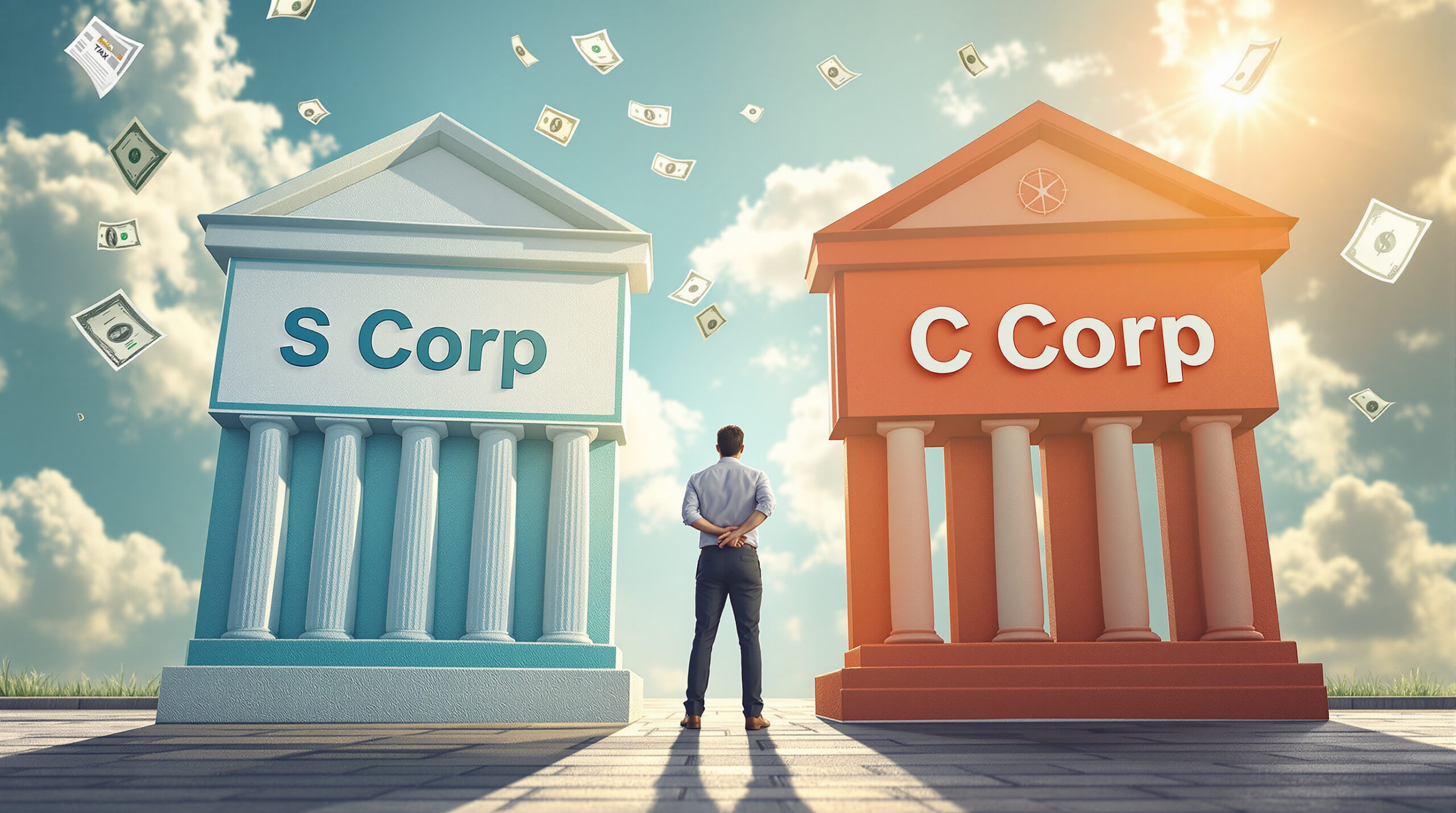
The Tax Truth About S Corps and C Corps: How Picking the Wrong Structure Could Cost You $27,000 in 2025
Most owners think the difference between an S Corp and C Corp is just paperwork or a tiny difference in tax rates. The reality is far harsher: choosing the wrong structure leads to massive double taxation, blocked deductions, and stress that escalates year after year. Too many thriving LLCs, freelancers, and real estate investors are handing $15,000-$30,000 extra to the IRS every year—simply by misunderstanding this choice. This post is your blunt, strategist-led guide to what is an S Corp or C Corp—and why getting this right in 2025 is a critical make-or-break for your business and family wealth.
Quick Answer: The S Corp vs C Corp Divide in Plain English
An S Corporation (S Corp) is a tax status that lets a qualifying small business pass profits directly to owners, avoiding corporate-level tax and offering powerful payroll-tax savings— see IRS S Corporation explanation. A C Corporation (C Corp) is a traditional corporation taxed on profits at the entity level, then again as dividends to owners. S Corps are a tool for owner-operators to extract income efficiently; C Corps are for businesses planning to raise capital, go public, or reinvest profits long-term. Understanding which one fits your income model in 2025 could mean the difference between a minor tax bill and a life-changing refund check.
Entity Structures Demystified: S Corp and C Corp
The classic myth is that an “Inc.” on your business fails means it’s automatically a C Corp, or that “S” just means small. Actually, any qualifying LLC or corporation can elect to be taxed as an S Corp by filing IRS Form 2553 (so long as you meet the restrictions: under 100 U.S. shareholders, domestic entity, one class of stock, and no partnerships or foreign owners).
The biggest differences come down to three factors:
- Taxation Points: C Corps pay a 21% federal tax rate on profits. If you distribute any of those profits, owners pay a second tax on dividends (up to 23.8% federal, plus California state rates). S Corps avoid this by having profits “flow through” to owners who pay only on their personal returns.
- Owner Payroll: S Corps require owners to pay themselves “reasonable compensation” via W-2 payroll, but also allow distributions not subject to self-employment tax. C Corps can structure salaries, but all distributions risk double taxation.
- Growth Plans: If you want outside investors, multiple stock classes, or to go public, you need a C Corp. The S Corp rules are strict and limit future options for capital raises.
If you’re a business owner, mislabeling your structure or missing an election can mean massive tax traps that accountants often overlook.
How Taxation Works: S Corp vs C Corp in 2025 (With Real Dollar Examples)
Let’s break down the numbers for a California solopreneur netting $180,000 in profit in 2025. A C Corp would pay 21% federal tax ($37,800), possibly 8.84% California ($15,912, CA Form 100), and when issuing $50,000 in dividends, the owner pays another $11,900+ in personal taxes. Total tax burden crosses $65,000 annually, slicing off 36%+ of real profit.
Same business as an S Corp:
- Owner pays themselves $60,000 W-2 salary (subject to payroll tax)
- The remaining $120,000 flows through as S Corp distribution, not subject to SE tax (saves $14,000+ per year compared to a Schedule C)
- Total tax burden can drop below $44,000, with strategic tax planning
Result: Tax savings of $21,000 or more—every year.
For those running larger teams, have outside investors, or plan to scale aggressively, the calculation shifts. C Corp status allows easier profit retention, more flexible equity, and is required for most venture funding. But the tax bill is steeper until (or unless) you plan to go public.
KDA Case Study: Tech Consultant Chooses S Corp, Saves $18,740 on 2025 Taxes
Chris, a San Diego-based IT consultant earning $230,000 as a sole owner LLC, had been running all income as Schedule C and losing $17,000+ per year to self-employment tax. He approached KDA in early 2025 wanting to hire his spouse, write off healthcare, and keep more of his income. The analysis made the answer clear: elect S Corp status and restructure his compensation away from full self-employment tax exposure.
KDA implemented:
- Filed S Corp election (Form 2553) with retroactive approval for 2025
- Set a $70,000 salary for Chris (W-2), the rest as S Corp distributions
- Added spouse to payroll for healthcare deduction optimization
- Documented all reasonable compensation per IRS guidelines
Results:
- Pain-free $18,740 first-year tax savings (cut SE tax from $21,165 to $7,315)
- $3,000 KDA fee offset by 6.2x ROI (before counting future compounding benefit)
- No audit trigger: salary supported by actual market rates, all payroll handled through Gusto
Chris now meets quarterly with KDA for ongoing S Corp strategy, including QBI optimization (qualified business income deduction). Total projected 5-year savings: $100,000+
Ready to see how we can help you? Explore more success stories on our case studies page to discover proven strategies that have saved our clients thousands in taxes.

The Real Reason Most Owners Cost Themselves Thousands: S Corp and C Corp Myths
Red Flag Alert: The #1 mistake is failing to document “reasonable compensation” for S Corps—leaving you exposed to IRS audit and back-taxes. According to IRS Publication 535, owners must be paid competitive W-2 wages before taking any distributions. Lowballing salary creates a spike in audit risk; overpaying wipes out the very savings S Corps create. Don’t gamble—get this right every year.
Myth #2: C Corps are only for “big” companies. Truth: Some startups can leverage the C Corp 1202 stock gain exclusion for a future tax-free exit, but only if structured correctly.
Myth #3: S Corps mean no paperwork. Truth: The compliance burden increases—there are strict filing deadlines (watch for Form 1120S and California Form 100S), payroll processing, and shareholder pay rules.
If you’re considering a switch, don’t do it on your own. Our entity formation experts walk you through step-by-step, ensuring audit-proof compliance and maximum savings. For a comprehensive breakdown of every optimization, see our complete S Corp tax guide.
Common Questions About S Corps and C Corps: 2025 Edition
How Do I Switch My LLC to an S Corp or C Corp?
Any LLC (or existing corporation) can elect S Corp status by filing Form 2553 with the IRS (and CA Form 100S), as long as you meet the S Corp requirements. To become a C Corp, simply form a corporation or check the box for C Corp status with the IRS and California FTB. There are strict deadlines for retroactive elections. See our entity formation page for details.
Can Real Estate Investors Use S Corps?
S Corps are rarely ideal for holding rental properties directly, due to the passive income and loss limitations. But investors running property management companies (with active income) can benefit. Always run an ROI scenario before structuring real estate through either entity.
When Does the S Corp or C Corp Structure Make the Most Sense?
- If you are a solo owner, 1099, or LLC with $60,000+ net profit, S Corp status almost always slashes your tax bill.
- If you plan to raise outside capital, issue multiple stock classes, or plan for a Silicon Valley exit, C Corp is your path—just know you must handle the double tax issue with long-term planning.
What If I Get the Structure Wrong?
If you’ve operated under the wrong entity for years, there are IRS-approved retroactive fixes—but the process is complex. KDA has guided dozens of high-income owners through late S Corp elections and C Corp to S Corp conversions with zero audit fallout. Book a call for a fix-it plan tailored to your scenario.
Pro Tips and Red Flags
Pro Tip: You can combine S Corp payroll with retirement planning (solo 401k, SEP, health plan premium deduction) to shelter far more of your income in your business. With the right setup, a $125,000 net-profits owner can cut their tax bill by $17,000—while saving $30,000+ in retirement contributions each year.
Red Flag: California S Corps owe the $800 minimum franchise tax and 1.5% income tax (California S Corp tax rules). Missing this on your return is a frequent cause of state notices.
This information is current as of 12/7/2025. Tax laws change frequently. Verify updates with the IRS or FTB if reading this later.
Bottom Line: Choose the Right Entity or Overpay Forever
Set up your entity correctly, and you save five figures per year, sleep at night, and run a business that is built to scale. Miss a deadline, shortchange your W-2, or pick the wrong structure, and you face double taxation, pointless payroll, and a lifetime of audit anxiety. Don’t guess—run your numbers, consult a strategist, and make this the year you stop gifting the IRS your hard-earned profit.
Book Your Entity Tax Structure Strategy Session
If you’re not 100% sure that your current business entity is set up to save you the most in taxes for 2025, let’s carve out a custom path. Book a 1-on-1 tax entity evaluation with our team—walk away with a clear, IRS-compliant plan to keep more of your income. Click here to lock in your strategy session now.


