
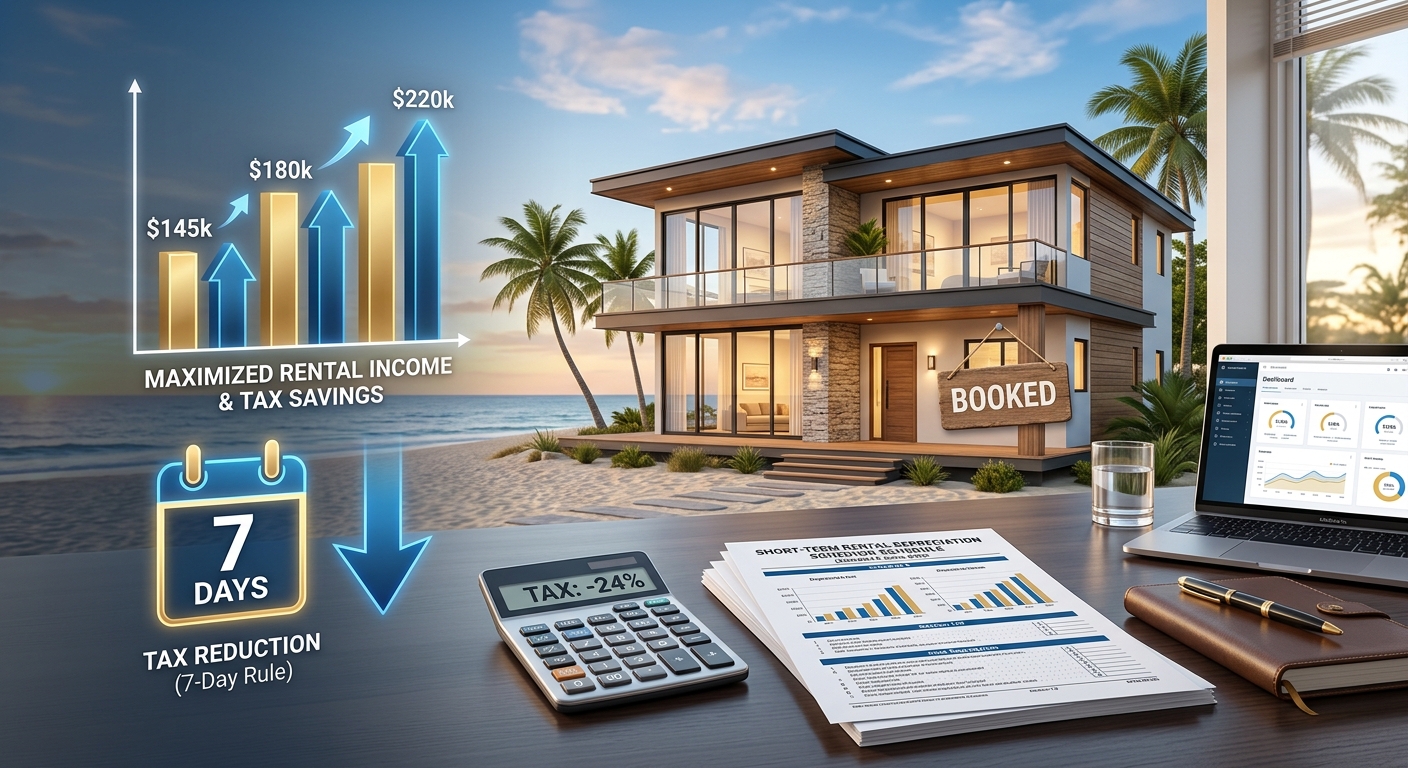
If you earn a high W-2 salary and you have watched a chunk of every paycheck vanish to federal taxes, there is a strategy that changes the math entirely. It is called the STR tax loophole, and in 2026 it remains one of the most powerful legal moves available to high earners who want to offset ordinary income with real estate depreciation. This is not a gimmick, it is not aggressive, and it is written directly into the tax code. But most people either misunderstand it or execute it wrong and lose the benefit entirely.
Let me be direct. The STR tax loophole lets you use losses generated by a short-term rental property to reduce your taxable W-2 or 1099 income, without qualifying as a real estate professional. That distinction matters, because the real estate professional path is nearly impossible for a full-time engineer, physician, or executive. The short-term rental route sidesteps that hurdle completely if you do it right.
Quick Answer: What Is the STR Tax Loophole?
The STR tax loophole is a provision that treats income and losses from a short-term rental as non-passive when the average guest stay is seven days or less and you materially participate in the activity. Because the loss is non-passive, it can offset active income like your salary. Pair that with a cost segregation study and 100% bonus depreciation, and a single property can generate a six-figure paper loss in year one.
Here is the plain English version. Normally, rental real estate losses are “passive” and can only offset other passive income. They sit trapped on your return doing nothing for your salary. The short-term rental exception breaks that rule. Get the average stay under seven days, prove you are hands-on, and the IRS stops calling it passive.
Why the STR Tax Loophole Exists in the First Place
This is not a loophole in the sneaky sense. It comes from the passive activity loss rules under Section 469 and the accompanying Treasury regulations. Congress wrote a specific carve-out. Under Treasury Regulation 1.469-1T(e)(3)(ii)(A), a rental is not even treated as a “rental activity” if the average customer use is seven days or less. That single sentence is the entire engine behind this strategy.
When the activity is no longer a rental activity, the automatic passive label from Section 469 does not apply. Instead, you fall under the general material participation tests. Clear one of those tests and your losses become non-passive. You can read the underlying rules in IRS Publication 925, which covers passive activity and at-risk rules in detail.
The reason high earners have flooded into this space over the past two years is simple. Once bonus depreciation returned to 100% for property acquired after January 19, 2025, the front-loaded deductions became enormous. Business Insider and Accounting Today have both reported a surge of high earners buying short-term rentals specifically to deduct much of the purchase price against W-2 income. The engine behind that playbook is the cost segregation study, and demand for those studies has exploded.
The Three Requirements You Absolutely Cannot Skip
The STR tax loophole works only if all three conditions are met. Miss one and the entire strategy collapses. I have seen taxpayers lose a $120,000 deduction because they got sloppy on a single element.
1. The Seven-Day Average Stay Rule
Your average guest stay must be seven days or less across the tax year. This is an average, not a maximum. If you rent to one guest for 30 days and nine guests for 3 days each, you calculate the average by dividing total rental days by total number of stays. A common Airbnb or VRBO property with weekend and week-long bookings usually lands comfortably under seven days, but you must track this precisely.
2. Material Participation
You must materially participate in the activity. There are seven tests, but three matter most for short-term rental owners:
- The 500-hour test: You participate more than 500 hours during the year.
- The substantially-all test: You do substantially all of the work the activity requires.
- The 100-hour test: You work more than 100 hours and no one else works more than you do.
In plain English, if you are the one handling bookings, guest communication, cleaning coordination, maintenance, and marketing, you likely qualify. The danger zone is hiring a full-service property manager who does everything. If the manager works more hours than you, you fail the material participation test and your loss goes back to being passive.
3. Cost Segregation and Bonus Depreciation
The seven-day rule and material participation only unlock the ability to use the loss. To create a loss worth using, you need accelerated depreciation. A cost segregation study reclassifies components of your property, appliances, flooring, landscaping, driveways, fixtures, into 5, 7, and 15-year property instead of the standard 27.5-year schedule. Those shorter-life assets qualify for 100% bonus depreciation in year one.
One important caution from the current landscape. The cost segregation industry has been flooded with cheap, AI-generated $500 studies that do not hold up. The IRS is scrutinizing studies built on generic percentages rather than actual parcel data. A basement rental or partial-home conversion labeled as a standalone dwelling is, in the words of one industry expert, “fatal to an examiner.” Use a legitimate engineering-based study. Do not cut this corner.
The Real Numbers: How Much Can You Actually Save?
Let me show you the math with real figures, because vague promises help no one.
Suppose you buy a $900,000 short-term rental. The land is worth $180,000, so your depreciable basis on the building is $720,000. A quality cost segregation study identifies that roughly 25% of that basis, about $180,000, can be reclassified into short-life property eligible for 100% bonus depreciation.
That means in year one, before considering your normal straight-line depreciation on the rest, you generate a $180,000 first-year deduction from cost segregation alone. Add your operating expenses, mortgage interest, and standard depreciation, and your total paper loss might reach $200,000, even though the property is cash-flow positive.
Now assume you are a married couple with $400,000 in combined W-2 income sitting in the 35% federal bracket. That $200,000 non-passive loss reduces your taxable income to $200,000. The tax savings? Roughly $70,000 in federal tax in a single year. If you want to run your own scenario, plug your numbers into a federal tax calculator to see the impact on your total bill.
Key Takeaway: A single well-structured short-term rental can generate a first-year deduction large enough to erase $60,000 to $90,000 in federal tax for a high earner. That is real money that stays in your pocket instead of Washington’s.
KDA Case Study: Dual-Physician Household Cuts $78,000 From Their Tax Bill
A married couple, both physicians, came to us with a combined W-2 income of $520,000. They were bleeding roughly 35 to 37 cents of every marginal dollar to federal tax and had zero real estate holdings. They had heard about the short-term rental strategy from a colleague but were terrified of doing it wrong and triggering an audit.
We built a defensible plan. They purchased a $1.1 million mountain cabin near a ski resort with strong nightly rental demand and a natural average stay well under seven days. We coordinated a legitimate engineering-based cost segregation study that reclassified $214,000 of basis into bonus-eligible property. Critically, we structured their involvement so that the wife handled all guest communication, booking management, and vendor scheduling herself, logging over 130 documented hours and clearing the material participation threshold since no single contractor worked more than she did.
The result in year one was a $231,000 non-passive loss applied directly against their salary income. That produced approximately $78,000 in federal tax savings. Their total investment in our planning, entity setup, and the cost segregation study was around $11,500. That is a first-year return of roughly 6.8x, and the depreciation benefits continue in subsequent years while they build long-term wealth through the property itself.
Ready to see how we can help you? Explore more success stories on our case studies page to discover proven strategies that have saved our clients thousands in taxes.
Step-by-Step: How to Execute the STR Tax Loophole Correctly
- Confirm your income makes it worth it – This strategy shines for households above roughly $250,000 in ordinary income. Below that, the tax bracket benefit shrinks.
- Buy the right property – Target markets with strong nightly and short-stay demand so your average stay naturally falls under seven days.
- Set up proper tracking from day one – Use your booking platform data to document average guest stay and keep a contemporaneous time log of your participation hours.
- Commission a legitimate cost segregation study – Use an engineering-based provider with actual parcel data, not a $500 spreadsheet product.
- Materially participate – Handle the work yourself or ensure no single contractor outworks you. Avoid full-service property management if you want the loss.
- File correctly – Report the activity properly and make sure your preparer understands the seven-day exception and Section 469 mechanics.
Common Mistakes That Destroy the STR Tax Loophole
Competitors rarely explain what goes wrong, so here is what I see kill this strategy in practice.
Hiring a full-service manager. The single most common failure. If a property manager handles everything, you almost certainly fail material participation. Your loss becomes passive and useless against your salary.
Ignoring the average-stay math. Owners assume they are fine because most stays are short, then a single long-term winter booking pushes the average over seven days. Track it monthly.
No contemporaneous time log. The IRS can and does ask you to prove your hours. A calendar reconstructed after an audit notice carries far less weight than a log you kept in real time.
Cheap or aggressive cost segregation. An indefensible study inflates your deduction on paper but collapses under examination. The IRS is actively targeting these right now.
Special Situations and Edge Cases
What If You Have a Property Manager?
You can use a co-host or cleaning service and still qualify, as long as your personal hours exceed theirs or you satisfy the 500-hour test outright. The key is that you cannot fully outsource the activity. Many successful STR owners use cleaners and handymen for tasks while personally running bookings, guest relations, pricing, and vendor coordination.
Can You Repeat It Every Year?
The giant first-year deduction from bonus depreciation is largely front-loaded, so year one produces the biggest benefit. However, buying an additional short-term rental in a future year can generate a fresh cost segregation deduction, which is why many investors scale into a small portfolio over time.
California-Specific Considerations
California does not conform to federal bonus depreciation. That means your enormous federal first-year deduction will not fully carry over to your California return. You will still depreciate the property for state purposes, but on the standard schedule. Your federal savings remain intact, but plan your California liability separately and do not assume the state mirrors your federal loss.
Is the STR Tax Loophole Right for You?
Yes, if:
- Your household income exceeds roughly $250,000 in ordinary income
- You are willing to be genuinely hands-on with the property
- You can buy in a market with short-stay demand
- You want to build real estate wealth while cutting taxes
No, if:
- You want a fully passive, hands-off investment
- You plan to hire a full-service manager for everything
- Your income sits in a low tax bracket
- You are not prepared to document your participation hours
This strategy also pairs well with broader entity and planning work. If you are scaling into multiple properties, coordinated tax planning services ensure your depreciation, entity structure, and long-term exit all work together rather than against each other. Investors building a portfolio should also review how we support real estate investors across passive income and depreciation strategy.
Ready to Reduce Your Tax Bill?
KDA Inc. specializes in strategic tax planning for business owners, S Corps, LLCs, and high-net-worth individuals. Book a personalized consultation and walk away with a clear plan.
Frequently Asked Questions About the STR Tax Loophole
Do I need to be a real estate professional to use this?
No. That is the entire point. The short-term rental exception lets you avoid the real estate professional status requirement, which is nearly impossible for full-time W-2 employees to meet.
How many hours do I need to work?
It depends on the test you use. The safest path is 500 hours, but many owners qualify under the 100-hour test as long as no other individual works more hours than they do.
What is the average stay I need to hit?
Seven days or less on average across all guest stays for the year. Track this using your booking platform records.
Will this trigger an audit?
Done correctly with documentation, it is a legitimate, code-supported strategy. Done sloppily, with a cheap cost segregation study and no time log, it raises real risk. The difference is preparation.
Can I use this for a property I already own?
Potentially, if you convert it to a short-term rental and can perform a cost segregation study. A “look-back” study can capture missed depreciation on property you have held, using a Form 3115 change in accounting method.
Does the loss carry forward if I cannot use it all?
If your loss exceeds your income, the excess is generally subject to the excess business loss limitation and may carry forward. A planner can model this for your situation.
This information is current as of 7/24/2026. Tax laws change frequently. Verify updates with the IRS or FTB if reading this later.
Book Your Short-Term Rental Tax Strategy Session
The STR tax loophole can wipe out tens of thousands in federal tax, but only when the seven-day rule, material participation, and cost segregation are executed with precision. One misstep with a property manager or a bargain-basement depreciation study can cost you the entire benefit. If you are a high earner ready to turn a short-term rental into a legitimate tax-slashing machine, let’s build your plan the right way. Click here to book your consultation now.



