
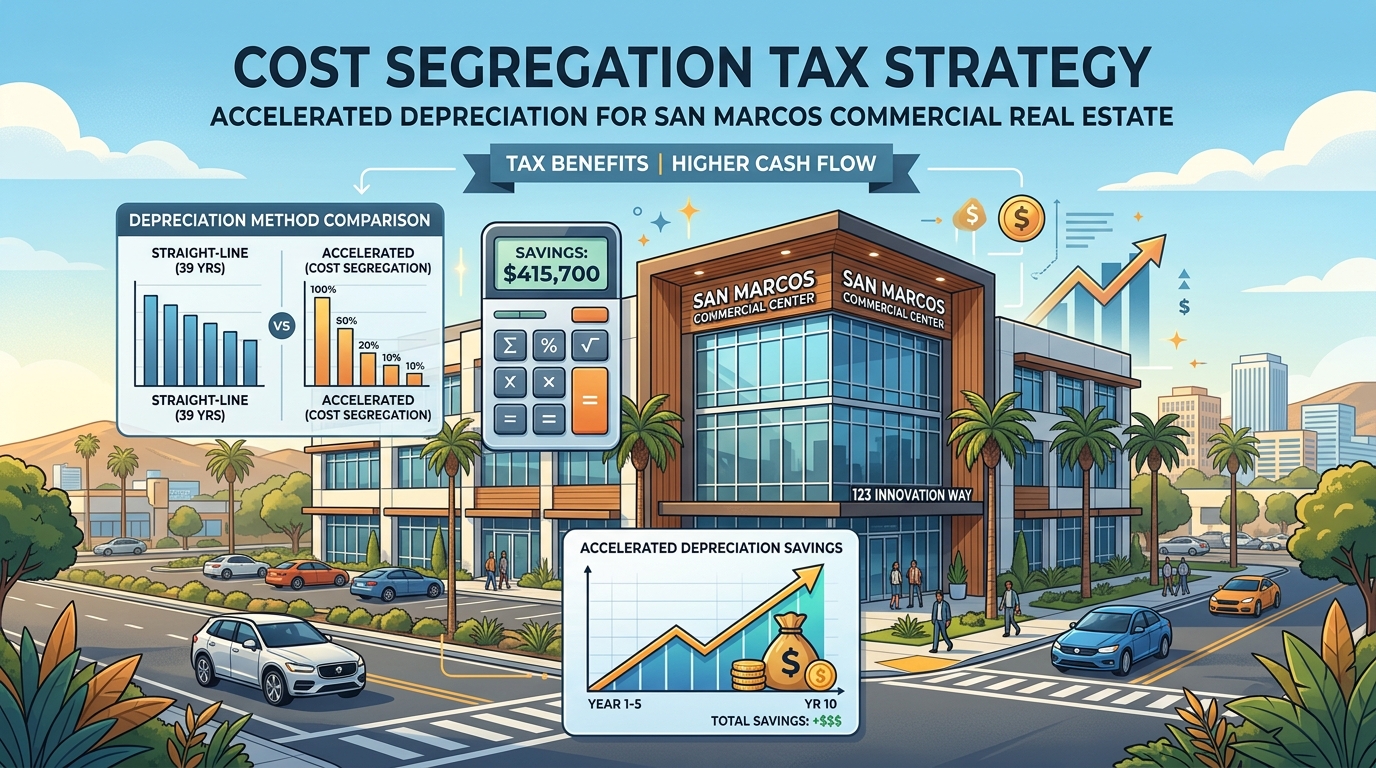
If you own commercial or rental property in North San Diego County, there’s a strategy sitting on your balance sheet right now that most investors never touch. It’s called cost segregation San Marcos CA property owners can use to accelerate depreciation, front-load deductions, and keep tens of thousands of dollars that would otherwise sit locked inside a 27.5 or 39 year depreciation schedule. And in 2026, this strategy is more powerful than it has been in years.
Here’s the short version: instead of writing off your building slowly over decades, a cost segregation study breaks your property into faster-depreciating components and lets you deduct much of that value in the first year. For a lot of San Marcos investors, that translates into a paper loss big enough to wipe out a serious chunk of their tax bill.
This guide walks through exactly how it works, who qualifies, what the 2026 rules mean, and where people go wrong. No fluff, no jargon dumps. Just the strategy explained the way we’d explain it to a client sitting across the desk.
Quick Answer: What Is Cost Segregation?
Cost segregation is an IRS-accepted tax strategy that reclassifies parts of a building into shorter depreciation categories (5, 7, and 15 years) instead of the standard 27.5 or 39 years. In plain English: it lets you take a huge portion of your building’s depreciation up front instead of dragging it out over decades. For a $1.5 million San Marcos property, a study can commonly free up $300,000 to $500,000 in accelerated deductions in year one.
This information is current as of 7/27/2026. Tax laws change frequently. Verify updates with the IRS or FTB if reading this later.
Why Cost Segregation Matters More in 2026
Depreciation is one of the most misunderstood tools in real estate. When you buy a building, the IRS assumes it wears out over time, so it lets you deduct a slice of the purchase price each year. That’s called straight-line depreciation. Residential rental property depreciates over 27.5 years. Commercial property depreciates over 39 years. That’s a slow drip.
Cost segregation speeds up the drip into a flood. The reason it’s especially relevant right now is bonus depreciation. Under the One Big Beautiful Bill Act, 100% first-year bonus depreciation was made permanent for qualifying property acquired after January 19, 2025. That means the short-life components a cost segregation study identifies (things like carpeting, cabinetry, specialized electrical, and landscaping) can often be deducted entirely in the first year rather than spread out.
Pair a cost segregation study with 100% bonus depreciation and the results are dramatic. A component that would have been written off over 15 years can now be deducted in full immediately. For a San Marcos investor with a growing portfolio, that’s the difference between a modest deduction and a six-figure one.
Key Takeaway: With 100% bonus depreciation now permanent for property placed in service after January 19, 2025, a cost segregation study can convert years of slow deductions into a single massive first-year write-off.
How Cost Segregation in San Marcos CA Actually Works
A proper study is an engineering-based analysis of your property. A qualified team physically reviews the building (or reviews detailed construction records) and assigns each element to the correct asset class. The IRS Cost Segregation Audit Techniques Guide is explicit about what a quality study requires: classify each asset, explain why it’s Section 1245 or Section 1250 property, substantiate the cost basis, and reconcile back to total actual cost. Actual costs beat estimates every time.
Here’s how the categories break down:
Step-by-Step: The Cost Segregation Process
- Property analysis – Your specialist reviews purchase documents, blueprints, and improvement records for the property. This usually takes one to two weeks.
- Site inspection – A physical walk-through (or documented remote review) identifies every component eligible for reclassification.
- Asset classification – Each item gets assigned to a 5, 7, 15, 27.5, or 39 year category based on IRS rules and case law.
- Cost basis allocation – The study substantiates the dollar value tied to each reclassified component using actual costs.
- Final report – You receive a defensible, documented study your tax preparer uses to file. Turnaround is typically 30 to 60 days.
Once the study is done, your CPA applies the reclassifications on your return. If you’re doing this on a property you’ve already owned for a few years, you don’t have to amend prior returns. You file Form 3115 to claim a catch-up deduction, capturing all the depreciation you should have taken in one year. That’s a powerful move for people who bought years ago and never ran a study.
Which Property Components Get Reclassified?
| Asset Category | Depreciation Life | Common Examples |
|---|---|---|
| Personal property | 5 or 7 years | Carpet, cabinets, appliances, decorative lighting |
| Land improvements | 15 years | Parking lots, landscaping, fencing, sidewalks |
| Building structure | 27.5 or 39 years | Foundation, roof, framing, HVAC (base) |
| Land | Not depreciable | The lot itself |
The magic is in shifting as much value as legally possible out of the 27.5 or 39 year buckets and into the 5, 7, and 15 year buckets, where bonus depreciation can then wipe them out in year one.
KDA Case Study: San Marcos Commercial Property Owner Unlocks $118,000 in Year One
A client came to us owning a mixed-use commercial building in San Marcos he’d purchased in early 2025 for $1.8 million. He’s a business owner in his early 50s with roughly $340,000 in combined income from his operating company and rental cash flow. His previous accountant had him on straight-line 39 year depreciation, giving him a modest annual deduction of about $46,000. He had no idea he was leaving money on the table.
We commissioned an engineering-based cost segregation study. The study reclassified roughly $520,000 of the building’s basis into 5, 7, and 15 year property, covering the parking lot, specialized electrical, interior finishes, and landscaping. Because the property was placed in service after January 19, 2025, those components qualified for 100% bonus depreciation.
The result: an additional first-year depreciation deduction of about $474,000 on top of his normal write-off. Against his tax situation, that generated approximately $118,000 in combined federal and California tax savings in the first year. He paid roughly $9,500 for the study and our planning work, producing a first-year return of more than 12x. He’s now using that freed-up cash to acquire a second property.
Ready to see how we can help you? Explore more success stories on our case studies page to discover proven strategies that have saved our clients thousands in taxes.
Who Qualifies for Cost Segregation?
Not every property owner benefits equally. Here’s a clear framework.
Yes, cost segregation likely makes sense if:
- Your property basis (excluding land) is $500,000 or more
- You own commercial, rental residential, short-term rental, or industrial property
- You have taxable income the deductions can offset
- You plan to hold the property for at least a few years
- You acquired or improved the property recently, especially after January 19, 2025
It may not be worth it if:
- Your property basis is very small (under $200,000)
- You plan to sell within a year or two (recapture can eat into the benefit)
- You have no income to offset and can’t use the passive losses
That last point matters. The passive activity loss rules under IRS Publication 925 can limit how much of a rental loss you can use against other income. High earners with W-2 wages often can’t deduct passive rental losses unless they qualify as a real estate professional or use the short-term rental strategy. This is exactly where planning matters. Our team works with real estate investors to structure ownership so the deductions actually land where they can be used.
The Short-Term Rental Angle
One of the hottest 2026 strategies involves high earners buying short-term rentals and using cost segregation to deduct much of the purchase price against W-2 income. When average guest stays are seven days or less and you materially participate, the activity may not be treated as passive, unlocking those accelerated deductions against ordinary income. If you’re a San Marcos professional with significant W-2 wages, this is worth a serious conversation before year-end. You can run rough numbers using a federal tax calculator to see the ballpark impact before committing.
California-Specific Considerations for San Marcos Investors
Here’s where a lot of out-of-state advice falls apart. California does not conform to federal bonus depreciation rules. That means while you can take 100% bonus depreciation on your federal return, California requires you to depreciate those assets under its own schedule.
This doesn’t kill the strategy. It just means your federal savings and California savings won’t match. The federal benefit is usually where the big number comes from, and it’s still enormous. But your California return will show a different (smaller) first-year deduction, and you’ll have a book-tax difference to track going forward.
There’s also the California LLC landscape to consider. If you hold your San Marcos property in an LLC, you’re paying the annual $800 minimum franchise tax plus the gross receipts fee once revenue crosses certain thresholds. Structuring your entity correctly matters, and it’s something we handle through our entity formation and planning services. Getting this wrong can quietly cost you thousands per year across a multi-property portfolio.
Key Takeaway: California decouples from federal bonus depreciation, so your federal and state deductions will differ. Plan for the book-tax difference, but don’t let it scare you off the far larger federal benefit.
Common Cost Segregation Mistakes to Avoid
This is the part competitors skip. The strategy is powerful, but it’s also a growing target for shortcuts, and the IRS has taken notice.
Mistake 1: The $500 AI-Generated Study
Since demand surged, a wave of cheap, AI-generated studies has flooded the market. Ask a language model to produce a cost segregation study and it hands you something that looks polished but can’t hold up. Run the same property through it twice and you can get two different answers. On a signed tax return, that’s a liability, not a shortcut. The IRS guide is clear that actual costs beat estimates. A study you can’t defend in an audit is worse than no study at all.
Mistake 2: Ignoring Depreciation Recapture
When you sell, the IRS recaptures some of that accelerated depreciation and taxes it, often at ordinary rates for the personal property portion. That doesn’t erase the benefit (you got years of tax-free use of that money), but you need to plan for it. A 1031 exchange can defer recapture entirely if you roll into a replacement property.
Mistake 3: Doing It on the Wrong Property
Running a study on a $180,000 condo rarely pencils out after fees. The strategy shines on larger properties where the reclassified value is substantial enough to justify the study cost several times over.
Mistake 4: No Income to Absorb the Deduction
A massive paper loss does nothing if you can’t use it. Timing your study to a high-income year, or pairing it with a property that qualifies as non-passive, is where real planning earns its keep.
Ready to Reduce Your Tax Bill?
KDA Inc. specializes in strategic tax planning for business owners, S Corps, LLCs, and high-net-worth individuals. Book a personalized consultation and walk away with a clear plan.
Frequently Asked Questions
How much does a cost segregation study cost in San Marcos?
Quality engineering-based studies for a single property typically range from $5,000 to $15,000 depending on property size and complexity. Avoid bargain-basement automated studies. The savings almost always dwarf the fee, often by 10x or more in the first year.
Can I do cost segregation on a property I bought years ago?
Yes. You don’t need to amend prior returns. You file Form 3115 for a change in accounting method and claim the entire missed depreciation as a catch-up deduction in the current year. This is one of the most overlooked wins for long-term owners.
Does cost segregation increase my audit risk?
A properly documented, engineering-based study does not increase risk in a meaningful way. Sloppy or estimate-based studies do. The key is documentation that follows the IRS Cost Segregation Audit Techniques Guide.
What happens to the deduction if I sell the property?
Depreciation recapture applies at sale. The personal property portion can be taxed at higher ordinary rates. A 1031 like-kind exchange can defer this entirely if you reinvest in another property.
Can I use the losses against my W-2 income?
Generally only if you qualify as a real estate professional or use the short-term rental material participation rules. Otherwise passive activity loss limits apply. This is a planning conversation, not a DIY decision.
Does California give me the same first-year benefit?
No. California doesn’t conform to federal bonus depreciation, so your state deduction will be smaller and spread out differently. The federal benefit remains the main event.
Is Cost Segregation Right for Your San Marcos Property?
If you own a property worth $500,000 or more, have income to offset, and plan to hold for several years, the odds are strong that a study will pay for itself many times over. The combination of permanent 100% bonus depreciation and a defensible engineering-based study is one of the most reliable wealth-building tax moves available to real estate investors in 2026.
The catch is execution. This isn’t a plug-and-play form. It requires a real study, correct entity structure, awareness of California’s non-conformity, and a plan for how you’ll actually use the deductions. Done right, it’s transformational. Done cheaply, it’s a future audit headache. If you want a partner who handles the whole picture, explore our cost segregation services and see how the pieces fit together for your situation.
Book Your Cost Segregation Strategy Session
If you own property in San Marcos and you’re still depreciating it over 27.5 or 39 years, you’re very likely overpaying the IRS by tens of thousands of dollars. Let’s find out exactly how much a cost segregation study could unlock for your portfolio in 2026, before another tax year slips away. Click here to book your consultation now.



