
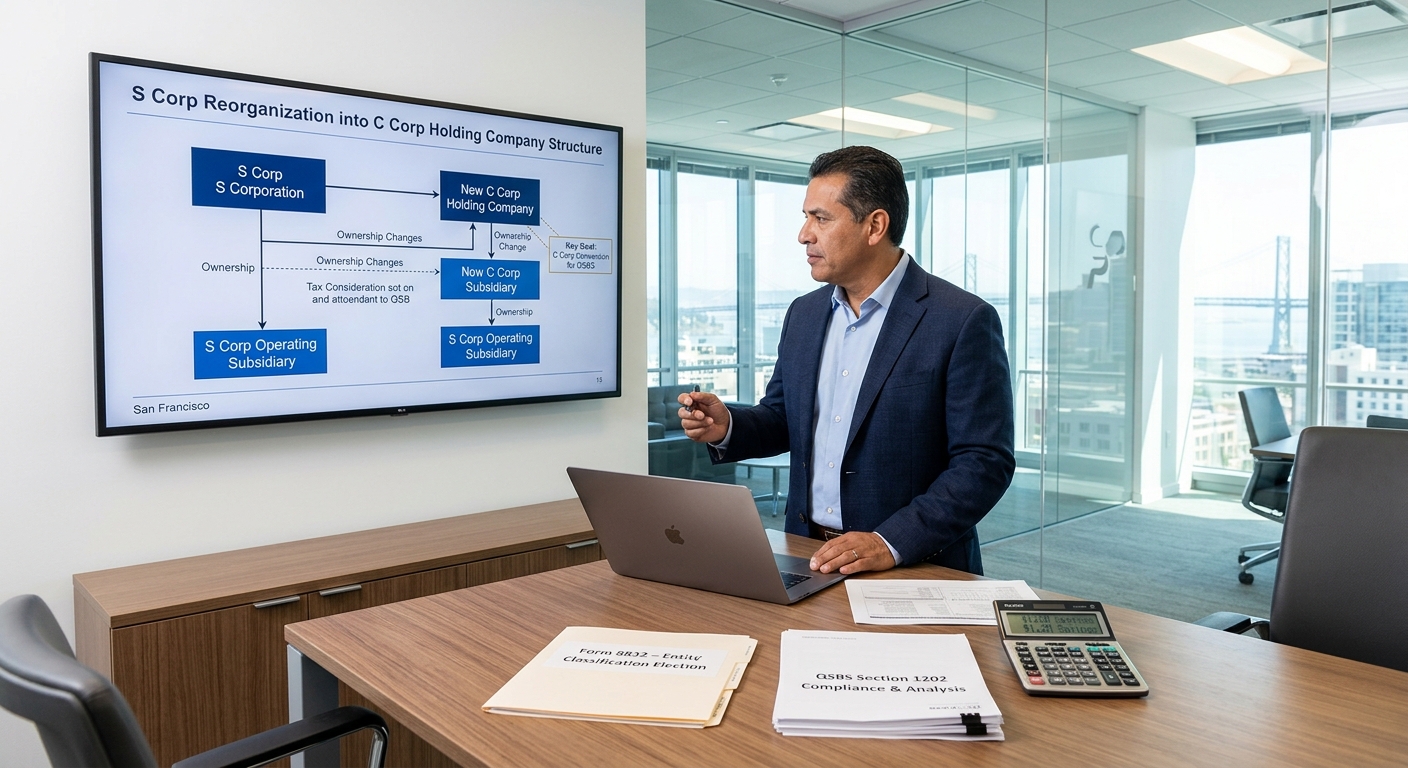
Most founders treat their S corp like a permanent fixture. They set it up years ago, they run payroll, they take distributions, and they never think about it again until a buyer shows up with an offer. That is exactly when the S corp to C corp holding conversation should have started three years earlier. Because the difference between selling your company as an S corp and selling it through a properly structured C corporation holding entity can be worth eight figures in tax-free gain, and the clock on that benefit does not start ticking until you make the move.
Here is the tension. The tax code contains one of the most generous exclusions available to business owners: Qualified Small Business Stock under Internal Revenue Code Section 1202. It can wipe out up to $15 million of gain per shareholder on a sale, completely federal tax free. And S corporations do not qualify for it. Only C corporation stock does. So the very structure most small business owners chose to save on self-employment tax may be the structure that costs them the single largest tax break in the entire code when they exit.
Quick Answer: What the S Corp to C Corp Holding Structure Actually Does
An S corp to C corp holding structure means you stop operating your growing business as a pass-through S corporation and instead position it as C corporation stock eligible for the Qualified Small Business Stock exclusion. In plain English: you restructure so that when you eventually sell, up to $15 million of your gain (or 10 times your basis, whichever is greater) can be excluded from federal income tax entirely. The trade-off is that C corps face entity-level tax and a five-year holding clock that starts only when the qualifying stock is issued. This is a strategy you build years before a sale, never at the closing table.
Under the One Big Beautiful Bill Act signed in July 2025, this benefit got materially bigger. The per-issuer exclusion cap rose from $10 million to $15 million and is now indexed for inflation. A tiered schedule was added so stock issued after July 4, 2025 earns a 50 percent exclusion after three years, 75 percent after four years, and the full 100 percent after five years. The gross asset threshold that determines eligibility also climbed. In short, the case for C corporation status is stronger now than it has been in a generation.
Why S Corp Owners Miss the $15 Million Exclusion Entirely
The Section 1202 exclusion is a federal benefit reserved for C corporation stock. If your company is an S corp, your ownership is not stock that qualifies, no matter how profitable or valuable the business becomes. This is the single most expensive blind spot in small business tax planning, and it happens because the S corp election that saved you money in the early years quietly locks you out of the biggest benefit at the finish line.
Consider the math. Say you built a business now worth $12 million and you sell it as an S corp. Your gain flows through to your personal return and gets taxed at long-term capital gains rates plus the net investment income tax, plus your state. In California that combined bite can exceed 37 percent. On a $12 million gain, that is well over $4 million to federal and state governments combined.
Now run the same sale where the equity qualifies as Qualified Small Business Stock held five years. Up to $12 million of that gain could be excluded from federal tax entirely. That is a difference measured in millions of real dollars, decided years earlier by a structuring choice most owners never even discussed. Many growth-stage business owners never learn this until it is too late to start the five-year clock.
The Five-Year Clock Is the Whole Game
The QSBS holding period does not begin when you started your company. It begins when the qualifying C corporation stock is actually issued. If you convert your LLC or restructure your S corp into a C corp today, your five-year clock starts today, not on the day you founded the business a decade ago. This is why waiting until a buyer appears is the most expensive mistake in this entire strategy. You cannot retrofit five years of holding time.
The S Corp to C Corp Holding Play, Step by Step
There is no single mechanical button labeled “convert to QSBS.” Instead, this is a deliberate restructuring that has to satisfy several technical requirements at once. Here is how the process generally unfolds for a business owner who wants to position for the exclusion.
- Confirm your business is a qualifying trade or business. Section 1202 excludes certain fields such as health, law, accounting, consulting, financial services, and other personal-service businesses. Manufacturing, technology, retail, and product companies generally qualify. This is step one because if your industry is excluded, the rest is moot.
- Revoke the S election or convert the entity. Your business becomes a C corporation for federal tax purposes. This is where the entity-level tax trade-off begins, so it must be modeled carefully against the exit benefit.
- Confirm the gross assets test at issuance. The company’s aggregate gross assets must sit below the statutory threshold at the moment the stock is issued. For stock issued after the 2025 law change, that ceiling is higher than it used to be, which lets larger companies still qualify.
- Document the stock issuance date. This date starts your five-year clock. Contemporaneous records matter enormously if the IRS ever asks you to prove eligibility.
- Hold, grow, and plan the exit around the timeline. The goal is to reach at least the five-year mark before a sale so you capture the full 100 percent exclusion under the post-2025 tiered rules.
Because this restructuring touches entity formation, ongoing tax filings, and long-term exit planning simultaneously, most owners lean on a coordinated team. Our tax planning services exist specifically to map these moves before they become irreversible mistakes.
Do Not Convert Too Late
Red Flag Alert: The most common failure is converting after a company has already raised a large priced round or grown its gross assets past the statutory ceiling. Once aggregate gross assets exceed the threshold at the moment of issuance, the stock never qualifies as QSBS, no matter how long you hold it. Timing is not a detail here. It is the entire strategy.
KDA Case Study: Product Company Founder Locks In a Multi-Million Dollar Exclusion
Marcus ran a specialty manufacturing business in Southern California that he had operated as an S corp since 2018. The business was throwing off strong profits, and the S corp structure had saved him meaningful self-employment tax over the years. But he came to us with a specific worry: a private equity group had approached him informally, and he suspected a real offer was coming within a few years. His business was already valued around $9 million and climbing.
When we reviewed his structure, the problem was obvious. As an S corp, none of his equity qualified for the Section 1202 exclusion. If he sold in the next 18 months as an S corp on a $12 million projected gain, he was staring down a combined federal and California tax bill north of $4.4 million. We modeled an S corp to C corp restructuring, confirmed his manufacturing business was a qualifying trade under Section 1202, and confirmed his gross assets sat comfortably under the post-2025 threshold at the planned issuance date.
We executed the conversion, documented the stock issuance date to start his five-year QSBS clock, and built his exit plan around holding past the five-year mark to capture the full 100 percent exclusion. Projected federal exclusion on his anticipated gain: up to $12 million shielded from federal tax. His planning engagement cost roughly $9,500 in the first year. The modeled first-year and exit tax savings ran into the millions, an ROI that is difficult to overstate. The single most important thing we did was start the clock early enough for it to matter.
Ready to see how we can help you? Explore more success stories on our case studies page to discover proven strategies that have saved our clients thousands in taxes.
California Residents Face a Painful Catch
Here is the part that trips up nearly every California founder. The Section 1202 exclusion is a federal benefit, and California does not conform to it. That means a California resident pays up to 13.3 percent California income tax on QSBS gain even when the federal exclusion is a full 100 percent. The state simply does not recognize the exclusion.
This does not kill the strategy. A $12 million gain that is fully excluded federally still saves you the entire federal capital gains tax and net investment income tax, which is the largest piece of the bill. But it means you must plan for the California layer separately and not assume the whole gain is tax free. Some founders explore changing residency well ahead of a sale, though the state’s rules on residency and anti-avoidance are aggressive and require real, documented lifestyle changes, not paperwork games.
This information is current as of July 27, 2026. Tax laws change frequently. Verify updates with the IRS or the California Franchise Tax Board if reading this later.
What About Proposition 40?
California voters will decide on Proposition 40 in November 2026, a proposed one-time 5 percent wealth tax on residents and trusts with net worth of $1 billion or more. For the vast majority of business owners this will never apply, but ultra-high-net-worth founders with complex entity structures should have their advisors watch it closely, since it factors in business interests and trust assets in the net worth calculation.
S Corp vs C Corp Holding: How to Decide
The S corp saved you money while you were operating and taking profits out year after year. The C corp holding structure is about the exit. Which one wins depends entirely on your plans. Here is a clear decision framework.
The C corp QSBS path makes sense if:
- You expect to sell the business within a realistic five-year-plus window
- Your company is in a qualifying trade or business (not health, law, accounting, consulting, or financial services)
- Your gross assets are still below the statutory threshold today
- Your projected exit gain is large enough that the exclusion dwarfs the C corp entity-level tax you will pay in the interim
Staying an S corp makes sense if:
- You have no near-term intention to sell and want to keep pulling profits out tax-efficiently
- You operate in an excluded personal-service field that cannot qualify for QSBS anyway
- Your business is already too large on gross assets to newly qualify
- Double taxation on retained profits would outweigh any future exclusion
Comparison: S Corp vs C Corp Holding for a Growing Business
| Factor | S Corp | C Corp Holding (QSBS) |
|---|---|---|
| Section 1202 exclusion | Not available | Up to $15M or 10x basis |
| Entity-level tax | None, pass-through | Yes, corporate tax on profits |
| Best for | Ongoing income extraction | Large future exit |
| Five-year clock | Not applicable | Starts at stock issuance |
| California conformity | Full pass-through | No QSBS conformity, 13.3% state tax on gain |
Key Takeaway: The right answer is rarely obvious and almost always depends on your realistic exit timeline. If a sale is more than five years out and your business qualifies, the C corp holding play can be worth millions.
What If I Already Raised Money or Have Investors?
If you have taken on outside capital, the analysis gets more complex but not impossible. Each round of financing affects your gross assets test and the timing of stock issuance. Investors themselves may separately qualify for their own QSBS exclusion on the shares they hold, which is often a strong selling point when raising capital. The critical issue is whether the company’s aggregate gross assets have already crossed the statutory ceiling. If they have, newly issued stock will not qualify. This is why the conversation must happen before, not after, a large priced round.
Can Trusts Multiply the Exclusion?
Yes, and this is where the strategy gets genuinely powerful for larger exits. The $15 million exclusion is a per-taxpayer, per-issuer limit. Families sometimes use properly structured, non-grantor trusts to transfer QSBS shares, with each trust potentially qualifying for its own separate exclusion. This technique, often called QSBS stacking, can multiply the total gain shielded far beyond a single $15 million cap. It demands careful trust design, real economic substance, and precise timing, so it is not a do-it-yourself project. But for founders anticipating a very large exit, the magnitude of the benefit makes it worth serious evaluation with a coordinated tax and estate team.
Ready to Reduce Your Tax Bill?
KDA Inc. specializes in strategic tax planning for business owners, S Corps, LLCs, and high-net-worth individuals. Book a personalized consultation and walk away with a clear plan.
Frequently Asked Questions
Does converting from S corp to C corp trigger immediate tax?
Revoking an S election and operating as a C corp does not by itself trigger an immediate tax on your business value, but it changes how profits are taxed going forward, introducing entity-level corporate tax. The bigger long-term consideration is starting your five-year QSBS clock and modeling the interim tax cost against the future exclusion benefit.
How long do I have to hold the stock to get the full exclusion?
For stock issued after July 4, 2025, you get a 50 percent exclusion at three years, 75 percent at four years, and the full 100 percent exclusion at five years. Older stock issued before that date generally follows the prior five-year, 100 percent rule. The clock starts when the qualifying C corp stock is issued.
Can any business use the QSBS exclusion?
No. Certain personal-service fields are excluded, including health, law, engineering as a personal service, accounting, consulting, athletics, financial services, and businesses where the principal asset is the reputation or skill of employees. Manufacturing, technology, retail, and product-based companies generally qualify. Confirm your specific situation with a professional before restructuring.
Does California give me the federal exclusion too?
No. California does not conform to Section 1202. A California resident can owe up to 13.3 percent state tax on QSBS gain even when the federal exclusion is 100 percent. You still capture the full federal benefit, which is the largest portion, but you must plan for the state layer separately.
The IRS is not hiding the $15 million exclusion from you. The tax code just made it invisible to anyone who never asked why their S corp could not qualify.
Book Your S Corp to C Corp Exit Strategy Session
If you are building toward a sale and your business is still an S corp, every month you wait is a month off a five-year clock that could shield millions from federal tax. Do not walk into a closing table and discover the mistake was made years earlier. Book a personalized consultation with our strategy team and get a clear, modeled answer on whether the QSBS path is right for your exit. Click here to book your consultation now.



