
Most small business owners in California pick an entity because a friend mentioned it over coffee, not because they understand what it does to their tax bill. That is how a simple choice between an S corporation, C corporation, or LLC quietly turns into a five figure mistake every single year.
Before you file one more return or sign one more operating agreement, you need a clear, practical way to compare them. This guide breaks down the real world tax impact of each structure, using plain English and concrete dollar examples so you can see exactly how your choice plays out at both the IRS and California Franchise Tax Board.
s-corp c-corp llc 차이 is not just a legal definition issue. It is a question of who pays tax on the profit, when they pay it, and at what rate. If you are a W-2 employee with a side business, a 1099 consultant, or a growing real estate investor, getting this wrong can cost you $10,000 or more every year in avoidable tax.
Quick Answer: How S Corps, C Corps, and LLCs Really Differ
At a high level, here is the bottom line on entity tax treatment for 2025 federal and California purposes.
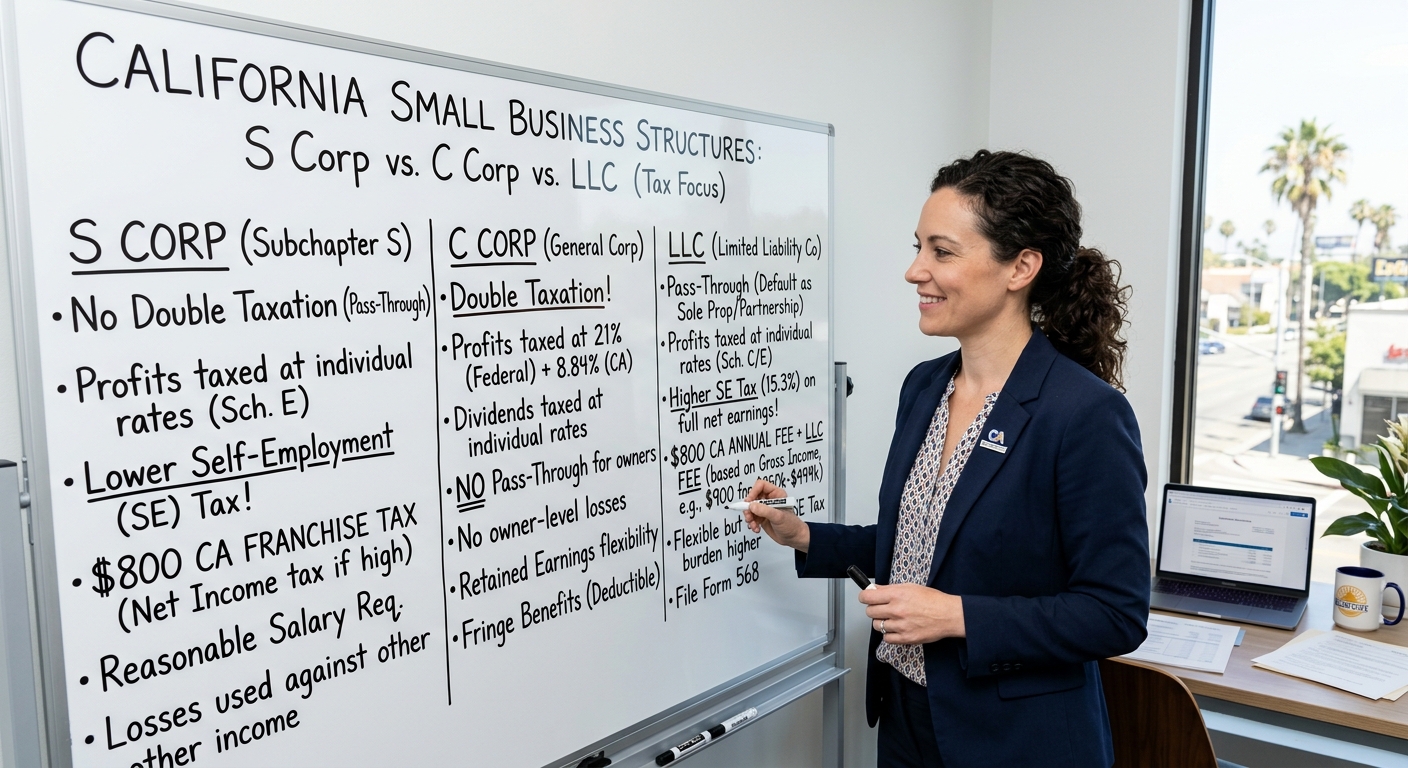
- LLC taxed as sole proprietor or partnership: Profit passes straight to your personal return. You pay federal and state income tax plus up to 15.3 percent self employment tax on most or all of the net income. In California, you also owe an annual franchise tax (generally at least $800).
- S corporation: Profit passes through to the owners, but only your W-2 salary is subject to Social Security and Medicare tax. The remaining profit is generally not subject to self employment tax. California still charges its franchise tax and an additional 1.5 percent tax on S corporation net income.
- C corporation: The corporation pays a 21 percent federal tax on its profit, plus California corporate tax. When you take money out as dividends, you pay individual tax again. That is the classic “double taxation” scenario.
So the real difference is not just “what is an S Corp?” but how each choice changes your mix of income tax, self employment tax, and California specific costs. The right answer depends on your profit level, how much cash you need personally, and whether you plan to reinvest profits.
Understanding s-corp c-corp llc 차이 Through One $200,000 Example
To make this concrete, let us look at a single scenario: a California based online marketing consultant netting $200,000 before owner compensation. We will walk through how that income looks under an LLC, S corporation, and C corporation.
Scenario 1: Single Member LLC (Disregarded Entity)
Under default rules, a one owner LLC is treated as a sole proprietorship for federal tax. That means all $200,000 of profit lands on Schedule C of your Form 1040.
- You pay federal income tax at your marginal bracket based on your total income.
- You also pay self employment tax of 15.3 percent on roughly the first $160,200 of net earnings (Social Security plus Medicare), then 2.9 percent Medicare on the rest, plus a potential 0.9 percent additional Medicare surtax if your income is high enough.
Self employment tax alone on $200,000 of net profit is easily in the $25,000 plus range. Add federal and California income tax and it is common to see a total effective tax burden north of 40 percent for high income LLC owners.
On top of that, California imposes a minimum franchise tax of $800 per year on most LLCs, plus gross receipts based fees for higher revenue levels. The key is that with this structure, almost every dollar of profit is exposed to self employment tax.
Scenario 2: S Corporation With Reasonable Salary
Now assume the same business elects to be taxed as an S corporation and pays the owner a $100,000 W-2 salary, with the remaining $100,000 distributed as S corporation profit.
- The $100,000 salary is subject to payroll tax (Social Security and Medicare), split between the corporation and the owner as with any employee.
- The $100,000 of remaining profit passes through to the owner on Schedule K-1 and is subject to income tax, but generally not subject to self employment tax.
Compared to the LLC scenario, this can easily shave $10,000–$15,000 or more off the combined Social Security and Medicare costs in a single year, depending on exact numbers. California will still charge the $800 minimum franchise tax plus 1.5 percent of S corporation net income.
The trade off is that you must run payroll correctly and set a salary the IRS would view as “reasonable compensation” for your role, which is discussed in detail in our complete S corporation tax strategy guide for California owners.
Scenario 3: C Corporation Retaining Profits
Finally, consider the same business operating as a C corporation. The company pays the owner a $100,000 salary and leaves the remaining $100,000 in the corporation.
- The corporation pays 21 percent federal corporate income tax on its $100,000 profit, or $21,000.
- California corporate tax applies as well, plus a minimum franchise tax.
- If the company later distributes that after tax profit as a dividend, the owner pays tax on the dividend again at individual rates.
For a business that reinvests heavily and does not distribute much cash, C corporation status can work, but for a solo consultant regularly drawing out profits, it often produces more total tax than an S corporation or LLC.
These three scenarios show why understanding s-corp c-corp llc 차이 is not academic. The same $200,000 profit can lead to very different tax outcomes depending on your election and planning.
How Different Taxpayers Should Think About Entity Choice
Each taxpayer persona faces slightly different trade offs. The IRS does not care what you call your entity. It looks at how money flows and which line on which form it shows up. That is where the savings are found or lost.
W-2 Employee With a Side Business
Imagine Sarah, a California engineer earning $220,000 on a W-2 plus $40,000 net from a side consulting LLC. Her employer already withholds Social Security tax on her full W-2 income up to the annual wage base. Because of that, much of her side business income only faces Medicare tax, not Social Security, for self employment purposes.
For Sarah, the incremental self employment tax on the extra $40,000 might be in the $3,000–$5,000 range. The compliance cost and payroll administration needed for an S corporation may not be worth it yet. A simple Schedule C or single member LLC might be the right answer while she tests the business.
However, if that side income grows to $80,000 or more and becomes a stable operation, reevaluating S corporation status can put real money back in her pocket, especially when combined with disciplined retirement contributions.
1099 Consultant or Freelancer as Primary Income
Now consider David, a self employed software consultant in Los Angeles netting $180,000 as a 1099 contractor. He does not have W-2 income elsewhere. As a sole proprietor or default LLC, almost that entire $180,000 is subject to self employment tax.
Restructuring David’s business as an S corporation and paying himself, for example, a $90,000 salary with $90,000 in pass through profit could cut self employment tax by $10,000–$13,000 a year after factoring in payroll taxes already embedded in his W-2.
This is the classic case where working with professionals who specialize in self employed taxpayers, such as the team described on our self employed taxpayer services page, can produce measurable, recurring savings.
Real Estate Investor With Rental Properties
For real estate investors, the picture is different. Rental income reported on Schedule E is generally not subject to self employment tax in the first place. That changes the value of S corporation status.
Many California landlords hold property in an LLC for liability and operational reasons, then accept that the income flows through directly to their 1040. An S corporation election rarely helps pure rental income from a self employment tax standpoint, though it can matter for certain active business operations like flips or development.
For these investors, sophisticated use of depreciation, including strategies like cost segregation, will usually matter more than entity form. That is where coordinating with specialists who serve real estate investors pays off.
Small Employer With Growing Team
A multi owner business with employees will have a different calculus again. Once you are running payroll anyway, the incremental complexity of S corporation status often feels smaller. At the same time, equity arrangements, stock options, and profit sharing must be handled carefully to preserve S corporation eligibility.
In those cases, a deeper advisory engagement that covers entity selection, compensation design, and state filing obligations, such as those described on our premium advisory services page, is usually the right path rather than a one off entity decision.
Red Flag Alert: Common Mistakes That Trigger IRS or California Problems
When owners start tinkering with entity status solely to cut tax, they often fall into predictable traps. Here are several issues we see repeatedly.
Unreasonably Low S Corporation Salary
The single biggest S corporation audit risk is paying yourself a salary that the IRS views as too low relative to the work you perform. If you report $250,000 in S corporation profit and pay yourself only $20,000 as W-2 wages, you are inviting scrutiny.
IRS guidance and case law make clear that S corporation owner employees must receive “reasonable compensation” for their services. While this is a facts and circumstances test, you should be prepared to justify your number with market data, time spent, and job duties. See the discussion of reasonable compensation in the IRS Internal Revenue Manual for background.
Ignoring California Franchise Tax and Fees
Entity choice also affects your ongoing obligations to the California Franchise Tax Board. Every corporation and most LLCs doing business in the state owe at least the $800 minimum franchise tax each year, even in loss years, along with entity level income or gross receipts based fees.
We routinely meet owners who create multiple LLCs or corporations for each rental, side hustle, or idea, not realizing they have triggered separate franchise tax bills for each entity. California takes those obligations seriously and will pursue penalties and interest when entities “go dark” without proper dissolution filings.
Double Taxation Surprises in C Corporations
Some owners read about the flat 21 percent federal corporate tax rate and leap to C corporation status assuming it is a bargain compared to individual brackets. They overlook the second layer of tax when they pull money out as dividends, especially if qualified dividend rates increase in future years.
If you are not carefully planning for how much profit stays in the business versus what you need personally, you can easily end up paying more tax overall as a C corporation than you would as an S corporation or LLC, even before considering California’s corporate tax rate.
Missing Deadlines for S Corporation Election
Another frequent problem is missing the filing window for S corporation election on Form 2553. For a calendar year business, that election generally must be made no later than two months and 15 days after the beginning of the tax year. While there are late election relief procedures under certain conditions, relying on them is risky and paperwork heavy.
These are all examples of how misunderstanding s-corp c-corp llc 차이 can cause trouble long after the initial entity paperwork is filed. A good strategy starts with awareness of these red flags.
KDA Case Study: LLC Owner Restructures and Saves Five Figures
A California marketing agency owner, Maria, came to KDA after three years of operating as a single member LLC. Her business had grown quickly to $350,000 in net profit, but every year her tax bill surprised her. In the most recent year, she paid roughly $45,000 in combined federal and California income tax plus over $25,000 in self employment tax. She was frustrated that her bank balance did not reflect the effort she was putting into the business.
We started by mapping out her current position and walking through the practical s-corp c-corp llc 차이 using her own numbers. Because nearly all her income was active service based revenue, the self employment tax exposure under the LLC structure was severe. We modeled a restructuring where her LLC elected to be taxed as an S corporation, with a $140,000 reasonable salary and the remaining profit as pass through distributions.
In the first full year after the change, Maria’s self employment tax burden dropped by roughly $14,000 while still keeping her within a defensible salary range for someone in her industry and market. Even after accounting for additional payroll costs and slightly higher California S corporation tax, her net savings were about $11,000 in year one. Our advisory fee for the entity analysis, election filing, and implementation support was under $4,000, giving her a nearly 3 to 1 first year return on investment and ongoing annual savings.
Ready to see how we can help you? Explore more success stories on our case studies page to discover proven strategies that have saved our clients thousands in taxes.
How to Decide Which Entity Fits Your Situation
There is no one size fits all answer, but there is a clear decision process you can follow. Think in terms of thresholds and behavior patterns rather than labels alone.
Step 1: Clarify Your Profit Level and Stability
If your net profit is under $50,000 and highly variable, keeping things simple with a Schedule C or basic LLC may be best. The potential self employment tax savings from an S corporation may not outweigh the cost and complexity of payroll and extra filings.
Once you are consistently above $80,000–$100,000 of net profit from active services, the math usually starts to favor an S corporation, provided you are comfortable with payroll and recordkeeping. Above $150,000–$200,000 in stable profit, not evaluating S corporation treatment is almost always leaving money on the table for service businesses.
Step 2: Identify How Much Cash You Need Personally
C corporations can sometimes make sense for owners who plan to leave profits inside the company for reinvestment, especially in capital intensive businesses. If you expect to pull out most of the profit each year for personal use, double taxation quickly becomes a concern.
Ask yourself how much you truly need to live and how much you realistically will reinvest. This will drive whether C corporation status is even worth entertaining compared to pass through options.
Step 3: Consider Your Exit Strategy
If you plan to sell your business in the future, the entity you pick now influences how sale proceeds are taxed later. Asset sales out of C corporations can generate both corporate level and shareholder level tax, while sales of S corporation stock or membership interests in an LLC can be more flexible.
There is no substitute for modeling out a few scenarios with someone who understands both tax and deal structure, especially for high value exits. That is where engaging professionals who focus on guiding business owners through growth and transition is worth every dollar.
Step 4: Get a Rough Tax Projection
Rather than guessing, plug your expected income into a tool such as a small business tax calculator to see how different structures and salary levels move your tax bill. This will not replace professional advice, but it will give you a feel for the range of outcomes.
At KDA, we usually build side by side projections for at least two structures over a multi year window so that clients can see not only year one savings but also how things evolve as profit grows, family circumstances change, or laws shift.
What the IRS and California Care About Most
Both the IRS and the California Franchise Tax Board are less interested in what you call your entity and more interested in whether you are following the economic substance of the rules. There are a few themes they focus on across structures.
Substance Over Form
Running personal expenses through a corporation or LLC does not magically convert them into deductions. The expense must be ordinary and necessary for your trade or business under rules outlined in IRS Publication 535. California largely follows federal definitions in this area.
This means that regardless of your entity, you should expect scrutiny if your books show large “business” expenses that look like lifestyle spending. Good bookkeeping and documentation protect you far more than the label of S corporation or LLC.
Timely and Accurate Filings
Each entity type carries its own return forms and deadlines, from Form 1120 for C corporations to Form 1120S for S corporations and Form 1065 for multi member LLCs taxed as partnerships. Late filing penalties can be substantial, particularly for pass through entities where penalties often apply per partner or shareholder.
California adds its own layers with forms like the LLC return of income and corporation franchise returns. Partnering with a firm that offers integrated tax preparation and filing services removes a lot of the calendar management risk so you can focus on running your operation.
Consistent Treatment Across Years
Flipping your election status every time your profit changes confuses both the IRS and the state. While you can change classifications in certain circumstances, it is not something to do casually. Each change involves elections, possible deemed transactions, and additional recordkeeping.
Before altering your entity status, it is worth building a two or three year projection to confirm that you are not just chasing a one year benefit at the cost of long term complexity.
Will This Trigger an Audit?
Many owners avoid exploring entity options out of fear that changing structures or claiming salary based self employment savings will put a target on their back. That fear is understandable but often misplaced.
Used correctly, S corporation elections and legitimate business structures are squarely within the rules. The IRS and California see them every day. The real audit triggers are patterns like consistently underpaying reasonable salary, claiming obviously personal expenses as business costs, or failing to file required entity returns altogether.
If you are documenting your decisions, paying yourself a defensible wage, and reporting income transparently, shifting from an LLC to an S corporation or carefully using a C corporation will not automatically cause problems. In fact, clear, consistent structures often reduce audit risk compared to muddled books in a default setup.
Key Takeaways for Choosing the Right Entity
First, understand that s-corp c-corp llc 차이 is largely about where tax shows up and which buckets are hit: income tax, self employment tax, and entity level tax. Second, remember that the “best” answer changes as your profit level, team size, and exit plans evolve. What made sense at $60,000 of side income may be leaving a lot of money on the table at $300,000 of primary income.
Third, do not underestimate California specific costs. Franchise taxes, LLC fees, and state apportionment rules matter just as much as federal brackets, especially once your business reaches meaningful scale.
Finally, treat entity choice as one part of a larger tax plan. Retirement contributions, healthcare arrangements, family employment strategies, and real estate decisions all interact with your chosen structure. An isolated entity decision without broader planning rarely delivers the full savings potential.
Ready to Reduce Your Tax Bill?
KDA Inc. specializes in strategic tax planning for business owners, S Corps, LLCs, and high-net-worth individuals. Book a personalized consultation and walk away with a clear plan.
Book Your Tax Strategy Session
If you are not sure whether your current structure matches your profit level and goals, that uncertainty is almost certainly costing you real money. A focused review of your situation can uncover whether a different mix of S corporation salary, LLC treatment, or even C corporation planning would lower your ongoing tax drag while staying fully compliant with IRS and California rules.
If you want a clear, numbers based answer tailored to your actual books instead of generic advice, schedule a strategy session with our advisory team. We will map out your current path, model alternatives, and give you a concrete action plan you can execute with confidence. Click here to book your consultation now.
This information is current as of 6/4/2026. Tax laws change frequently. Verify updates with the IRS or FTB if reading this later.



