
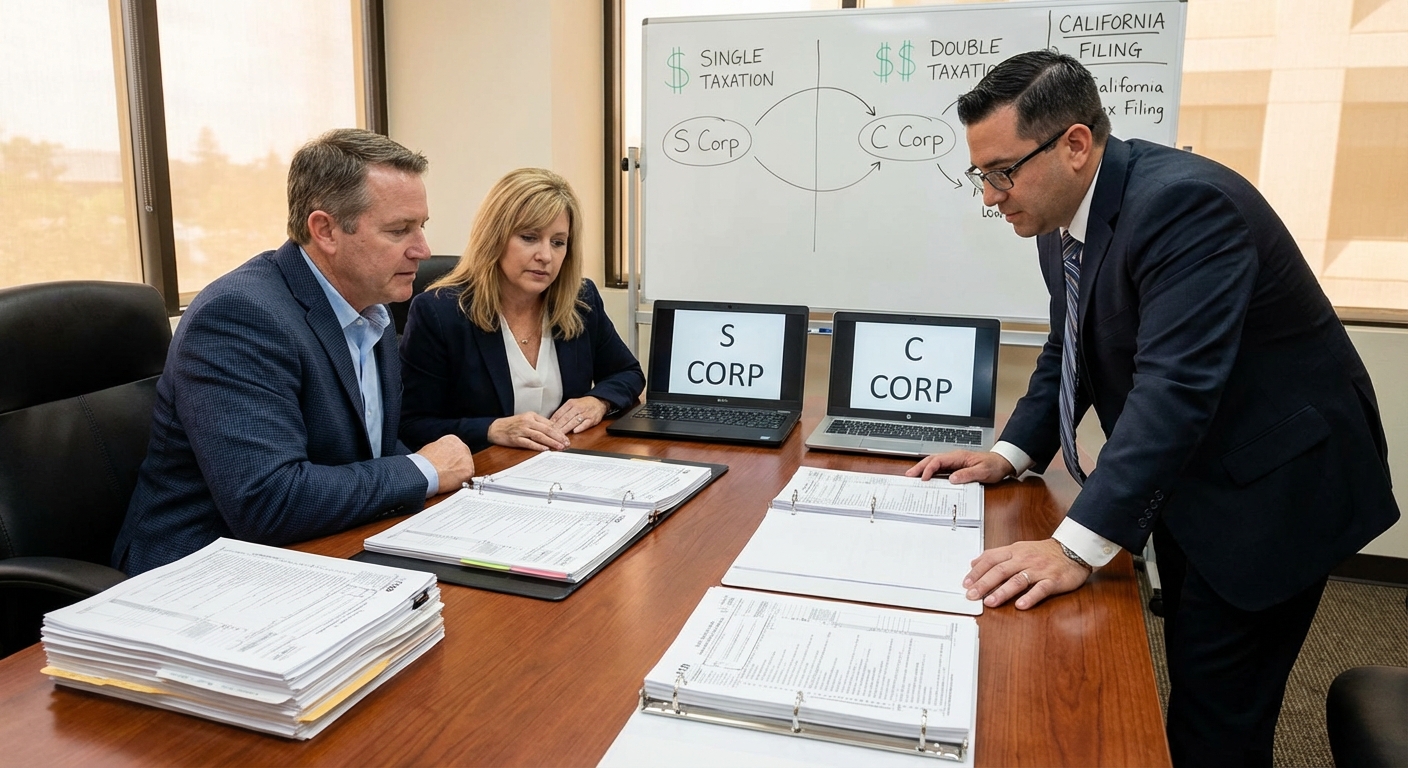
The Real Stakes of Choosing Subchapter S Corporation vs C-Corp for 2026: What California Owners Are Never Told
If you’re running a business in 2026, odds are you’ve debated whether to set up as a subchapter S corporation vs C-Corp. Most California owners pick based on rumors, Facebook group threads, or what their friends did—not hard numbers. The harsh reality: the wrong entity could mean double taxation, lost deductions, and a mountain of paperwork you could have avoided. The right move can save $25,000 (or more) every single year. Here’s what you won’t hear from generic accountants or templated legal sites.
Quick Answer:
A C Corporation pays corporate tax on all its profits, and you (as the owner) pay tax again when you take money out as dividends—usually 21% corporate level, plus 15–23.8% on qualified dividends federally, plus California tax. A Subchapter S Corporation, meanwhile, passes all profits through to owners’ individual returns, so income is only taxed once, but S Corps face tight eligibility rules and specific salary requirements you must follow. Most business owners save thousands annually with an S Corp but risk IRS audits if they miss the fine print.
The real decision in subchapter s corporation vs c-corp planning is whether profits are meant to support an owner or compound inside an entity. Under IRC §11, the C-Corp’s 21% rate only works if earnings stay retained; once dividends are paid, IRC §§301–316 trigger a second tax that most California owners underestimate. S Corps sacrifice flexibility in exchange for cleaner, single-layer taxation.
Inside the IRS Rules: What Is a Subchapter S Corporation vs C-Corp?
Let’s get clear on definitions, because the IRS is obsessed with these terms. A C Corporation (C Corp) is the baseline corporate structure under federal law—taxes paid at the company level, then again by shareholders on dividends. This is the “double taxation” penalty. Subchapter S Corporation (S Corp) refers to a C Corp or LLC that has made the IRS S election (using Form 2553), allowing profits and losses to “pass-through” directly to owner tax returns without a corporate-level tax. But S Corps are not immune—they come loaded with strict ownership, paperwork, and payroll requirements.
Here’s a side-by-side comparison to clear the confusion:
| Category | C Corporation | S Corporation |
|---|---|---|
| Taxation | Double tax: corporate (21%) + individual | Single tax: owner pays directly |
| Owners | Unlimited, anyone (even foreign) | 100 max, only U.S. people |
| Ownership Types | Individuals, entities, trusts | Individuals, a few trusts—no entities |
| Profit Distribution | Any way, flexible | Must match share ownership (%) |
| Franchise Tax (CA) | $800 minimum, extra on net income | $800 minimum + 1.5% of net CA income |
| IRS Scrutiny | High if distributions to owner-officers | Very high on “reasonable salary” |
Key Takeaway: S Corps are almost always the better choice for owner-operators making over $80,000/year—if they run payroll right. But C Corps still make sense for high-growth startups, international businesses, or companies keeping profits inside the business long-term.
KDA Case Study: S Corp Rebuild for a Los Angeles Agency Owner
Persona: LLC owner, $220,000 profit, consulting agency, California resident
Jasmine owned a marketing agency in Los Angeles, clearing $220,000 of profit per year—initially structured as a C Corp on her lawyer’s advice. After C Corp taxes and then dividend taxes, Jasmine kept roughly $127,000. She came to KDA frustrated with high double-tax penalties. Our team calculated she could legally reclassify as a Subchapter S Corporation, set a $95,000 “reasonable salary,” and route the remainder ($125,000) as S Corp distributions not subject to self-employment tax. This switch put an extra $27,900 in Jasmine’s pocket after accounting for FICA, state, and local taxes. Jasmine paid KDA $3,500 for the restructuring and ongoing compliance, netting an 8x return in her first year. With advanced planning, we also secured retroactive S Corp election and avoided IRS late election penalties (see Form 2553 rules).
Ready to see how we can help you? Explore more success stories on our case studies page to discover proven strategies that have saved our clients thousands in taxes.

How C Corps and S Corps Really Tax Your Profits in 2026
This isn’t theoretical—here’s a breakdown of two $200,000 profit scenarios for a single-owner business in California for 2026:
- C Corp:
- Paid $200,000 in profits
- 21% federal corporate tax = $42,000
- Net $158,000, distributed as dividends
- 15% federal dividend tax = $23,700
- California taxes (state corporate & personal) = ~$13,000+
- Owner keeps: ~$121,300 after all taxes
- S Corp:
- Set $90,000 as “reasonable salary” (runs through payroll, FICA applied)
- Remaining $110,000 is S Corp distribution (no self-employment tax, single level of income tax)
- Federal and California tax combined: ~$55,500 on all income (salary + distribution)
- Owner keeps: ~$144,500 after all taxes (plus potential QBI deduction of 20%)
Simply put, running as a properly structured S Corp saves this owner $23,000+ in a single year. Multiply that by five years, and you’ve bought a house. If you mess up the S Corp, though—by skipping payroll, classifying non-qualified income, or violating ownership limits—the IRS can back-tax you as a C Corp plus penalties.
Red Flags and Hidden Risks: Why Owners Slip Up on the S Corp vs C Corp Choice
Most mistakes with S Corps fall into three traps:
- Paying owners only distributions and no salary—the #1 reason for IRS audits (see IRS S Corp guidance).
- Taking non-U.S. investors or more than 100 shareholders—violates S election status.
- Wrong tax year close or late S election filings—gets forced back into C Corp taxation.
Pro Tip: To avoid expensive errors, request help from a CPA who regularly files S Corp elections and payroll. Many online services file the forms but don’t audit your eligibility or payroll setup—which can cost you over $25,000 in retroactive taxes and penalties.
If you’re a California business owner thinking about switching—or currently stuck with C Corp consequences—our S Corp & entity planning team specializes in forensic eligibility reviews, payroll setup, and state tax compliance.
What Does California Do Differently with S Corps vs C Corps?
Both S Corps and C Corps pay the California Franchise Tax Board (FTB) a minimum $800 annual fee. S Corps pay an extra 1.5% tax on net California-source income, while C Corps pay a flat 8.84% state corporate tax. But the “double tax” wave is the federal layer—S Corp owners escape this if all rules are followed. Also, California doesn’t recognize federal S elections if you miss their paperwork deadlines (see California FTB guidance). This means you could face unexpected state double taxation even if you got it right with the IRS.
Our tax planning services can show you the exact California/IRS forms deadlines and the real after-tax impact based on your expected profits. For most owner-operators, the state-level S Corp tax is far less painful than getting hit with the federal C Corp double layer—and California compliance must be airtight to keep those savings.
For a complete breakdown of S Corp strategies, see our comprehensive S Corp tax guide.
Will This Trigger an Audit? S Corp and C Corp Red Flags in 2026
The IRS is increasing scrutiny on “reasonable compensation” for S Corp owners. If you’re taking all profits as distributions and a tiny salary, or if your S Corp distributes profits unequally among shareholders, these are audit magnets (see IRS audit red flags). C Corp owners often run into trouble for incorrectly classifying dividends as deductible business expenses. For S Corps, the main risk is failing to run payroll or missing S election deadlines. Get this wrong, and the IRS can revoke your S status retroactively—forcing years of double-tax C Corp treatment, plus penalties.
This information is current as of 1/30/2026. Tax laws change frequently. Verify updates with the IRS or FTB if reading this later.
FAQ: S Corp vs C Corp Entity Decisions for 2026
Who should pick a C Corp over an S Corp?
If you have multiple classes of stock, plan to take on venture capital, want unlimited growth or plan to keep earnings inside the corporation, a C Corp often makes more sense. If you’re aiming for a pass-through, single-tax profile, and want maximum after-tax distributions, S Corp usually wins for small and mid-sized owner-operators.
Can I switch back and forth between C Corp and S Corp?
You can—but switching to an S Corp requires IRS approval using Form 2553 (must file by March 15 of that tax year unless you want late-election headaches). Switching from S to C is easier, but be careful of built-in gains tax and potential double taxation during the conversion year.
What’s the penalty for missed S Corp payroll?
The IRS can reclassify your S Corp distributions as “wages,” hit you with payroll tax penalties, and revoke your S election for persistent noncompliance. This often leads to a tax bill of $15,000–$50,000+, including penalties and back taxes.
What happens if I have foreign shareholders in my S Corp?
S Corps are immediately disqualified if you add non-U.S. shareholders. At that point, you revert to C Corp taxation for the entire year, which can be catastrophic for tax planning purposes.
Does California recognize federal S Corp elections?
Yes, but paperwork must be filed correctly and on time with the Franchise Tax Board. Miss it, and you face double taxation at both state and federal levels even if IRS accepted your election.
Common Mistakes Owners Make When Choosing S Corp or C Corp
- Ignoring the impact of “reasonable compensation” payroll for S Corp owners
- Overlooking deadlines for state and federal S Corp elections
- Assuming you can add international owners to an S Corp
- Not tracking California’s unique S Corp tax rules (such as the 1.5% tax on profits)
- Attempting “DIY” conversion without a qualified tax strategist—can trigger audit or penalties
Bottom Line: Always work with a tax professional who does hundreds of entity setups and restructures every year—generic lawyers or software can’t keep up with the year-by-year IRS rule changes.
Book Your Entity Transformation Session
If your current business structure is costing you thousands in double taxes or missed deductions, don’t guess—book a strategy session with our entity specialists. We’ll customize a plan, check all California and IRS deadlines, and give you a clear path to keep more profit for 2026. Click here to book your consultation now.



