
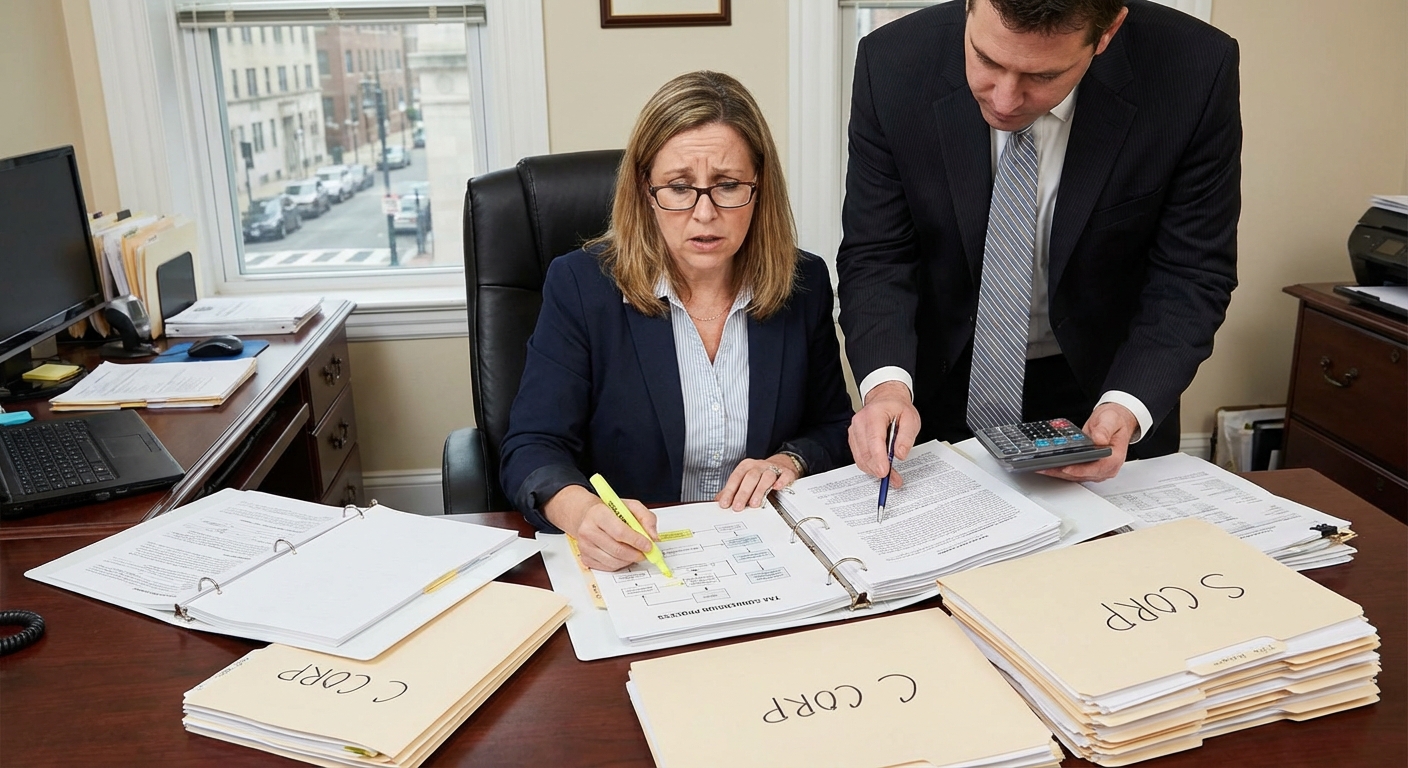
The Hidden Landmines of Converting a C Corp to an S Corp: California’s 2026 Survival Guide for Business Owners
Most business owners assume flipping a C Corp into an S Corp is “just an election”—file a form, maybe pay a little tax, and enjoy perpetual savings on payroll and profits. The reality? One slip in this process triggers five- and even six-figure tax disasters most CEOs don’t see coming until it’s too late. If you run a profitable California corporation and are planning—or even considering—a move to S Corp status in 2026, you need to know the real-world traps, legal nuances, and IRS rules before signing anything.
Quick Answer: Transitioning from a C Corp to an S Corp unlocks major tax savings but involves hidden risks—such as built-in gains tax, lingering double-tax triggers, CA-specific FTB audits, and strict eligibility roadblocks. Strategic planning with clear books, IRS compliance, and California-specific guidance is the only way to avoid penalties or accidentally torpedoing your accumulated profits.
The biggest mistake owners make is treating tax issues in conversion of c corp to s corp as a filing exercise instead of a tax recognition event. The IRS doesn’t reset history just because you elect S status—built-in gains, accumulated earnings, and basis all carry forward under IRC §§1374 and 312. If you don’t model these exposures before filing Form 2553, you can permanently lock in taxes you thought you were escaping.
This guide breaks down everything a business owner, financial controller, or solo entrepreneur must know to avoid disaster—and ethically stack the deck in your favor.
This information is current as of 1/14/2026. Tax laws change frequently. Verify updates with the IRS or FTB if reading this later.
How the C Corp to S Corp Conversion Works (and Why It’s Complicated)
At face value, converting a traditional C corporation into an S corporation is accomplished by filing IRS Form 2553 and, in California, submitting FTB Form 3560. But this is just paperwork. The real complexities start with what your corporation owns, owes, or earns on the day of conversion.
- Built-in Gains (BIG) Tax applies to appreciated assets held at conversion—meaning if you sell for a gain in the next five years, you pay corporate-level tax on the appreciation that occurred while you were a C Corp.
- California’s Franchise Tax Board (FTB) has additional reporting and minimum tax rules for both C and S Corps, with severe enforcement on improper conversions.
- Converted S Corps must pass eligibility tests—too many shareholders or ineligible owners block the switch entirely or create a nullified election, which can have disastrous ramifications.
This is where tax issues in conversion of c corp to s corp become financially lethal for asset-heavy businesses. The built-in gains tax applies at the entity level—even after conversion—meaning shareholders pay tax on profits that never reach their personal returns. Many owners don’t realize they’re effectively carrying a five-year corporate tax time bomb after becoming an S Corp.
If you’re a business owner asking, “Will my accumulated C Corp profits escape double taxation if I switch now?” the answer is almost always a resounding “NO”—unless you plan this with precision.
Example:
Karen, owner of a tech C Corp in San Jose with $2.4 million in retained earnings and $1 million in equipment (which has appreciated $600,000 since purchase), plans to convert into an S Corp in January 2026. If she liquidates or sells her equipment post-conversion, the $600,000 appreciation is subject to both the C Corp built-in gains tax and, potentially, double tax exposure if distributed as a dividend. In contrast, profits built after conversion may be distributed tax-efficiently. That sharp divide is the minefield.
What Triggers Tax on the Day of Conversion?
When switching to an S Corp, the IRS sets a built-in gains recognition period—currently five years. In that window, if your S Corp sells any asset valued higher than its “tax basis” on the conversion date, the built-in gain is taxed at the highest corporate rate (currently 21% at the federal level).
California stacks additional pain on top: The FTB recognizes these unrealized gains and may subject them to the 8.84% corporate tax during the same window. These taxes are paid at the entity level, not by shareholders individually. For major asset holders—like real estate firms, tech companies, or service providers with valuable IP—this can result in combined tax hits north of $200,000 for mid-sized conversions.
The critical variable is “tax basis”—a technical term meaning what you originally paid for an asset (minus depreciation, plus improvements). If you’re unsure what your assets’ basis is, you’re flying blind. That’s a classic conversion audit trigger.
How to Beat the Built-In Gains Tax (BIG Tax)
- Do NOT convert to S Corp if you anticipate selling major assets in the next five years. Wait it out as a C Corp, or sell before conversion.
- Have a qualified professional do a step-up in basis review on all depreciable property—some assets may qualify for Section 179 or bonus depreciation that can offset gains.
- Document liabilities and contingent liabilities at conversion—for instance, legal settlements or unrecorded tax debts also carry forward.
Strategic tax planning can save $50,000+ on a standard $300,000 gain. See IRS Publication 542 for supporting regulations and reporting requirements.
For a comprehensive breakdown of S Corp strategies, see our comprehensive S Corp tax guide.
KDA Case Study: Doctor’s C Corp Navigates S Corp Trap and Saves $97,300
Dr. “Mike” runs a private dental practice as a C Corp in Los Angeles, with $780,000 annual profits and about $320,000 in retained earnings as of 2025. Frustrated with double-taxed distributions (totaling about $45,000/year), he approached KDA for help converting to an S Corp while minimizing exposure. KDA constructed a two-phase plan: 1) He distributed most C Corp profits as bonuses (which were deducted at the C Corp level, reducing retained earnings) just before the conversion window, dropping exposure for the post-election period; 2) KDA tracked and documented the basis for all practice equipment, ensuring that any post-conversion sale during the five-year BIG window would be essentially break-even for tax purposes. KDA also helped file an IRS Private Letter Ruling request to clarify eligibility. Dr. Mike ended up saving $66,700 in federal built-in gains tax, $30,600 on California FTB taxes, and cut his ongoing tax bill by $42,000 yearly—paying KDA less than $11,000 for the whole process, a return of over 9x his investment.
Ready to see how we can help you? Explore more success stories on our case studies page to discover proven strategies that have saved our clients thousands in taxes.
The “Ineligible S Corp” Problem: Shareholder, Stock, and Entity Traps
Red Flag Alert: Not all C Corps can become S Corps, and many businesses wreck their tax status by missing these details:
- Maximum 100 shareholders, all must be U.S. citizens or residents
- Only one class of stock allowed (no preferential dividends or convertible shares)
- Certain types of trusts, partnerships, and foreign owners are strictly forbidden from holding S Corp shares
If you convert and realize afterward you had an ineligible shareholder or security on your books, the IRS can terminate your S Corp election retroactively—instantly creating a multi-year tax nightmare with back taxes, penalties, and interest. This is where off-the-shelf legal forms and “DIY” conversions can destroy a business.
Among the most dangerous tax issues in conversion of c corp to s corp is a defective election. If the IRS later determines you had an ineligible shareholder, second class of stock, or improper ownership structure, it can retroactively terminate S status—reclassifying years of income as C Corp income with penalties and interest. At that point, the tax damage is no longer reversible.
Pro Tip: Before filing, perform a detailed “S Corp Qualification Audit” to document all owners, citizenship, and share classes. Fix issues BEFORE you convert, not after.
If you’re unsure about your eligibility or entity setup, our entity formation services can help ensure you’re bulletproof before the IRS or FTB ever look at your file.
FAQ: The Most Costly Mistakes When Converting from C Corp to S Corp
What happens to accumulated C Corp earnings after I convert? They remain double taxed when distributed, unless you clear them out beforehand using salaries, bonuses, or dividends prior to S Corp election. Distributions of post-conversion profits are single-taxed, but old retained earnings are always double-taxed if disbursed.
One of the most overlooked tax issues in conversion of c corp to s corp is that retained earnings don’t magically become tax-free. Under IRC §312, those earnings remain “tainted” as C Corp profits and are still subject to double taxation when distributed—even years after conversion. Owners who don’t deliberately drain or restructure retained earnings before the election often discover they’ve just deferred, not eliminated, the tax.
Will California’s $800 minimum franchise tax still apply? Yes. Every S Corp in California pays the $800 minimum tax per year, or 1.5% of net income, whichever is greater. See FTB guidance on S Corps for specifics.
Is there an IRS form for this conversion? Yes. You must file Form 2553 with the IRS and, if late, include a reasonable cause letter. For California, file FTB Form 3560. Both have strict deadlines—typically within two months and 15 days after the intended start date.
Can I convert back from S Corp to C Corp later? Yes, but this is not a “free” change. The conversion locks you out of S Corp status for five tax years if revoked, and doing so can create further built-in gain tax traps. Only switch back if there’s a compelling business or tax reason, and never without a full forward-looking plan.
What the IRS Won’t Tell You: How Post-Conversion Transactions Trigger the BIG Tax
The IRS doesn’t handhold—if you sell appreciated property after the S Corp election, you can get stung even if you didn’t know about the built-in gains tax. Real-world trap: Selling business real estate for $400,000 above tax basis in year three after conversion means $84,400 in federal and California entity-level taxes— owed even if the property was originally purchased by the C Corp a decade ago.
Document your fixed assets, know your basis, and never trigger major sales casually in the first five years after conversion. If your business is holding appreciated assets, run all planned transactions by a qualified tax strategist before execution.
Action Plan for a Smooth C Corp to S Corp Conversion in California
- Audit ownership and share structure in advance
- Clear out C Corp retained earnings before conversion—use legal methods, like bonuses or dividends, to avoid post-conversion double tax
- Perform thorough basis analysis for all property, equipment, and intangibles
- Coordinate IRS and FTB filings—deadlines matter
- Engage a tax pro who has converted dozens of C Corps to S Corps (not just an accountant who does one a year)
If you want a step-by-step estimate of your entity’s potential tax bill post-conversion, use this small business tax calculator.
Will This Trigger an Audit?
The IRS and FTB have stepped up enforcement of improper entity conversions in California, especially with the economic ripple of 2022-2025 legislative changes. Your conversion is most likely to trigger a state audit if:
- There are changes to beneficial ownership or shareholder citizenship issues
- Your prior-year C Corp filings show unusually large distributions, retained earnings “zeroed out” suddenly, or property sales at conversion
- Your books or depreciation schedules are incomplete or inconsistent
A conversion handled poorly can easily lead to back taxes, penalties, and years of wasted ROI on your new S Corp status. Plan proactively. Audit-proof your transition with documentation, legal oversight, and timely filings.
Bottom Line for Owners Ready to Convert in 2026
Converting from C Corp to S Corp is not a DIY project—the tax, legal, and state compliance risks are too great. Most success stories are built on a multi-year plan, surgical payout structuring, and detailed basis documentation. The path is lucrative but lined with traps for the unprepared. If you’re earning $200,000+ in net profits as a C Corp and you’re tired of double taxation, S Corp conversion could save you $30,000+ per year in the right hands—just not if you skip any of the steps above.
Book a C Corp to S Corp Strategy Call
Don’t risk retroactive IRS penalties or miss your shot at slashing double taxation. Our team specializes in California entity conversions and audit-proof tax planning. Book a personalized session with KDA’s senior strategists and get mapped action steps for your specific situation. Click here to secure your strategy session now.


