
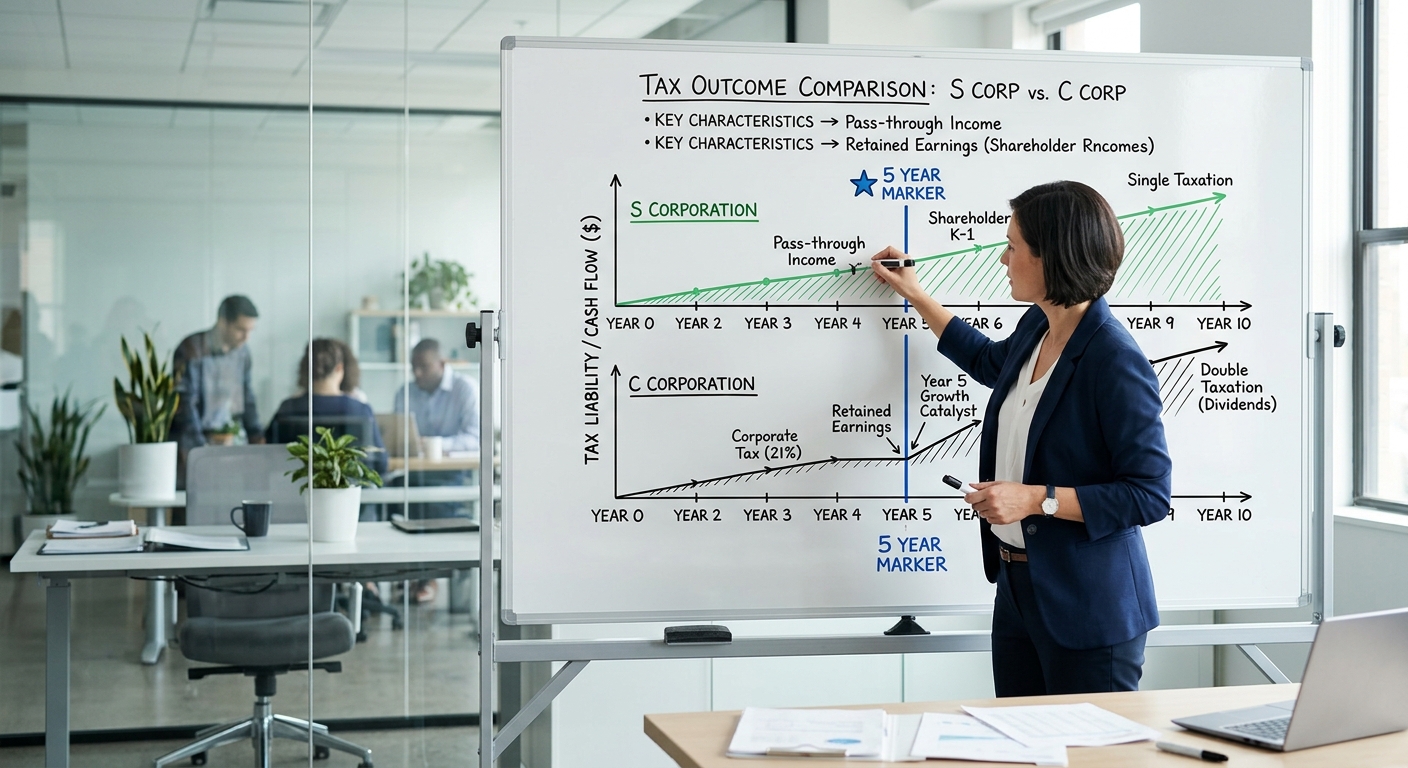
When owners think about changing their S corporation election, they usually focus on this year’s tax bill and ignore the long tail of consequences. Moving from an S corporation back to a C corporation touches distributions, built in gains, reasonable compensation, and future exit options, and the five year waiting rule controls how flexible you really are. If you understand how the s corp to c corp 5 year framework works, you can decide whether a one time tax benefit is worth locking in a multi year structure.
Quick Answer
Switching from S corporation status to C corporation status triggers a five tax year cooling off period under Internal Revenue Code section 1362(g). In plain English, once you terminate your S election and become a C corporation, you generally cannot re elect S status again until five tax years have passed. During that period, you live with C corporation double taxation, different distribution rules, and separate planning for built in gains and losses. The choice can be smart in specific situations, but it is not reversible on a whim.
How the s corp to c corp 5 year rule actually works
Section 1362 sets out when you can make or revoke an S corporation election. Subsection (g) imposes the five year restriction. If an S election is terminated voluntarily by the shareholders or automatically by failing eligibility tests, the corporation generally cannot elect S status again until the fifth tax year after the year of termination.
For example, assume a calendar year S corporation revokes its election effective January 1, 2026. Tax years 2026, 2027, 2028, 2029, and 2030 must be C corporation years. The earliest new S election can be effective is January 1, 2031. That is the practical meaning of the five year window. There are limited relief provisions if the IRS agrees the termination was unintentional, but you should never count on that outcome when you are doing proactive tax planning.
This rule is separate from, but often confused with, the built in gains tax regime under section 1374. As of recent law changes, the built in gains recognition period is generally five years as well, but it applies when you go from C to S, not the other way around. You always need to distinguish the five year waiting rule for a fresh S election from the five year recognition period for old C corporation gains.
S corporation rules are collected in several IRS resources, including Form 2553 instructions and Publication 542 on corporations. They do not give you strategy though; they only give you mechanics. Strategy is what determines whether you should accept a C corporation regime for the entire five year block or keep your S corporation status and solve problems a different way.
Tax planning reasons to move from S corporation to C corporation
Owners normally elect S status to avoid double taxation and reduce self employment tax through reasonable salaries plus distributions. So why would anyone choose to revoke that election knowing the s corp to c corp 5 year rule locks them into C status for a long stretch?
Retaining earnings at a lower corporate rate
One reason is cash retention. C corporations pay their own income tax and can keep after tax profits in the business. If the federal corporate rate plus your state rate is meaningfully lower than your personal bracket, it can sometimes make sense to keep profits in a C corporation during heavy growth years instead of passing every dollar through to your individual return.
Consider a married couple in California with an S corporation making $800,000 of net profit. Pass through income of that size can easily land them in the 37 percent federal bracket plus over 10 percent state tax. If the business will reinvest $500,000 back into equipment and staff, but not immediately, running that income through a C corporation at a 21 percent federal rate plus state corporate taxes might reduce the current year tax bill by tens of thousands of dollars. The trade off is that future dividends will be taxed again when profits are distributed, and the five year lock makes this structure sticky.
If you are a growth focused owner in this situation, it is worth talking with a firm that focuses on business owners and understands how corporate level planning fits into your bigger picture. Too many advisers still default to S corporation status without modeling C corporation outcomes over several years.
Resetting shareholder mix or capital structure
S corporations are limited to one class of stock and have strict shareholder eligibility rules. You cannot bring in nonresident aliens, corporate investors, or partnerships as owners without destroying S status, and you cannot create preferred shares with different economic rights. Some founders intentionally revoke their S election to raise capital, issue preferred shares, or bring in institutional or foreign investors. Once they make that move, the s corp to c corp 5 year clock starts and they live with C corporation rules for the foreseeable future.
When complex capital structures and growth financing enter the picture, tax planning and entity structure decisions should be coordinated. In many cases it makes sense to pair this with formal tax planning services so you see hard numbers on how C corporation status will affect salaries, dividends, and exit taxes before you file anything.
KDA Case Study: High income S corporation owner evaluates a five year C corporation window
Here is a real world type scenario. A California software consultant operates through an S corporation with $1.2 million of annual net profit after paying herself a $200,000 W 2 salary. Her pass through income pushes her into the top federal and state brackets, and she feels the cash strain of quarterly estimated tax payments. At the same time, the business plans a multi year investment cycle building a new product line that will require roughly $500,000 of reinvested profit per year for the next three years.
She approached KDA to ask whether revoking her S election and operating as a C corporation for at least five years would ease the personal tax burden during the build out period. We modeled side by side projections showing five years as an S corporation versus five years as a C corporation under the s corp to c corp 5 year framework. In the C corporation model, the company paid corporate tax at 21 percent on retained earnings earmarked for reinvestment, with no dividends for the first three years. In the S corporation model, all income still landed on her Form 1040, generating immediate personal tax each year.
Over the full five year period, the projections showed roughly $210,000 of tax savings in present value terms by using a C corporation, even after accounting for eventual qualified dividends in years four and five. Professional fees for the restructuring, projections, and ongoing planning totaled about $35,000, leaving a net benefit of around $175,000. On top of that, the owner appreciated the psychological relief of not seeing such large K 1 numbers while she was investing heavily back into the company.
Ready to see how we can help you? Explore more success stories on our case studies page to discover proven strategies that have saved our clients thousands in taxes.
Red Flag Alert: Common mistakes when revoking an S election
Revoking S status is simple mechanically but risky if you have not mapped out the s corp to c corp 5 year consequences. Shareholders often sign a revocation letter without thinking through distributions, basis, and compensating themselves properly in the new C corporation environment. Here are traps we see often.
Ignoring accumulated adjustments account and basis
The accumulated adjustments account, or AAA, tracks post election S corporation earnings that have not yet been taxed to shareholders. When you terminate S status, distributions from the former S corporation can still come out of that AAA balance tax free or as capital gain rather than dividends if they happen in the right order and within a specific time frame. If you ignore AAA and later make distributions as a C corporation, shareholders may pay higher dividend tax than necessary.
Owners should plan whether to make a final S corporation distribution before revocation to clean out AAA, or whether to preserve some balance for later use if permitted. These decisions hinge on shareholder basis, state tax rates, and projected dividend patterns. IRS Publication 541 and Schedule K 1 instructions describe the technical ordering rules, but a seasoned adviser translates them into a distribution calendar you can actually follow.
Failing to adjust compensation strategy
In an S corporation, the IRS focus is making sure owner employees pay themselves a reasonable W 2 salary so they cannot dodge payroll tax by labeling everything a distribution. In a C corporation, the tension flips. If you pull too much cash out as salary and bonuses, the IRS can challenge those payments as disguised dividends and deny the corporate deduction, especially in closely held companies.
After a status change, you should revisit officer compensation benchmarks, bonus structures, and fringe benefits. For C corporations, the IRS guidance in Publication 535 on business expenses is particularly relevant, because it outlines deductibility criteria for compensation and benefits. Getting this wrong for even one year inside the s corp to c corp 5 year window can wipe out any theoretical benefit you hoped to achieve.
How the five year rule affects future exit and estate planning
For owners building toward a sale event or succession plan, the five year restriction creates timing pressure. If you expect to sell company stock or assets within the next three to seven years, your decision to remain an S corporation or become a C corporation shapes after tax exit proceeds significantly.
Stock sale vs asset sale outcomes
Buyers often prefer asset purchases so they can step up basis in equipment, intangible property, and goodwill, and then claim depreciation and amortization. Sellers usually prefer stock sales because they produce long term capital gain and cleaner legal separation. S corporation status makes it easier to thread that needle with creative structures like section 338(h)(10) elections that treat a stock sale as an asset sale for tax purposes while keeping the legal form simple.
If you voluntarily become a C corporation and the s corp to c corp 5 year rule means you cannot switch back before an exit, you lose several flexible S corporation exit tools. A pure C corporation often faces double taxation in an asset sale: once at the corporate level on built in gain and again at the shareholder level when after tax proceeds are distributed.
Consider a California manufacturing firm with appreciated equipment and goodwill worth $8 million and almost zero tax basis. As an S corporation, a well designed sale structure can often produce a single layer of tax, resulting in maybe $2 million of combined federal and state tax and $6 million of net proceeds to the owners, depending on other factors. As a C corporation facing double tax on an asset sale, total tax could exceed $3 million, dropping net proceeds closer to $5 million. That is an enormous price to pay for a few earlier years of C corporation rate savings.
Estate planning and shifting future growth
Advanced estate strategies like freezing current value in one class of shares and shifting future appreciation to heirs or trusts interact differently with S and C corporations. Some common estate planning entities such as certain types of trusts are eligible S corporation shareholders, but others are not. If you change status and the five year rule keeps you in C corporation form, you have to coordinate corporate planning with your estate attorney more tightly.
High net worth business owners who expect liquidity events or generational transfers should work with an advisory team that includes tax strategists and estate counsel, not just a preparer. Firms that deliver premium advisory services are built for this kind of multi year, multi entity planning rather than just annual compliance.
Will the IRS ever let you back into S status sooner?
Business owners sometimes hope they can “try” C corporation status for a year or two and then ask the IRS for forgiveness if they do not like it. Under the statute, the default rule is clear: once an S election terminates, you are locked out of re electing S status for five tax years. There is a relief mechanism if the IRS agrees the termination was inadvertent, but that is aimed at accidental eligibility failures more than deliberate strategic revocations.
For example, if an S corporation accidentally issues a small number of shares to an ineligible shareholder and quickly corrects the mistake upon discovery, the corporation can file for relief to preserve S status. In contrast, signing a formal revocation because you wanted a temporary rate arbitrage is not inadvertent; it is intentional. The IRS has little reason to grant early re election in those cases, especially if doing so would reduce total tax over the five year span.
The takeaway is that you should treat the five year rule as effectively absolute when planning. If a strategy only works assuming you can flip back to S status in two or three years, it probably is not a real strategy at all. Build projections on the assumption that C corporation status will run the full s corp to c corp 5 year period and then compare that to staying S for the same time horizon.
How to model a five year C corporation scenario
Because the decision plays out over time, you need a structured way to compare scenarios. A simple year one tax comparison is almost always misleading. A better approach is to model at least five years of projected income, reinvestment, distributions, and potential sale events under both S and C structures.
Step by step framework for owners
- Project business profit and reinvestment needs for at least five years, including realistic ranges rather than a single number.
- Estimate your personal tax brackets each year assuming S corporation pass through versus C corporation salary plus dividends.
- Identify planned distributions to shareholders versus profits that can remain in the business for growth.
- Layer in potential sale events or recapitalizations, even if timing is uncertain.
- Quantify total tax over the full period under both structures, not just the first year.
If your business profit is relatively stable and you expect to withdraw most earnings each year for personal use, S corporation status often wins once you account for dividend taxation. If profit is lumpy and you can genuinely retain earnings long term, a carefully planned five year C corporation window may add up. Running your numbers through a small business tax calculator can help you sanity check assumptions before you pay for formal modeling.
What about California specific considerations?
California taxes both S corporations and C corporations, but in different ways, and those differences matter when thinking about the s corp to c corp 5 year decision. California S corporations pay a 1.5 percent entity level tax plus pass through income to owners who then pay individual tax. C corporations pay an 8.84 percent entity level tax, and individual shareholders pay tax on dividends separately.
For an S corporation, a $1,000,000 profit leads to $15,000 of California corporate tax plus individual tax on the $985,000 of pass through income. For a C corporation, the same profit produces $88,400 of California corporate tax, but if you retain all after tax earnings in the company and pay no dividends, the shareholder might not owe California tax on that business income for that year. Over a five year window, this difference can support the case for a C corporation in some growth scenarios, but the math shifts once you start paying dividends or planning an exit.
California also imposes an annual franchise tax and various filing obligations that apply regardless of federal status. If you are already doing business in the state, you will continue filing state returns whether you are an S or C corporation. The core question is not compliance burden; it is the pattern of entity level versus individual level tax over the five year block.
Will switching structures increase audit risk?
Any structural change that dramatically changes your tax profile can draw attention, but the IRS and state agencies care more about whether your reporting is consistent and supported than about whether you are an S or C corporation. The move itself does not automatically trigger an audit, but poor documentation and sloppy execution often do.
Red flag patterns include sudden drops in reported owner compensation without business justification, large related party transactions without clear terms, and unusual distributions before or after the status change. If you are moving into a five year C corporation window, it is especially important to document board minutes, valuation support for compensation and buyouts, and the business reasons for retaining earnings or paying dividends at each stage.
Firms that handle audit representation know the patterns that examiners focus on. Building your plan with that perspective from day one reduces the risk that your s corp to c corp 5 year strategy turns into an expensive controversy three years down the road.
Ready to Reduce Your Tax Bill?
KDA Inc. specializes in strategic tax planning for business owners, S Corps, LLCs, and high-net-worth individuals. Book a personalized consultation and walk away with a clear plan.
Frequently asked questions
Can I revoke my S election for one year only?
In practice, no. Once you revoke or terminate S status, the five year waiting rule applies. Even if you intend to “try C status” for one year and then go back, the law does not support that plan in most cases. You should assume that once you leave S status, you are committing to at least five years as a C corporation unless you qualify for narrow inadvertent termination relief.
Does the five year rule apply if I change entities entirely?
If you liquidate the corporation and start a brand new entity, different rules come into play, including potential recognition of gain on liquidation and the tax consequences of transferring assets. The IRS can also look through transparent attempts to circumvent the statute. Treat any drastic step like liquidation as its own complex transaction rather than a shortcut around the s corp to c corp 5 year requirement.
What if my income drops after I switch to a C corporation?
This is one of the biggest practical risks. If you move to C status during a boom year expecting high profits and then the business has lean years, you may find yourself paying corporate tax where pass through treatment would have been better. Because the five year rule prevents you from quickly flipping back, it is wise to build conservative and downside scenarios into your projections, not just best case outcomes.
Bottom line and next steps
The decision to revoke an S election and accept the five year restriction is not a simple rate comparison. It is a multi year strategy question that touches cash flow, exit timing, estate planning, and audit posture. Many owners would be better off tightening their S corporation salary strategy, cleaning up bookkeeping, or restructuring related entities rather than triggering the s corp to c corp 5 year clock without a clear, quantified benefit.
This information is current as of 6/9/2026. Tax laws change frequently. Verify updates with the IRS or your state tax authority if you are reading this later.
Book Your Tax Strategy Session
If you are weighing a status change and want real numbers instead of guesswork, sit down with a strategist who has built these models many times before. KDA’s team can walk you through five year S versus C projections, distribution planning, and exit scenarios tailored to your situation so you do not lock yourself into a structure that quietly drains your wealth. Click here to book your consultation now.



