
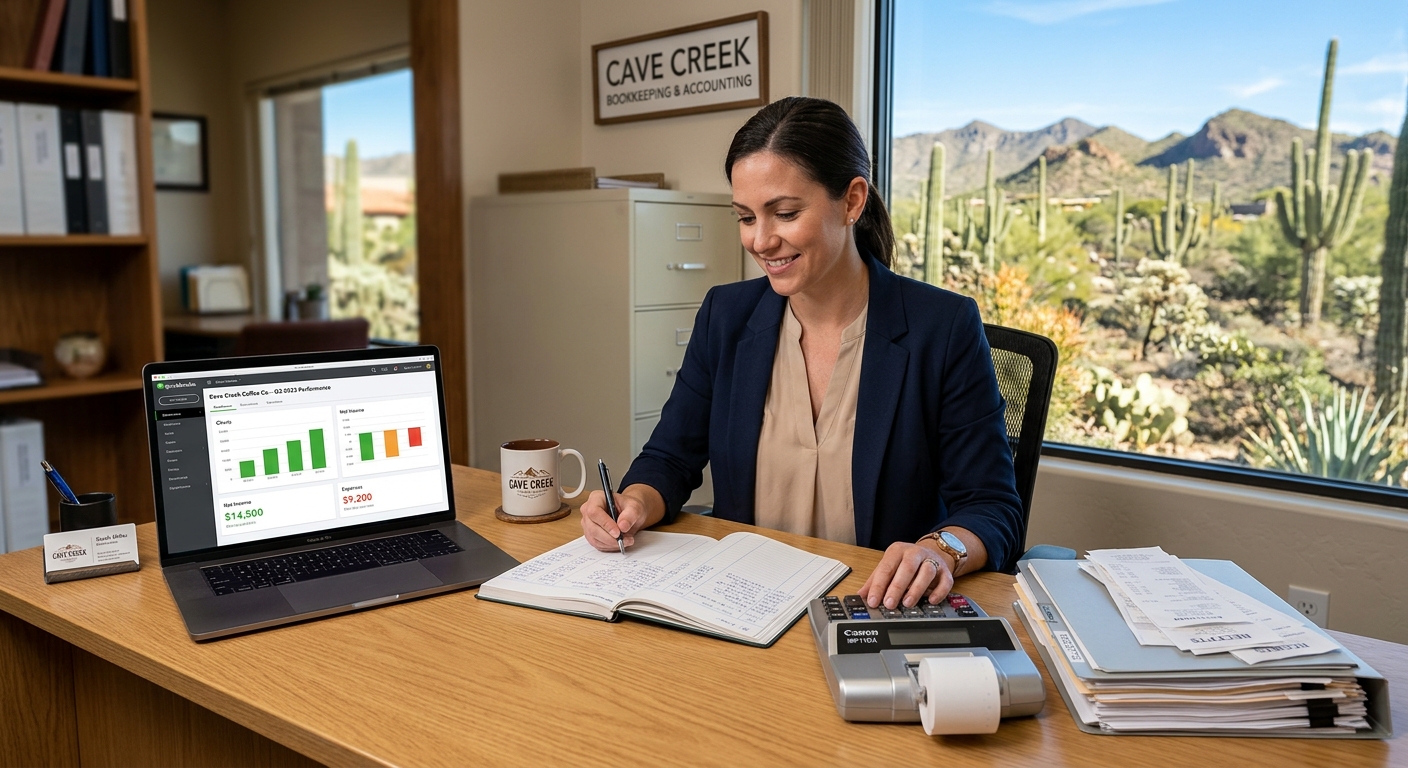
Most small business owners in the high desert don’t lose money because they aren’t working hard. They lose it because their books are a mess. If you run a company in the North Valley and you’re hunting for the best bookkeeping services in Cave Creek Arizona, you already sense the truth: disorganized records quietly drain thousands of dollars every year through missed deductions, late penalties, and bad decisions made on stale numbers.
This guide walks through exactly how clean bookkeeping turns into real tax savings, what the 2026 rule changes mean for your business, and how to know when it’s time to stop doing it yourself. No fluff, no jargon dumps. Just the plainspoken strategy we use with clients every single week.
Quick Answer
Good bookkeeping is not just data entry. It is the foundation that lets you claim every legal deduction, avoid IRS and Arizona Department of Revenue penalties, and make decisions based on accurate profit numbers. For most Cave Creek businesses, professional bookkeeping costs $300 to $800 per month and typically returns three to five times that in captured deductions and avoided mistakes.
Why the Best Bookkeeping Services in Cave Creek Arizona Matter More in 2026
Cave Creek sits in Maricopa County, a fast-growing corner of Arizona full of contractors, consultants, boutique retailers, hospitality operators, and real estate professionals. Every one of those business types faces the same problem: the tax code keeps shifting, and sloppy records make it impossible to keep up.
For the 2026 tax year, several changes make accurate books more valuable than ever. The dollar threshold for issuing Forms 1099-MISC and 1099-NEC jumped from $600 to $2,000 for payments made after December 31, 2025. That sounds like a break, but it means your records need to correctly track which vendors crossed that new line. Section 179 expensing limits also climbed to a $2.5 million deduction ceiling with a $4 million investment cap, giving equipment-heavy businesses in the trades a huge write-off opportunity, but only if your books cleanly separate capital purchases from routine expenses.
The IRS also quietly raised the standard mileage rate mid-year due to inflation. If you’re not logging business miles properly, you’re leaving deductions on the table. This is the real cost of weak bookkeeping. It is not the monthly fee you avoid. It is the deductions you never capture because nobody was tracking them.
This information is current as of 7/18/2026. Tax laws change frequently. Verify updates with the IRS or the Arizona Department of Revenue if reading this later.
What Clean Books Actually Do for Your Tax Bill
Let’s get specific, because “good bookkeeping saves money” is the kind of vague promise that puts people to sleep. Here is where the dollars actually come from.
1. Captured Deductions You Would Otherwise Miss
When your transactions are categorized correctly throughout the year, deductions surface automatically. Home office costs, software subscriptions, mileage, professional development, business meals, and merchant processing fees all add up. A contractor spending $18,000 a year on materials, tools, and vehicle costs who only reports $12,000 because the records were incomplete just handed the government tax on $6,000 of phantom profit. At a combined federal and Arizona rate, that is real money gone.
2. Penalty Avoidance
The IRS assesses failure-to-file and failure-to-pay penalties that stack fast. Arizona adds its own layer for late or incorrect filings. Clean books mean you file on time, file accurately, and never trigger the kind of mismatch that invites a notice. Prevention here is worth thousands.
3. Better Decisions From Real Numbers
You cannot manage what you cannot measure. When your profit and loss statement is accurate to the week, you know whether to hire, whether to raise prices, and whether that new truck is actually affordable. Guessing is expensive.
If you want to see roughly how your numbers translate into tax owed, you can plug your figures into a small business tax calculator to get a ballpark before you talk to a professional. It is a helpful reality check for owners who have never seen their true tax picture.
KDA Case Study: Cave Creek Contractor Recovers $11,400 in Missed Deductions
A general contractor operating out of Cave Creek came to us running roughly $420,000 in annual revenue through a single-member LLC. He was a classic 1099-heavy operator: crews, subcontractors, materials, and a work truck. His “bookkeeping” was a shoebox of receipts and a bank app he checked once a month. He had no idea what his real profit was, and his prior returns showed it.
When we rebuilt his books for the year, the problems were obvious. He had never separated capital equipment from supplies, so he missed a large Section 179 deduction on a $32,000 trailer and tooling package. His vehicle mileage was completely untracked. Dozens of subcontractor payments were miscoded, which also created a 1099 filing risk. And he had been paying self-employment tax on income that could have been restructured.
Our team cleaned up twelve months of records, properly classified his equipment for Section 179, reconstructed a defensible mileage log, and correctly categorized every vendor. The result was $11,400 in additional legitimate deductions in the first year alone, plus a clean set of books he could actually run his business from. He paid roughly $3,900 for the cleanup and ongoing monthly service. That is nearly a 2.9x first-year return before we even touched entity strategy.
Ready to see how we can help you? Explore more success stories on our case studies page to discover proven strategies that have saved our clients thousands in taxes.
DIY vs Professional Bookkeeping: A Straight Comparison
Plenty of Cave Creek owners start out doing their own books, and for a very early-stage side hustle, that can be fine. But there is a tipping point. Here is how the two approaches stack up.
| Factor | DIY Bookkeeping | Professional Service |
|---|---|---|
| Monthly cost | $0 to $50 software | $300 to $800 |
| Time cost | 8 to 15 hours/month | Under 1 hour/month |
| Deduction capture | Often incomplete | Maximized and documented |
| Audit readiness | Low | High, records defensible |
| Error risk | High | Low |
| Tax planning ready | Rarely | Always |
The math usually favors professional help once you cross roughly $75,000 in revenue or start hiring subcontractors. The hours you spend fighting spreadsheets are hours you are not selling, building, or serving clients. That opportunity cost is invisible but very real.
How to Choose the Right Bookkeeping Partner in Cave Creek
Not all bookkeeping is created equal. A data-entry service that just reconciles your bank account is very different from a tax-integrated bookkeeping team that sets you up to save money at filing time. Here is what to look for.
Should You Hire a Tax-Integrated Bookkeeper?
Yes, if:
- You have subcontractors or issue 1099s
- You buy equipment or vehicles for the business
- Your revenue exceeds $75,000 annually
- You want your books to feed directly into tax planning
Basic bookkeeping may be enough, if:
- You are a very early-stage solo operator
- You have simple, low-volume transactions
- You already work closely with a tax strategist separately
Step-by-Step: How to Vet a Bookkeeping Service
- Confirm tax integration – Ask whether their bookkeeping connects to actual tax planning, or if it stops at reconciliation.
- Check their software – QuickBooks Online or Xero should be standard. Ask how they handle receipts and mileage.
- Ask about 1099 tracking – Confirm they monitor vendor payments against the new $2,000 threshold.
- Review their cleanup process – A good partner will fix historical messes, not just start fresh and ignore the past.
- Verify local knowledge – They should understand Arizona filing requirements and Maricopa County business realities.
Our team specializes in exactly this kind of tax-integrated support. If you’d like to see the full scope of what we handle for businesses in the area, review our bookkeeping and payroll services and how they connect to year-round strategy.
Common Bookkeeping Mistakes That Cost Cave Creek Owners
These are the errors we see over and over. Each one is a leak in your financial bucket.
Mixing Personal and Business Accounts
Commingling funds is the single most common mistake. It muddies your records, weakens your liability protection, and makes deductions nearly impossible to prove in an audit. Open a dedicated business checking account and a business card, and run everything through them.
Ignoring Mileage and Vehicle Logs
With the IRS raising mileage rates in 2026, an untracked work vehicle is a large missed deduction. A contractor or realtor driving 15,000 business miles a year is potentially leaving several thousand dollars unclaimed.
Misclassifying Capital Purchases
Equipment, machinery, and vehicles may qualify for Section 179 expensing or bonus depreciation, but only if they are recorded correctly. Lumping a $30,000 trailer in with office supplies means you either miss the deduction or claim it wrong.
Falling Behind and Cramming at Tax Time
Reconstructing a year of records in April guarantees mistakes and missed deductions. Monthly bookkeeping keeps everything current and defensible. This is where a self-employed operator especially benefits, and our support for self-employed professionals is built around keeping you ahead of the deadline instead of scrambling.
What Happens If You Get This Wrong?
Weak bookkeeping is not a neutral choice. It carries real downside. If your records do not support your deductions and you get audited, the IRS can disallow them, add back the tax, and pile on penalties and interest. If you miss 1099 filing obligations for your subcontractors, you face per-form penalties that add up quickly. And if you underpay because your profit numbers were wrong, you can trigger estimated tax penalties on top of everything else.
Key Takeaway: The cost of professional bookkeeping is almost always smaller than the cost of the deductions, penalties, and bad decisions that come from doing it badly.
Ready to Reduce Your Tax Bill?
KDA Inc. specializes in strategic tax planning for business owners, S Corps, LLCs, and high-net-worth individuals. Book a personalized consultation and walk away with a clear plan.
Frequently Asked Questions
How much do bookkeeping services cost in Cave Creek, Arizona?
Most small businesses pay between $300 and $800 per month depending on transaction volume, number of accounts, and whether payroll is included. Cleanup of prior-year records is usually a separate one-time fee.
Do I need bookkeeping if I already have a tax preparer?
Yes. A tax preparer files your return based on the numbers you give them. If those numbers are wrong or incomplete, your return is too. Bookkeeping produces the accurate data your preparer depends on.
What is the difference between bookkeeping and accounting?
Bookkeeping records and categorizes daily transactions. Accounting interprets those records for tax filing, strategy, and financial reporting. You need clean bookkeeping first before accounting can do its job well.
Can bookkeeping really lower my tax bill?
Indirectly but powerfully, yes. Clean books surface every legal deduction, prevent penalties, and enable proactive tax planning. Businesses with organized records consistently pay less than those guessing at tax time.
What software should my Cave Creek business use?
QuickBooks Online and Xero are the two most widely supported platforms. The right choice depends on your industry, transaction volume, and whether you need payroll or inventory features.
When should I switch from DIY to professional bookkeeping?
The usual tipping points are crossing $75,000 in revenue, hiring subcontractors or employees, or reaching a point where books are eating more than a few hours of your time each month.
Will professional bookkeeping help me in an audit?
Absolutely. Organized, categorized, reconciled records with supporting documentation are your best defense. They turn an audit from a nightmare into a routine review.
Book Your Bookkeeping and Tax Strategy Session
If your books are a shoebox, a spreadsheet you dread, or an app you check once a month, you are almost certainly overpaying and underprotected. Let’s fix that before another deduction slips away. Our team will show you exactly where the leaks are and how much cleaner records could save your Cave Creek business this year. Click here to book your consultation now.



