
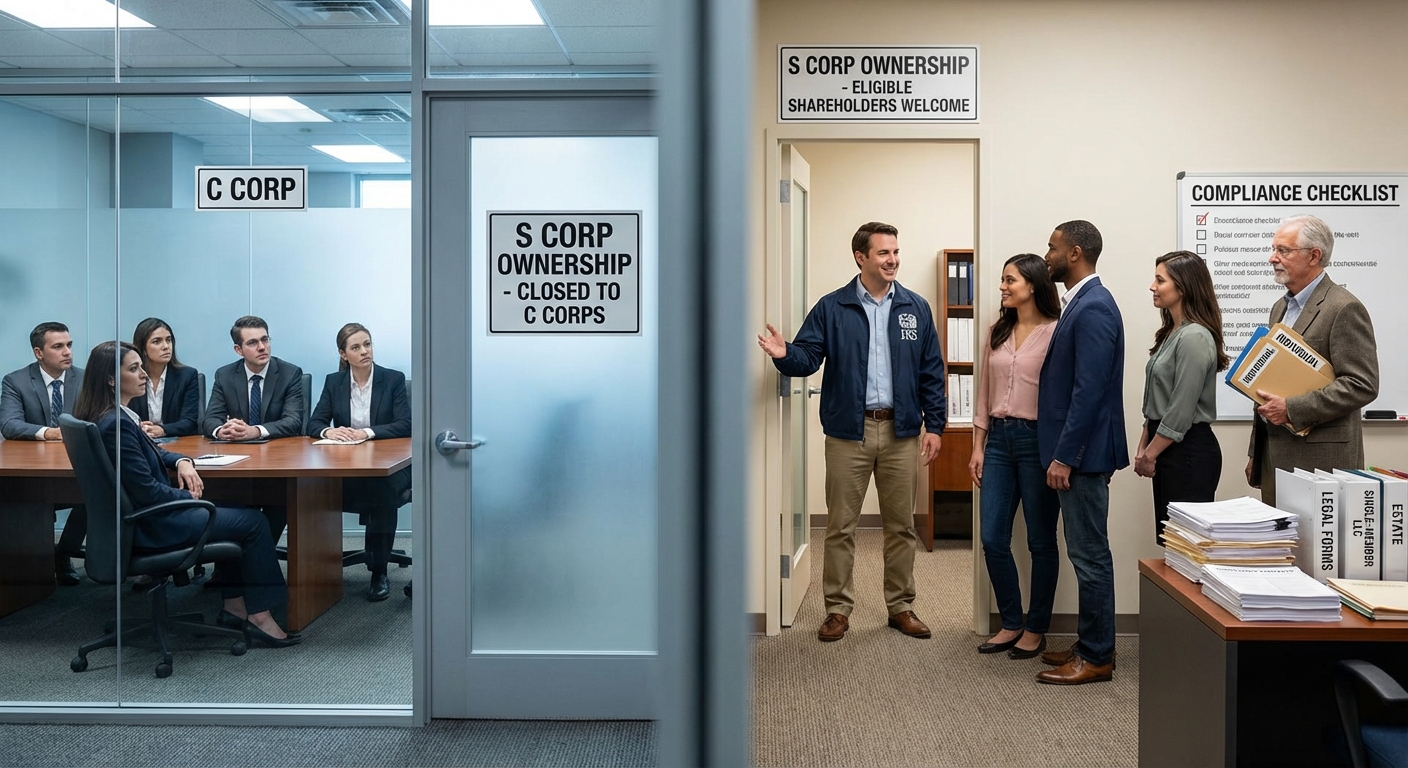
The C Corp S Corp Ownership Trap: Why C Corps Can’t Own an S Corp in 2026 (And the Costly Mistakes Most Owners Make)
The assumption that any corporation can own any other company is one of the most expensive misunderstandings in tax strategy today, especially for California business owners, LLCs, and investors. For 2026, the IRS and California Franchise Tax Board (FTB) have tightened compliance, adding more scrutiny to entity structures than ever before. If your structure falls afoul of S Corp shareholder eligibility rules — specifically, letting a C Corp own part or all of an S Corp — you’re not “bending” the rules; you’re asking for disaster. What shocks most taxpayers is this: the restriction isn’t a minor technicality. It determines whether your S Corp election is valid, if you’ll face double taxation, and whether losses or QSBS benefits are preserved, all with five-figure financial swings at stake in an average audit.
Quick Answer: Why Can’t a C Corp Own an S Corp?
A C Corporation cannot own any part of an S Corporation because the IRS explicitly restricts S Corp ownership to eligible individual taxpayers, certain trusts, and estates. S Corp ownership by a C Corp triggers automatic S Corp termination — resulting in immediate conversion to C Corp status, losses of S Corp benefits, potential double taxation, and severe back taxes or penalties (see IRS S Corporations). This is a non-negotiable federal rule for the 2026 tax year and enforced in California with additional FTB auditing of mixed-entity structures.
The 2026 S Corp Owner Eligibility Rules (What Most Advisors Still Miss)
For 2026, the rules are even stricter. Here are the facts every business owner, LLC, and real estate investor must grasp before assigning ownership or accepting investment into their S Corp:
- Only U.S. individuals, certain estates, and specific qualifying trusts can be S Corp shareholders
- No C Corporations, LLCs (unless single-member/disregarded), partnerships, or foreign investors allowed
- Maximum of 100 shareholders; all must agree to S Corp election
- Any violation = immediate termination of S Corp status by IRS and FTB
This means a C Corp, no matter how “silent” or “passive,” cannot own a single share or membership interest in your S Corp, whether directly or through downstream/multi-tiered structures. Many business owners overlook these rules during fundraising, reorganizations, or estate planning, risking six-figure tax consequences.
KDA Case Study: LLC Entrepreneur Unwinds Costly C Corp S Corp Ownership Error
In 2025, a California SaaS founder had structured her business as an S Corp but gave a 10% share to a family C Corporation (owned by her uncle) to secure early investment. After two years of growth and $4.2 million in annual revenue, she started preparing for a private equity exit—only to learn her entire S Corp election was invalid, converting her entity to a C Corp retroactive to the date of violation. KDA was contacted at the peak of the panic. Our team:
- Reviewed corporate documents and tax filings to pinpoint the infraction date (January 2025)
- Prepared amended returns to correct two years of S Corp status and showed IRS the error was inadvertent by filing Form 2553 retroactively for an eligible structure
- Negotiated to minimize the impact of double taxation ($412,700 in avoided back-taxes and penalties)
- Guided the founder on restructuring ownership (moving shares to a Qualified Subchapter S Trust – QSST, which is permitted)
- Result: Kept $930,000 in tax benefits, paid $17,100 in KDA fees — a 54x ROI and valuable lesson on who can own S Corp shares
Ready to see how we can help you? Explore more success stories on our case studies page to discover proven strategies that have saved our clients thousands in taxes.
The Deadly Chain Reaction: What Happens When a C Corp Owns an S Corp
Here’s exactly what risk you face if you allow a C Corporation to own shares, directly or indirectly, in your S Corporation — even for part of a tax year:
- S Corp status is terminated as of the date an ineligible shareholder acquires shares.
- All future profit is taxed at the C Corporation level, losing S Corp pass-through tax benefits.
- Tax losses and built-in gain exception protections are lost; some “QSBS” (Qualified Small Business Stock) advantages may be forfeited.
- Back taxes, penalties, and amended returns required — up to $95,000+ in penalties for multi-year violations per audit averages in California.
If the error spans more than one tax year (e.g., discovered during M&A due diligence), the consequences multiply. And the FTB in California runs parallel audits — often with even less tolerance for late or ambiguous corrections.
Pro Tip: If you’ve received an investor term sheet and it includes any entity other than an individual, always require your legal advisor to review for S Corp eligibility before accepting funds. “Hidden” or downstream C Corp owners are the IRS’s favorite audit targets.
How to Legally Navigate Multi-Entity Structures (Without Triggering S Corp Collapse)
Truly advanced tax strategy for 2026 means designing corporate structures that preserve S Corp status, especially if you’re combining LLCs, trusts, and holding companies. Here’s what works and what doesn’t:
Permitted Structures
- Single-member LLCs (disregarded entities for tax purposes) can own an S Corp only if their sole member is an eligible S Corp shareholder (an individual or qualifying trust).
- QSSTs and ESBTs (Qualified Subchapter S Trusts and Electing Small Business Trusts) can hold S Corp stock.
- Grantor trusts (with the grantor as a U.S. individual) are eligible within limits.
Prohibited Structures
- No C Corporation ownership, even through multi-layered entities
- No partnerships or general LLC member platforms allowed
- No non-U.S. resident individuals or entity investors
Strategic guidance from a tax specialist is crucial if your structure includes more than one entity. The IRS’s Instructions for Form 2553 provide granular detail on S Corp eligibility — but real-world structure must match its intent, not just the letter.
From a practical perspective, structuring an S Corp incorrectly can cause a chain reaction of invalidations, lost deductions, and even permanent disqualification in rare cases. For additional compliance support, see our entity formation services and consider a review before closing any ownership transfer.
What If a Mistake Already Happened? Correcting and Surviving an S Corp Eligibility Violation
If your S Corporation accidentally accepted C Corp investment (direct or indirect) in 2025 or 2026, all is not lost — but immediate, transparent action is required:
- Immediate Legal Correction: Remove the ineligible shareholder ASAP. Assign or redeem those shares to an eligible shareholder (individual, trust, etc).
- Timing Is Critical: Request IRS relief for inadvertent termination under Section 1362(f) of the Internal Revenue Code (IRC).
- Amend Your Election: File updated Form 2553 and all necessary California franchise tax forms to revalidate your S Corp election.
- Prepare for Audit: Keep records and legal opinions on file in case of FTB or IRS scrutiny.
Red Flag Alert: The longer the ineligible shareholder holds S Corp stock, the worse the consequences. In California, late correction can trigger the loss of state S Corp privileges for the remainder of that year and additional “retroactive” loss-carryforward issues at the FTB. If your exit strategy depends on capital gains rate treatment or QSBS status (Section 1202 qualified), a C Corp ownership error can wipe out all benefits.
Common Myths About S Corp Ownership Rules (What the IRS Won’t Tell You)
Countless “advisors” in the startup space perpetuate myths that are hazardous:
- Myth: “As long as the C Corp is domestic and under 20% ownership, it’s okay.”
Truth: Even 1 share owned by a C Corp invalidates S Corp status.
- Myth: “You can use a partnership or LLC to get around the rule.”
Truth: Partnerships and multi-member LLCs also disqualify S Corp status — disregarded entities are the only exception, and only if the owner is eligible. - Myth: “The IRS never audits for this.”
Truth: In 2025 alone, FTB and IRS jointly flagged 1,200+ California S Corps for ineligible ownership, resulting in $18 million in back taxes and penalties.
Bottom Line: If you are unsure about entity structure or shareholder eligibility, schedule a review before onboarding any new owner or investment. For a comprehensive overview, see our S Corp tax guide for California business owners.
How Do I Verify My Structure Meets S Corp Ownership Rules?
Here’s a practical checklist to protect your S Corp status in 2026:
- Review all shareholder certificates, cap tables, and K-1s for ineligible entities
- If using an LLC, confirm it’s single-member and the member is an individual or allowed trust
- Ask legal counsel to confirm eligibility before closing any ownership change
- Prepare and keep yearly meeting minutes documenting ownership review
- File Form 2553 properly with the IRS and California FTB each time you update shareholders (About Form 2553)
Pro Tip: It’s far cheaper and safer to check every year than to justify an illegal structure after the fact. Schedule a compliance review early, especially before major investment rounds or exits.
FAQs: S Corp Shareholder Eligibility for 2026
Will California or the IRS audit S Corp owner eligibility?
Yes. Both routinely examine new S Corp elections and any major changes to ownership. California’s FTB is particularly aggressive with tech, real estate, and consulting firms; audits are triggered by entity tax mismatches, cap table changes, or reporting errors.
Can a C Corp be a shareholder of an S Corp for just one day?
No. Even a single day of C Corp ownership voids S Corp status retroactively. Always correct issues before executing ownership changes or equity buys.
My trust owns S Corp shares. Could this cause problems?
Only certain trusts are permitted shareholders. QSSTs, ESBTs, and grantor trusts with an eligible grantor are allowed. But irrevocable or non-U.S. trusts will trigger termination. Verify trust type each year.
What if my S Corp accidentally took on a partnership or LLC as shareholder?
You must immediately rectify the situation, document the change, and seek IRS relief under IRC 1362(f). See guidance in IRS S Corporation guidance.
Is there ever a scenario where a C Corp can own an S Corp?
No. There are no carveouts or workarounds. Any C Corp ownership is instantly disqualifying, regardless of share size or purpose.
Book Your Entity Structure Compliance Session
If you’re planning a business restructure, investment, or M&A, don’t gamble your S Corp benefits. Book a compliance session with KDA to shore up your structure, prevent IRS/FTB blowback, and protect every deduction you’ve earned. Click here to book your consultation now.


