
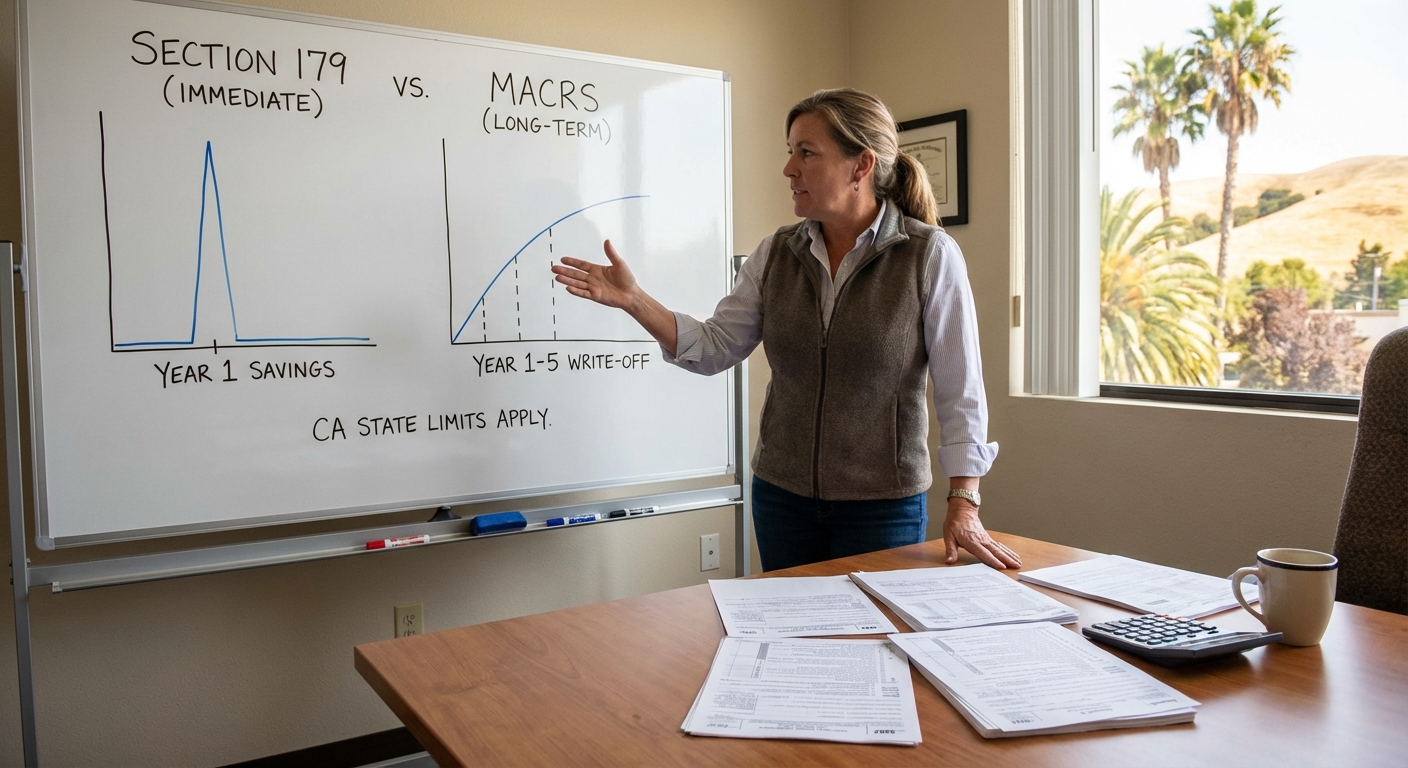
The Brutal Truth About Section 179 Deduction vs MACRS in California: Why Most Business Owners Pay Too Much in 2025
Here’s the dirty secret: the wrong depreciation move can push your tax bill up by $17,000 or more, even if you think you’re savvy. Most California business owners believe that “depreciation math” is for CPAs. Big mistake. The wrong decision—Section 179 deduction or Modified Accelerated Cost Recovery System (MACRS)—has real cash consequences. And the IRS is ratcheting up compliance checks for anyone claiming large deductions in 2025. If you’re not weighing federal vs. California differences, you’re burning money.
Featured Snippet Quick Answer: For 2025, the Section 179 deduction lets you immediately expense qualifying equipment up to $1,220,000 federally (phases out after $3,050,000 in total purchases). MACRS offers slower, multi-year depreciation. California limits Section 179 to just $25,000 per year and rarely allows bonus depreciation, unlike the federal rules. Choosing the wrong method could mean thousands in wasted deductions or higher risk of audit.
This article rips apart the myths, clarifies the federal v. California rule split, and gives you step-by-step tactics—so you keep more cash. If you’re a business owner, real estate investor, or 1099 pro, read every word.
This information is current as of 2/12/2026. Tax laws change frequently. Verify updates with the IRS or FTB if reading this later.
Section 179 Deduction vs MACRS: Core Definitions and Immediate Differences (2025)
Let’s get the basics squared away. Section 179 deduction is a federal tax rule that lets businesses write off the full cost of qualifying equipment and software in the year it’s placed in service, up to $1,220,000 for 2025. But in California, Section 179 tops out at $25,000 per year—no, that’s not a typo. The MACRS (Modified Accelerated Cost Recovery System) is the IRS’s main depreciation method, spreading cost recovery over 3, 5, 7, or even 27.5+ years.
If you run an LLC, S Corp, C Corp, or even a sole proprietorship, the federal math and California math are not synced. That gap is why so many businesses in California get hammered with back taxes or wasted carryforwards.
For example: You buy $90,000 in equipment in 2025. Federally, you may write off the full $90,000 using Section 179. On your California return? You get just $25,000 this year—the rest gets stretched out under MACRS.
When modeling section 179 deduction vs macrs 2024 california, you’re not choosing between “fast or slow depreciation.” You’re choosing between immediate federal cash flow and staggered California tax relief. Under Internal Revenue Code §179, you can expense up to $1,220,000 federally in 2025—but California Revenue & Taxation Code caps you at $25,000 total. That forced state add-back creates temporary taxable income in CA that many owners fail to forecast, which distorts quarterly estimates and entity-level planning.
If you’re a California business owner running payroll or scaling up, failing to align your Section 179 vs. MACRS strategy could mean you’re carrying phantom profits for years. And the FTB knows where to look.
KDA Case Study: Bay Area Tech Consultant Slashes $22,400 Off Tax Bill (But Only with Correct 179 vs MACRS Moves)
Janet, a San Jose-based 1099 consultant, earned $340,000 in 2025 and needed major hardware upgrades. Her old CPA told her everything could go under Section 179 “just like last year.” KDA’s review showed:
- The prior accountant put $80,000 in equipment fully under Section 179 for both federal and California returns in 2024, triggering an FTB audit letter for $7,550 and a multi-year recapture because CA only allowed $25,000 for Section 179—rest defaulted to MACRS.
- KDA performed a tax projection reclassifying all 2025 purchases. On federal: $90,000 full expensing under Section 179. On CA: $25,000 Section 179, $65,000 MACRS over five years. KDA coordinated with the FTB audit officer using expert tax prep services and resolved the issue without penalty.
- Net result: Janet saved $22,400 on her federal taxes for 2025 and avoided over-reporting state income. Audit penalty exposure dropped to zero.
Ready to see how we can help you? Explore more success stories on our case studies page to discover proven strategies that have saved our clients thousands in taxes.

How Section 179 Deduction Really Works in California (And the California Tax Trap)
At the federal level for 2025, businesses can write off up to $1,220,000 of equipment, computers, off-the-shelf software, and certain vehicles, phasing out completely at $3,050,000 in total purchases. Section 179 is a goldmine for immediate write-offs. But California? The state keeps its Section 179 cap at $25,000, and you usually can’t take bonus depreciation at all on your CA return.
- Section 179 property must be used more than 50% for active business use.
- Federally, both new and used property qualify; CA follows suit, but only up to the $25,000 annual cap.
- California law, as of 2025, does NOT conform to most federal bonus depreciation changes. Bonus depreciation lets you write off 100% of new assets federally, but CA ignores it. All excess goes to MACRS.
- If you write off $60,000 federally, only $25,000 is expensed for CA—the rest is spread over the MACRS schedule, usually 5 or 7 years (see California FTB Form 3885 instructions).
Advanced planning around section 179 deduction vs macrs 2024 california should always include income limitation analysis. Federally, Section 179 cannot exceed taxable business income (IRC §179(b)(3)), meaning excess deductions carry forward. California applies its own $25,000 cap and income limitation separately. If your entity has fluctuating profits, mis-timing the election can strand deductions federally while still forcing MACRS treatment at the state level.
Here’s the tactical reality of section 179 deduction vs macrs 2024 california: California effectively forces a dual-ledger depreciation system. You file federal Form 4562 using full expensing or bonus, then recompute everything for CA on Form 3885 with a $25,000 179 cap and no bonus conformity. That delta becomes a Schedule M-1 or M-2 timing difference for corporations and flows into basis tracking for S Corp shareholders. If you’re not reconciling this annually, you’re inviting audit adjustments.
Many businesses get nailed for audit flags when their e-filed federal expensing numbers don’t match their California depreciation schedules. That’s a red flag for the Franchise Tax Board (FTB), and untangling those numbers is expensive and stressful.
Pro Tip: Always provide complete bookkeeping records showing when and how assets were placed in service. This reduces FTB audit risk by up to 90%.
Where MACRS Depreciation Still Wins (and Why Owners Get Burned Without It)
The Modified Accelerated Cost Recovery System (MACRS) is the IRS’s default depreciation math for most business assets. Here’s how it stacks up:
- Allows you to recover the cost of tangible property (equipment, certain buildings, vehicles) over a set of years: 3, 5, 7, 15, or even 39 years for real estate.
- In California, most assets that can’t be immediately expensed under Section 179 (beyond $25,000 cap) MUST use MACRS.
- For 2025, bonus depreciation is still 100% federally but CA largely ignores bonus—forcing you onto the slower MACRS path.
- MACRS generates larger write-offs in earlier years, but less than immediate expensing (Section 179 or bonus).
- Show the math: $60,000 equipment purchase in 2025 (after $25,000 Section 179 CA cap) = $35,000 over next 5 or 7 years using MACRS. Means your state tax savings are spread out, NOT immediate.
Key Takeaway: If you only plan federal taxes, you may face phantom income or have to pay California state taxes on “income” you thought you wrote off. Align both federal and state methods upfront.
Comparison Table: Section 179 vs MACRS vs Bonus Depreciation (2025, Federal & CA Math)
| Factor | Section 179 (Federal) | Section 179 (CA) | MACRS | Bonus Depreciation (Federal) | Bonus Depreciation (CA) |
|---|---|---|---|---|---|
| Annual Limit (2025) | $1,220,000 | $25,000 | No limit | 100% until phase out | None |
| Can expense fully in year 1? | Yes | Only up to $25,000 | No | Yes | No |
| Recapture Risk | High, if business use drops | High, same | Lower | Very high | N/A |
| Applies to used assets? | Yes | Yes | Yes | Yes | No |
| California conformity | Partial | Full (for 179, up to $25K) | Full | No | No |
Common Mistakes That Trigger an Audit (Or Cause You to Overpay)
Red Flag Alert: Mixing up Section 179 and bonus depreciation for federal and California returns is the #1 depreciation error flagged by California’s FTB in 2025. Over 16,000 business and LLC owner returns were adjusted in 2024 for excessive 179 claims and unsupported asset schedules, according to recent IRS and California S Corp/LLC regulations.
- Relying on generic tax software: Most programs default to federal values and fail to properly calculate California-specific differences.
- Assuming 100% asset expensing for both tax authorities: Not true for California, especially on commercial vehicles and equipment placed in service mid-year.
- Forgetting about asset “use percentage”: If equipment is also used personally, both IRS and FTB may deny the write-off.
- Not maintaining detailed asset logs: The IRS and FTB love documentation. Keep purchase invoices, placed-in-service dates, and usage logs for every item claimed.
This can be resolved with one IRS form—most taxpayers never file it. Use IRS Form 4562 to report all Section 179 and depreciation expenses, and reconcile the figures separately for California on your state return.
Should I Use Section 179, MACRS, or Both? Decision Framework for 2025
- If your business profit is under $200K and your equipment spend is under $25K, max out Section 179 for both federal and CA. Simple, immediate savings.
- If your equipment spend is $25K-$1M, take full federal Section 179, but only $25K for CA—rest goes to MACRS. This means two different sets of depreciation for assets purchased the same year.
- If you qualify for bonus depreciation federally (still 100% in 2025), use it for the fastest write-off, but remember CA ignores most bonus depreciation.
- If you buy used equipment, remember: Section 179 applies for both new and used, bonus depreciation (federal) only for new property (except some recent changes), and MACRS covers anything not eligible for 179 or bonus.
Bottom Line: Always run parallel projections for federal and California returns. Coordinate with your tax pro to avoid “phantom income” and maximize after-tax cash flow.
Strategically, section 179 deduction vs macrs 2024 california is a cash-flow timing arbitrage decision. If you expect higher federal income in 2025 but lower California income in future years, accelerating federal 179 while accepting California MACRS spread can optimize blended tax liability. But if you anticipate selling the business, changing entity structure, or dropping below 50% business use, Section 179 recapture under IRC §179(d)(10) can erase prior savings. Sophisticated planning means modeling exit timing, basis impact, and state conformity before you elect anything.
Pro Tip: Estimate Your Tax Savings Before You Buy
Want to know how using Section 179 deduction or MACRS will affect your bottom line? Plug your business asset purchase plan into this small business tax calculator and compare both options side-by-side.
FAQ: The Hard Questions Every California Owner (and Their CPA) Needs Answered
How do I make sure my federal and CA depreciation schedules don’t trigger an audit?
Keep segregated records for asset purchases, and explicitly state the difference in Section 179 claims on your California return. Use Form 4562 for IRS and CA Form 3885 for your state taxes.
Is there a “best” method for high-value vehicles and trucks?
In 2025, high-value SUVs and trucks can qualify for accelerated depreciation using Section 179 as well—federally up to $28,900 per vehicle. California still caps total expensing at $25,000 (for all qualifying property combined). MACRS fills in the rest. Get customized vehicle deduction advice for your entity from our tax planning services.
Will claiming high Section 179 deductions raise my audit risk in 2025?
It can. The IRS and FTB both look for excessive or unsupported Section 179 claims, especially if your business usage percentage is under 70% or your total expensing approaches the federal or state caps. Audit rates have jumped 14% for aggressive depreciation claims on S Corps in the last tax year (IRS business audit data).
Can LLCs and S Corps use Section 179 and MACRS together?
Yes, but you must clearly allocate each asset’s cost and report it correctly for federal and CA returns—with all supporting documents. Miss this, and you’re flagged for review.
What’s the penalty for getting this wrong?
Mistakes mean forced recapture and penalties, including a retroactive income adjustment. In extreme cases, if you’re audited and your records are deficient, you could face a 20% accuracy-related penalty on the entire amount disallowed.
The Golden Rule: Never Trust Default Tax Software With California Depreciation
Most out-of-the-box tax programs do not automatically split the difference between federal and CA Section 179 or bonus depreciation. You must verify and adjust entries for every qualifying asset.
For example, a business owner using TurboTax claimed $60,000 in 179 expense on both federal and CA returns. After an FTB audit, $35,000 was forced onto a five-year MACRS schedule and an $1,180 penalty was assessed. Don’t rely on software—know the rules, or have a pro who does.
Book Your California Depreciation Tax Strategy Session
If you’re struggling to make sense of Section 179 deduction vs MACRS or worried about California conformity traps on your asset purchases, it’s time to get expert help. Book a customized tax consultation and leave with a clear, side-by-side federal vs. CA asset deduction blueprint—no more guesswork, just savings. Click here to book your consultation now.


