
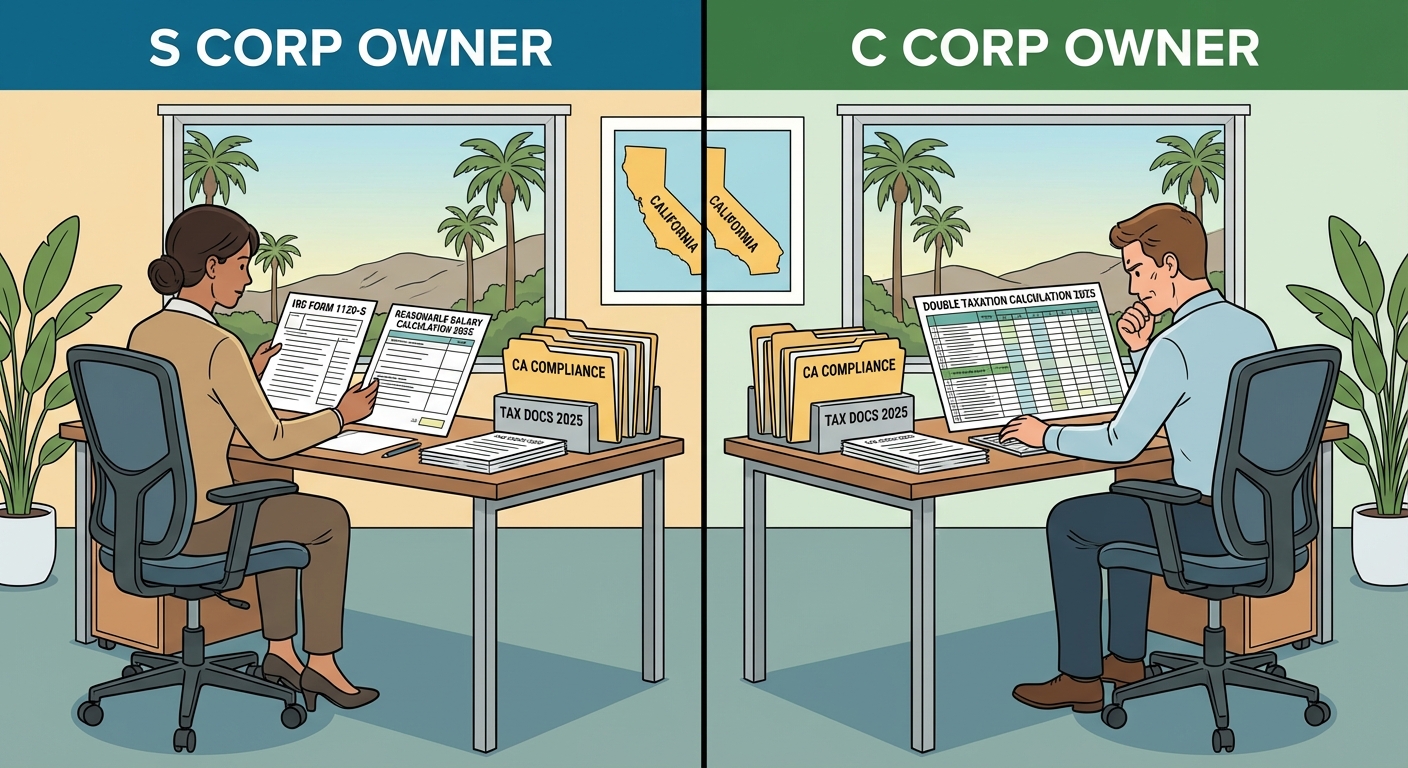
The 2026 S Corp vs C Corp Tax Showdown: True Savings, Audit Traps, and California’s New Rules
Most business owners still believe choosing S Corp or C Corp is a paperwork formality—unaware it can cost (or save) over $30,000 a year just in federal and California taxes. The real tax difference is never about what your bank balance says—it’s about how much of it actually sticks after taxes, payroll, and compliance. If you’re a W-2 high earner forced into a side business, a tech 1099 consultant, or a seven-figure real estate investor, making the wrong entity move in 2026 could drain every dollar you fought to earn.
Quick Answer: What’s the Real S Corp vs C Corp Tax Difference?
C Corp vs S Corp taxes are night-and-day for 2026: S Corps pass profits to owners (who pay only personal tax) and avoid self-employment tax on distributions—but require payroll and strict IRS rules. C Corps pay their own flat 21% corporate tax, then owners are taxed again on dividends—often costing $25,000+ more for growing businesses. California punches an extra 8.84% franchise tax on C Corps. Choosing wrong is a painful, often irreversible mistake.
The numbers: An S Corp with $200,000 of profit can save $18,400 versus C Corp, if owners run an IRS-approved salary. But a C Corp wins if you plan to reinvest all profit—sometimes unlocking bigger state-level deductions or future sale benefits.
How the IRS and California Tax S Corps and C Corps in 2026 (with Real Numbers)
Let’s get clear on definitions—and the tax cut math. An S Corporation is a “pass-through” entity: profits aren’t taxed at the business level; instead, they go straight to your individual return. No double taxation. You must, however, pay yourself a “reasonable salary,” subject to payroll and employment taxes; remaining profit can be distributed as dividends (not subject to Social Security/Medicare taxes). IRS guidance: see IRS S Corp basics.
A C Corporation pays corporate tax (21% federal + 8.84% California), then, if profits are distributed as dividends, those dollars are taxed again on your personal 1040 return—up to 37% federal plus state. For details, refer to IRS C Corp guidance.
Here’s how it plays out for a California owner with $350,000 net profit:
- S Corp: $120,000 is paid as W-2 salary; $230,000 is distributed as S Corp profit (bypasses payroll tax). Income taxed only once on 1040.
- C Corp: Entire $350,000 is taxed 21% federal ($73,500), 8.84% CA ($30,940); owner pays tax again on any dividends withdrawn (can add $55,000+ in extra taxes at high income).
California also charges S Corps a minimum $800 franchise fee, plus a 1.5% S Corp tax on net income, which is far less than the 8.84% C Corp charge. Proven savings: S Corps save five figures per year—but only if you avoid the common compliance traps described below.
If you’re an LLC, note that both S Corp and C Corp election are possible—but not both at once. Choosing the wrong status can backfire on IRS or FTB audit. Get entity setup help tailored for business owners who care about after-tax profit, not theory.
KDA Case Study: Bay Area Tech 1099 Chooses Wrong, Gets Rescued ($27,900 Net Savings)
Dave, a 42-year-old Silicon Valley software engineer, left his W-2 to consult for $400,000 as a 1099 contractor in 2025. His CPA set up a C Corp, promising professional “credibility.” In year one, Dave paid $84,800 in combined federal and CA corporate taxes—and another $29,860 on dividends, netting just $223,340 after tax. KDA reviewed his entity status, rebuilt his books for S Corp election, and fixed payroll retroactive to January. Dave’s total 2026 tax bill dropped to $55,760, keeping $27,900+ more in his pocket. Fee: $5,200 (5.4x ROI in the first year alone).
Ready to see how we can help you? Explore more success stories on our case studies page to discover proven strategies that have saved our clients thousands in taxes.

Who Actually Wins: S Corp vs C Corp by Persona
Your best choice depends on how you take money, your exit goals, and IRS appetite for “reasonable” compensation. Here’s a breakdown by taxpayer persona for 2026:
- W-2s moonlighting as side business owners: S Corp nearly always wins. Pay yourself salary (e.g., $100K), take the rest as distribution—skip 15.3% self-employment tax on that chunk. Savings: $8,000–$18,000/year. Trap: must run payroll, keep spotless minutes.
- High-earning 1099s and consultants: S Corp often wins if you withdraw profits. If reinvesting (new hires, R&D, PE buyout), C Corp structure offers more flexibility—multiple classes of stock, outside investors. Trap: C Corp can force you into double-taxation hell if you ever want to cash out.
- Real estate investors: S Corp rarely makes sense (loss of depreciation, real property traps). C Corp used sparingly for syndications. For most, LLC taxed as partnership is smarter, but if you’re flipping—or aiming for outside capital—consider C Corp only with $1M+ profit and legal advice.
- LLC owners with high net income: S Corp election crushes SE tax over $70K profit. C Corp rarely wins unless you’re reinvesting all profit or planning for a big sale with potential Qualified Small Business Stock (QSBS) exclusion. See IRS Section 1202.
Strategic entity selection is about matching tax mechanics to real money flows—not “what your friends did.” For more tailored advice, see our tax planning services for business owners and high-income 1099s.
C Corp vs S Corp Tax Math: Audit Traps if You Guess Wrong
The worst entity mistake in 2026: choosing based on “someone told me it’s best.” Both S Corps and C Corps are under IRS and CA FTB (Franchise Tax Board) audit scrutiny for different reasons:
- S Corp red flags: Owner payroll that’s way below industry norm, missing Form 941 filings, not recording annual board minutes. IRS and FTB are cracking down on underpaid officer wages (see IRS Form 2553 instructions). For every $30,000 in salary you underpay, you risk $10,000+ in penalties and back taxes.
- C Corp audit risks: Unreasonable shareholder expenses, personal use of corporate assets, failure to document dividends, and aggressive loss carry-forwards. Expect FTB to cross-check Net Operating Losses and luxury expense deductions carefully starting 2026.
Quick Tip: S Corps must withhold and remit payroll taxes, file Form 941 and 940 quarterly, and keep annual Form W-2s for all employees/owners. C Corps must issue 1099-DIV for any shareholder dividends paid out.
Self-employed and want to model total tax on S Corp or C Corp profit? Use a small business tax calculator to see real after-tax differences before you commit. Don’t forget to compare California’s annual $800 S Corp fee and 1.5% tax to the much steeper C Corp state rate.
California-Specific Entity Traps and the 2026 Legal Landscape
California throws in extra curveballs: S Corps pay the $800 minimum tax plus 1.5% franchise tax, while C Corps pay $800 plus 8.84% on net income. Before 2025, some owners dodged state tax by “moving” entities out of state. In 2026, the FTB’s new residency audits (including AB5 enforcement) make that nearly impossible unless you physically move.
New legislation on the horizon may tighten loopholes for large C Corps but could also impact main street businesses—Assembly Bill updates or the ballot-led wealth tax could hit retained earnings hard for passive C Corp owners. S Corp and C Corp owners alike must keep ultra-detailed documentation in 2026—CA FTB is matching filings to IRS, so a mismatch is a huge audit magnet.
This information is current as of 2/17/2026. Tax laws change frequently. Verify updates with the IRS or FTB if reading this later.
Common S Corp vs C Corp Myths That Drain Your Profits
- Myth 1: C Corps always pay more tax. Not always—if you reinvest all profits or plan a Section 1202 QSBS exit, C Corp can yield long-term wins. But expect bigger pain on annual cash withdrawals.
- Myth 2: S Corps are “set and forget.” False. S Corps need quarterly payroll filings, bulletproof salary calculation, and careful tracking of board meetings/dividends. Miss one, and you risk audit or losing S election (nightmare paperwork to fix).
- Myth 3: “I can switch any time.” Not easily. Moving from C Corp to S Corp is possible (by filing Form 2553), but converting assets can be a taxable event. Going S Corp to C Corp is easier, but you may forfeit pass-through tax benefits for years—in some cases, forever.
- Myth 4: LLCs avoid all the above headaches. Only if you elect partnership status and remain below $120,000 net profit. At higher profits, missing out on S Corp tax status costs thousands in extra payroll tax.
Will S Corp or C Corp Status Trigger an Audit in 2026?
The short answer is: It depends less on your entity label and more on the paperwork you keep. Key IRS and FTB triggers for audit in 2026:
- Underpaying S Corp owner salary
- Disproportionate distributions to shareholders
- Unexplained loans between owners and corporation
- Misclassifying contractors as employees
- Inconsistent payroll or dividend reporting year-to-year
Red Flag Alert: California’s FTB will coordinate data with the IRS to find mismatches between state and federal forms—especially for S Corps with low owner payroll or C Corps claiming big losses matched with high officer compensation. Audit rates nearly doubled in 2025 for flagged filers, according to the latest Forbes Tax Guide. Documentation is your audit shield.
Want to see more detailed S Corp and C Corp strategies? Review our comprehensive S Corp tax guide for California.
FAQs: S Corp vs C Corp for 2026—Your Top Questions
Can a non-US citizen own an S Corp?
No. S Corps can only have U.S. citizens or resident aliens as shareholders. C Corps and LLCs are more flexible for non-citizens.
What happens if your profit is under $60,000?
It usually doesn’t make sense to elect S Corp status under this threshold due to added payroll costs. LLCs or Schedule C often win here, but run your numbers first.
Is there a cap on the number of owners?
S Corps allow up to 100 shareholders (all must be individuals, certain trusts, or estates). C Corps: unlimited owners, any entity type.
How hard is it to switch from C Corp to S Corp?
It requires careful prep—timing matters to avoid built-in gains tax and other transition pitfalls. Coordinate with your CPA before making any moves.
Can you run both an S Corp and C Corp at the same time?
Not under the same EIN—separate legal entities only.
How do KDA’s advisory clients get these results?
We run a true side-by-side, ROI-driven scenario, model future profits, and document every form to match IRS/FTB expectations. Our tax blueprint is built for six- and seven-figure founders who can’t afford to guess wrong.
Book Your Tax Structure Strategy Session
If you want to keep more profit, avoid double taxation, and sleep at night knowing your entity matches IRS and FTB rules, book your tax structure review. The right move now could add $10,000–$25,000 (or more) to your after-tax income every year.Click here to book your consultation now.


