
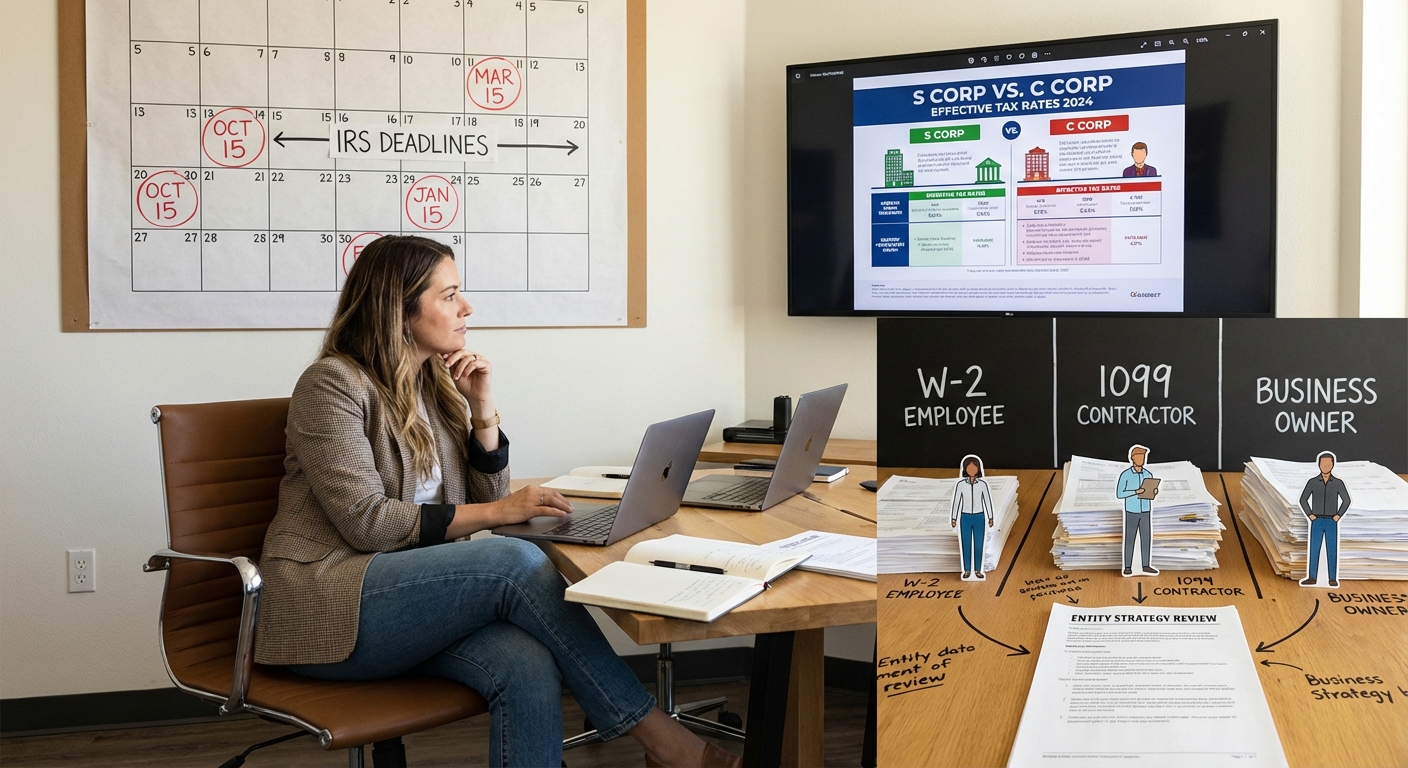
The 2026 S Corp vs C Corp Showdown: California’s No-BS Guide to Entity Selection, Audit Traps, and Real Tax Savings
Every year, thousands of California business owners and high-earning 1099s walk right into a tax trap by choosing the wrong entity—or by failing to review their “set it and forget it” setup.
Here’s the truth: Picking between an S Corp and a C Corp for the 2026 tax year can mean the difference between taking home 22–29% more after tax—or triggering double taxation, extra compliance headaches, and blowing your shot at key IRS deductions. Let’s unpack the real, up-to-date math for s corp vs c corp comparison in 2026, dial in the winning strategy for your persona, and bust the most dangerous myths that get owners audited or overcharged every single tax season.
Quick Answer: What’s the Bottom-Line Difference for 2026?
An S Corp is a pass-through entity—no corporate-level federal tax—whereas a C Corp pays its own flat federal rate (21%), plus you’ll pay again on dividends. S Corps save self-employment tax on profit above a reasonable salary but have owner restrictions. C Corps are best for reinvesting profits, going public, or equity-heavy startups. Switches after the wrong choice can cost $10K–$80K in penalties, missed savings, and retroactive tax. For 2026, IRS and California changes make the old “rules of thumb” obsolete for most.
A proper s corp vs c corp comparison starts with how income is taxed at each layer. S Corps pass profit through to shareholders under Subchapter S (IRC §§1361–1379), avoiding the 21% entity-level tax imposed on C Corps under IRC §11. C Corp earnings are taxed once at the corporate level and again when distributed as dividends—often at 15%–23.8% federally, plus California tax. If you routinely distribute profits, that second layer compounds fast.
How Entity Choice Impacts Your 2026 Take-Home: The Real Tax Math
Here’s how selecting S Corp vs C Corp plays out by taxpayer scenario:
- W-2 business owner (LLC/S Corp): Earns $150K from business. If S Corp, pays salary of $60K; rest passes through free of self-employment tax. Taxes: $15,000 payroll, $18,000 federal/state on personal return. Net after-tax: $117K.
- C Corp owner: $150K profit taxed at 21% corporate level; dividend taxed again at 23.8% rate when distributed. After double tax, typically $91K–$104K left—$13K–$26K less than S Corp.
- 1099/professional LLC owner (not an S Corp): Pays self-employment tax (15.3%) plus income tax on all profit. On $150K, will owe ~$42K in combined tax. S Corp election often saves $7K–$15K/year even after payroll setup fees.
The differences are amplified at higher income and when reinvesting large profits. For most actively operating small businesses, S Corp wins—but traps abound (including salary requirements and strict shareholder rules, per our complete S Corp tax guide).
An advanced s corp vs c corp comparison must account for payroll tax exposure. S Corp owners split income between W-2 salary (subject to Social Security and Medicare) and distributions (not subject to self-employment tax under IRC §1402). C Corp shareholders who take compensation pay payroll tax on wages too—but dividends escape payroll tax while triggering double income taxation. The real optimization question isn’t just “21% vs pass-through”—it’s how much income you need personally versus how much stays inside the company.
Why Most Owners Blow Their Entity Election—and How to Avoid It
Too many business owners pick a C Corp based on myths about “deducting everything,” not understanding that double taxation erases those perks unless you plan to reinvest all income or need equity for venture funding. Meanwhile, advisors push S Corps on everyone—even if the business doesn’t generate enough profit to justify the added costs.
The real question is: Where is your money going? Will you take profits out each year, or leave them in for growth and M&A? Are you solo, have non-U.S. investors, or plan to go public? These are where the IRS, FTB, and franchise tax board scrutiny hit hardest, and where California’s $800 minimum franchise fee and 1.5% S Corp tax come into play.
Red Flag: C Corps cannot be shareholders of S Corps. Pulling the wrong lever here can invalidate your election overnight (see IRS Form 2553 instructions).
KDA Case Study: Health Industry Founder Saves $62K by Flipping C Corp to S Corp
Sara, a Los Angeles health tech founder, operated as a C Corp on advice from her last CPA. The logic? “You’ll attract VC money and get better deductions.” Her company cleared $310,000 profit in 2025—but plans for outside equity fizzled. By April 2026, she’d paid over $92,000 in combined federal/state tax (21% C Corp, plus 23.8% qualified dividend when extracting cash). After consulting KDA, we showed her a retroactive S Corp path: electing S status, correcting payroll, and amending returns. Her 2026 net savings: $62,400—after our fees. She paid KDA $6,900 that year, and has made S Corp profit distribution her standard go-forward approach.
Ready to see how we can help you? Explore more success stories on our case studies page to discover proven strategies that have saved our clients thousands in taxes.

Strategic Traps in S Corp vs C Corp (and How to Escape in 2026)
- Salary “Reasonableness” Audit Trap: S Corp owners must pay themselves a market-rate W-2 salary, backed by payroll records and benchmarks. IRS and FTB audit for underpayment. See IRS S Corp overview.
- C Corp “Accumulated Earnings” Surtax: Keeping too much profit inside a C Corp can trigger a 20% additional tax if not documenting business expansion plans (see IRS accumulated earnings tax rules).
- Shareholder Restrictions: S Corps can’t have non-U.S. owners or more than 100 shareholders—key if you have investors abroad.
- California Franchise Fees: S Corps pay a flat $800/year and 1.5% tax; C Corps pay the higher-of $800 or 8.84% on net income. At $300K profit, the difference can be $7,000+/yr.
- Year-End Designation Traps: Forgetting the S election deadline means waiting until the next tax year, losing another year of savings. Late filings can sometimes be fixed—but only with the right IRS explanations (see CA FTB Form 100/100S).
For implementation, our tax planning services guide owners through deadlines, paperwork, and structuring to side-step these pitfalls—especially as California rules keep shifting.
How to Decide: Frameworks, Edge Cases, and When to Switch
Choose an S Corp in 2026 if:
- You keep most profits and want to avoid double tax on dividends
- Your company is closely held (solo or family ownership, no non-U.S. shareholders)
- Your annual profit after expenses is $70K or more, or you’re paying significant self-employment tax
- You want to maximize 199A/QBI deduction (up to 20% off business income—see IRS Publication 535)
Choose a C Corp if:
- You plan to bring in outside investors (VCs, non-US owners)
- You’ll reinvest ALL profits for growth, not pull out cash as dividends
- You want to offer complex stock plans including ISOs, RSUs
- You have or want to prepare for a public offering (IPO) in the coming years
California’s unique 1.5% S Corp tax and $800 minimum franchise tax applies to both, but the 8.84% C Corp rate can be a silent killer for large-profits businesses operating only in CA.
A California-focused s corp vs c corp comparison can’t ignore state math. An S Corp pays 1.5% of net income to the Franchise Tax Board, while a C Corp pays 8.84%—nearly six times higher before dividend tax even enters the picture. On $500,000 of California profit, that’s a $36,700 state-level spread before federal layering. High-margin service businesses operating solely in California often see the S Corp structure dominate purely on state efficiency.
For a step-by-step decision framework and implementation guide, reference our detailed entity setup section in the California S Corp Tax Strategy Hub.
Pro Tips, Red Flags, and 2026 IRS & FTB Changes You Need to Know
- Pro Tip: For 2026, new IRS enforcement systems use AI to spot S Corp “salary dumping” and C Corp dividend misreporting—make sure your payroll and distributions line up with industry benchmarks (see IRS corporations page).
- Red Flag: If your S Corp loses eligibility (wrong shareholder class, missed deadlines, C Corp investor added), your S election will be revoked—effectively retroactive to January 1, with resulting double tax for the entire year.
- For 1099s/LLCs: 1099 consultants in California often pay nearly 13.3% more tax pre-entity restructure; S Corp status is usually a must despite setup and payroll fees.
- For Real Estate Professionals: C Corps cannot claim many real estate-specific deductions S Corps or LLCs can. Asset protection or long-term planning may shift the needle, but don’t expect C Corps to work for passive landlords.
FAQ: Answering Owners’ Toughest S Corp vs C Corp Questions
What is a “reasonable salary” for an S Corp owner in California?
You must pay yourself a wage comparable to others doing your job. In 2026, audits focus on W-2 comp above $65,000 for commonly owned service S Corps, though market rate depends on industry and region. Underpayment triggers penalties and retroactive payroll tax per IRS S Corp guidelines.
Can owners “flip” from one structure to another?
Yes, but only by filing the right forms (IRS Form 2553 for S Corp election, IRS Form 8832 for C Corp conversion) and often amending the state/entity documents. Late elections require FTB/IRS explanations and back payroll correction. See our case study above for a six-figure example.
Do S Corps pay California franchise tax?
Yes: $800 minimum + 1.5% of net income. C Corps pay at a higher 8.84% rate or $800 minimum, whichever is more. This often means S Corps win handily at profits over $80,000, but not always.
Can a C Corp own an S Corp?
No. Any corporate shareholder invalidates S Corp status—see our detailed S Corp strategy guide for the costly traps owners fall into.
What about LLCs—where do they fit?
Single-member LLCs default to Schedule C sole-proprietor. Multi-member LLCs default to partnership taxation. Either can elect S Corp or C Corp status (with the right paperwork) for major tax savings. Without electing, most pay higher self-employment tax on profit above $120K/year.
Book Your Entity Strategy Session
If you’re unsure whether your current structure is bleeding you dry—or are ready to upgrade your tax game in 2026—book your entity and tax strategy session now. We’ll give you an exact recommendation based on your goals, risk tolerance, and dollar targets—and handle the paperwork, so you get the savings without the stress. Click here to book your consultation now.


