
Quick Answer: What Are the 2024 Long-Term Capital Gains Tax Rates?
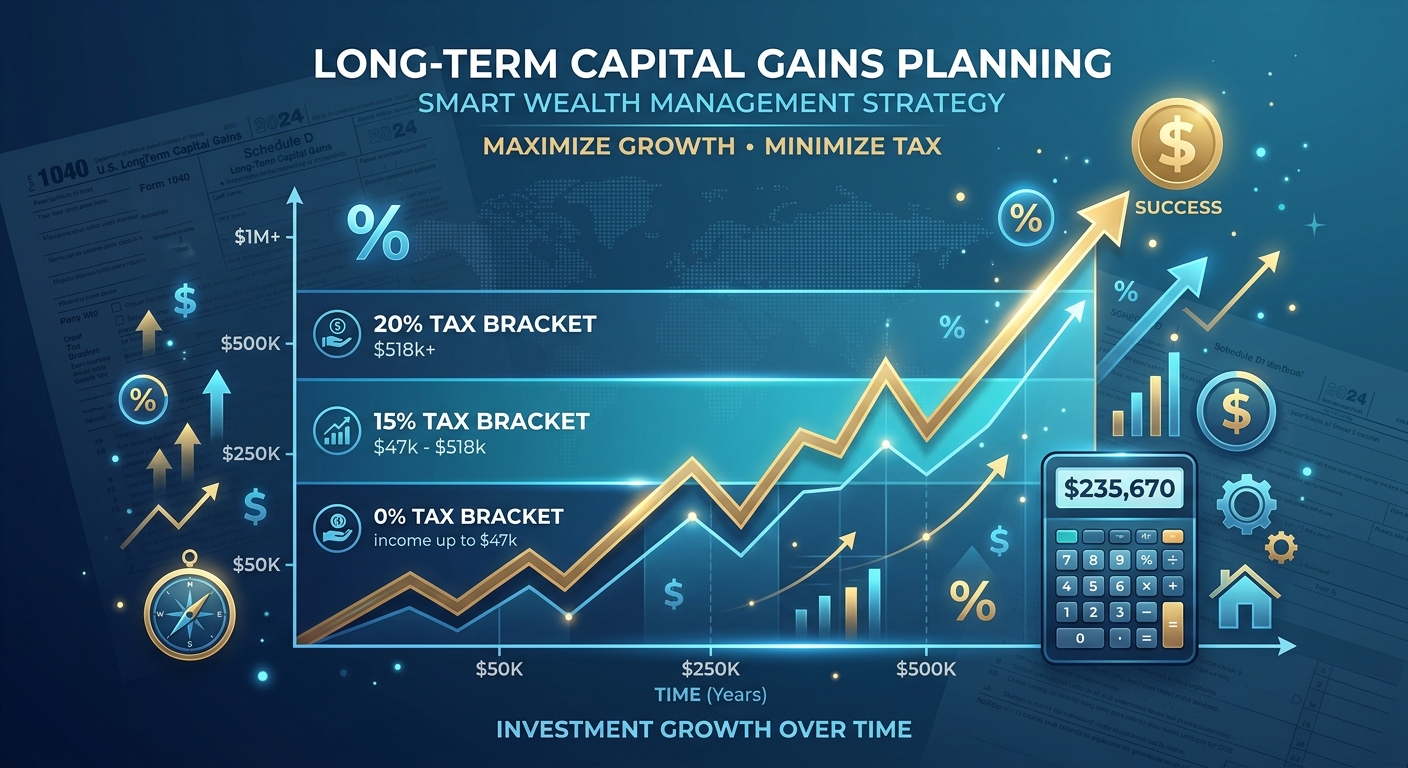
For 2024, the tax rate on long term capital gains 2024 ranges from 0% to 20% at the federal level, depending on your taxable income and filing status. Single filers with taxable income up to $47,025 pay 0%, those earning between $47,026 and $518,900 pay 15%, and income above $518,900 triggers the maximum 20% rate. California residents face an additional layer: the state taxes all capital gains as ordinary income at rates up to 13.3%, making it one of the most expensive states for investment exits.
Why Most Investors Get Capital Gains Tax Wrong
Here’s the uncomfortable truth: most people selling appreciated assets in 2024 are leaving thousands on the table because they don’t understand how the holding period interacts with their marginal tax bracket. A tech employee who sells $200,000 of RSUs after just 11 months pays federal tax at 37% plus California’s 13.3% rate. That’s a $100,660 tax bill. Hold those same shares for one additional month to cross the 12-month threshold, and the federal rate drops to 15%, cutting the bill to $56,600. That’s $44,060 saved by waiting 30 days.
The second mistake? Ignoring the Net Investment Income Tax (NIIT). If your modified adjusted gross income exceeds $200,000 as a single filer or $250,000 if married filing jointly, you’ll pay an additional 3.8% surtax on investment income. That pushes the effective top federal rate on long-term gains to 23.8%, not 20%.
The third trap is California’s treatment of capital gains. Unlike most states that offer preferential rates for long-term gains, California taxes them exactly like wages. If you’re in the top state bracket, you’re paying 13.3% regardless of whether you held the asset for one year or twenty.
Federal Long-Term Capital Gains Tax Rates for 2024: The Complete Breakdown
The IRS defines long-term capital gains as profits from assets held longer than 12 months. The rates are progressive, but they’re calculated separately from your ordinary income brackets.
Single Filers
- 0% rate: Taxable income up to $47,025
- 15% rate: Taxable income from $47,026 to $518,900
- 20% rate: Taxable income above $518,900
Married Filing Jointly
- 0% rate: Taxable income up to $94,050
- 15% rate: Taxable income from $94,051 to $583,750
- 20% rate: Taxable income above $583,750
Heads of Household
- 0% rate: Taxable income up to $63,000
- 15% rate: Taxable income from $63,001 to $551,350
- 20% rate: Taxable income above $551,350
These thresholds are indexed annually for inflation, which means they increase slightly each year. For comparison, the 2023 single filer 0% threshold was $44,625. The 2024 increase to $47,025 means an additional $2,400 of capital gains can now be harvested tax-free if your other income stays below that line.
How Taxable Income Is Calculated for Capital Gains
Your capital gains rate isn’t determined by your gross income. It’s based on your taxable income, which is your adjusted gross income minus either the standard deduction or itemized deductions. For 2024, the standard deduction is $14,600 for single filers and $29,200 for married couples filing jointly.
Here’s an example: You’re single, earn $55,000 in W-2 wages, and sell stock for a $30,000 long-term gain. Your AGI is $85,000. After the $14,600 standard deduction, your taxable income is $70,400. Your ordinary income fills the first $40,400 of taxable income ($55,000 wages minus $14,600 deduction). That leaves $30,000 of capital gains. The first $6,625 ($47,025 threshold minus $40,400 already used) is taxed at 0%. The remaining $23,375 is taxed at 15%, which equals $3,506 in federal tax on the gain.
The Net Investment Income Tax: The Hidden 3.8% Surcharge
Congress added the NIIT in 2013 as part of the Affordable Care Act, and it still catches high earners off guard. This 3.8% surtax applies to the lesser of your net investment income or the amount by which your modified adjusted gross income exceeds the threshold.
NIIT Thresholds for 2024:
- Single filers: $200,000
- Married filing jointly: $250,000
- Married filing separately: $125,000
- Head of household: $200,000
Net investment income includes long-term capital gains, short-term gains, dividends, interest, rental income, royalties, and passive business income. It does not include wages, Social Security benefits, or active business income.
Example: You’re married filing jointly with $280,000 of combined W-2 income and $100,000 in long-term capital gains from selling rental property. Your MAGI is $380,000. The amount over the $250,000 threshold is $130,000. Your net investment income is $100,000. The NIIT applies to the lesser amount, which is $100,000. You owe 3.8% of $100,000, or $3,800, on top of the 15% federal capital gains rate.
California Capital Gains Tax: No Preferential Treatment
California is one of nine states that tax long-term capital gains as ordinary income. There is no reduced rate, no holding period benefit, and no special treatment for investment assets. If you’re in the 9.3% California bracket, your gains are taxed at 9.3%. If you’re in the top 13.3% bracket (income over $1 million for most filers), your gains face that rate.
This creates a stacked burden for high earners. A California resident in the top brackets selling highly appreciated stock pays:
- 20% federal long-term capital gains rate
- 3.8% Net Investment Income Tax
- 13.3% California state tax
- Total: 37.1% combined rate
On a $500,000 capital gain, that’s $185,500 in total tax. For perspective, if the same taxpayer lived in Nevada, Florida, or Texas (states with no income tax), they’d pay only the federal 23.8%, or $119,000. That’s a $66,500 savings from residency alone.
California-Specific Strategies
If you’re a California resident planning a large capital event, timing your residency can save six figures. You must genuinely establish residency in another state, which means more than just renting an apartment. The California Franchise Tax Board looks at where you’re registered to vote, where your car is registered, where your professional licenses are held, and where you spend the majority of your time. If you’re audited and the FTB determines you were still a California resident during the sale, you’ll owe back taxes, penalties, and interest.
Another California-specific consideration: the sale of a business. If you sell a C corporation, the gain is treated as a capital gain at the federal level but ordinary income in California. If you structure the business as an S corporation, the passthrough treatment can sometimes offer better results, but you’ll need to model both federal and state impacts before closing.
For real estate investors, Opportunity Zone deferrals can postpone recognition of gains until 2026 (or until you sell the Opportunity Zone investment, whichever is earlier). California conforms to the federal Opportunity Zone rules, so the deferral works at both levels. However, the step-up in basis for long-held Opportunity Zone investments does not apply in California, which means you’ll eventually pay state tax on the full deferred gain.
Short-Term vs. Long-Term: Why One Day Matters
Assets held for 12 months or less generate short-term capital gains, which are taxed as ordinary income. That means the same rates as your wages: up to 37% federally in 2024, plus California’s 13.3% for high earners. The difference between selling on day 364 and day 366 can be dramatic.
Scenario: You bought 1,000 shares of a tech stock at $50 on March 1, 2023. By February 28, 2024, the stock trades at $150. You want to sell. Your gain is $100,000. If you sell on February 28, it’s a short-term gain taxed at ordinary income rates. Assuming you’re in the 35% federal bracket and the 9.3% California bracket, you owe $44,300 in tax. If you wait until March 2, 2024, it becomes a long-term gain taxed at 15% federally and 9.3% in California. Your tax bill drops to $24,300. That’s a $20,000 savings for waiting three days.
This is why tax-loss harvesting in December is so popular, but it’s also why you need to track your holding periods down to the day. Your brokerage will report the acquisition date and sale date on Form 1099-B, and the IRS will cross-check it. If you misreport a short-term gain as long-term, expect a CP2000 notice and a bill for the difference plus interest.
How to Calculate Your Effective Capital Gains Tax Rate
Most investors focus on the headline rates, but your effective rate is what matters. It’s the total tax paid divided by the total gain. Here’s the formula:
Effective Rate = (Federal Tax + NIIT + State Tax) / Total Gain
Let’s walk through a real scenario. You’re single, live in Los Angeles, and earn $180,000 as a software engineer. You sell stock with a $75,000 long-term gain. Your taxable income is $240,400 after the standard deduction ($180,000 + $75,000 – $14,600). That puts you in the 15% federal capital gains bracket and triggers the 3.8% NIIT because your MAGI exceeds $200,000. California taxes you at 9.3%.
Federal tax: $75,000 × 15% = $11,250
NIIT: $75,000 × 3.8% = $2,850
California tax: $75,000 × 9.3% = $6,975
Total tax: $21,075
Effective rate: 28.1%
If you thought you’d only owe 15%, you just underestimated by $9,825.
KDA Case Study: Real Estate Investor Saves $34,000 with Deferred Sales Trust
David, a 52-year-old real estate investor in San Diego, owned a rental property he purchased in 2008 for $425,000. By early 2024, the property was worth $1.2 million. His depreciation recapture totaled $87,000, and his adjusted basis was $338,000. If he sold outright, his federal tax would be $129,300 (15% on $775,000 of gain plus 25% on $87,000 of recapture) and California tax would be $114,665 (13.3% on the full $862,000 recognized gain). His total bill: $243,965.
David worked with KDA to structure a Deferred Sales Trust before closing. He sold the property to the trust, which then sold it to the buyer. The trust invested the proceeds in a diversified portfolio and paid David installments over 15 years. This deferred recognition of the gain, spreading it across multiple lower-income years during retirement when his marginal rates would drop. His projected tax over 15 years: $148,200. Upfront tax paid in 2024: $0. Total savings: $95,765 in taxes deferred and reduced. He paid KDA $8,500 for the structure and trust administration. His first-year ROI: infinite. His lifetime ROI: 11.2x.
Ready to see how we can help you? Explore more success stories on our case studies page to discover proven strategies that have saved our clients thousands in taxes.
Collectibles, Real Estate, and Other Special Capital Assets
Not all capital gains are taxed at the standard 0%, 15%, or 20% rates. The IRS carves out higher rates for specific asset types.
Collectibles
Gains from selling collectibles (art, antiques, stamps, coins, precious metals, gems, alcoholic beverages, and certain other tangible personal property) are taxed at a maximum federal rate of 28%, even if held long-term. If you’re in a lower ordinary income bracket, your rate may be lower, but you’ll never get the 0% or 15% preferential rates available for stocks and bonds.
Example: You bought a rare painting in 2015 for $80,000 and sold it in 2024 for $250,000. Your gain is $170,000. Even though you held it for more than a decade, the federal tax is 28% of $170,000, or $47,600. In California, you’d also owe 13.3%, or $22,610. Total: $70,210.
Qualified Small Business Stock (QSBS)
Section 1202 allows investors in qualified small business stock to exclude up to $10 million of gain (or 10 times their basis, whichever is greater) if the stock was held for more than five years. This is one of the most powerful wealth-building provisions in the tax code, but it comes with strict requirements. The corporation must be a C corporation, it must have less than $50 million in assets at the time of issuance, and at least 80% of its assets must be used in an active trade or business.
California only partially conforms. It excludes just 50% of the gain for stock issued before 2013 and offers no exclusion for stock issued after September 27, 2010. If you’re relying on QSBS treatment for a startup exit, you’ll still face full California tax on the gain unless you move out of state before the sale.
Unrecaptured Section 1250 Gain
When you sell rental real estate, a portion of the gain attributable to depreciation is taxed at a maximum 25% federal rate, not the standard 15% or 20% capital gains rate. This is called unrecaptured Section 1250 gain. The rest of the gain (appreciation above your original purchase price) qualifies for the standard long-term capital gains rates.
Breakdown: You bought a fourplex in 2010 for $500,000. You claimed $125,000 in depreciation over 14 years, reducing your basis to $375,000. You sell in 2024 for $900,000. Your total gain is $525,000. The first $125,000 (the depreciation recapture) is taxed at 25% federally. The remaining $400,000 is taxed at 15% (assuming you’re in that bracket). Federal tax: $31,250 + $60,000 = $91,250. California taxes the full $525,000 at your marginal rate.
Tax-Loss Harvesting: How to Lower Your 2024 Capital Gains Bill
If you’ve realized capital gains earlier in the year, selling losing positions before December 31 can offset those gains dollar-for-dollar. Capital losses first offset capital gains of the same type (short-term losses offset short-term gains, long-term losses offset long-term gains). Any excess short-term loss can offset long-term gains, and vice versa. If your total losses exceed your total gains, you can deduct up to $3,000 of the excess against ordinary income ($1,500 if married filing separately). Losses beyond that carry forward indefinitely.
Example: You realized $60,000 in long-term gains from selling Tesla shares in March. In November, you’re holding Meta shares with a $25,000 unrealized loss. If you sell Meta before year-end and immediately buy it back, you’d trigger a wash sale and lose the deduction. Instead, wait 31 days or buy a similar but not substantially identical tech stock. Your net taxable gain drops to $35,000, saving you $3,750 in federal tax (15% rate) and $2,325 in California tax (9.3% rate).
California conforms to federal wash sale rules, so the same 30-day restriction applies at the state level. Be aware that the IRS is watching for wash sales across multiple accounts. If you sell Tesla in your brokerage account and your spouse buys it in their IRA within 30 days, the IRS can disallow the loss.
Should You Harvest Gains in Low-Income Years?
If your income drops temporarily due to a job transition, sabbatical, or business loss, you may have an opportunity to realize gains at 0% or 15% instead of waiting until you’re in a higher bracket. This is especially valuable for early retirees or entrepreneurs between exits.
Scenario: You quit your $200,000 job in June to start a business. For the second half of 2024, you have minimal income. Your taxable income for the year is only $60,000 after deductions. You’re holding appreciated stock with a $30,000 unrealized gain. If you sell before year-end, your taxable income rises to $90,000. You’re still in the 15% long-term capital gains bracket, so you owe $4,500 in federal tax (15% of $30,000) plus California tax. If you wait until next year when your business is profitable and your income returns to $200,000+, that same gain could be taxed at 15% federal plus 3.8% NIIT plus 13.3% California, totaling $9,630. You save $5,130 by selling in the low-income year.
You can also use this strategy to step up your basis. After selling, immediately repurchase the same shares. You’ve locked in the gain at a lower rate and reset your cost basis higher, which reduces future tax when you sell again.
Gifting Appreciated Assets: The Double Benefit
If you’re planning to gift money to family members, consider gifting appreciated stock instead of cash. The recipient assumes your cost basis and holding period, so they’ll owe tax on the gain when they eventually sell. But if they’re in the 0% capital gains bracket (taxable income below $47,025 for single filers or $94,050 for joint filers), they can sell the stock and pay zero federal tax.
Example: You want to give your adult daughter $20,000 to help with a down payment. You’re in the 35% federal bracket and 9.3% California bracket. You own Apple shares with a $5,000 basis and $20,000 current value. If you sell the shares and give her cash, you owe $2,250 in federal tax (15% on $15,000 gain) and $1,395 in California tax. You’re left with $16,355 to give. If instead you gift her the shares directly, she sells them, and she has no other income for the year, she owes zero federal tax and likely minimal California tax (depending on her full financial picture). She gets the full $20,000. You avoid $3,645 in tax by switching from cash to shares.
Annual gift tax exclusion for 2024 is $18,000 per recipient ($36,000 for married couples). You can gift appreciated assets up to that amount without filing a gift tax return. Above that, you’ll need to file Form 709, but no tax is due unless you’ve exhausted your lifetime exemption ($13.61 million for 2024).
Red Flag Alert: Common Capital Gains Mistakes That Trigger IRS Scrutiny
The IRS receives copies of all Forms 1099-B from brokerages, and their systems automatically flag discrepancies. Here’s what gets taxpayers in trouble:
Misreporting the holding period. Your broker reports whether the gain is short-term or long-term. If you override that on your return and claim long-term treatment for a short-term sale, the IRS will send a CP2000 notice proposing additional tax.
Failing to report cryptocurrency gains. The IRS explicitly asks on the front page of Form 1040 whether you received, sold, or exchanged digital assets. Answering “no” when you had crypto transactions is perjury. The IRS has been receiving John Doe summonses from exchanges since 2019 and has transaction data going back years. If you’re caught, expect back taxes, a 20% accuracy penalty, and potential criminal referral in egregious cases.
Not tracking basis correctly for stock acquired through RSUs, ESPP, or options. When your employer grants RSUs that vest, the value at vesting is reported as W-2 income. That amount becomes your basis. When you later sell the shares, your gain is the sale price minus that basis, not minus zero. Many taxpayers forget to adjust their basis and overpay. Conversely, some forget that their basis was already taxed as W-2 income and mistakenly report the full sale price as a gain. Both errors invite audits.
Ignoring state tax when moving mid-year. If you were a California resident for part of the year and sold assets during that period, California gets to tax the gain even if you moved to Nevada in November. You’ll need to file a part-year California return and allocate the gain correctly. The FTB audits these returns aggressively.
How Capital Gains Affect Your Medicare Premiums
If you’re 65 or older and enrolled in Medicare, large capital gains can trigger Income-Related Monthly Adjustment Amounts (IRMAA), which increase your Part B and Part D premiums. IRMAA is based on your modified adjusted gross income from two years prior. For 2024 premiums, the Social Security Administration looks at your 2022 tax return.
For 2024, the standard Part B premium is $174.70 per month. If your 2022 MAGI exceeded $103,000 (single) or $206,000 (married filing jointly), you’ll pay between $244.60 and $594.00 per month, depending on how far above the threshold you landed. A one-time capital gain can push you into a higher IRMAA bracket for a full year.
The good news: you can appeal. If your income dropped due to a life-changing event (retirement, divorce, death of spouse, loss of income-producing property, employer settlement payment), Social Security allows you to request a recalculation using a more recent year’s income. File Form SSA-44 with supporting documentation.
If your gain was from a Roth conversion or a one-time asset sale, you may not qualify for the appeal, but it’s worth asking. Some taxpayers successfully argue that the gain was non-recurring and their ongoing income is lower.
Using Charitable Remainder Trusts to Eliminate Capital Gains Tax
A Charitable Remainder Trust (CRT) is one of the most underutilized strategies for eliminating capital gains tax on highly appreciated assets. You transfer the asset to an irrevocable trust, the trust sells it tax-free, and you receive income from the trust for a term of years or for life. At the end of the term, the remainder goes to the charity you named.
How it works: You own $1 million of Amazon stock with a $100,000 basis. If you sell it outright, you’ll owe roughly $214,200 in federal tax (15% on $900,000 plus 3.8% NIIT) and $119,700 in California tax (13.3%). Total tax: $333,900. If instead you fund a CRT with the stock, the trust sells it and pays zero tax. The full $1 million is invested. You receive 5% annually ($50,000) for 20 years. Assuming 6% growth, you receive $1,146,992 over the term. The charity receives approximately $1.2 million at the end. You also get an immediate income tax deduction for the present value of the remainder interest, which is roughly $380,000, saving you another $126,000 in taxes (assuming a 33% combined federal and state rate).
CRTs work best when you’re charitably inclined, don’t need immediate access to the full principal, and want to spread income over time. They require legal and trustee fees (typically $5,000 to $15,000 to establish, plus annual administration fees), but the tax savings on large gains make the cost trivial.
How to Report Capital Gains on Your Tax Return
Capital gains and losses are reported on Form 8949, which feeds into Schedule D. Your broker will send you Form 1099-B, which lists every sale, the date acquired, date sold, proceeds, cost basis, and whether the gain is short-term or long-term. Most tax software imports this data directly, but you should verify it.
If your broker reports basis to the IRS (which they’re required to do for most stocks purchased after 2011), you must use that basis unless you have records proving it’s wrong. If basis isn’t reported, you’re responsible for tracking it. Keep purchase confirmations, dividend reinvestment records, and corporate action statements (stock splits, mergers, spinoffs) indefinitely.
For wash sales, your broker will adjust the basis and mark the disallowed loss on Form 1099-B. You don’t need to calculate it yourself, but you should understand what happened. The disallowed loss isn’t gone; it’s added to the basis of the replacement shares, which reduces your gain (or increases your loss) when you eventually sell those shares outside the wash sale window.
California does not have a separate capital gains form. You report gains on Schedule D (540) using the same amounts as your federal return. The difference is that California’s tax rate structure applies to the net gain.
Ready to Reduce Your Tax Bill?
KDA Inc. specializes in strategic tax planning for business owners, S Corps, LLCs, and high-net-worth individuals. Book a personalized consultation and walk away with a clear plan.
Frequently Asked Questions About Capital Gains Tax Rates in 2024
Do I pay capital gains tax if I reinvest the proceeds?
Yes. Reinvesting proceeds does not defer or eliminate the tax. The only exception is a Section 1031 like-kind exchange for real estate or the sale of a primary residence that qualifies for the Section 121 exclusion. For stocks, bonds, and other securities, you owe tax in the year of sale regardless of what you do with the money.
Can I deduct investment fees and advisory costs against my capital gains?
No. The Tax Cuts and Jobs Act eliminated the deduction for investment advisory fees and other miscellaneous itemized deductions through 2025. Brokerage commissions and fees directly related to the purchase or sale of securities adjust your basis (increase for purchase fees, decrease proceeds for sale fees), but ongoing management fees are not deductible.
What happens if I sell stock at a loss in my taxable account and my spouse buys the same stock in their IRA within 30 days?
The wash sale rule applies across accounts you control or accounts controlled by your spouse. If your spouse buys substantially identical shares within the 30-day window before or after your sale, the IRS will disallow your loss. The disallowed loss adjusts the basis of the shares your spouse purchased, but because those shares are now inside an IRA, you never get the tax benefit. This is a permanent loss of the deduction, not just a deferral. Avoid buying the same security in tax-deferred accounts during the wash sale window.
How do capital gains affect my Affordable Care Act subsidies?
Premium tax credits for ACA marketplace plans are based on your household income as a percentage of the federal poverty level. Capital gains count as income, so realizing a large gain can reduce or eliminate your subsidy and trigger a repayment obligation when you file your return. If you’re receiving subsidies and planning a large sale, model the impact before pulling the trigger. In some cases, spreading the sale across two tax years keeps you under the subsidy cliff.
Do capital gains count toward the Social Security earnings test?
No. If you’re receiving Social Security benefits before your full retirement age and still working, the earnings test only applies to wages and self-employment income. Capital gains, dividends, interest, and pension income do not count. However, capital gains do increase your provisional income, which can cause up to 85% of your Social Security benefits to become taxable.
What Changed for 2024 and What to Watch for 2025
The inflation adjustments for 2024 increased the capital gains brackets by approximately 5.4% compared to 2023. The single filer 0% threshold moved from $44,625 to $47,025. The 15% ceiling moved from $492,300 to $518,900. These adjustments are automatic and based on the chained Consumer Price Index.
For 2025, expect another inflationary increase, likely in the 3% to 4% range if inflation continues to moderate. The IRS typically releases the updated brackets in October or November.
One legislative change on the horizon: the Tax Cuts and Jobs Act provisions expire at the end of 2025 unless Congress extends them. If the expanded standard deduction and adjusted ordinary income brackets revert to pre-2018 levels, more taxpayers will be pushed into higher capital gains brackets. The interaction between ordinary income tax brackets and capital gains thresholds is complex, and changes to one affect the other. Stay tuned for updates as the 2025 legislative session approaches.
California has no pending legislation that would create a preferential capital gains rate. Governor Newsom’s most recent budget proposal includes expanded sales tax on software and digital services, but no changes to income or capital gains treatment.
Currency Disclaimer
This information is current as of 5/19/2026. Tax laws change frequently. Verify updates with the IRS or FTB if reading this later.
Take Control of Your Capital Gains Strategy Now
If you’re sitting on six figures of unrealized gains and don’t have a clear exit plan, you’re gambling with your wealth. The difference between a reactive sale and a strategic one is often $30,000, $60,000, or more in unnecessary tax. Book a personalized consultation with our strategy team and get a clear, compliant plan that protects your gains and lowers your tax bill. Click here to book your consultation now.



