
Quick Answer
Choosing between a **small business s corp vs c copr** structure is one of the most expensive decisions owners get wrong. For many profitable California businesses, an S corporation can cut thousands from self employment and federal tax, while a C corporation can make sense when you plan to reinvest profits and scale aggressively. The right answer depends on profit level, owner compensation, future exit plans, and how comfortable you are with California’s franchise tax rules.
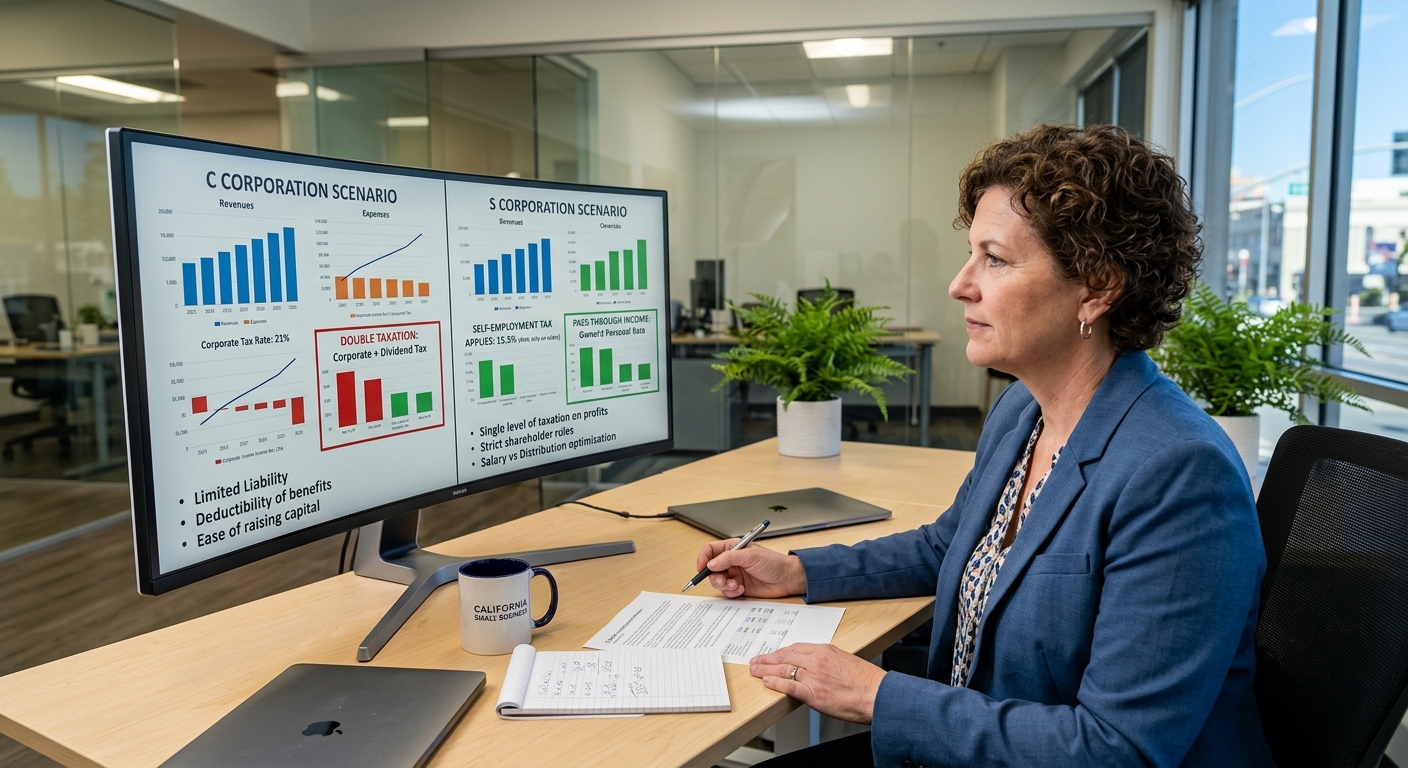
How S Corp And C Corp Taxation Really Works
Most owners hear “double taxation” and assume C corporations are automatically bad. That is not always true, but you need to understand the mechanics first.
At a high level:
- An S corporation is a pass through entity. The company itself generally does not pay federal income tax. Profits and losses flow to the shareholders, who report them on their individual returns, typically on Schedule E. S corporation rules are detailed in IRS instructions for Form 1120 S.
- A C corporation is a separate taxpayer. It files Form 1120, pays corporate income tax on its profits, and then shareholders pay tax again on any dividends received. See IRS guidance for Form 1120 for details.
In California, both entity types are also subject to state level taxes. Most S corporations pay a 1.5 percent franchise tax on net income, while C corporations pay the standard corporate income tax rate on their profits. That 1.5 percent state cost is usually small compared to the federal savings an S corporation can unlock for the right owner.
According to IRS Publication 542, the corporate rules for both structures overlap in many areas, but the way owners are taxed is radically different. Getting that part wrong can easily cost a six figure sum over a decade.
Where The Big Tax Savings Show Up For S Corporations
The real attraction of the S corporation for small businesses is self employment tax savings. A sole proprietor or single member LLC pays self employment tax, currently 15.3 percent combined for Social Security and Medicare, on all net profit reported on Schedule C. In an S corporation, only the owner’s W 2 wages are subject to payroll tax. Remaining profit is distributed as a dividend like pass through that is not hit with that additional 15.3 percent.
For example, imagine a consultant in California earning $220,000 in net profit as a single member LLC:
- As a Schedule C filer, that entire $220,000 is exposed to self employment tax (with some limitations at higher income), easily generating more than $25,000 in payroll taxes alone.
- If the business elects S corporation status and pays the owner a reasonable salary of $120,000, only that wage is subject to payroll tax. The remaining $100,000 flows through as S corporation profit without self employment tax, potentially saving $15,000 or more per year.
Those savings usually dwarf California’s 1.5 percent S corporation franchise tax. On $220,000 of profit, 1.5 percent is $3,300. Many 1099 professionals would rather pay $3,300 to California and save $15,000 to $20,000 at the federal level.
Owners who want someone to run the numbers for their personal situation often benefit from working directly with a firm that focuses on self employed taxpayers. A customized projection will show you whether an election this year makes sense or if you should wait until your profits are consistently higher.
KDA Case Study: California Consultant Restructures To S Corporation
A Los Angeles marketing consultant came to KDA earning roughly $190,000 per year on a 1099, reporting everything on Schedule C. She was single, no employees, and had been told by a friend that “S corporations are too much paperwork.” Her prior preparer never suggested another structure, and she was paying more than $32,000 each year in combined income and self employment taxes.
After reviewing her books, we recommended electing S corporation status and setting her W 2 salary at $105,000, supported by industry compensation data. The remaining profit, after a few additional deductions, was about $70,000.
Here is what changed in the first full year after restructuring:
- Payroll tax was now calculated only on the $105,000 salary instead of the entire profit. That cut her self employment related taxes by about $10,700.
- The S corporation still paid California’s 1.5 percent franchise tax, which came to roughly $2,600.
- We also cleaned up her bookkeeping, correctly classifying a portion of her expenses and capturing another $8,000 of legitimate deductions she had missed.
Net result: roughly $14,000 in first year tax savings. Her all in cost for our entity analysis, S corporation election, and ongoing compliance support was about $4,500, delivering more than a three to one return in the first year alone and likely higher in each future year as her income grows. She also gained clearer financial reports that support loan applications and long term planning.
Ready to see how we can help you? Explore more success stories on our case studies page to discover proven strategies that have saved our clients thousands in taxes.
When A C Corporation Can Still Make Sense
Despite the double taxation issue, a C corporation can be the right vehicle for certain small businesses, especially those that want to retain profits in the company, raise outside capital, or eventually sell shares.
Key benefits include:
- Potentially lower tax on retained earnings. If the corporation keeps profits instead of distributing them, shareholders do not pay any additional tax until they receive dividends or sell shares.
- Access to certain fringe benefits, such as more flexible health reimbursement arrangements, that can be easier to structure through a C corporation under IRS Publication 15 B.
- Clear separation between ownership and management, which can help with investor expectations if you are building a scalable company.
For example, a tech startup that expects to lose money for the first few years but ultimately aims for a venture backed exit is rarely an S corporation. A straight C corporation fits investor expectations and lets the business accumulate losses at the entity level that can offset future profits.
By contrast, a California therapist operating solo with $150,000 of annual net income usually gets no advantage from a C corporation. They are not raising capital, they do not need complex stock structures, and the double layer of tax on distributions often leaves them worse off than either S corporation or single member LLC status.
Owners in this position should look at how ongoing corporate compliance fits into their broader goals. If your priority is efficient cash extraction and personal wealth building, firms offering robust tax planning services can help design a structure that keeps more of each additional dollar of profit in your pocket.
Reasonable Salary Rules For S Corporation Owners
The biggest audit risk in the S corporation world is unreasonably low owner compensation. The IRS expects shareholder employees who perform services to receive a salary that reflects what they would have to pay someone else to do their job. Underpaying wages just to minimize payroll tax is a red flag and a common focus area of audit representation services.
To set a defensible salary, consider:
- Industry compensation surveys for your role and region.
- The portion of your time spent on revenue generating work versus high level strategy.
- How much profit remains after paying yourself that wage.
Suppose your S corporation earns $300,000 in profit before owner pay, and you currently take $60,000 of W 2 wages plus $240,000 of distributions. That ratio will likely draw scrutiny. A more sustainable mix might be $150,000 of wages and $150,000 of pass through profit. You still save self employment tax on the second half, but you are not trying to treat nearly all your income as distribution.
According to multiple IRS rulings summarized in IRS written determinations, the Service has successfully reclassified distributions as wages when salaries were clearly below market levels. That often triggers not only back payroll tax but penalties and interest, erasing the intended benefit.
Business owners who want help getting payroll, bookkeeping, and entity structure aligned frequently turn to a team experienced in bookkeeping and payroll support. Clean books and properly documented compensation go a long way toward surviving any future scrutiny.
How California Franchise Tax Changes The Math
California adds another moving piece to the small business s corp vs c copr evaluation. All corporations in the state owe at least a minimum franchise tax, and S corporations owe 1.5 percent of net income. That means a California LLC taxed as a disregarded entity could face a different mix of flat fees and gross receipts based charges than an S corporation conversion.
Consider a small design agency in San Diego with $280,000 of net profit.
- As an LLC taxed as a sole proprietorship, the owner might pay the LLC annual fee plus self employment tax on the full profit.
- As an S corporation, the agency pays 1.5 percent franchise tax, or about $4,200, but trims payroll tax significantly by routing a portion of profit through as distributions.
- As a C corporation, California corporate income tax applies to the full profit, and any dividends later paid to the owner show up again on the individual return.
Because California is an expensive tax state overall, cutting federal self employment tax using an S corporation often outweighs the state franchise tax cost for service firms with profits above roughly $80,000 to $100,000. Exact break even points will vary based on filing status and other income, so using a calculator to estimate your federal liability can be helpful. A simple way to do this is to plug your numbers into a federal tax calculator under each entity scenario and compare the results side by side.
Business owners who need help evaluating how entity choice interacts with California’s web of rules should review how firms like KDA support business owners navigating complex state and federal taxes. Matching structure to your specific mix of income, payroll, and growth plans is where most of the savings live.
Red Flag Alert: Common Mistakes That Trigger IRS Scrutiny
Certain behaviors show up again and again in examination files, especially for S corporations. Avoid these if you want to keep your risk profile low.
- Failing to run payroll at all for an active shareholder, while still taking distributions each year.
- Using personal accounts for corporate expenses and never documenting reimbursements, which blurs the line between the entity and the individual.
- Ignoring basis calculations and loss limitations summarized in IRS Form 7203 instructions, then claiming more losses than allowed.
- Switching back and forth between C corporation and S corporation status without understanding built in gains tax rules.
On the C corporation side, red flags often include accumulated earnings that appear far higher than the company’s documented business needs. Publication 542 explains how the IRS evaluates whether a C corporation is simply parking cash to avoid individual level tax. If they conclude that is the case, an accumulated earnings tax can apply, adding another layer of cost.
Owners with growing profits who are unsure whether prior returns were done correctly should consider a proactive file review. Having a professional check your entity election, salary levels, and distributions before an IRS letter arrives is almost always cheaper than trying to repair problems after the fact.
What If Your Profits Are Still Small?
Not every business is ready for S corporation status. If your net profit is under roughly $60,000, the administrative overhead of payroll, separate tax filings, and California franchise tax can chew up most of the potential savings.
In the early years, you may be better served focusing on accurate bookkeeping, capturing every legitimate deduction, and building repeatable revenue before layering on a more complex structure. Once your profit climbs, you can revisit whether a change makes sense and time an election so it aligns with clear growth.
During this phase, the best investment is often in systems rather than entities. That might mean bringing in bookkeeping help once a month, implementing mileage and expense tracking tools, and sitting down with a strategist annually to map out the next one to three years of decisions instead of reacting in March or April.
Will Switching Structures Trigger An Audit?
Many owners worry that changing from a sole proprietorship or LLC to an S corporation or C corporation will put a target on their back. In practice, millions of elections are filed each year, and entity changes are routine when they are supported by real business reasons.
What matters more than the change itself is whether your filings make sense after the switch. If you suddenly claim dramatically lower income without any corresponding drop in revenue, or if your payroll pattern clearly ignores reasonable compensation principles, that is where agents tend to focus.
Handled correctly, a move from one structure to another is simply part of your evolution as an owner. The key is documenting why you made the change, maintaining clean books from day one in the new entity, and matching your salary, distributions, and retained earnings to a sensible story the numbers can support.
Bottom Line
The choice between a small business s corp vs c copr is not a matter of one size fits all rules. For many profitable solo and closely held California businesses, S corporation status paired with a well supported reasonable salary delivers substantial savings on self employment and overall tax. For firms planning to raise capital or reinvest heavily in growth, a C corporation can provide the structure investors expect, even with double taxation in the picture.
If you are unsure where you fall on that spectrum, the next step is to model three or four years of projections under each scenario instead of guessing. A focused strategy session can surface which structure fits your income trajectory, risk tolerance, and exit plans. That conversation often pays for itself the first year it helps you avoid a costly misstep and continues to compound as your business scales.
This information is current as of 7/9/2026. Tax laws change frequently. Verify updates with the IRS or the California Franchise Tax Board if you are reading this at a later date. For a deeper exploration of how different tax elections interact with owner compensation and long term planning, review our complete S corporation strategy overview here: comprehensive S corporation tax guide for California owners.
Ready to Reduce Your Tax Bill?
KDA Inc. specializes in strategic tax planning for business owners, S Corps, LLCs, and high-net-worth individuals. Book a personalized consultation and walk away with a clear plan.
Book Your Tax Strategy Session
If you are debating entity choice and wondering whether your current setup is quietly draining cash each year, stop guessing. Book a personalized consultation with our strategy team, and we will walk through your numbers, compare structures, and outline a clear, compliant path to lower taxes. Click here to book your consultation now.



