
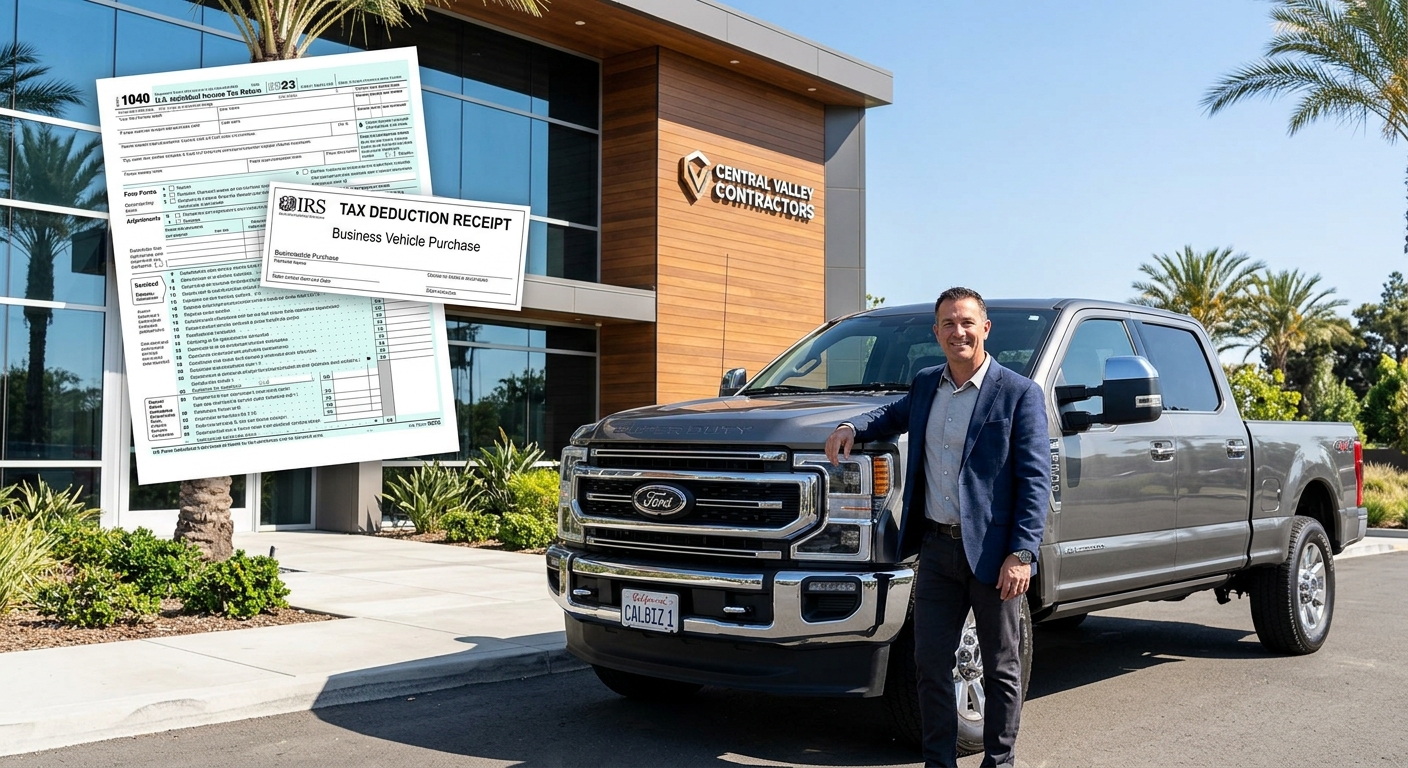
Most California Business Owners Buy the Wrong Truck and Lose $30,000 in Year-One Tax Savings
A contractor in Riverside buys a $78,000 Ford F-250 Super Duty for job sites, expecting to write off the entire cost in the first year. He files his federal return, takes the full Section 179 deduction truck 2024 California write-off, and feels great about his tax bill. Then California sends him a notice. The state only allowed $25,000 of that deduction. His state tax bill jumped by $6,900 overnight, and he had no idea it was coming.
This happens to thousands of California business owners every single year. The gap between what the IRS allows and what the Franchise Tax Board (FTB) allows on vehicle deductions is enormous, and most people only discover it after they have already filed. If you bought or plan to buy a heavy truck, SUV, or van for business use, the rules that follow will determine whether that purchase saves you $30,000 or more in taxes, or barely moves the needle.
Quick Answer
The Section 179 deduction lets you write off the full purchase price of a qualifying business vehicle in the year you place it in service. For 2024, the federal limit is $1,160,000. For 2025, it rises to $1,250,000. Under the One Big Beautiful Bill Act (OBBBA), 2026 and beyond push it to $2,500,000. But California caps Section 179 at just $25,000 and does not conform to federal bonus depreciation at all. That means a $75,000 truck that is fully deductible on your federal return may only generate a $25,000 California deduction in year one, creating a state tax gap of $3,000 to $6,500 depending on your income bracket.
Why the Section 179 Deduction Truck 2024 California Rules Create a $50,000 Federal-State Gap
Section 179 of the Internal Revenue Code, found in IRS Publication 946, allows businesses to deduct the full cost of qualifying property in the year it is placed in service instead of spreading it over multiple years through depreciation. For vehicles, the rules split into two categories based on gross vehicle weight rating (GVWR).
Vehicles Under 6,000 Pounds GVWR
Passenger automobiles, sedans, and light SUVs under 6,000 pounds GVWR are subject to the luxury automobile depreciation limits under IRC Section 280F. For 2024, the first-year depreciation cap is $20,400 (with bonus depreciation) or $12,400 (without). That means even if you buy a $60,000 BMW X5 for business, your maximum first-year deduction is $20,400 federally. California does not conform to bonus depreciation, so the state cap drops even further.
Vehicles Over 6,000 Pounds GVWR
This is where the real savings live. Trucks, SUVs, and vans with a GVWR exceeding 6,000 pounds are exempt from the Section 280F luxury limits. That means you can deduct the full purchase price under Section 179 up to the annual limit. Popular qualifying vehicles include the Ford F-250/F-350, Chevrolet Silverado 2500HD/3500HD, RAM 2500/3500, GMC Sierra 2500HD, Toyota Tundra (certain configurations), Chevrolet Tahoe, GMC Yukon XL, Ford Expedition Max, Mercedes-Benz GLS, and many commercial vans like the Ford Transit and Mercedes Sprinter.
Here is where the California trap springs. Many business owners assume that the same deduction flows through to their California return. It does not. Under California Revenue and Taxation Code (R&TC) Sections 17250 and 24356, the state caps Section 179 at $25,000 with a $200,000 investment phase-out threshold. California also completely rejects federal bonus depreciation under IRC Section 168(k). So a business owner who buys a $75,000 qualifying truck gets the full $75,000 deduction federally but only $25,000 in California, creating a $50,000 gap that must be depreciated over five to seven years using straight-line or MACRS methods on the California return.
The Real Dollar Impact
Consider these three scenarios for a California business owner who buys a $80,000 Ford F-350 with 100% business use:
| Income Level | Federal Section 179 Savings | California Year-One Savings | Year-One Gap |
|---|---|---|---|
| $100,000 profit | $18,400 (federal taxes saved) | $2,325 (CA taxes saved on $25K) | $16,075 |
| $200,000 profit | $26,400 | $2,788 | $23,612 |
| $350,000 profit | $29,600 | $3,075 | $26,525 |
The state deduction gap compounds because California’s top marginal rate hits 12.3% (plus the 1% Mental Health Services Tax above $1 million), meaning every dollar of deduction you cannot take in year one costs real money.
Five Rules That Determine Whether Your Truck Qualifies for a Full Section 179 Write-Off
Not every truck purchase results in a full deduction. Fail any one of these five tests and your write-off shrinks dramatically or disappears entirely.
Rule 1: The GVWR Must Exceed 6,000 Pounds
GVWR stands for Gross Vehicle Weight Rating. It is the maximum allowable weight of the vehicle when fully loaded, including passengers, cargo, and fuel. You can find this number on the manufacturer’s label inside the driver’s door jamb or in the owner’s manual. Do not confuse GVWR with curb weight. A vehicle with a 5,800-pound curb weight might have a 7,200-pound GVWR. The GVWR is what matters for Section 179 purposes. If you buy a truck with a 5,900-pound GVWR, you fall under the Section 280F luxury caps, and your first-year deduction drops from potentially $80,000 to just $20,400 federally.
Rule 2: Business Use Must Exceed 50%
Under IRC Section 179(d)(4), the vehicle must be used more than 50% for qualified business purposes in the year it is placed in service. If business use falls to 50% or below, Section 179 is completely disallowed, and you must use straight-line depreciation under the Alternative Depreciation System (ADS). The IRS expects contemporaneous records showing mileage, business purpose, destination, and date for every business trip. A mileage log app or spreadsheet is not optional. It is required.
Rule 3: The Vehicle Must Be Placed in Service During the Tax Year
Ordering a truck in December does not count if it is not delivered and placed in service until January. “Placed in service” means the vehicle is ready and available for its intended use. If you are targeting a 2024 deduction, the truck must be delivered and operational before December 31, 2024. For a 2025 deduction, before December 31, 2025.
Rule 4: The Purchase Cannot Exceed the Section 179 Annual Limit
For 2024, the federal Section 179 limit is $1,160,000 with a phase-out beginning at $2,890,000 in total qualifying property. For 2025, the limit is $1,250,000 with a $3,130,000 phase-out. Under the OBBBA (signed into law in 2025), the 2026 limit jumps to $2,500,000 with a $4,000,000 phase-out. Most single-truck purchases fall well within these limits, but if you are buying multiple vehicles and equipment in the same year, the phase-out can reduce your deduction dollar for dollar.
Rule 5: Your Deduction Cannot Exceed Taxable Business Income
Section 179 deductions cannot create a business loss. If your business generates $60,000 in taxable income and you buy an $80,000 truck, your Section 179 deduction is limited to $60,000 in that year. The remaining $20,000 carries forward to future years. This income limitation catches many business owners who purchase late in the year when they do not yet know their final profit numbers. For a complete breakdown of how entity structure affects these limits, see our comprehensive S Corp tax strategy guide.
KDA Case Study: Sacramento Landscaping Company Owner Saves $34,200 With Proper Truck Deduction Strategy
Daniel runs a landscaping and hardscape business in Sacramento structured as an LLC taxed as an S Corp. In late 2024, he purchased a new $82,000 Chevrolet Silverado 3500HD (GVWR: 11,500 lbs) and a $34,000 enclosed trailer for his crew. His CPA at the time told him to “just take Section 179 on everything,” which he did on both his federal and California returns using the same numbers.
When Daniel came to KDA for a second opinion, we found three costly errors. First, his California return claimed the full $116,000 in Section 179 deductions when the state only allows $25,000 total. Second, he had not set up dual depreciation schedules to properly track the California difference. Third, he had zero documentation for business-use percentage, leaving the entire deduction vulnerable in an audit.
Here is what KDA did. We amended his California return before the FTB caught the discrepancy. We set up proper dual federal-state depreciation schedules. We implemented a GPS-based mileage tracking system that documents 92% business use across his fleet. We filed the AB 150 Pass-Through Entity (PTE) elective tax election to bypass the $40,000 SALT cap on his S Corp distributions. And we restructured his equipment purchase timing so future buys maximize both federal and state deductions in the same year.
The result: Daniel’s corrected federal deduction was $116,000 (full Section 179), saving him $27,840 in federal taxes. His corrected California deduction was $25,000 in Section 179 plus $18,200 in MACRS depreciation on the remaining balance, saving $4,997 in state taxes. Combined with the AB 150 election saving $3,363 and the mileage documentation securing the deduction against audit, his total first-year benefit was $34,200. He paid KDA $4,800. That is a 7.1x return on investment in year one, with an additional $18,400 in California depreciation deductions flowing through over the next four years.
Ready to see how we can help you? Explore more success stories on our case studies page to discover proven strategies that have saved our clients thousands in taxes.
The Five Costliest Section 179 Truck Mistakes California Business Owners Make
After reviewing hundreds of business vehicle returns, these are the five errors we see most often. Each one costs between $3,000 and $25,000 in overpaid taxes or audit exposure.
Mistake 1: Using the Same Section 179 Amount on Federal and California Returns
This is the single most common error. California’s $25,000 cap and total rejection of bonus depreciation mean your state return requires a completely separate depreciation schedule. If your tax software auto-populates the California return from the federal, you must manually override the depreciation entries. Failing to do this either triggers an FTB notice or, worse, you lose the federal deduction in an audit because your records are inconsistent.
Mistake 2: Buying a Vehicle Just Under 6,000 Pounds GVWR
Many popular SUVs, like certain configurations of the Jeep Grand Cherokee, Toyota 4Runner, and Chevrolet Tahoe, have GVWR ratings that hover right around the 6,000-pound threshold. A 5,900-pound GVWR vehicle falls under Section 280F limits, capping your first-year deduction at $20,400 instead of the full purchase price. Always verify the GVWR on the specific VIN before purchasing. The same model can have different GVWR ratings depending on trim level, engine, and options.
Mistake 3: No Contemporaneous Mileage Log
The IRS requires “adequate records” under IRC Section 274(d) to substantiate business use of a vehicle. A year-end estimate is not sufficient. You need a log showing date, destination, business purpose, and miles driven for each trip. The IRS Publication 463 spells this out clearly. Without it, the IRS can deny the entire Section 179 deduction, not just the unsupported portion.
Mistake 4: Ignoring the Business Income Limitation
Section 179 cannot create or increase a net operating loss. If your business profit is $45,000 and you buy a $75,000 truck, your deduction caps at $45,000 for the year. The remaining $30,000 carries forward. Business owners who do not run year-end projections before purchasing often discover this limit after the fact, creating cash flow problems when the expected tax refund does not materialize.
Mistake 5: Forgetting the AB 150 PTE Election
California S Corp and partnership owners can elect the Pass-Through Entity (PTE) tax under AB 150, which pays state income tax at the entity level and generates a dollar-for-dollar federal tax credit. This effectively bypasses the $40,000 SALT deduction cap under OBBBA. If you are buying a truck through an S Corp and not filing the AB 150 election, you are leaving $2,000 to $8,000 on the table every year. Our tax planning services include AB 150 election analysis as a standard part of every engagement.
Section 179 Deduction Truck Strategies for 2024, 2025, and 2026: A Side-by-Side Comparison
The tax landscape for vehicle deductions has changed significantly across these three tax years due to OBBBA. Here is how the numbers stack up.
| Factor | 2024 | 2025 | 2026 (OBBBA) |
|---|---|---|---|
| Federal Section 179 Limit | $1,160,000 | $1,250,000 | $2,500,000 |
| Federal Phase-Out Threshold | $2,890,000 | $3,130,000 | $4,000,000 |
| Federal Bonus Depreciation | 60% | 40% (pre-OBBBA) / 100% (OBBBA retroactive) | 100% |
| California Section 179 Limit | $25,000 | $25,000 | $25,000 |
| California Phase-Out | $200,000 | $200,000 | $200,000 |
| California Bonus Depreciation | 0% | 0% | 0% |
| SALT Cap | $10,000 | $10,000 | $40,000 |
| QBI Deduction (Section 199A) | Subject to sunset | Subject to sunset | Permanent |
The most significant change is OBBBA’s restoration of 100% bonus depreciation, which had been phasing down by 20% per year since 2023. This means a $90,000 truck placed in service in 2026 can be fully deducted in year one through either Section 179 or bonus depreciation at the federal level. California remains completely unmoved by these changes.
If you want to see how a large truck purchase affects your overall tax picture, run the numbers through this small business tax calculator to estimate the net impact on your federal bill.
The OBBBA Bonus Depreciation Restoration Changes the Math
Before OBBBA, business owners had to rely more heavily on Section 179 because bonus depreciation was dropping to 40% in 2025. Now that 100% bonus depreciation is permanently restored, you have two paths to a full first-year deduction. The key difference is that bonus depreciation can create or increase a net operating loss, while Section 179 cannot. For business owners with fluctuating income, stacking bonus depreciation instead of (or in addition to) Section 179 can generate loss carryforwards that offset future income. This is an advanced move that requires careful modeling of current-year and projected income.
How to Set Up Dual Depreciation Schedules for Your Truck: A Step-by-Step Process
Every California business owner who takes Section 179 on a vehicle must maintain separate federal and state depreciation records. Here is the exact process.
Step 1: Record the Full Purchase Details
Document the vehicle year, make, model, VIN, GVWR (from door jamb sticker), purchase price, date placed in service, and business-use percentage. Keep the purchase agreement, loan documents, and title in your permanent tax file.
Step 2: Calculate the Federal Deduction
For a qualifying vehicle over 6,000 pounds GVWR with 100% business use, your federal deduction equals the full purchase price (up to the Section 179 limit) or 100% bonus depreciation, whichever strategy your tax advisor recommends. If business use is less than 100%, multiply the purchase price by the business-use percentage first.
Step 3: Calculate the California Deduction
California allows only $25,000 in Section 179 (total across all qualifying property, not per vehicle). Zero bonus depreciation. The remaining balance must be depreciated using the Modified Accelerated Cost Recovery System (MACRS) over five years for trucks or the class life applicable to the vehicle type. This creates a separate California depreciation schedule that runs for years after the federal deduction has been fully taken.
Step 4: Track the Annual California Depreciation Difference
Each year, your California return will show depreciation income or expense that differs from the federal return. This difference is tracked on California Schedule CA (540 or 540NR) as an addition or subtraction. Your bookkeeping system must maintain both schedules simultaneously. QuickBooks and similar platforms can handle this with proper setup, but many business owners (and some tax preparers) miss this requirement entirely.
Step 5: Reconcile at Disposition
When you sell, trade in, or dispose of the vehicle, the gain or loss calculation differs between federal and California because the remaining basis is different. A vehicle fully depreciated under Section 179 on the federal side still has $30,000 to $50,000 in remaining basis on the California side. This means your California gain on sale will be significantly lower (or your loss higher) than the federal amount. Missing this adjustment means overpaying California taxes on the disposition.
What If You Already Filed and Missed These Deductions?
If you purchased a qualifying truck in 2024 or 2025 and did not take the proper Section 179 deduction, you have options. For federal returns, you can file an amended return (Form 1040-X for individuals or Form 1120S-X for S Corps) within three years of the original filing deadline. For California, amended returns use Form 540X or 100X.
If your original return claimed the wrong depreciation method entirely, you may need to file a Form 3115 (Application for Change in Accounting Method) to switch to the correct depreciation treatment. This is more complex but can also trigger a “catch-up” adjustment under IRC Section 481(a) that recovers all previously missed depreciation in a single tax year. We have seen this recover $8,000 to $22,000 for business owners who used straight-line depreciation when they qualified for Section 179 or bonus depreciation.
Red Flag Alert: Filing an amended return solely to increase a vehicle deduction can draw IRS scrutiny if the business-use documentation is weak. Before amending, make sure your mileage logs, insurance records, and business records support the claimed percentage. If you cannot prove 51% or higher business use with contemporaneous records, the amendment could trigger worse outcomes than the missed deduction.
Will Claiming Section 179 on a Truck Trigger an Audit?
Vehicle deductions are consistently among the top IRS audit triggers. The IRS Data Book shows that Schedule C filers claiming vehicle deductions are audited at roughly 2x the rate of those who do not. However, taking a legitimate Section 179 deduction on a qualifying truck is not inherently risky. What triggers audits is the combination of large vehicle deductions with:
- No mileage log or substantiation records
- 100% business use claimed on a vehicle that appears personal (a luxury SUV with no commercial signage, for example)
- Section 179 claimed on a vehicle under 6,000 pounds GVWR
- Inconsistent reporting between federal and state returns
- Vehicle deduction that exceeds business income (which Section 179 should prevent, but bonus depreciation does not)
Pro Tip: If your business use is genuinely 90% or higher, document it thoroughly and take the full deduction without hesitation. The IRS rewards compliance, not timidity. A well-documented 95% business-use claim is far safer than a poorly documented 60% claim.
Ready to Reduce Your Tax Bill?
KDA Inc. specializes in strategic tax planning for business owners, S Corps, LLCs, and high-net-worth individuals. Book a personalized consultation and walk away with a clear plan.
Frequently Asked Questions About Section 179 Truck Deductions in California
Can I Take Section 179 on a Used Truck?
Yes. Unlike the new vehicle interest deduction under OBBBA, Section 179 applies to both new and used vehicles, as long as the vehicle is new to your business. It does not need to be new from the factory. A $45,000 used Ford F-250 with a GVWR over 6,000 pounds qualifies for the same Section 179 treatment as a brand-new one.
What If I Use the Truck 70% for Business and 30% Personal?
You multiply the purchase price by your business-use percentage. A $80,000 truck at 70% business use means a $56,000 eligible amount for Section 179 or bonus depreciation. The remaining $24,000 (personal portion) is never deductible. You must maintain mileage records proving the 70/30 split.
Does Leasing a Truck Instead of Buying Change the Deduction?
Leased vehicles do not qualify for Section 179. However, lease payments are deductible as a business expense under IRC Section 162, and California generally conforms to federal lease deduction rules. For vehicles over a certain fair market value, the IRS requires a “lease inclusion amount” adjustment that slightly reduces the annual deduction. Whether leasing or buying produces a better tax outcome depends on your specific cash flow, credit situation, and tax bracket.
Can I Take Section 179 on a Truck Used in a Rental Property Business?
Rental property activity generally does not qualify as an “active trade or business” under Section 179(d)(1). If you use a truck exclusively for managing rental properties, the Section 179 deduction may be disallowed unless you qualify as a Real Estate Professional Status (REPS) taxpayer or operate a separate property management business. The truck would still be depreciable under MACRS, just not eligible for the immediate write-off.
What Happens If My Business Use Drops Below 50% After I Take Section 179?
If business use falls to 50% or below in any year during the MACRS recovery period, the IRS requires “recapture” of the excess depreciation. You must include the recaptured amount as ordinary income on your tax return for the year business use drops. This is calculated under IRC Section 179(d)(10) and can generate a surprise tax bill of $5,000 to $20,000 depending on the original deduction amount.
Is There a Section 179 Deduction for the New Vehicle Loan Interest Under OBBBA?
No. The new OBBBA provision allowing up to $10,000 in vehicle loan interest deduction applies only to personal vehicles that are brand new with final assembly in the United States. It is a completely separate provision from Section 179. Business vehicles claimed under Section 179 use business interest deduction rules, not the new personal vehicle interest provision.
This information is current as of April 7, 2026. Tax laws change frequently. Verify updates with the IRS or FTB if reading this later.
Book Your Vehicle Deduction Strategy Session
If you bought a truck, SUV, or van for your business and you are not sure whether you took the right deduction, or if you are planning a purchase and want to maximize your write-off before year-end, stop guessing and get it right. Our team builds custom federal-state depreciation schedules, files AB 150 PTE elections, and structures vehicle purchases so you capture every dollar the law allows. Click here to book your consultation now.


