
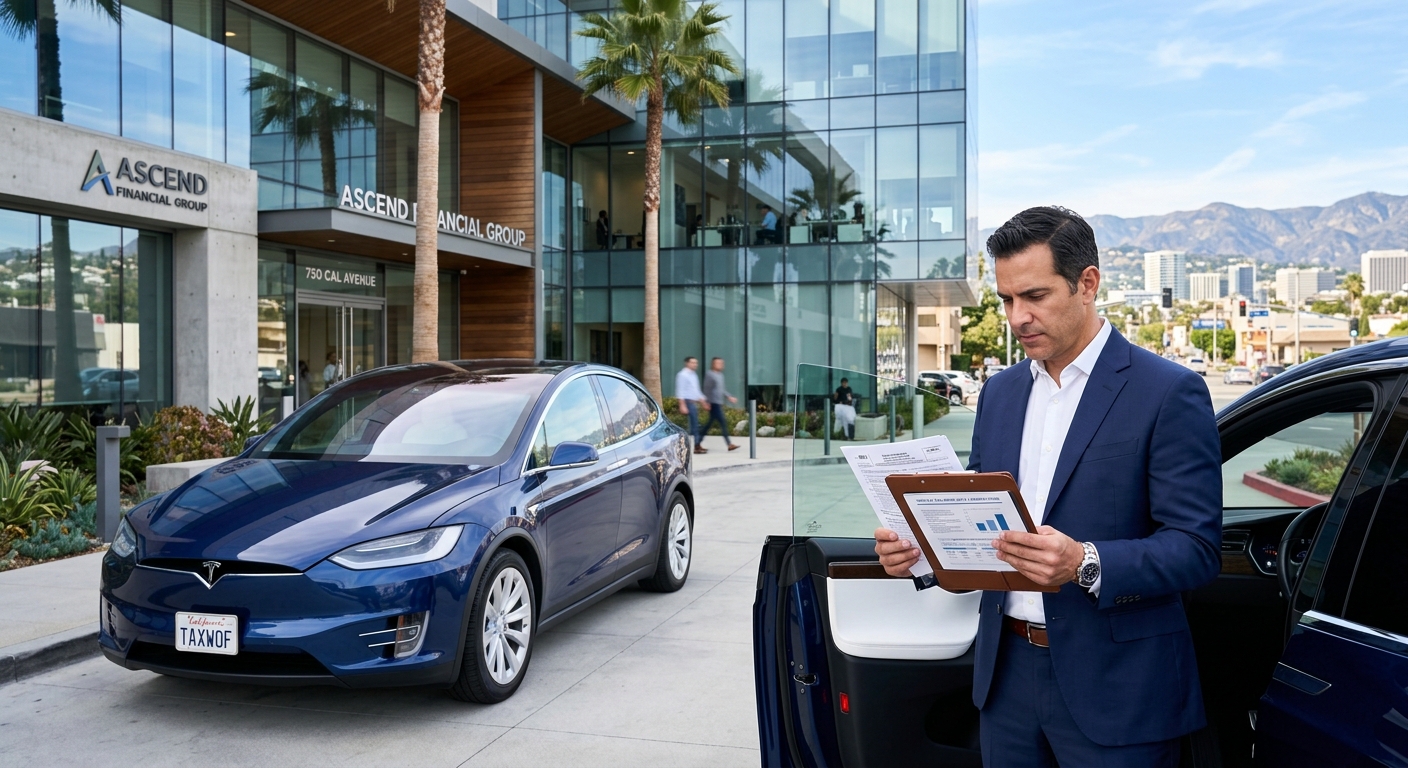
You bought a Tesla Model X for your business. It weighs over 6,000 pounds. You run it for client meetings, site visits, or daily operations. And yet, your accountant told you to “depreciate it over five years.” That’s a $60,000 to $80,000 mistake — and it happens every single year to California business owners who don’t understand how the Section 179 deduction Tesla Model X 2025 California rules actually work under the current tax code.
Here’s the truth: the Tesla Model X qualifies as a heavy SUV under IRS rules. That distinction alone changes your entire tax strategy. With the reinstatement of 100% bonus depreciation under the One Big Beautiful Bill Act (OBBBA) for assets placed in service after January 19, 2025, stacking Section 179 on top can wipe out a massive chunk of your taxable income in year one — if you do it correctly. If you don’t, you’re gifting the IRS your money on a four-year installment plan.
This guide breaks down exactly how to claim the full deduction, the California-specific traps that catch most business owners off guard, and the documentation you need to survive an audit.
Quick Answer
For the 2025 tax year, the Tesla Model X qualifies for the Section 179 deduction under the heavy SUV category (vehicles over 6,000 lbs GVWR). The federal deduction limit for SUVs under Section 179 is $30,500. When stacked with 100% bonus depreciation reinstated under OBBBA, business owners may be able to deduct the full purchase price of a qualifying Tesla Model X in year one at the federal level. California does not conform to 100% bonus depreciation and caps its own Section 179 at $25,000, creating a significant federal-state gap you must plan around.
Why the Tesla Model X Qualifies for the Section 179 Deduction in 2025
The IRS draws a hard line between passenger vehicles and heavy SUVs. That line lives at 6,000 pounds of Gross Vehicle Weight Rating (GVWR). Cross it, and you’re in a different tax universe.
The Tesla Model X has a published GVWR of approximately 6,768 to 6,788 pounds depending on the trim. That puts it squarely in the heavy SUV category under IRC Section 179(b)(5)(B), which means the standard luxury vehicle depreciation caps — which would limit your first-year federal deduction to around $12,200 — do not apply.
Instead, you access two stacking mechanisms:
- Section 179 expensing: Allows immediate deduction of qualifying business property, with a $30,500 cap specifically for SUVs over 6,000 lbs in 2025
- 100% Bonus Depreciation: Reinstated under OBBBA for qualifying assets placed in service after January 19, 2025 — allowing the remaining basis to be deducted in full in year one
Here’s what that looks like on a $95,000 Tesla Model X purchased 100% for business use:
- Section 179 deduction: $30,500
- Remaining basis: $64,500
- 100% bonus depreciation on remaining basis: $64,500
- Total year-one federal deduction: $95,000
At a combined federal and California marginal rate of 37% federal plus 9.3% California state, that $95,000 deduction produces approximately $43,985 in direct tax savings — for a business owner who would have otherwise spread that deduction over five years.
For a deeper breakdown of how S Corps and LLCs structure these deductions at the entity level, see our complete S Corp tax strategy guide for California.
KDA Case Study: Torrance Business Owner Writes Off $91,000 in Year One
A Torrance-based commercial real estate consultant came to KDA in early 2025 after purchasing a Tesla Model X for $91,000. She used the vehicle exclusively for client property tours, contractor meetings, and site visits — roughly 22,000 business miles annually. Her previous accountant had placed the vehicle in a standard 5-year depreciation schedule, which would have produced a $18,200 first-year deduction.
KDA reclassified the vehicle correctly as a heavy SUV and applied the Section 179 deduction ($30,500) followed by 100% bonus depreciation on the remaining $60,500 basis. Her federal year-one deduction jumped from $18,200 to $91,000 — a $72,800 difference. At her 35% federal bracket, that additional deduction alone produced approximately $25,480 in federal tax savings. Adding California conformity adjustments (discussed below), her net first-year tax savings reached $28,600.
She paid KDA $2,500 for the engagement. First-year ROI: 11.4x.
Ready to see how we can help you? Explore more success stories on our case studies page to discover proven strategies that have saved our clients thousands in taxes.
The California Non-Conformity Trap: What the Tesla Model X Deduction Actually Looks Like on Your State Return
California does not conform to federal bonus depreciation. Full stop. The California Franchise Tax Board (FTB) follows its own depreciation rules under California Revenue and Taxation Code Section 24356, which means the 100% bonus depreciation reinstated under OBBBA has no effect on your California state return.
California does allow Section 179 — but with a $25,000 cap, not the federal $1,160,000 limit. For an SUV, the federal $30,500 SUV cap effectively becomes a $25,000 California cap as well.
Here’s how the same $95,000 Tesla Model X deduction breaks down by jurisdiction:
| Deduction Component | Federal | California |
|---|---|---|
| Section 179 (SUV cap) | $30,500 | $25,000 |
| Bonus Depreciation (100%) | $64,500 | $0 |
| Regular 5-Year Depreciation (Yr 1) | $0 | $14,000 (est.) |
| Total Year-One Deduction | $95,000 | $39,000 |
This creates a Schedule CA adjustment. Your California taxable income will be higher than your federal taxable income in year one — but lower in subsequent years as California depreciates the remaining basis while your federal book shows zero. Your tax professional must maintain dual depreciation schedules and file Form 4562 for both federal and California returns separately.
Missing this dual-tracking requirement is one of the most common errors KDA corrects in new client engagements. Many business owners discover years later that their California depreciation was never properly computed, leading to FTB audit notices and recapture issues.
The 50% Business Use Requirement — and How the IRS Verifies It
Section 179 and bonus depreciation both require that the vehicle be used more than 50% for qualified business purposes. If business use drops below 51%, you lose Section 179 eligibility and bonus depreciation, and you’re forced into Alternative Depreciation System (ADS) — which spreads deductions over six years instead of five.
The IRS does not accept your estimate. Under IRS Publication 463, taxpayers must maintain a contemporaneous mileage log documenting:
- Date of each trip
- Business destination
- Business purpose (not just “client meeting” — be specific: “met with John Torres at 4500 Sepulveda Blvd re: lease negotiation”)
- Odometer reading at start and end
- Total miles driven during the year, both business and personal
Apps like MileIQ, Everlance, or even a dedicated Google Sheet work. What doesn’t work: reconstructing your mileage in April from memory, or providing a single annual total with no supporting detail.
For an S Corp or LLC, the vehicle can be owned by the entity — which simplifies documentation. All mileage becomes business mileage by default. Personal use is then reported as a taxable fringe benefit on the shareholder’s W-2. This is often the cleanest structure for business owners with multiple vehicles.
Want to estimate how much your business vehicle deduction will actually reduce your tax bill? Run the numbers through this small business tax calculator to see your projected savings before filing.
Section 179 Deduction Tesla Model X 2025 California: The Step-by-Step Claiming Process
Getting this deduction right requires more than just marking a box. Here’s the exact sequence to claim your Tesla Model X write-off correctly on your 2025 federal and California returns:
Step 1: Confirm the GVWR on the Vehicle Documentation
The GVWR must exceed 6,000 lbs. Find this on the door jamb sticker, the manufacturer’s website, or the vehicle title. The Tesla Model X shows 6,768–6,788 lbs. Screenshot it and keep it in your tax file permanently.
Step 2: Calculate Your Business Use Percentage
Total business miles divided by total miles driven equals your business use percentage. If you drove 18,000 business miles out of 22,000 total, your business use is 81.8%. All deductions are multiplied by this percentage.
Step 3: Apply Section 179 First
Per IRS rules, Section 179 must be applied before bonus depreciation. On an $95,000 vehicle at 81.8% business use, your adjusted basis is $77,710. Apply the $30,500 SUV Section 179 cap first. Remaining basis: $47,210.
Step 4: Apply 100% Bonus Depreciation
On your federal return, the remaining $47,210 basis is fully deductible in year one under OBBBA’s reinstated 100% bonus depreciation. Federal year-one total: $77,710.
Step 5: File Form 4562
Form 4562 — “Depreciation and Amortization” — is required for any year you claim Section 179 or bonus depreciation. Part I covers Section 179. Part II covers bonus depreciation. Both must be completed accurately. Errors on Form 4562 are a known IRS audit trigger.
Step 6: File Your California Depreciation Separately
On your California state return, apply California’s $25,000 Section 179 cap and no bonus depreciation. Begin regular 5-year MACRS depreciation on the remaining California basis. Track both federal and California depreciation schedules separately going forward.
Common Mistakes That Trigger an IRS Review
The vehicle deduction space is one of the IRS’s perennial audit targets. These are the mistakes most likely to trigger a closer look:
Claiming 100% Business Use Without Documentation
The IRS knows that very few vehicles are used exclusively for business. A sole proprietor who commutes from home to an office and claims 100% business use will draw scrutiny. If you genuinely have 100% business use (because a personal vehicle handles all personal trips), document it meticulously.
Deducting Before the Vehicle Is “Placed in Service”
You cannot claim Section 179 or bonus depreciation on a vehicle you purchased but haven’t yet started using for business. “Placed in service” means actively used in the business — not just owned. If you ordered your Tesla in November 2025 but didn’t take delivery until January 2026, your deduction is a 2026 event.
Recapture From Dropping Below 50% Business Use
If your business use drops below 50% in any subsequent year, the IRS may require you to recapture (repay) a portion of the Section 179 and bonus depreciation you previously claimed. This is reported on Form 4797 and can create a significant unexpected tax bill. Track your business use every year — not just year one.
Using Personal Funds for an Entity-Owned Vehicle
If the vehicle is owned by your LLC or S Corp, all payments should flow through the business account. Mixing personal and business funds in a vehicle owned by the entity can jeopardize the deduction and create self-dealing issues.
Red Flag Alert: The IRS specifically cross-checks Schedule C and Form 4562 for vehicle deductions against the income level reported. A contractor reporting $80,000 in gross income who deducts a $95,000 Tesla will likely be flagged for review. Make sure your business income supports the scale of the deduction you’re claiming.
Does the EV Tax Credit Affect Your Section 179 Deduction?
Under OBBBA, the federal EV tax credit (previously $7,500) was eliminated for personal vehicle purchases. If you’re purchasing the Tesla Model X as a business asset, the Section 30D credit is no longer available anyway — it applied to personal use vehicles. The business deduction under Section 179 and bonus depreciation has always been the primary tool for business owners, and that framework remains intact.
However, the OBBBA did create a new personal vehicle auto loan interest deduction — up to $10,000 per year for new vehicles purchased after December 31, 2024, with income phase-outs beginning at $100,000 (single) and $200,000 (MFJ). This applies to personal vehicles only, not business vehicles. It does not interact with or replace the Section 179 deduction.
What If I Use the Tesla Model X for Both Business and Personal Use?
Mixed-use vehicles are the norm, not the exception. The tax code accommodates this — but it requires honest accounting. Here’s how it works in practice:
Assume you drove your Tesla Model X 20,000 miles in 2025. Of those, 14,000 were business miles (70% business use). Your adjusted cost basis for deduction purposes is $95,000 x 70% = $66,500.
- Section 179 deduction: $30,500 (or $66,500 x 70% = $46,550 — deduct the lesser of the two after applying the SUV cap)
- The remaining basis is eligible for 100% bonus depreciation at the federal level
The remaining 30% personal use is simply not deductible. No recapture, no penalty — as long as you documented the split accurately throughout the year.
Our tax planning services include a vehicle deduction review that covers business use calculation, entity ownership structuring, and dual-state depreciation tracking to make sure you’re capturing every dollar without overreaching.
Is the Section 179 Deduction Tesla Model X 2025 California Worth It for Your Situation?
Yes, if:
- Your business is profitable and you have taxable income to offset
- You use the vehicle more than 50% for business purposes
- You have clean mileage documentation or are willing to build the habit
- Your vehicle was placed in service in the 2025 tax year
- You understand and plan for the California non-conformity adjustment
No, if:
- Your business is operating at a loss (Section 179 cannot create a loss beyond business taxable income)
- You cannot demonstrate consistent business use above 50%
- You leased the vehicle rather than purchased it (lease payments are handled differently)
- You expect to use the vehicle primarily for commuting — commuting miles are never deductible
Key Takeaway: The Section 179 deduction on a Tesla Model X purchased for business use in 2025 can produce $40,000 to $80,000+ in federal deductions in year one, but only if you apply the rules correctly, document business use thoroughly, and plan for California’s non-conformity gap.
Ready to Reduce Your Tax Bill?
KDA Inc. specializes in strategic tax planning for business owners, S Corps, LLCs, and high-net-worth individuals. Book a personalized consultation and walk away with a clear plan.
Frequently Asked Questions
Does the Tesla Model X qualify for the Section 179 deduction?
Yes. The Tesla Model X has a GVWR exceeding 6,000 lbs, which qualifies it as a heavy SUV under IRC Section 179(b)(5)(B). This means it is not subject to the standard luxury vehicle depreciation caps. The 2025 Section 179 deduction cap for SUVs over 6,000 lbs is $30,500, and the remaining basis may be eligible for 100% bonus depreciation at the federal level under OBBBA.
Can I write off the full purchase price of a Tesla Model X in 2025?
At the federal level, yes — if the vehicle is used 100% for business. You apply the $30,500 Section 179 cap first, then deduct the remaining basis via 100% bonus depreciation. California does not allow 100% bonus depreciation, so your California year-one deduction will be significantly lower, creating a temporary difference that reverses over the vehicle’s depreciable life.
What records do I need to support this deduction?
You need a contemporaneous mileage log showing the date, business destination, business purpose, and odometer readings for every business trip. You also need proof of purchase, the vehicle’s GVWR documentation, and Form 4562 filed with your tax return. Reconstructed logs are a known audit red flag — maintain real-time records throughout the year.
What happens if I sell the Tesla Model X after taking the full deduction?
When you sell a vehicle for which you took Section 179 or bonus depreciation, any gain on the sale is treated as ordinary income (depreciation recapture) under IRC Section 1245, up to the amount previously deducted. This is taxed at your ordinary income rate, not the more favorable long-term capital gains rate. Plan your exit strategy carefully before taking a large first-year deduction on a vehicle you may sell within a few years.
Should the Tesla Model X be owned personally or by my LLC?
For most business owners, entity ownership simplifies the deduction. The LLC or S Corp purchases and insures the vehicle, all business miles are automatically business miles, and personal use is reported as a fringe benefit. Personal ownership with a business reimbursement arrangement is also viable but requires more documentation discipline. Your choice should align with your entity structure and insurance strategy.
This information is current as of March 23, 2026. Tax laws change frequently. Verify updates with the IRS or FTB if reading this later.
Stop Leaving $40,000+ on the Table — Book Your Vehicle Deduction Strategy Session
If you purchased a Tesla Model X or any heavy SUV for your business in 2025 and haven’t reviewed your Section 179 and bonus depreciation strategy, there’s a high probability you’re overpaying federal and California taxes this year. Our team has helped dozens of California business owners recover five-figure deductions they didn’t know they were entitled to — in the same tax year they bought the vehicle. Click here to book your personalized tax strategy consultation now and find out exactly what you’re entitled to claim before your return is filed.


