
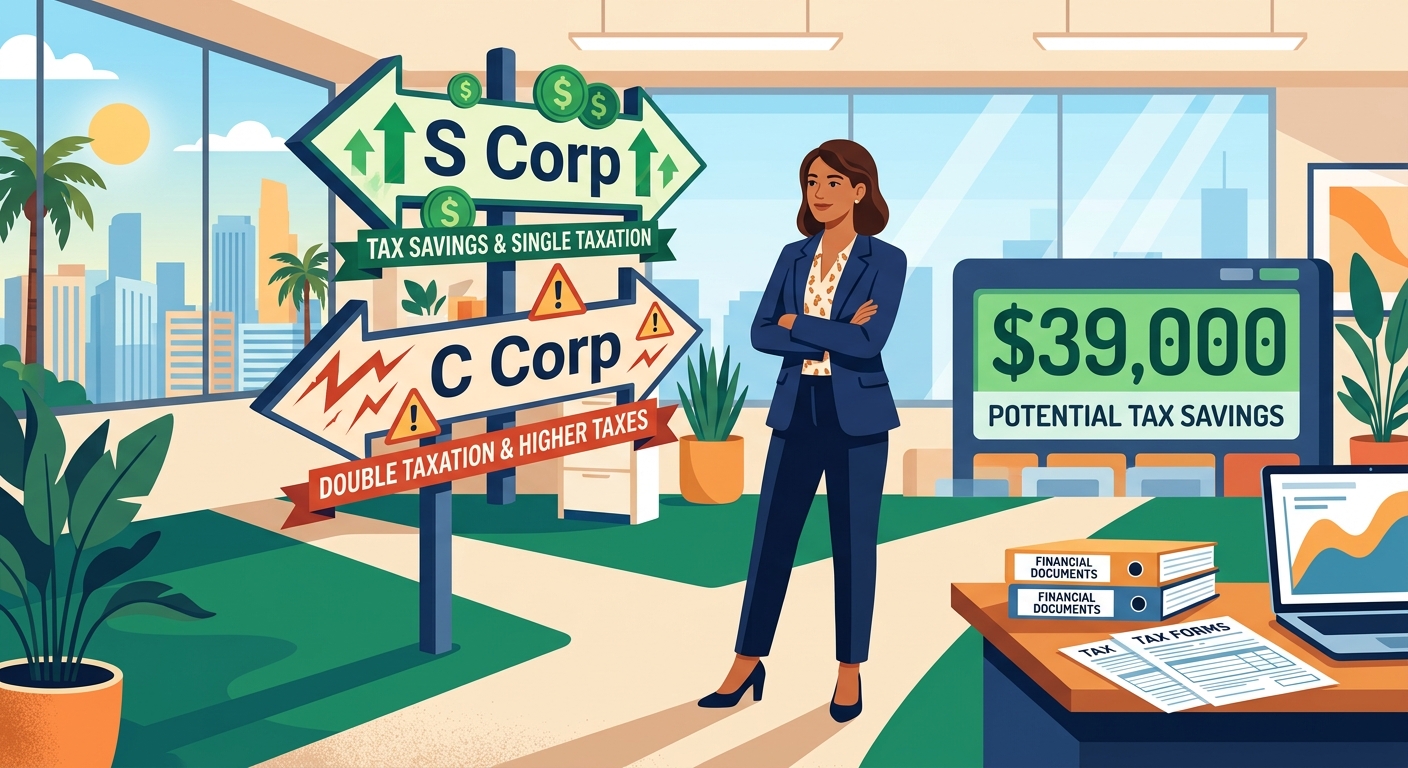
Most Owners Skip the Math. That One Shortcut Costs $39,000 a Year.
A Sacramento business owner came to us last year convinced she belonged in a C Corp. Her CPA told her the 21% corporate rate was “the lowest she could get.” She never ran the full calculation. When we built her a proper S Corp vs C Corp tax calculator comparison across all five tax layers, the gap was $39,287 per year in extra taxes she had been paying for three years running. That is $117,861 gone before she ever saw the problem.
The 21% federal corporate rate is real. But it is one number inside a five-layer tax system that includes federal dividend taxes, California franchise tax differentials, the QBI deduction under IRC Section 199A, and the AB 150 Pass-Through Entity tax election. When you only look at one layer, you miss the other four. And those other four layers are where the real money disappears.
Quick Answer
An S Corp vs C Corp tax calculator compares total tax liability across five layers, not just the federal corporate rate. For California business owners earning $100,000 to $350,000 in profit, the S Corp structure typically saves $17,600 to $64,700 per year when you account for federal entity tax, dividend double taxation, California franchise tax (8.84% vs 1.5%), the QBI deduction, and the AB 150 PTE election. Running these numbers before choosing your entity structure is the single most important financial decision you will make as a business owner.
The Five-Layer S Corp vs C Corp Tax Calculator Breakdown
Every online calculator you find gives you one number. Federal tax. That is like measuring a house by the front door and ignoring the rest of the building. Here is what a real S Corp vs C Corp tax calculator must account for at $200,000 in business profit.
Layer 1: Federal Entity Tax
A C Corp pays 21% on its net income at the corporate level under IRC Section 11. On $200,000, that is $42,000 right off the top. An S Corp pays zero federal entity-level tax. The income passes through to your personal return under Subchapter S of the Internal Revenue Code. That $42,000 difference is just the starting point.
Layer 2: Federal Dividend Double Taxation
After the C Corp pays its $42,000, the remaining $158,000 gets taxed again when it reaches you as a dividend. At the 15% qualified dividend rate, that is another $23,700. Total federal tax on a C Corp: $65,700. An S Corp owner pays ordinary income tax on the pass-through amount, minus the self-employment tax savings on distributions above a reasonable salary. At a $75,000 salary on $200,000 profit, the S Corp owner’s total federal tax lands around $39,800. Federal gap alone: $25,900.
Layer 3: California Franchise Tax Differential
California taxes C Corps at 8.84% of net income under Revenue and Taxation Code Section 23151. On $200,000, that is $17,680. S Corps pay 1.5% under R&TC Section 23802, which is $3,000. California gap: $14,680. Many business owners overlook this layer entirely because they focus on the federal calculation and forget that California runs its own tax system with different rates for each entity type.
Layer 4: QBI Deduction Under IRC Section 199A
The Qualified Business Income deduction, made permanent under the One Big Beautiful Bill Act (OBBBA), gives S Corp shareholders a 20% deduction on qualified pass-through income. On $200,000, that is a $40,000 deduction, saving roughly $8,800 to $14,800 in federal taxes depending on your marginal bracket. C Corp shareholders get zero QBI deduction. This benefit is exclusively for pass-through entities. If you want to see exactly how your specific profit level changes the calculation, plug your numbers into this small business tax calculator to estimate your total liability under each structure.
Layer 5: AB 150 PTE Election
California’s AB 150 allows S Corps and partnerships to pay state tax at the entity level, generating a dollar-for-dollar federal tax credit that bypasses the $40,000 SALT cap under OBBBA. On $200,000, this saves an additional $2,000 to $4,000 depending on your income and deduction profile. C Corps cannot use the PTE election because they already pay tax at the entity level under a completely different rate structure.
Side-by-Side Comparison at Three Income Levels
| Profit Level | C Corp Total Tax | S Corp Total Tax | Annual S Corp Advantage |
|---|---|---|---|
| $100,000 | $38,940 | $21,340 | $17,600 |
| $200,000 | $78,687 | $39,400 | $39,287 |
| $350,000 | $142,168 | $77,468 | $64,700 |
These numbers assume a reasonable salary of 35-40% of profit, California residency, filing as married jointly, and no other significant income sources. Your specific situation may shift the numbers, but the directional gap holds across virtually every profit range above $50,000.
The Five Costliest Entity Selection Mistakes California Owners Make
Running the S Corp vs C Corp tax calculator comparison is step one. But even owners who run the numbers still make critical errors that erase the savings they thought they locked in.
Mistake 1: Trusting the 21% Rate Without Calculating the Other Four Layers
This is the most common trap. A business owner hears “21% corporate rate” and assumes that is lower than their personal bracket of 32% or 35%. They skip the dividend tax, California differential, QBI loss, and PTE election. The all-in C Corp rate at $200,000 profit is roughly 39.3% when you add every layer. The all-in S Corp rate at the same profit is roughly 19.7%. That is a 19.6-percentage-point difference hiding behind a single number.
Mistake 2: Setting an Unreasonable S Corp Salary
The IRS scrutinizes S Corp officer compensation under the “reasonable salary” standard established in David E. Watson, P.C. v. United States. If you pay yourself $30,000 on $200,000 in profit, expect a reclassification audit. The IRS Palantir SNAP AI system cross-references your industry, revenue, and compensation data. A salary in the 35-45% range of net profit is the safe zone for most service-based businesses. Underpay, and you lose the entire S Corp advantage to penalties and back taxes.
Mistake 3: Missing the March 15 Form 2553 Deadline
Form 2553, Election by a Small Business Corporation, must be filed by March 15 of the tax year you want the election to take effect (for calendar-year filers). Miss this date, and you remain a C Corp or sole proprietor for the entire year. The good news: Rev. Proc. 2013-30 provides late election relief if you file within 3 years and 75 days of the intended effective date. But it requires a reasonable cause statement and unanimous shareholder consent. Our entity formation services handle these elections properly from day one so you never need the relief procedure.
Mistake 4: Ignoring California Bonus Depreciation Nonconformity
Under OBBBA, federal law restored 100% bonus depreciation for assets placed in service after 2025. California does not conform. Under R&TC Sections 17250 and 24356, California requires its own depreciation schedule using pre-bonus methods. If you claim 100% bonus depreciation on your federal return but forget the California adjustment, expect an FTB notice and potential penalties. Every S Corp and C Corp in California must maintain dual depreciation schedules.
Mistake 5: Skipping the AB 150 PTE Election
This is free money left on the table. The PTE election under California Revenue and Taxation Code Section 19900 allows the S Corp to pay state tax at the entity level. The owner gets a dollar-for-dollar credit on their federal return that bypasses the $40,000 SALT deduction cap. At $200,000 in S Corp income, this election saves roughly $2,000 to $4,000 depending on your total state tax. It costs nothing to file. You just have to know it exists and submit it by the original return due date.
Key Takeaway: The S Corp vs C Corp tax calculator comparison only works if you account for all five layers and avoid the implementation errors that cancel out the savings.
KDA Case Study: Sacramento Marketing Agency Owner Saves $41,200 in Year One
Rachel owned a digital marketing agency in Sacramento generating $220,000 in annual profit. She had been operating as a C Corp for four years because her original attorney told her the 21% rate was “the best deal available.” She came to KDA after reading about the QBI deduction and wondering if she was missing something.
We built a full five-layer S Corp vs C Corp tax calculator analysis for her specific situation. The results were stark. Her C Corp structure was costing her $41,200 per year in excess taxes compared to an S Corp election with proper salary planning.
Here is what KDA implemented:
- Filed Form 2553 for S Corp election effective the following tax year
- Submitted FTB Form 3560 for California S Corp registration
- Set a reasonable salary of $82,000 (37% of profit) based on BLS data for marketing agency directors in the Sacramento MSA
- Activated AB 150 PTE election for $3,200 in additional SALT cap bypass savings
- Established dual depreciation schedules for California nonconformity on bonus depreciation
- Opened a Solo 401(k) with $23,500 employee deferral plus 25% employer match on the $82,000 salary
- Claimed the 20% QBI deduction on $138,000 in pass-through income
Rachel paid KDA $5,800 for the full entity conversion, payroll setup, and tax planning engagement. Her first-year savings: $41,200. That is a 7.1x return on investment. Over five years, her projected savings total $206,000, assuming flat income and no further optimizations.
Ready to see how we can help you? Explore more success stories on our case studies page to discover proven strategies that have saved our clients thousands in taxes.
Three Narrow Scenarios Where a C Corp Actually Wins
The S Corp vs C Corp tax calculator almost always favors the S Corp for California owners earning between $50,000 and $500,000 in profit. But there are three narrow exceptions where the C Corp structure produces a better result. For a deeper dive into every angle of this decision, read our comprehensive S Corp tax strategy guide for California.
Scenario 1: Venture Capital Funding with Signed Term Sheet
If you have a signed term sheet from a VC firm requiring C Corp status, convert. VCs need preferred stock classes, which S Corps cannot issue under IRC Section 1361(b)(1)(D). But “I might raise money someday” is not a reason. Over 99.95% of small businesses never take VC funding. Do not pay an extra $39,000 per year in taxes on the hope that institutional capital shows up.
Scenario 2: QSBS Under IRC Section 1202
Qualified Small Business Stock allows C Corp shareholders to exclude up to $10 million in capital gains (or 10x their basis) when they sell shares held for five or more years. OBBBA expanded the QSBS tiers, making this more attractive for tech startups planning a genuine exit. However, California does not conform to the federal QSBS exclusion under R&TC Section 18152.5. You still pay California’s 13.3% rate on the gain. Run the full calculation including the state tax before assuming QSBS justifies C Corp status.
Scenario 3: Full Profit Retention Below $250,000
If you plan to reinvest 100% of profits into the business and never take distributions, the C Corp’s 21% flat rate may beat the S Corp’s pass-through taxation at higher brackets. But two warnings apply. First, retained earnings above $250,000 trigger the accumulated earnings tax under IRC Section 531, adding a 20% penalty. Second, the money is still trapped inside the corporation. The moment you take it out as a dividend, double taxation kicks in and eliminates the deferral advantage.
Decision Framework
| Your Situation | Best Entity | Why |
|---|---|---|
| $50K-$500K profit, taking distributions | S Corp | Five-layer advantage of $12,000-$70,000/year |
| Signed VC term sheet | C Corp | Required for preferred stock classes |
| QSBS exit planned within 5 years | C Corp | Up to $10M federal gain exclusion (CA taxed) |
| 100% retention below $250K | C Corp (maybe) | 21% deferral, but trapped capital |
| Starting new business, no VC | S Corp | QBI, PTE, single taxation from day one |
Eight Steps to Convert From C Corp to S Corp in California
If you ran your own S Corp vs C Corp tax calculator and discovered you are overpaying, here is the exact process to fix it.
Step 1: Verify Eligibility Under IRC Section 1361(b)
S Corps are limited to 100 shareholders, all of whom must be U.S. citizens or residents. Only one class of stock is allowed. If your corporation has foreign shareholders, multiple stock classes, or more than 100 investors, you cannot elect S Corp status without restructuring first.
Step 2: Evaluate Built-In Gains Tax Under IRC Section 1374
If your C Corp holds appreciated assets, converting to an S Corp triggers a five-year BIG tax recognition period. Any appreciation that existed at the time of conversion is taxed at the highest corporate rate (21%) if the asset is sold within five years. Calculate this exposure before filing.
Step 3: Calculate and Eliminate Accumulated Earnings and Profits
C Corps carry accumulated earnings and profits (AE&P) under IRC Section 312. After converting to S Corp, this AE&P follows the entity and can recharacterize S Corp distributions as taxable dividends under IRC Section 1368(c). Distribute or eliminate AE&P before or immediately after the election using the AAA bypass election under IRC Section 1368(e)(3).
Step 4: File Form 2553 with the IRS
Submit Form 2553, Election by a Small Business Corporation, to the IRS by March 15 of the tax year you want the election to take effect. All shareholders must sign. If you are late, attach a reasonable cause statement under Rev. Proc. 2013-30 for relief within 3 years and 75 days of the intended effective date.
Step 5: File FTB Form 3560 with California
California requires separate notification of S Corp status. File Form 3560, S Corporation Election or Termination/Revocation, with the Franchise Tax Board. The IRS and FTB do not communicate S Corp elections to each other. Skip this step and California will continue taxing you as a C Corp at 8.84%.
Step 6: Set Up Payroll with Reasonable Compensation
Register with the California Employment Development Department (EDD) for payroll taxes. Set your officer salary based on industry benchmarks from the Bureau of Labor Statistics. Document how you arrived at the number. The IRS reviews S Corp officer compensation as part of its standard examination procedures.
Step 7: Activate the AB 150 PTE Election
File the PTE election by the original due date of your S Corp return (March 15 for calendar-year filers, or by the extended due date if you make the election with your return). This generates a dollar-for-dollar federal credit that bypasses the $40,000 SALT cap. There is no downside to filing it.
Step 8: Establish Dual Depreciation Schedules
Because California does not conform to federal bonus depreciation under R&TC Sections 17250 and 24356, you must maintain separate federal and state depreciation schedules for every depreciable asset. This requires your tax software to track two parallel systems. Miss this, and your California return will be wrong.
OBBBA Permanent Changes That Affect Your S Corp vs C Corp Tax Calculator
The One Big Beautiful Bill Act locked in several provisions that permanently shift the S Corp vs C Corp tax calculator in favor of pass-through entities. These are not temporary. They do not expire.
QBI Deduction Made Permanent
The 20% deduction on qualified business income under IRC Section 199A was set to expire after 2025. OBBBA made it permanent. This means the $8,800 to $14,800 annual advantage at $200,000 profit is locked in for every future tax year. C Corp owners will never qualify for this deduction.
100% Bonus Depreciation Restored
Bonus depreciation had been phasing down (80% in 2023, 60% in 2024, 40% in 2025). OBBBA restored it to 100% retroactively. S Corp owners can write off the full cost of qualifying equipment and assets in the year placed in service. But remember: California does not conform. You still need dual depreciation schedules.
Section 179 Increased to $2.5 Million
The Section 179 expensing limit jumped to $2.5 million under OBBBA, up from $1.16 million. This benefits both S Corps and C Corps, but S Corp owners stack it with QBI and PTE elections for a compounding advantage.
SALT Cap Set at $40,000
The state and local tax deduction cap is now permanently set at $40,000 under OBBBA. Without the AB 150 PTE election, California S Corp owners would lose deductibility on state taxes above this threshold. The PTE election solves this by shifting the tax payment to the entity level, where the cap does not apply.
Estate Exemption at $15 Million
For business owners planning multi-generational wealth transfer, the $15 million per-person estate tax exemption ($30 million married with portability) under OBBBA creates significant planning opportunities that interact with your entity structure choice. S Corp shares pass through more cleanly in estate planning due to the single layer of taxation.
Will This Trigger an IRS Audit?
Switching from C Corp to S Corp does not automatically trigger an audit. But the IRS Palantir SNAP AI system cross-references entity classification changes with several data points:
- Officer compensation relative to industry benchmarks and gross revenue
- Distribution-to-salary ratios that appear aggressive
- Sudden changes in depreciation methods between tax years
- AE&P that disappears without proper documentation
- Form 7203 basis calculations that do not reconcile with prior-year K-1 amounts
The way to stay off the audit radar is straightforward. Set a defensible salary, document your basis, maintain clean books, and file every required form on time. S Corp elections themselves are routine. The IRS processes hundreds of thousands of them every year. It is the sloppy implementation that draws attention, not the election itself.
Pro Tip: Keep a written salary determination memo in your permanent tax file. List three comparable positions from the BLS Occupational Employment Statistics, your geographic area, years of experience, and hours worked. This document alone can resolve a salary inquiry before it becomes a full audit.
Ready to Reduce Your Tax Bill?
KDA Inc. specializes in strategic tax planning for business owners, S Corps, LLCs, and high-net-worth individuals. Book a personalized consultation and walk away with a clear plan.
Frequently Asked Questions
Can an LLC Use the S Corp vs C Corp Tax Calculator?
Yes. An LLC is a legal structure, not a tax classification. Your LLC can elect to be taxed as an S Corp by filing Form 2553 or as a C Corp by filing Form 8832. The five-layer calculator applies identically to LLCs that have elected corporate tax treatment. Most single-member LLCs earning over $60,000 in profit benefit from electing S Corp status.
Does California Recognize the QBI Deduction?
No. California does not conform to IRC Section 199A. The QBI deduction only reduces your federal tax bill. However, the AB 150 PTE election provides a separate California-level benefit that partially compensates. Your S Corp vs C Corp tax calculator must account for this by separating federal and state calculations.
What Happens If I Already Revoked My S Corp Election?
Under IRC Section 1362(g), you cannot re-elect S Corp status for five years after a revocation without IRS consent. A Private Letter Ruling (PLR) costs $15,300 as of 2026 and is not guaranteed to be approved. Before revoking, run the full five-year projection to make sure you are not locking yourself into $197,000 or more in cumulative excess taxes.
How Often Should I Rerun the Calculation?
Annually, at minimum. Your profit level, salary, filing status, and applicable tax laws change. What made sense at $100,000 in profit may shift at $300,000. The five-layer comparison should be part of your year-end tax planning every single year.
What Is the Minimum Profit to Justify S Corp Election?
Most tax professionals set the threshold at $50,000 to $60,000 in annual net profit. Below that, the payroll costs, franchise tax, and compliance burden can eat into the self-employment tax savings. Above $60,000, the S Corp advantage grows rapidly with every additional dollar of profit.
Does OBBBA Change the Calculator for Future Years?
Yes, permanently. The QBI deduction, 100% bonus depreciation, $2.5 million Section 179, and $40,000 SALT cap are all locked in. The S Corp vs C Corp tax calculator no longer needs to account for sunset provisions on these items. The five-layer advantage is structural and permanent for pass-through entity owners in California.
This information is current as of April 24, 2026. Tax laws change frequently. Verify updates with the IRS or FTB if reading this later.
Book Your Five-Layer Entity Tax Analysis
If you have been relying on the 21% rate as your only data point, you are almost certainly overpaying. The five-layer S Corp vs C Corp tax calculator analysis we build for each client accounts for federal entity tax, dividend double taxation, California franchise tax differentials, the permanent QBI deduction, and the AB 150 PTE election. Stop guessing and get the actual number. Click here to book your personalized entity tax analysis now.
“The IRS does not punish you for choosing the right entity structure. It punishes you for choosing the wrong one and never running the math.”



