
Many owners of successful S corporations assume converting to a C corporation will automatically unlock bigger valuations, easier investor money, or better stock option plans. What they are not told up front is that the wrong move, at the wrong time, can quietly add six figures of extra tax over a few years.
Before you sign off on any restructuring, you need to understand the real s corp to c corp conversion tax consequences and how they hit you as the shareholder, not just the entity. Done well, a switch can support long term growth. Done poorly, it can trap cash inside the company, trigger built in gain tax, and create double taxation on money you thought you already paid tax on.
Quick Answer
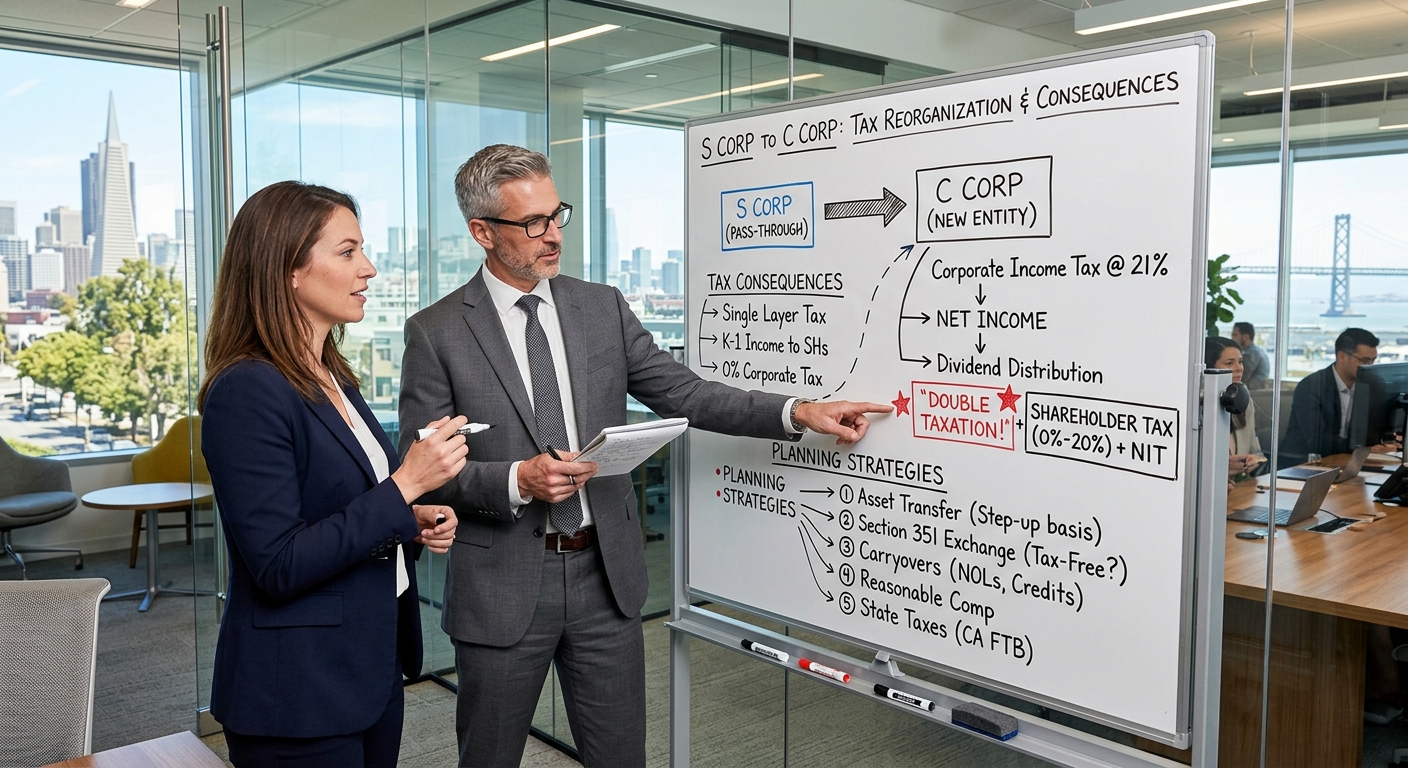
Switching from an S corporation to a C corporation does not create a tax bill on day one by itself, but it changes the rules for everything that happens after. Future profits are taxed at the corporate level, then taxed again when distributed as dividends. Appreciated assets can trigger built in gains tax if sold in the recognition period after conversion. Old S corporation earnings must usually be tracked in a separate account and can be distributed without a second tax hit, but only if you handle the ordering rules correctly and keep clean records.
This information is current as of 7/1/2026. Tax laws change frequently. Verify updates with the IRS if you are reading this later, and review IRS guidance such as IRS Publication 542 for corporations and IRS Publication 589 for S corporations.
Why Business Owners Consider an S to C Conversion
Most owners do not wake up wanting a new tax structure for fun. They are reacting to one of a few triggers:
- Outside investors who will only put money into a C corporation
- Plans to grant stock options or restricted stock to employees
- Desire to retain earnings for expansion without passing all profit to shareholders every year
- Concerns about reasonable compensation challenges on S corporation salaries
If this sounds familiar, you are in the target audience tax focused business owners who are already generating six figure profits and thinking about scale, not just survival. At that level, the entity choice is no longer a paperwork detail. It is a multi year tax planning decision that affects how, when, and how much you can pull out of the company.
For a deeper California specific foundation on S corporation strategy before you consider leaving S status, read our broader discussion in this complete guide to S corporation tax strategy in California. That article sets the baseline for when S status is powerful. This one focuses on what you risk and gain when you walk away from it.
Core s corp to c corp conversion tax consequences
From a tax perspective, converting from S to C is less about a single event and more about three buckets of consequences that unfold over time.
1. Corporate level tax on future profits
Once your S election terminates, the company becomes a C corporation. Going forward, income is taxed under subchapter C. That means:
- The corporation files Form 1120 instead of Form 1120 S
- Federal income tax is computed at corporate rates on taxable income
- Shareholders no longer report their share of company profit on Schedule E each year
Example: Assume your S corporation earns $500,000 of taxable income per year with one 100 percent owner in the 37 percent personal bracket. Under S status, that owner reports the full $500,000 on their personal return, pays roughly $185,000 of federal tax, and can often distribute most of the cash without another tax layer.
After converting to a C corporation, the entity pays corporate tax first. If the blended corporate rate on that income is roughly 21 percent, the corporation owes about $105,000. That leaves $395,000 of after tax cash inside the company.
If the company then distributes $300,000 as dividends, the shareholder pays tax again at qualified dividend rates, say 20 percent plus 3.8 percent net investment income tax. On $300,000, that second layer is about $71,400. Combined, you are now looking at around $176,400 of tax on $500,000 of profit. That is not always worse than the S corporation outcome, but the cash flow timing and where the tax is paid look very different.
2. Built in gains on appreciated assets
The next major element is built in gains tax. When an S corporation with appreciated assets terminates its S election, the corporation can be subject to corporate level tax on the built in gain if those assets are recognized within a defined recognition period after conversion. The rules are complex, but the basic idea is that the IRS wants to prevent shareholders from permanently avoiding corporate tax on appreciation that economically accrued while the company was in a pass through regime.
For current details, practitioners rely on guidance in IRS Publication 542 and related regulations. In practice, you need a balance sheet level review to identify assets such as real estate, equipment with large depreciation differences, or intangible property that may carry hidden exposure if sold post conversion.
Example: Your S corporation owns a building with a $600,000 tax basis and a $1,200,000 fair market value on the date you terminate S status. If you sell the building two years later for $1,300,000, there is a $700,000 gain. Depending on timing and other factors, a portion of that gain can be hit with corporate built in gains tax, which currently mirrors the corporate income tax rate, before any remaining amount ever flows to shareholders.
3. Double taxation on distributions and E&P
When you switch from S to C, the company can end up with two buckets of undistributed earnings:
- Accumulated Adjustments Account, which tracks previously taxed S corporation income
- Accumulated earnings and profits from C corporation years
Distributions after conversion must follow ordering rules. In many cases, distributions first come out of the AAA and are tax free to the extent of shareholder stock basis because owners already paid tax on those profits under S status. Once AAA is exhausted, distributions are treated as dividends to the extent of earnings and profits, then as return of capital, then as capital gain.
This is where sloppiness creates surprise tax bills. If you or your preparer do not maintain accurate AAA and E&P schedules after conversion, you can mischaracterize distributions and trigger unnecessary qualified dividend income. That is on top of the corporate level tax already paid.
How conversion plays out for different taxpayer types
The same structural change can affect different taxpayers in very different ways.
High earning W 2 owner operator
Consider a California engineer who left employment to build a consulting firm and now pays themselves a $220,000 W 2 salary from their S corporation plus takes $280,000 in annual distributions on top. Under S status, they are already in the top federal and California brackets. Adding more pass through income pushes them into higher marginal rates and phaseouts on deductions.
In this case, a move to C status might smooth personal cash flow. The corporation could retain a slice of earnings each year and reinvest at the corporate level, while the owner takes a more modest salary and dividend mix. However, when you factor in California taxes and the second layer on dividends, the savings are highly sensitive to how much cash is actually needed personally each year. This is the type of modeling work our tax planning services run through before we suggest any entity change.
1099 consultant with modest profits
A solo consultant netting $140,000 after expenses through an S corporation will almost never benefit from a conversion to C status. The corporate layer adds friction without real advantages, especially if you are still pulling most of the cash out every year for living expenses. For this persona, staying lean as an S or even Schedule C and focusing on clean records, retirement contributions, and simple quarterly estimates is usually the smarter move.
Real estate heavy S corporation
Real estate inside S corporations is notoriously tricky. If your S corporation holds appreciated property, converting to C status before a sale can turn what might have been a single level, long term capital gain into a two layer tax stack at corporate and shareholder level. For many real estate investors, the better path is to restructure holdings well before appreciation becomes massive or to separate operating businesses from property ownership entities.
KDA Case Study: S Corporation Owner Facing Investor Pressure
One California client, a software founder, came to us with a three year old S corporation generating about $900,000 of net profit on $2.5 million of revenue. Two venture funds were interested in a $4 million investment but insisted on a C corporation structure. The founder assumed the only path forward was to convert immediately, without considering the timing or the companys built in gains exposure.
We dug into the balance sheet and found roughly $600,000 of appreciated intangible value tied to internally developed software recorded at low tax basis. A rushed conversion followed by an equity recap could have exposed a large slice of that value to built in gains tax if a future exit landed inside the recognition window. We instead designed a phased plan that preserved S status for two additional years, allowed the founder to cleanly distribute $500,000 of old S corporation earnings, and positioned the conversion just before the funding round with a reworked cap table.
The result: over the following four years, the company still paid corporate income tax on profits after conversion, but the founder avoided approximately $180,000 of combined built in gains and double taxation that would have occurred under the investors original timeline. Our advisory fee for this work was around $28,000 over the project, producing more than a 6x first phase return before even considering ongoing planning.
Ready to see how we can help you? Explore more success stories on our case studies page to discover proven strategies that have saved our clients thousands in taxes.
Red flag alert: Common mistakes in S to C conversions
Certain errors show up repeatedly when we review prior conversions:
- No formal valuation or asset schedule at the time S status terminates
- Failure to track AAA and E&P separately year by year
- Continuing to distribute cash as if the company were still an S corporation
- Ignoring state level issues, especially California franchise and minimum tax rules
For example, if you keep using shareholder draws and do not document them as dividends with proper board approvals, you can end up with messy basis calculations and questions if the IRS examines the return. And if you assume every distribution is a tax free return of capital because you remember paying a lot of tax under S status, you are setting yourself up for an ugly correction later.
In California, you also have to balance the state corporate tax against personal rates. The state layer can tilt the math one way or the other for high income owners, which is why generic advice from national blogs often misleads California based businesses.
Will this trigger an audit?
Changing your corporation from S to C is a valid, routine step when done for real business reasons and properly documented. The IRS is not in the business of punishing legitimate conversions. The risk comes from sloppy execution: missing or late filings, inconsistent treatment of distributions, or unrealistic valuations of appreciated assets.
According to IRS enforcement statistics and commentary in resources like IRS Publication 556 on examinations, the agency tends to focus on patterns of underreported income, abusive loss claims, or mismatches between entity filings and shareholder returns. A well documented conversion with clear board minutes, accurate forms, and aligned K 1 and 1099 DIV reporting is far less likely to attract attention than a business that casually flips status without understanding the reporting consequences.
How to evaluate whether conversion makes sense for you
Before you make any election changes, work through a structured decision process. Here is a practical framework we use with clients.
Step 1: Map your three year profit and cash needs
Start by projecting realistic business profit for the next three years and how much cash you actually need to take home. An S to C conversion may look attractive on paper only if you plan to leave a meaningful portion of earnings in the company. If you are still in a phase where every dollar of profit ends up in your personal checking account, the double tax of C status will usually hurt more than it helps.
Step 2: Identify appreciated assets and potential exits
List business assets that could trigger built in gains exposure: real estate, intellectual property, or equipment with large book tax differences. Ask yourself what is likely to be sold, merged, or spun off in the recognition window after conversion. If a major sale is on the horizon, you may be better off deferring conversion until after the transaction or restructuring the asset ownership first.
Step 3: Compare S versus C under your actual numbers
Run both scenarios with tax software or a modeling spreadsheet instead of relying on rules of thumb. That means computing federal and state tax at the entity and shareholder level under both regimes, including qualified dividends, net investment income tax, and any state surcharges that apply. The comparison often surprises owners who assume the new lower corporate rate automatically wins.
Step 4: Consider investor and exit expectations
Finally, align your tax structure with where you want the business to go. Venture investors, private equity, and strategic buyers often have strong preferences for C corporations, especially when they are planning for stock option plans, multiple financing rounds, or public offerings. The tension is between short term tax efficiency as an S corporation and long term deal flexibility as a C.
What if you change your mind later?
Once you terminate S status, you cannot usually hop back and forth at will. There are rules that limit how soon you can re elect S treatment, and the history of your AAA and E&P carries forward. Flipping between statuses to chase short term rate differences is not a viable strategy.
If you went C for a specific investor deal and circumstances change, there may be paths back to pass through taxation, but they come with their own tax consequences and planning challenges. This is where close reading of resources like IRS Publication 589 and related revenue procedures matters, and even those do not replace customized modeling.
Fast tax fact: Distributions after conversion
One of the most misunderstood pieces of the puzzle is how post conversion distributions are taxed. In simple terms:
- Distributions up to AAA generally reduce shareholder basis and are not taxed again
- Once AAA is zero, distributions are dividends to the extent of E&P
- Distributions beyond E&P reduce basis, then create capital gain
The hard part is not the ordering rule itself, but holding the line in your accounting system and shareholder communication. You need to know when you have actually used up AAA, not just assume. Getting this wrong can easily cost a growing company $20,000 to $50,000 in avoidable dividend tax over a few years.
Where calculators and online tools can help
While there is no single calculator that perfectly models every nuance of an S to C conversion, you can start by understanding your overall tax posture. Tools like a robust tax bracket calculator help you see where your current income puts you for federal purposes and what an additional layer of C corporation income or dividends might do to your marginal rates.
Those tools are not a replacement for detailed modeling, but they quickly show how close you are to higher brackets or surtaxes. That alone can inform whether a structure that locks in corporate level tax is likely to help or hurt your long term plan.
Bottom line
The headline topic of s corp to c corp conversion tax consequences hides a messy reality. There is no universal yes or no answer. The right decision depends on the mix of your profits, how much cash you need personally, your asset base, and your funding and exit path. What is clear is that casual status changes done to please investors or mimic a friends structure can quietly erode hundreds of thousands of dollars over a decade.
For many mid market owners, the best move is not to convert immediately, but to tighten up S corporation practices, revisit compensation, improve bookkeeping, and use targeted planning to reclaim tax dollars they are already leaving on the table. Only once that foundation is solid should you weigh whether C status aligns with your long term goals.
Ready to Reduce Your Tax Bill?
KDA Inc. specializes in strategic tax planning for business owners, S Corps, LLCs, and high-net-worth individuals. Book a personalized consultation and walk away with a clear plan.
Book your tax strategy session
If you are wrestling with the real world impact of s corp to c corp conversion tax consequences on your business and personal returns, you do not have to guess. Our team works every day with S corporation and C corporation owners across California to model the tradeoffs, structure clean conversions when they make sense, and avoid costly surprises on built in gains and distributions. Click here to book your consultation now.



