
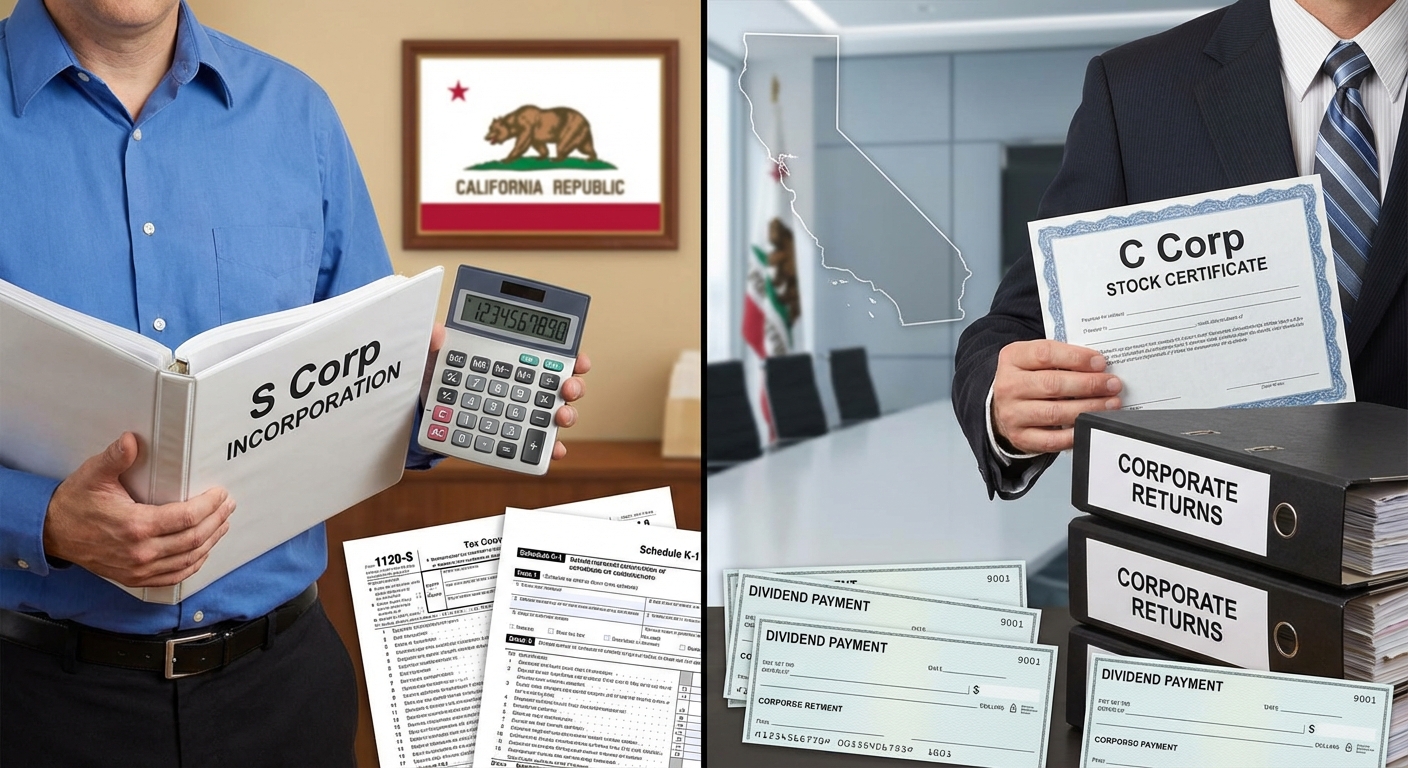
S Corp or C Corp? The Hidden Tax Decision That Changes Everything for California Owners in 2026
For the 2026 tax year, California business owners and investors face a critical question: should they choose an S Corp or a C Corp structure? It’s not just a paperwork exercise—pick wrong, and you could overpay the IRS by $25,000 or more every year. The stakes are even higher in California, where state-specific rules, franchise taxes, and recent law changes put added pressure on entity selection. Here’s what most lawyers and online incorporation services won’t tell you about making this choice in 2026, with real numbers, practical checklists, and the essential IRS rules you can’t ignore.
Quick Answer
Should you form an S Corp or C Corp? Most owner-operators and small businesses in California will save tens of thousands with an S Corp, because business income passes through at a single tax rate and avoids C Corp double taxation. But C Corps still outshine S Corps for high-growth startups, companies raising outside capital, and those targeting the Section 1202 stock exclusion—if you can endure higher complexity and potential double tax at exit. Don’t make this choice on autopilot: run the numbers for your specific profit levels, reinvestment goals, and exit plans.
The real question behind should i form an s corp or c corp is how many times you want the same dollar taxed. Under IRC §1366, S Corp income hits your return once, while C Corp income under IRC §11 is taxed at the corporate level and again when distributed. In California, that second layer is often what quietly wipes out profits for owner-operators.
This information is current as of 1/29/2026. Tax laws change frequently. Verify updates with the IRS or FTB if reading this later.
How S Corp and C Corp Differ: Plain English Comparison
Let’s start at the foundation. An S Corp is a small business corporation that “passes through” its profits and losses to your personal tax return, sidestepping federal corporate income tax. But there’s a catch: you must pay yourself a reasonable salary (as regulated by IRS S Corp rules), and distributions beyond salary avoid self-employment tax.
A C Corp, by contrast, pays its own federal income tax (now 21% flat rate). Owners only pay personal tax when they take money out as dividends—or when they sell shares. That’s where “double taxation” comes in: profits are taxed at both corporate and personal levels, unless you reinvest.
When clients ask should i form an s corp or c corp, we model cash flow, not just tax rates. If profits are distributed annually, the S Corp almost always wins due to avoided payroll tax on distributions and no second layer of tax. If profits stay inside the company for 3–7 years, a C Corp’s 21% federal rate can outperform—but only if dividends are deferred and QSBS rules remain intact.
- Example: If your business earns $220,000 in profits and you are an S Corp, all that income passes through to your 1040—after you pay yourself a salary (say, $80,000) and deduct payroll taxes. As a C Corp, $220,000 is taxed first at 21% ($46,200) before you can distribute any remaining cash as a dividend—where it’s taxed again at your capital gains or dividend rate.
If you’re an LLC owner or entrepreneur trying to decide, it’s critical to match the structure to your income pattern. Many business owners discover in year two they’re stuck in a tax-inefficient setup because they didn’t project their profit, payroll, or exit timing right. Our breakdown covers both structures with state and federal examples, pitfalls, and what to do next.
When an S Corp Delivers the Biggest Tax Savings
Owner-operators, consultants, solo LLC owners, and family-owned service businesses are the classic fit for an S Corp. Why? The structure allows you to:
- Pay yourself a reasonable salary (subject to payroll tax)
- Distribute excess profit as dividends, skipping self-employment/FICA tax (15.3%) on that portion
- Take advantage of IRS pass-through deductions—like Section 199A QBI
Let’s map a real scenario:
- A single-member consulting LLC profits $170,000 in 2026
- Loses $26,010 to self-employment tax if remain as Schedule C
- Saves roughly $8,925 per year by electing S Corp—after paying themselves $75,000 salary and taking $95,000 as a distribution (no SE tax on distribution)
- Franchise Tax Board (FTB) CA annual cost: $800 minimum plus 1.5% franchise tax, still better net than the double tax hit of a C Corp
You’ll also pick up state pass-through entity (PTE) tax credits in 2026, which became more lucrative this year. That’s a unique California advantage for S Corp filers that can neutralize high personal income taxes on business profit, according to current FTB guidance.
Strategic year-end moves can save thousands. Our tax planning services help you identify these opportunities, whether you’re weighing S Corp or C Corp status for your California business.
KDA Case Study: Dental Practice Transforms with S Corp Election
Meet Dr. Jen, a California dentist earning $285,000 annually through her single-location practice (previously an LLC taxed as a sole proprietor). She was paying over $44,000 a year in federal and state taxes, plus $17,400 in self-employment tax. When KDA stepped in, we:
- Converted her LLC to an S Corp mid-year (Form 2553 filed for 2026)
- Structured $130,000 as a W-2 salary (justified via industry comp surveys)
- Paid remaining $115,000 as S Corp distribution (no FICA/SE tax owed)
- Coordinated with her payroll provider to ensure ongoing compliance and timely payroll tax deposits
- Leveraged CA’s PTE tax election for significant state credits
Results: First year net tax savings: $14,750 after S Corp set-up and payroll. ROI: 5.1x on KDA fee ($2,900). Dr. Jen now invests the surplus in retirement and office upgrades she couldn’t previously afford.
Ready to see how we can help you? Explore more success stories on our case studies page to discover proven strategies that have saved our clients thousands in taxes.

When a C Corp Actually Wins: Startup, IPO, and Long-Term Growth Playbook
If your business needs venture capital, plans to IPO, or wants to qualify for the Section 1202 Qualified Small Business Stock (QSBS) exclusion, a C Corp structure makes sense. Here’s why:
- Flat 21% federal tax rate on retained profits
- The potential for 100% exclusion from capital gains tax (up to $10 million) if holding QSBS at exit (Section 1202 rules—complex but powerful)
- Easier to issue multiple classes of stock, attract institutional investors, and defer taxes until money leaves the company
Example: Tech startup raises $5 million, operates at a loss for three years, then sells for $20 million. Because founders structured as a C Corp and followed QSBS rules, they save up to $2 million in federal capital gains tax at exit. An S Corp would block this savings.
If corporate profit will be reinvested for years (no owner distributions), the double tax risk—where profit is taxed in C Corp, then taxed again when distributed as dividends—may not hit until later. But the C Corp CA franchise tax is higher (8.84%) and doesn’t scale well for Main Street owner-operators.
For most owners asking should i form an s corp or c corp, the answer changes once profits are pulled out personally. California’s 8.84% corporate tax plus dividend tax often exceeds the combined S Corp payroll and pass-through burden for businesses under roughly $400,000 in annual profit. C Corps shine on exit—not on annual distributions.
Which Structure Fits LLC Owners, Realtors, and 1099 Consultants Best?
Most LLCs and self-employed service professionals in California maximize savings with the S Corp structure once their profit exceeds $80,000–$100,000 a year. Below that threshold, the payroll, compliance, and franchise tax costs may offset your gains. For real estate investors holding rental property, neither S nor C Corp is typically ideal; LLC taxed as partnership or disregarded entity still rules for asset protection and step-up at death.
Consultants and creative professionals risk triggering personal service corporation (PSC) rules if C Corp is chosen—which erases the supposed tax benefits and locks in punitive federal rates. S Corp election lets you split income and payroll and tap QBI deduction (20%), so every dollar works harder.
Get tax help tailored for self-employed Californians—don’t let one-size-fits-all advice cost you real money over the next decade.
What the IRS and Franchise Tax Board Won’t Tell You: Red Flags and Myths
Here are the audit triggers and myths tripping up California business owners every year:
- Myth: “C Corps are just for big companies.” False—structure depends on exit, capital, and reinvestment plans.
- Red Flag: S Corp owner pays themselves too little salary. The IRS expects “reasonable compensation,” or you risk back-taxes and penalties (see official S Corp guidance).
- Trap: Failing to make correct state PTE election for S Corp: you could leave $3,000–$9,000 per year on the table.
- Mistake: C Corp owners pay out all profits as dividends, triggering double taxation without the benefit of QSBS exclusion or long-term reinvestment.
Pro Tip: Run your numbers through a small business tax calculator before making any entity decision. Shape the corporation around your true needs—not trends or generic articles.
Who Should Really Form an S Corp or C Corp in 2026?
Form an S Corp if:
- Your profit exceeds $80,000/year, you operate solo or in a small team, and you’re not raising VC money soon
- You want ongoing payroll plus quarterly distributions to cut self-employment taxes
- You’ll benefit from California’s PTE workaround
Form a C Corp if:
- You expect to keep profits in the company for years without distributions
- You plan to raise outside equity, issue employee stock options, or target a buyout/IPO (especially with Section 1202-qualified stock)
- Your profits are so high that even double taxation doesn’t erase the benefits (rare for main street businesses below $400,000 in profits)
Key Takeaway: The best entity is not generic. Use your specific revenue, reinvestment plans, and exit goals as the primary filter in 2026—especially with California’s strict state tax overlays.
What If My Business Model Changes After I Choose?
Both conversions are possible, but not painless. S Corp to C Corp and vice versa both trigger unique IRS events (built-in gains taxes, election restrictions, waiting periods). For a step-by-step on how to convert, see our S Corp strategy guide. Always map out timing—usually, changes are effective at the start of the next year and require IRS approval.
FAQ: California S Corp vs C Corp (2026 Edition)
Will an S Corp save money if I reinvest profits every year?
Not usually. S Corps require profits to flow through to your 1040—even if not distributed. If you plan to keep all profits in the company for years, a C Corp with its flat 21% rate can sometimes win, but weigh long-term distribution plans.
Do both S Corp and C Corp pay California franchise tax?
Yes. Both face California’s minimum $800 fee, but S Corps pay 1.5% on net profit and C Corps pay 8.84%—a huge cost difference if most cash is distributed annually.
I’m a real estate investor—should I use an S Corp?
Rarely. Real estate appreciation and rental losses aren’t treated optimally in S Corps; partnerships or disregarded entities (LLC/Sole Prop) generally deliver better step-up and depreciation treatment.
How hard is it to switch from LLC to S Corp or C Corp?
Converting an LLC to S Corp is common (file Form 2553 with IRS and update with the CA Secretary of State). Switching to C Corp is more complex—often requires a new entity and assets transfer, plus built-in gains triggers. Always use a professional for the conversion process.
Will choosing wrong trigger an audit?
Not by itself, but red flags exist: unreasonable S Corp compensation, improper PTE elections, and C Corp dividend mismatches draw IRS scrutiny (see IRS Publication 542).
Pro Tips, Traps, and the Bottom Line
Pro Tip: Every owner-operator should run their forecasted profit through a small business tax calculator before committing to S Corp or C Corp status. Even small differences in salary or distribution strategy can change your effective tax rate by 7% or more.
Key Takeaway: Don’t rely on online buzz around C Corp or S Corp. Use your own numbers, specific state rules, and planned exit timeline to decide. The wrong entity choice will quietly bleed your company dry—get a second opinion before you file or convert.
Book Your Tax Entity Assessment
Struggling with entity selection could be costing you five figures annually. Get a seasoned strategist to run your real-world numbers, design your best-case scenario, and help you file the right forms. Book your confidential tax strategy call now and start saving immediately—before the 2026 window closes.



