
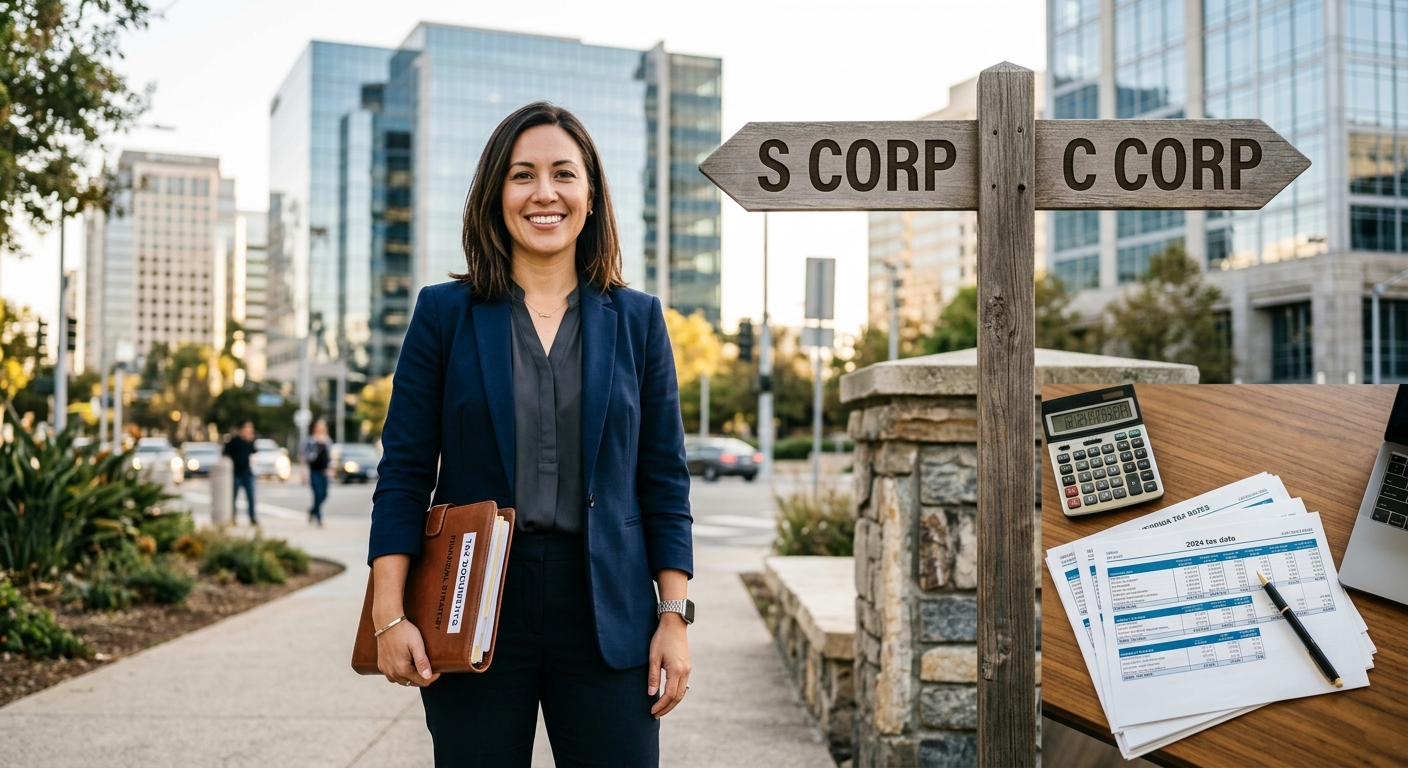
Here is a scenario that catches successful business owners off guard: you set up an S Corp years ago to save on self-employment taxes, it worked beautifully, and now a venture capital firm wants to write you a check, or you are stacking profits you do not need to distribute, and suddenly the structure that saved you money is the structure holding you back. That moment is when the S corp conversion to C corp conversation moves from theoretical to urgent, and getting it wrong can cost you six figures in avoidable tax.
Most advisors treat the S Corp as the final destination for a growing company. It is not. For a specific and growing group of businesses, converting from an S Corp to a C Corp is one of the smartest moves available in 2026, and for another group it is a costly mistake dressed up as sophistication. The difference comes down to a handful of facts about your business that you can identify in an afternoon.
Quick Answer: When an S Corp Conversion to C Corp Actually Makes Sense
An S corp conversion to C corp makes sense when you plan to raise institutional capital, retain significant earnings inside the business rather than distributing them, want to offer stock-based compensation to employees, or expect to qualify for the Qualified Small Business Stock exclusion under Section 1202. It rarely makes sense if you distribute most of your profits each year, because the C Corp’s double taxation will erode the money you take home. The conversion itself is administratively simple, but the tax consequences that follow require careful planning around built-in gains, accumulated adjustments accounts, and passive income rules.
Before we break down each trigger, understand the core mechanical difference. An S Corp is a pass-through entity, meaning profits flow directly to your personal return and get taxed once at your individual rate. A C Corp is a separate taxpayer, meaning it pays a flat 21 percent federal corporate tax on profits, and then you pay tax again when those profits reach you as dividends. That second layer of tax is the entire reason people fear C Corps, and also the reason it can be a hidden advantage in the right circumstances.
The Five Real Triggers for an S Corp Conversion to C Corp
Nobody should convert their entity because a blog told them to. You convert when your business hits a specific inflection point. Here are the five that actually justify the move, ranked by how often we see them drive real decisions.
1. You Are Raising Venture Capital or Institutional Money
This is the number one reason profitable companies convert. Venture capital funds, private equity firms, and most institutional investors legally cannot or will not invest in an S Corp. The reason is structural: S Corps are limited to 100 shareholders, cannot have most entity shareholders such as partnerships and other corporations, cannot have foreign shareholders, and can only issue one class of stock. VC deals require preferred stock, foreign limited partners in the fund, and entity-level investors. All of that is prohibited under Subchapter S.
If you are pitching investors and they are serious, the term sheet will require a C Corp, usually a Delaware C Corp specifically. The election to become a C Corp is one signed statement, but the timing matters enormously because of built-in gains, which we cover below.
2. You Are Retaining Earnings Instead of Distributing Them
Here is the math that surprises people. If your S Corp earns $500,000 and you are in a high individual bracket, you pay tax on the full $500,000 at rates that can reach 37 percent federally plus California’s top marginal rate, even if you leave most of that money in the business to fund growth. That is the pass-through curse: you are taxed on profits whether you take them home or not.
A C Corp earning that same $500,000 pays 21 percent federal corporate tax, and you only pay the second layer of tax on money you actually distribute. If you are reinvesting heavily and pulling out only a modest salary, the C Corp lets earnings compound inside the business at a lower blended rate. Growing manufacturers, capital-intensive service firms, and companies building toward a large acquisition often benefit here.
3. You Want to Offer Real Equity Compensation
Attracting top talent increasingly means offering stock options and equity. Incentive stock options, which carry favorable tax treatment for employees, can only be issued by C Corps. The single-class-of-stock rule in an S Corp makes sophisticated equity plans nearly impossible. Many business owners discover this constraint the hard way when a key hire asks for options they cannot legally grant.
4. You Are Chasing the Section 1202 Qualified Small Business Stock Exclusion
This is the sleeper strategy that sophisticated founders love. Under Section 1202 of the Internal Revenue Code, if you hold qualified small business stock in a C Corp for at least five years, you can exclude a substantial portion of the gain when you sell, potentially up to 100 percent of gains up to the greater of $10 million or ten times your basis. S Corp stock does not qualify for this exclusion. Only C Corp stock does. For founders building a company they intend to sell in five or more years, converting to a C Corp and starting the Section 1202 clock can be worth millions in tax-free gain at exit.
5. The 21 Percent Corporate Rate Beats Your Personal Rate
For some owners, especially those in the highest individual brackets who live in high-tax states, the flat 21 percent federal corporate rate is simply lower than what they pay as a pass-through. When combined with a modest salary strategy and disciplined distributions, the total tax picture can favor the C Corp. This requires running the actual numbers for your situation, which is exactly where a real projection matters. You can start by estimating your business tax picture with a small business tax calculator before you ever sit down with a strategist.
KDA Case Study: Tech Founder Converts to C Corp and Unlocks $2.1M in Section 1202 Savings
One of our clients, whom we will call Marcus, ran a software development firm structured as an S Corp in the San Francisco Bay Area. For years the S Corp worked perfectly, saving him roughly $18,000 annually in self-employment taxes on his $220,000 profit. Then his product gained traction, a growth equity firm expressed interest in a $4 million round, and Marcus realized his entity structure was about to become a dealbreaker.
When Marcus came to us, he was three weeks from signing a term sheet and had no plan for the conversion. We mapped out the full picture. First, we handled the mechanics of revoking the S election so the company became a C Corp effective at the start of a clean tax period, which mattered for both the investors and the Section 1202 clock. Second, we structured his stock issuance so that his shares qualified as qualified small business stock from day one of C Corp status, starting the five-year holding period immediately.
We also modeled his built-in gains exposure and confirmed that because the company held few appreciated assets, his built-in gains tax risk was minimal. The strategic result: Marcus closed his round on a compliant C Corp structure, and based on his projected exit in year six, the Section 1202 exclusion is positioned to shield an estimated $2.1 million of gain from federal tax. He paid us roughly $9,500 for the conversion planning and first-year corporate structuring. The projected first-year and exit-stage return runs well into the hundreds to one range once the exclusion is realized.
Ready to see how we can help you? Explore more success stories on our case studies page to discover proven strategies that have saved our clients thousands in taxes.
Why Most Business Owners Get the Built-In Gains Tax Wrong
Here is the trap that turns a smart conversion into an expensive one. When you convert from an S Corp to a C Corp, the reverse direction, C Corp to S Corp, triggers the built-in gains tax under Section 1374. Many owners confuse the direction of this rule and panic unnecessarily, or worse, ignore it when it actually applies to a future re-election.
The built-in gains tax is a corporate-level tax on appreciated assets that existed when an entity switches into S Corp status. When you go S Corp to C Corp, the immediate concern is different: you are collapsing the accumulated adjustments account and dealing with how prior undistributed S Corp earnings get treated. Any earnings you accumulated as an S Corp and did not distribute can generally be paid out tax-favorably during a limited post-conversion window, but miss that window and those distributions can later be treated as ordinary C Corp dividends subject to the second layer of tax.
Pro Tip: After an S corp conversion to C corp, you typically have a one-year post-termination transition period to distribute your accumulated adjustments account balance to shareholders without it being taxed as a C Corp dividend. Miss this window and you may pay dividend tax on money you already paid tax on once as an S Corp owner. This single detail is where we routinely save clients tens of thousands of dollars.
Red Flag Alert: The Passive Income Trap
If your former S Corp had accumulated earnings and profits and generates significant passive investment income after conversion planning goes sideways, you can trigger unexpected taxes and even jeopardize elections. Investment-heavy businesses need to be especially careful about how retained earnings and passive income interact during and after conversion. This is not a do-it-yourself project.
Step-by-Step: How to Execute an S Corp Conversion to C Corp
The administrative process is genuinely straightforward. The strategic process around it is where the real work lives. Here is the sequence.
- Confirm the conversion is right for you by running a multi-year projection comparing pass-through tax versus corporate tax on your actual profit and distribution pattern. Do not skip this. Roughly a third of owners who ask us about converting should not.
- Revoke the S election by filing a statement of revocation with the IRS service center where you file your return. The revocation must be signed by shareholders holding more than 50 percent of the shares. Timing determines your effective date.
- Choose your effective date carefully. A revocation filed by the 15th day of the third month of the tax year can be retroactive to the first day of that year. File later and it takes effect the following year unless you specify a prospective date.
- Distribute your accumulated adjustments account within the post-termination transition period if you have accumulated S Corp earnings you want to pull out tax-favorably.
- Set up C Corp compliance systems including corporate payroll, reasonable compensation documentation, and quarterly estimated corporate tax payments using Form 1120 going forward instead of the S Corp’s Form 1120-S.
- Document Section 1202 eligibility if the qualified small business stock exclusion is part of your plan, and keep meticulous records of your stock basis and issuance date.
Because the tax consequences ripple across multiple years, this is a strategy where professional tax planning services pay for themselves many times over. The signed forms are easy. The consequences are not.
What If I Change My Mind After Converting?
This is the most important warning in the entire article. Once you revoke your S election and become a C Corp, you generally cannot re-elect S Corp status for five years without IRS consent. This five-year lockout under the tax code exists specifically to prevent owners from flip-flopping to game the system. So treat the conversion as a long-term decision, not a reversible experiment.
There is also a second reason the five-year window matters. When you eventually go back to an S Corp, the built-in gains tax under Section 1374 can apply for a recognition period on any appreciation that built up during the C Corp years. That means a poorly timed round trip can generate a corporate-level tax you never saw coming. Plan the entry and model the potential exit before you sign anything.
S Corp vs C Corp: The Comparison That Actually Matters
Below is the practical breakdown owners need when weighing the decision. Focus on the rows that match your situation rather than trying to optimize every line.
| Factor | S Corp | C Corp |
|---|---|---|
| Federal tax on profits | Passed through to owners at individual rates up to 37 percent | Flat 21 percent at corporate level |
| Second layer of tax | None | Yes, on distributed dividends |
| Number of shareholders | Limited to 100 | Unlimited |
| Foreign or entity owners | Not allowed | Allowed |
| Classes of stock | One only | Multiple allowed |
| Section 1202 exclusion | Not eligible | Eligible after five years |
| Best for | Owners distributing most profits | Owners raising capital or retaining earnings |
Should You Convert? A Simple Decision Framework
Convert to a C Corp if:
- You are raising venture or institutional capital that requires it
- You retain most of your profits inside the business for growth
- You want to issue incentive stock options to employees
- You are targeting a Section 1202 exclusion at a future sale five or more years out
Stay an S Corp if:
- You distribute most of your annual profit to yourself
- You want to avoid double taxation on take-home earnings
- You have no plans to raise outside equity
- Your priority is minimizing self-employment tax on active income
California-Specific Considerations You Cannot Ignore
For California business owners, the calculus has an extra layer. California does not fully recognize federal Section 1202 treatment the way some states do, so the qualified small business stock exclusion that shields you federally may not shield you from California state tax on the same gain. That does not kill the strategy, but it changes the size of the prize and must be modeled.
California also imposes its own corporate franchise tax on C Corps, generally 8.84 percent of net income, alongside minimum franchise tax obligations. When you stack the federal 21 percent, the California 8.84 percent, and the dividend tax on distributions, the total burden on money you actually take home can be steep. This is precisely why the retain-earnings scenario, where you leave money in the business, is where California C Corps shine, and why the distribute-everything scenario is where they hurt. This information is current as of 7/23/2026. Tax laws change frequently. Verify updates with the IRS or California Franchise Tax Board if reading this later.
Ready to Reduce Your Tax Bill?
KDA Inc. specializes in strategic tax planning for business owners, S Corps, LLCs, and high-net-worth individuals. Book a personalized consultation and walk away with a clear plan.
Frequently Asked Questions
How long does an S corp conversion to C corp take to become effective?
The revocation itself is immediate once properly filed, but the effective date depends on timing. File by the 15th day of the third month of your tax year and it can be retroactive to the start of that year. File later and it generally takes effect the following tax year unless you specify a prospective date.
Will converting trigger an immediate tax bill?
The conversion itself does not usually create an immediate federal tax event, but the treatment of your accumulated adjustments account, any prior earnings and profits, and appreciated assets can create tax consequences if mishandled. This is why the post-termination transition period distribution planning is so critical.
Can I switch back to an S Corp if it does not work out?
Generally not for five years without IRS consent. The tax code imposes a five-year waiting period after revoking an S election before you can re-elect it, so treat the conversion as a long-term commitment rather than a reversible test.
Does a C Corp really pay tax twice?
Only on distributed profits. The corporation pays 21 percent federal tax on earnings, and shareholders pay dividend tax on money actually distributed to them. Profits retained inside the business are taxed only once at the corporate level, which is the entire reason the retain-earnings strategy works.
The Bottom Line on Converting Your Entity
An S corp conversion to C corp is neither the trap that fearful advisors describe nor the magic bullet that startup culture promises. It is a precision tool. Used at the right inflection point, when you are raising capital, retaining earnings, building equity compensation, or positioning for a Section 1202 exit, it can save or shield hundreds of thousands to millions of dollars. Used carelessly, the double taxation and five-year lockout can lock you into a structure that quietly bleeds your take-home income.
The IRS gives you the flexibility to change structures. It does not give you a warning when you time it wrong. The owners who win are the ones who model the decision across multiple years before they sign a single form.
Book Your Entity Strategy Session Before You Convert
If your business is approaching a funding round, stacking retained earnings, or you suspect you have outgrown your S Corp, do not guess your way through a conversion that locks you in for five years. Our strategy team will run your actual numbers, map your built-in gains and Section 1202 exposure, and tell you plainly whether converting will save you money or cost you. You will leave the session with a clear direction and a timeline. Click here to book your consultation now.



