
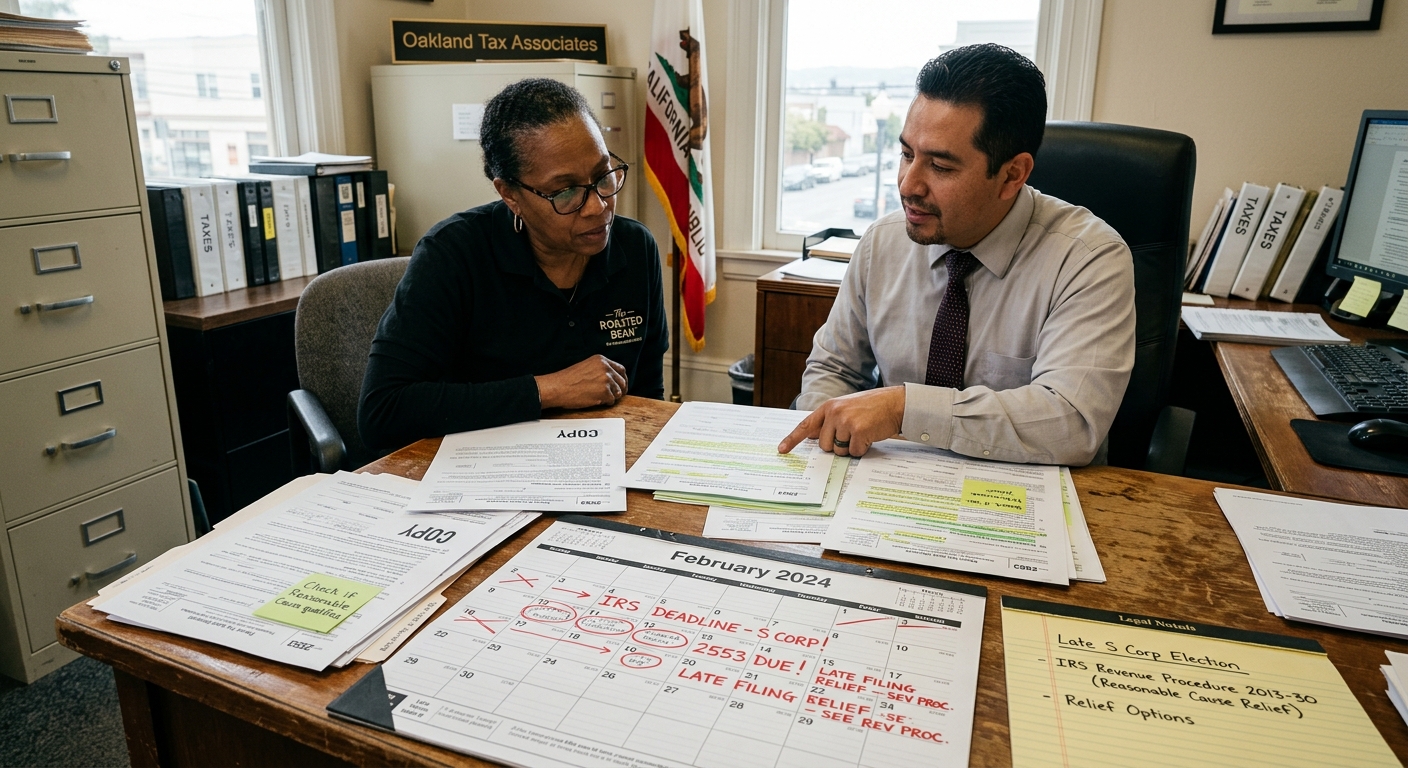
Most small business owners who miss the S corporation election deadline assume the IRS clock has run out on their tax savings. That assumption can easily cost a profitable California LLC or corporation five figures per year in extra payroll and self employment tax.
The good news: the IRS has a formal pathway to fix many late elections without a full blown private letter ruling. That pathway lives in Rev Proc late S Corp election relief under Revenue Procedure 2013 30 and related guidance. If you understand how this relief works and move before your window closes, you can often rescue the election and lock in savings you thought were gone.
Quick Answer
For many closely held corporations and LLCs that intended to be taxed as S corporations but missed Form 2553, Revenue Procedure 2013 30 allows a simplified late election. If you meet the eligibility rules, file the right statements, and show you have consistently treated the entity as an S corporation for tax purposes, the IRS will generally respect your late filing as if it were timely. This can retroactively shift profit from self employment tax or double tax treatment into S corporation flow through status.
This information is current as of June 19, 2026. Tax laws and IRS procedures change frequently. Confirm details with your advisor or directly with the IRS if you are reading this later.
How Late S Corporation Election Relief Actually Works
Revenue Procedure 2013 30 is the core IRS guidance that consolidates and simplifies relief for late S corporation elections and some related elections. Instead of paying for an expensive private letter ruling, qualifying small corporations can self certify why they filed late and ask the IRS to treat Form 2553 as if it was filed on time.
Under the Rev Proc framework, you generally must show three things:
- You were eligible to be an S corporation on the effective date you are requesting.
- You intended to be an S corporation as of that date.
- You have consistently filed and treated the entity as an S corporation on all returns since that date, or you did not file returns at all.
The technical details live in the text of Revenue Procedure 2013 30. If you are a business owner trying to apply this on your own, be careful. The IRS gives you one streamlined shot here. If you botch the filing, you may need an expensive ruling later.
If you are an LLC or corporation owner deciding whether S corporation status is the right move going forward, it helps to step back and look at the overall structure and savings opportunities. For a broader view of how S corporation strategy fits into California tax planning, see our complete S corporation tax guide for California owners.
Who Typically Uses Late Election Relief
In practice, we see three types of taxpayers using Rev Proc late S corporation election relief:
- Single owner California LLCs that have been profitable for a year or two and realize they have been overpaying self employment tax.
- New corporations where the attorney formed the entity, but nobody actually filed Form 2553 with the IRS.
- Existing C corporations with one or a few shareholders that thought their CPA mailed Form 2553, only to learn later it was never accepted.
These owners often have net profits in the 75,000 to 400,000 per year range. At that level, cleaning up the S election can easily save 8,000 to 35,000 per year in combined payroll and income taxes compared to staying as a default LLC or C corporation.
Why California Owners Need Extra Care
California overlays state rules on top of federal S corporation status. You still face the 1.5 percent California S corporation tax and the annual 800 minimum franchise tax. Getting the federal election fixed is only part of the story. You also need to confirm your California returns match the S corporation treatment and that your reasonable salary and payroll setup hold up under scrutiny.
If you own an LLC or corporation and your situation is more complex than a simple single member entity, it can be worth talking with specialists who work daily with business owners navigating entity and salary decisions. The interaction between federal S corporation rules and California franchise tax can be unforgiving if you guess.
Key Eligibility Rules Under Rev Proc Late S Corp Election Relief
If you want to rely on the streamlined procedure instead of a formal ruling, you must satisfy specific conditions. While you should always review the actual Revenue Procedure or talk with a strategist, these are the big ones you cannot ignore.
1. Small Corporation or LLC with Eligible Shareholders
The entity must qualify as an S corporation under the normal rules. That means:
- No more than 100 shareholders.
- Only allowable shareholders individuals, certain trusts, and estates, but not partnerships or corporations.
- Only one class of stock.
- A domestic entity organized in the United States.
If you accidentally issued preferred shares or took investment from an ineligible shareholder, you have a deeper problem than just a late Form 2553. That kind of situation often requires customized cleanup strategy and sometimes cannot be fixed through the simple Rev Proc route.
2. Reasonable Cause for Filing Late
Revenue Procedure 2013 30 requires you to include a statement of reasonable cause for failing to file Form 2553 on time. This is not a novel; it is a concise explanation that a human IRS reviewer can understand. Typical reasonable cause explanations include:
- Miscommunication between your attorney and CPA about who would file the election.
- A mistaken belief that the entity was already treated as an S corporation.
- Reliance on a tax preparer who did not realize a separate filing was required.
You are not required to be perfect, but you must show that you took ordinary business care and prudence and that the failure was not due to willful neglect. The more your actions look like you intended S corporation treatment, the stronger your reasonable cause story.
3. Consistent S Corporation Treatment on Returns
One of the most important conditions is that since the date you wanted S corporation status, you have consistently filed returns and treated the entity and its shareholders as if the election were already in place.
That typically means you have already filed Form 1120 S returns, issued K 1 schedules to shareholders, and paid yourself a W 2 salary if you are an owner operator. If you filed as a C corporation or as a sole proprietorship instead, you may still have options, but they will not fit the streamlined late election box.
At this point, the questions stop being purely technical and start impacting payroll systems, bookkeeping, and prior year corrections. This is where many owners also bring in outside help with bookkeeping and payroll support tied to S corporation strategy to avoid creating new compliance issues while fixing the election.
Step by Step: Using Rev Proc Late S Corp Election Relief
For a qualifying small business, the process to request relief under Revenue Procedure 2013 30 is straightforward but must be executed precisely. Here is the high level roadmap.
Step 1: Confirm Eligibility and Timeline
First, confirm that you meet the shareholder and single class of stock requirements. Second, check the timing rules. Revenue Procedure 2013 30 generally provides relief if you are within three years and 75 days of the intended effective date, although there are specific variations depending on facts.
If you are far outside that window, you may still have options, but you are more likely in private letter ruling territory. That is a different cost and decision analysis entirely.
Step 2: Gather Prior Returns and Evidence
Next, assemble prior tax returns, payroll records, and any correspondence that shows you have treated the entity as an S corporation. This might include:
- Previously filed Form 1120 S returns.
- W 2s issued to owner employees.
- Shareholder K 1s attached to individual Form 1040 returns.
- Operating agreements or bylaws that support single class of stock status.
Revenue Procedure 2013 30 relief lives or dies on whether the IRS believes you truly acted like an S corporation all along. Documentation that backs that up is powerful.
Step 3: Prepare and File Form 2553 with Required Statement
You then prepare Form 2553 as if you were making a timely election, but you also attach the specific late election statements required by Revenue Procedure 2013 30. Those statements cover your reasonable cause explanation and affirm that all shareholders have reported income consistent with S corporation treatment.
The IRS instructions for Form 2553 include a section on late election relief and reference to Revenue Procedure 2013 30. You can find the current instructions on the IRS Form 2553 guidance page. Read that section carefully before you sign anything.
Step 4: Monitor IRS Response and Clean Up State Filings
Once you file the late election package, the IRS will eventually send a determination letter indicating whether it accepts your election as timely. While you wait, you should work through your California Franchise Tax Board reporting to ensure it aligns with the S corporation status you are requesting at the federal level.
If the IRS accepts your late election, you may want to recalibrate estimated taxes, adjust owner salary levels, and revisit your broader tax plan. If the IRS denies relief, you are not necessarily done, but the strategy shifts toward whether private letter ruling or forward looking planning makes more sense.
Red Flag Alert: Common Mistakes That Derail Late Elections
Because late S corporation election relief feels like a second chance, many owners rush the process and accidentally trigger red flags that can derail otherwise fixable situations.
Missing or Inconsistent Returns
If you have gaps in filings or years where you filed as a sole proprietorship or C corporation, the IRS may not believe you truly intended S corporation treatment all along. That does not mean all hope is gone, but it usually means you will need more customized representation to clean up the past before or alongside the late election request.
Ignoring Reasonable Compensation
Even if the IRS grants your late election, they can still challenge whether you paid yourself a reasonable salary as an owner employee. A California consultant with 250,000 in net profit who pays themselves 30,000 in W 2 wages is asking for payroll tax scrutiny.
Before filing a late election, model what a defensible reasonable salary looks like in your industry, then update your payroll. The fact that you proactively corrected underpayment before the IRS questions it can help your credibility.
Forgetting About State Level Issues
Many online articles walk through federal late election relief and never mention state tax agencies. California cares about your classification too. If you act like an S corporation federally but your state returns tell a different story, you increase your audit risk and can owe unexpected state level tax and penalties.
If you are a California based investor or operator, this is a good moment to talk with a strategist who regularly handles tax planning tied to entity structure and multi year projections, not just annual filing. The choices you make in your late election year ripple through future estimated taxes, retirement contributions, and real estate or business investments.
KDA Case Study: California Consultant Fixes Missed S Election
Consider a real world case. A solo marketing consultant in Los Angeles formed an LLC in 2022. By 2024, the business was generating 210,000 in net profit after expenses. The owner had heard about S corporation savings and assumed their attorney handled the election. Their CPA filed Form 1120 S in 2024 with a modest 80,000 salary to the owner. In early 2026, an IRS notice revealed there was no approved S election on file.
If left as a default disregarded LLC, the owner would owe self employment tax on nearly the entire 210,000 profit, around 29,000 in Social Security and Medicare alone, plus income tax. With an S corporation in place and an 80,000 salary, the owner would instead pay payroll tax on the wage and treat the remaining 130,000 as pass through profit, saving roughly 15,000 in payroll taxes for that year.
KDA walked through the facts and confirmed the LLC met the shareholder and single class of stock rules. We helped the owner document that they genuinely thought the S election was handled at formation, and that they had consistently filed as an S corporation and paid themselves a salary in line with industry norms. We then prepared a late Form 2553 package under Revenue Procedure 2013 30, with a focused reasonable cause statement and shareholder consents.
The IRS accepted the late election as timely, retroactive to January 1, 2024. The owner kept the 15,000 payroll tax savings for 2024, aligned their 2025 estimates with the new structure, and worked with us on retirement contributions that leveraged the new W 2 wages. They paid a few thousand dollars in professional fees and saw a first year after tax ROI of roughly 4 to 1.
Ready to see how we can help you? Explore more success stories on our case studies page to discover proven strategies that have saved our clients thousands in taxes.
Will Late S Election Relief Trigger an Audit
Many owners hesitate to file for late election relief because they fear it will draw the IRS spotlight. In reality, using the formal Revenue Procedure 2013 30 framework is less risky than leaving years of inconsistent treatment on file.
The IRS cares far more about unfiled returns, obvious underreporting, and aggressive abuse of deductions than it does about a cleanly documented late S election where everyone has already reported income consistently. Of course, if your reasonable compensation or shareholder basis is already thin, the late election may be the moment a strategist needs to shore up those weak spots.
If you want a rough sense of how your total business income and salary mix might land for federal purposes, you can plug broad numbers into a tool like a small business tax calculator. That will not replace strategy, but it can frame what is at stake before you make election decisions.
What If You Are Beyond the Normal Relief Window
Sometimes a California business owner discovers the problem after the standard three year and 75 day window has passed. Perhaps the entity has been operating for a decade, the tax preparer retired, and nobody realized Form 2553 was never properly accepted.
In these situations, you may still be able to pursue relief, but it generally requires a formal private letter ruling request. That process is slower, more expensive, and more technical. The IRS user fee alone can run thousands of dollars, and you must prepare a full factual record and legal analysis.
At that point, part of the analysis is whether the future tax savings justify the cost and risk of a ruling, or whether it is more efficient to make a clean break and elect S corporation status prospectively from the current year forward. That decision hinges on profit levels, shareholder ages, and longer term exit or real estate plans.
How Late Election Relief Interacts with Other Tax Strategies
Fixing a missed S election is rarely an isolated move. Once you recast the entity as an S corporation, other planning opportunities open up or change shape.
Retirement Contributions
Owner employees can use W 2 wages from an S corporation to fund Solo 401 k or SEP IRA contributions. If you shift from Schedule C income to S corporation wages and distributions, your retirement contribution math changes. That can either increase or decrease the optimal savings level depending on your age and goals.
Real Estate and Passive Income
Many S corporation shareholders are also real estate investors. Once your active business profit flows through an S corporation, you may rethink how you hold rental property, whether as a separate LLC, a disregarded entity, or another structure. The interaction between passive losses on Schedule E and active income on K 1s can materially change your annual tax outcomes.
If you are building a portfolio of rentals or planning to move into syndications, consider reading more about how S corporations interact with real estate strategies in our broader California S corporation guide referenced earlier, then pair that with direct planning focused on how we support real estate investors managing multiple entities and income streams.
Ready to Reduce Your Tax Bill?
KDA Inc. specializes in strategic tax planning for business owners, S Corps, LLCs, and high-net-worth individuals. Book a personalized consultation and walk away with a clear plan.
Frequently Asked Questions About Late S Corporation Elections
How late is too late to fix an S election
For streamlined relief under Revenue Procedure 2013 30, the outside window is generally three years and 75 days from the date you wanted S corporation status. If you are past that, you might still have options, but you are likely in private letter ruling territory. That is a separate strategic conversation about cost, risk, and expected tax savings.
Do all shareholders need to sign off on the late election
Yes. All shareholders must consent to S corporation status and must have reported income consistent with that status on their personal returns. If one shareholder refuses to cooperate or has filed differently, you have to address that gap before the IRS is likely to grant relief.
Can an LLC use late S election relief
Yes. Many late election cases involve LLCs that elected to be taxed as corporations and then as S corporations. There is an interplay between Form 8832 entity classification elections and Form 2553 for S status. Revenue Procedure 2013 30 covers some of this tangle, but missteps can lock you into unintended tax treatment. That is one reason LLC owners in California often bring in professional guidance before attempting a retroactive S election.
Bottom Line
Missing the original S corporation election deadline is painful, but for many California LLCs and corporations it is not fatal. The IRS has built a formal on ramp through Revenue Procedure 2013 30 that lets eligible businesses file a late election, explain what happened, and lock in the tax treatment they thought they already had.
The bigger mistake is ignoring the problem. Every year you delay potentially leaves 10,000 or more on the table in extra payroll tax or double taxation, money that could be paying down debt, funding retirement, or backing your next investment property.
Book Your Tax Strategy Session
If you suspect your S election was never filed, was filed late, or may not have been accepted, do not guess. Have a specialist review your entity documents, prior returns, and payroll setup, and map out whether Rev Proc late S corporation election relief or another approach makes sense for you. Book a focused consultation with our strategy team and walk away with a clear, defensible plan. Click here to book your consultation now.



