
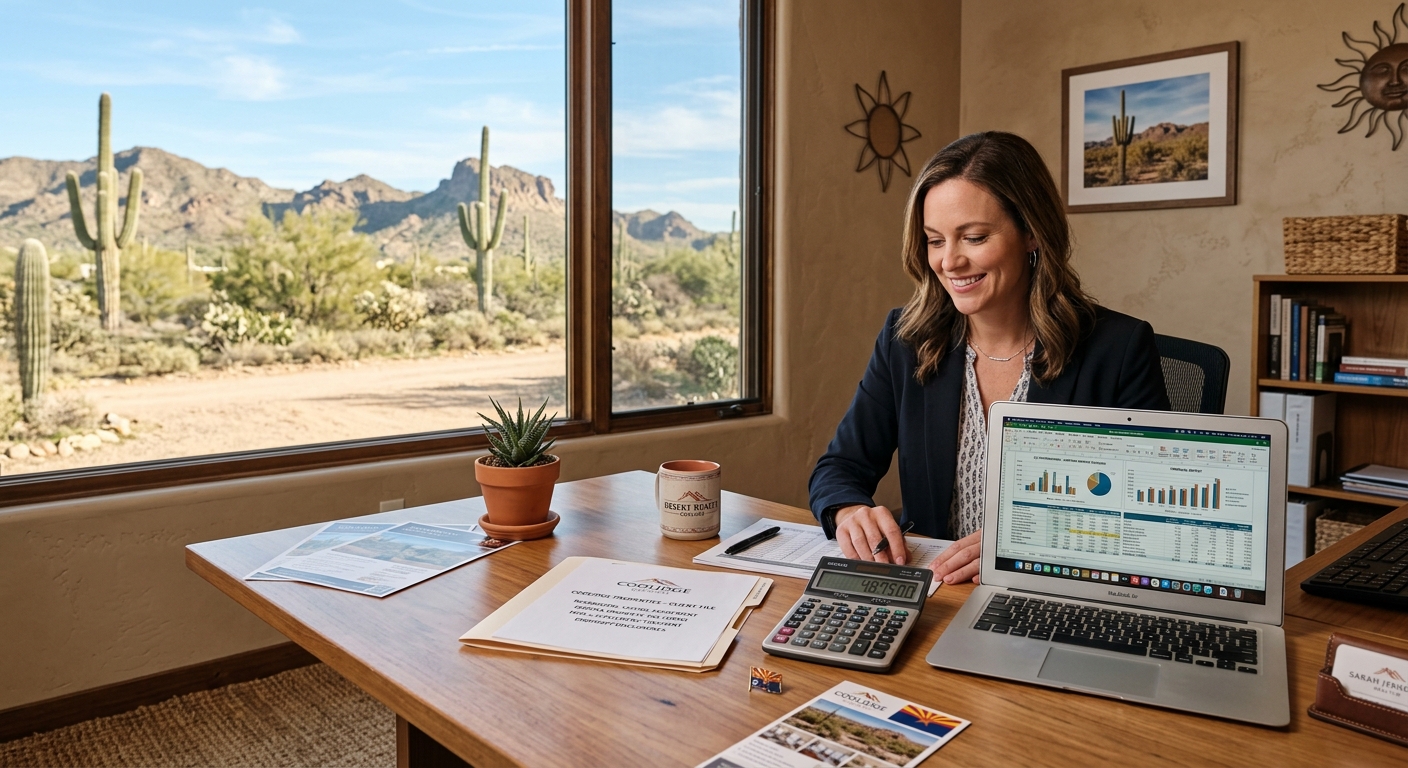
Why Coolidge, Arizona Real Estate Investors Need a Specialized CPA
If you own rental property in Coolidge, Arizona, or you’re thinking about buying your first investment property in Pinal County, the tax side of real estate is where most people lose money without even realizing it. Finding a real estate CPA near me Coolidge Arizona is not just about filing your return on time. It is about making sure every dollar you spend on that property works in your favor when tax season arrives. And if you are not working with someone who understands real estate taxation at a granular level, you are almost certainly leaving thousands on the table.
Whether you are a landlord managing a single-family rental on North Arizona Boulevard or a growing investor building a portfolio across Pinal County, KDA offers tax preparation services in Coolidge designed specifically for property owners who want to keep more of what they earn. This guide covers the deductions, strategies, and compliance requirements that Coolidge real estate investors need to know heading into the 2026 tax year.
Quick Answer
A real estate CPA near Coolidge, Arizona helps property investors maximize depreciation, claim every eligible deduction, navigate Arizona’s state tax rules, and stay fully compliant with both IRS and Arizona Department of Revenue requirements. The right CPA can save a typical Coolidge rental property owner between $4,000 and $12,000 per year in taxes through proper strategy and documentation.
What Makes Coolidge, AZ a Unique Market for Real Estate Investors
Coolidge sits in the heart of Pinal County, one of the fastest-growing areas in Arizona. The city has experienced steady population growth as people move away from the higher costs of Phoenix and Tucson, looking for affordable housing with easy commuting distance to metro job centers. For real estate investors, that combination of affordability and growth creates a favorable environment for cash-flowing rental properties.
But Coolidge comes with its own set of tax considerations that generic online tax software simply cannot address:
- Arizona state income tax: Arizona uses a flat tax rate of 2.5% as of 2026, which applies to rental income. This is lower than many states, but proper structuring can still reduce your effective rate.
- Property tax assessments: Pinal County property taxes are assessed based on the Limited Property Value (LPV), and understanding how your assessment affects your deductible expenses matters for your Schedule E.
- No city-level income tax in Coolidge: Unlike some Arizona municipalities, Coolidge does not impose a city income tax on residents, but there are Transaction Privilege Tax (TPT) implications for short-term rentals.
- Proximity to infrastructure growth: Arizona currently has 184 data centers with 86 more planned, driving economic expansion into surrounding communities like Coolidge and creating new rental demand.
A real estate CPA near me in Coolidge, Arizona who understands these local dynamics can position your investment for maximum tax efficiency rather than just checking boxes on a return.
The Core Deductions Every Coolidge Landlord Should Claim
Rental property deductions are where the real savings happen. But here is the problem: most investors either miss deductions entirely or claim them incorrectly, which triggers IRS scrutiny. Let us walk through the deductions that matter most for Coolidge property owners.
Depreciation: Your Biggest Tax Shield
Residential rental property depreciates over 27.5 years under IRS rules (see IRS Publication 946). If you bought a rental property in Coolidge for $250,000 and the land value is $50,000, your depreciable basis is $200,000. That gives you roughly $7,273 per year in depreciation deductions, reducing your taxable rental income without spending a single extra dollar.
But here is where it gets strategic. If you purchased the property and never conducted a cost segregation study, you are likely depreciating the entire building as a single asset over 27.5 years. A cost segregation study can reclassify certain components like appliances, carpeting, landscaping, and electrical systems into 5, 7, or 15-year categories. On a $250,000 Coolidge rental, this could accelerate $40,000 to $60,000 in deductions into the first few years of ownership.
KDA’s cost segregation services help investors identify exactly which components qualify for accelerated depreciation.
Mortgage Interest and Loan Costs
Every dollar of mortgage interest you pay on your Coolidge rental property is deductible on Schedule E. If your monthly mortgage payment is $1,400 and roughly $900 of that goes toward interest, you are looking at $10,800 per year in deductible interest. Loan origination fees, points paid at closing, and refinancing costs also create deduction opportunities that many investors overlook.
Repairs vs. Improvements: Getting the Classification Right
The IRS draws a clear line between repairs (deductible in the current year) and improvements (capitalized and depreciated over time). If you replaced a broken window in your Coolidge rental, that is a repair. If you added a new room or installed a new roof, that is an improvement. Getting this wrong can cost you thousands in either overpaid taxes or audit risk.
Here is a practical example. You spent $3,500 replacing the HVAC system in your Coolidge property. Many investors deduct this as a repair, but the IRS considers it a capital improvement because it extends the useful life of the property. That $3,500 must be depreciated, not expensed in one year. A real estate CPA near me in Coolidge, Arizona would catch this before it becomes an audit problem.
Property Management and Operating Expenses
These are the everyday costs of running a rental property that many landlords fail to track properly:
- Property management fees (typically 8% to 10% of monthly rent in Coolidge)
- Insurance premiums for landlord policies
- HOA dues (if applicable)
- Pest control services
- Lawn care and landscaping maintenance
- Advertising costs to find tenants
- Legal fees for lease preparation or eviction proceedings
- Mileage to and from the property for management purposes (67 cents per mile for 2026)
If you collect $1,500 per month in rent on your Coolidge property and your total deductible expenses including depreciation, interest, insurance, and management fees reach $1,800, you actually show a $300 monthly loss on paper. That loss can offset other income, depending on your participation level and adjusted gross income.
Real Estate CPA Near Me Coolidge Arizona: Passive Loss Rules You Cannot Ignore
One of the most misunderstood areas of real estate taxation is the passive activity loss rules under IRS Publication 925. Here is how they work in practical terms for Coolidge investors.
The $25,000 Special Allowance
If your modified adjusted gross income (MAGI) is $100,000 or less and you actively participate in managing your rental property, the IRS allows you to deduct up to $25,000 in passive rental losses against your non-passive income (like wages or business income). This phases out between $100,000 and $150,000 MAGI.
So if you earn $95,000 from your day job and your Coolidge rental shows a $15,000 loss after depreciation and expenses, you can use that entire $15,000 loss to reduce your W-2 taxable income. At a combined federal and Arizona tax rate of roughly 26%, that saves you $3,900 in taxes.
Real Estate Professional Status (REPS)
If you spend more than 750 hours per year in real estate activities and more than half your working time is in real estate, you can qualify as a Real Estate Professional under IRS Publication 527. This unlocks the ability to deduct unlimited rental losses against any type of income, including wages, business income, and investment gains.
For Coolidge investors who manage multiple properties or work in real estate full-time, REPS can be worth tens of thousands of dollars per year. But the documentation requirements are strict. You need contemporaneous time logs, not retroactive estimates. KDA helps clients set up tracking systems that withstand IRS scrutiny.
KDA Case Study: Coolidge Real Estate Investor Slashes Tax Bill by $9,200
Marcus, a 41-year-old electrician working in the Phoenix metro area, owned two rental properties in Coolidge. He had been using a general tax preparer who filed his Schedule E with basic depreciation and limited deductions. His annual tax bill on rental income was roughly $6,800.
When Marcus came to KDA, we conducted a full review of his rental operations. Here is what we found:
- His preparer had been depreciating a property improvement as a repair, missing $4,200 in accumulated depreciation
- He had never deducted mileage for trips to his Coolidge properties from his Phoenix home (roughly 130 miles round trip, twice monthly)
- His home office, used exclusively to manage rental properties, was not being deducted
- He qualified for the $25,000 passive activity loss special allowance but had not been using it properly
KDA restructured his filings, amended his previous two returns to capture missed deductions, and implemented a tracking system for ongoing expenses. The result: Marcus saved $9,200 in the first year, including $3,400 from the amended returns. He paid KDA $2,800 for the engagement, generating a 3.3x return on investment in year one alone.
Ready to see how we can help you? Explore more success stories on our case studies page to discover proven strategies that have saved our clients thousands in taxes.
Arizona-Specific Tax Considerations for Coolidge Property Owners
Arizona’s tax landscape has shifted in recent years, and Coolidge investors need to stay current. Here are the state-level considerations that a qualified real estate CPA near me in Coolidge, Arizona should be addressing with you.
Arizona’s Flat Tax Rate
Arizona implemented a flat income tax rate of 2.5% starting in 2023. This applies to all taxable income, including rental income reported on your Arizona return. While this is one of the lowest state rates in the country, it still adds up. On $50,000 of net rental income, you owe $1,250 to Arizona alone. Proper deduction maximization at both the federal and state level matters.
Transaction Privilege Tax for Short-Term Rentals
If you are renting your Coolidge property on Airbnb, Vrbo, or any platform for stays of less than 30 days, you are subject to Arizona’s Transaction Privilege Tax (TPT). The state rate is 5.5%, and Pinal County may add additional surcharges. Failure to register and collect TPT can result in back taxes, penalties, and interest. This is an area where many Coolidge short-term rental operators get caught off guard.
Federal Conformity Updates
Arizona recently passed a tax package with updated federal conformity provisions. This means Arizona now aligns more closely with federal tax law for items like bonus depreciation, Section 179 expensing, and qualified business income deductions. However, conformity is not automatic for every provision. Your CPA needs to verify which federal deductions Arizona recognizes and which require state-level adjustments.
Entity Structuring for Coolidge Rental Properties
Should you hold your Coolidge rental properties in an LLC? What about an S Corp? The answer depends on your specific situation, but here is a framework to evaluate your options.
LLC for Asset Protection
Most real estate CPAs recommend holding each rental property (or at least each group of properties) in a separate LLC. This provides liability protection. If a tenant sues over an injury at one property, creditors generally cannot reach your other assets or properties held in separate entities. In Arizona, forming an LLC costs $50 for online filing with the Arizona Corporation Commission.
S Corp Election: When It Makes Sense
If you are actively managing properties and earning management fee income, an S Corp election can reduce your self-employment tax burden. For example, if you pay yourself a reasonable salary of $50,000 through an S Corp and distribute an additional $30,000 in profits, you avoid roughly $4,590 in self-employment taxes on the distribution. However, this structure adds complexity and compliance costs, so it only makes sense above certain income thresholds.
KDA’s entity formation services can help you determine the right structure for your Coolidge real estate portfolio.
S Corp vs. LLC for Rental Income: Key Differences
| Factor | LLC (Default) | S Corp Election |
|---|---|---|
| Self-Employment Tax | Rental income generally exempt | Only on salary portion |
| Asset Protection | Strong liability shield | Strong liability shield |
| Complexity | Minimal compliance burden | Payroll, W-2s, corporate returns |
| Best For | Passive rental income | Active management income above $80K |
| Annual Filing Cost | $0 Arizona (no annual report fee) | $500 to $1,500+ for payroll and 1120-S |
Common Mistakes Coolidge Real Estate Investors Make on Their Tax Returns
After working with hundreds of property investors, these are the errors we see most frequently from Coolidge area landlords:
1. Not Separating Land and Building Values
You cannot depreciate land. Period. But many investors use the purchase price without properly allocating between land and building. If you bought a Coolidge property for $220,000 and your county assessment shows 25% land value, your depreciable basis is $165,000. Getting this number wrong from day one cascades through every year of ownership.
2. Missing the Section 199A Deduction
The Qualified Business Income (QBI) deduction under Section 199A allows eligible rental property owners to deduct up to 20% of their net rental income. On $40,000 of net rental income, that is an $8,000 deduction, saving you roughly $1,760 in federal taxes at the 22% bracket. Many Coolidge landlords do not realize their rental activity qualifies, especially if they meet the safe harbor requirements of maintaining separate books, performing at least 250 hours of rental services, and keeping contemporaneous records.
3. Ignoring the Home Office Deduction
If you use a dedicated space in your home exclusively to manage your Coolidge rental properties, you can deduct that space. The simplified method allows $5 per square foot up to 300 square feet, or $1,500 per year. The actual expense method can yield higher deductions if your home expenses are significant.
4. Failing to Track Vehicle Mileage
Every trip to your Coolidge rental property for maintenance, tenant screening, or inspections is deductible. At 67 cents per mile for 2026, a landlord driving 200 miles per month for property-related purposes generates $1,608 in annual deductions. But you need a mileage log with dates, destinations, and business purposes. No log means no deduction if audited.
5. Not Reporting Security Deposits Correctly
Security deposits are not taxable income when you receive them, as long as you plan to return them. But if you apply a security deposit to cover unpaid rent or damages, that portion becomes taxable income in the year you apply it. This trips up many landlords at audit time.
What Happens If You Get Audited on Rental Income
The IRS has been increasing its audit focus on rental income, particularly for investors who report consistent losses. With the agency now embracing artificial intelligence for fraud detection and pattern recognition, returns with unusual deduction patterns are being flagged more aggressively in 2026.
If your Coolidge rental property return gets selected for examination, here is what you need to have ready:
- Complete records of all income received, including security deposits applied
- Receipts or bank statements for every deduction claimed
- Depreciation schedules showing original cost basis and annual calculations
- Mileage logs for vehicle deductions
- Lease agreements and tenant correspondence
- Proof of material participation (if claiming REPS status)
KDA offers audit representation services to handle IRS correspondence and examinations on your behalf. Having professional representation during an audit is not optional. It is essential.
Should You Elect S Corp Status for Your Coolidge Rental Business?
Yes, if:
- Your net rental management income exceeds $60,000 annually
- You actively manage properties full-time or near full-time
- You want to reduce self-employment taxes on management fees
- You are comfortable running payroll and filing Form 1120-S
No, if:
- Your rental income is purely passive
- Your net profit is under $40,000
- You prefer minimal administrative burden
- You hold properties for long-term appreciation only
If you want to estimate the tax impact of different entity structures, run the numbers through our small business tax calculator to see how your rental income would be taxed under different scenarios.
Ready to Reduce Your Tax Bill?
KDA Inc. specializes in strategic tax planning for business owners, S Corps, LLCs, and high-net-worth individuals. Book a personalized consultation and walk away with a clear plan.
Frequently Asked Questions: Real Estate CPA Near Me Coolidge Arizona
How much does a real estate CPA cost in Coolidge, Arizona?
Most real estate CPA services for a single rental property in Coolidge range from $500 to $1,500 per year, depending on complexity. Multi-property portfolios or investors needing entity-level returns and cost segregation studies typically pay $1,500 to $4,000. The tax savings generated by a qualified CPA almost always exceed the fees paid.
Can I deduct travel expenses to my Coolidge rental property?
Yes. If you live outside Coolidge and travel to your property for management, maintenance, or tenant-related purposes, that mileage is deductible. You can also deduct airfare, lodging, and meals at 50% if the trip is primarily for rental property business. Keep detailed records of dates, purposes, and distances traveled.
Do I need an LLC for my Coolidge rental property?
An LLC is not required by the IRS or Arizona, but it is strongly recommended for liability protection. Without an LLC, a lawsuit related to your rental property could put your personal assets at risk. Arizona LLC formation is straightforward and inexpensive at $50 for online filing.
What is the best way to track rental expenses?
Use dedicated bookkeeping software like QuickBooks or a property management platform that integrates with your accounting system. Keep a separate bank account for each property or at minimum for your rental business as a whole. Save all receipts digitally and maintain a mileage log for vehicle deductions.
How does Arizona’s 2.5% flat tax affect my rental income?
Arizona’s flat income tax of 2.5% applies to net rental income after federal deductions. If you have $30,000 in net rental income after all expenses and depreciation, you owe Arizona $750. While this is relatively low compared to states like California at 13.3%, proper deduction planning ensures you only pay tax on the true net amount.
Can I do a 1031 exchange on a Coolidge rental property?
Yes. A 1031 exchange allows you to defer capital gains taxes by reinvesting the proceeds from selling your Coolidge property into a like-kind replacement property. The replacement property does not need to be in Arizona. You must identify the replacement within 45 days and close within 180 days. Working with a real estate CPA near me in Coolidge, Arizona ensures the exchange meets all IRS requirements and you do not accidentally trigger a taxable event.
What records should I keep for my Coolidge rental property?
Keep all records for at least three years after filing the return that includes the rental income or loss. For depreciation-related records, keep documentation for as long as you own the property plus three years after you sell it and report the gain or loss. This includes purchase closing statements, improvement receipts, and depreciation schedules.
The 2026 Outlook for Coolidge Real Estate Investors
Coolidge sits in a favorable position heading into the second half of 2026. Pinal County’s growth trajectory continues as housing affordability drives migration from the Phoenix metro. Small investors now represent roughly 63% of all real estate investor activity nationwide, and the Coolidge market is particularly attractive to this segment because of lower entry prices and solid rental yields.
At the same time, the IRS is intensifying its compliance focus. The Department of Justice’s Fraud Division has announced that tax crimes will be a priority, and the IRS’s adoption of AI-powered pattern detection means that poorly documented rental returns face higher audit risk than ever before. The combination of a growing market and tighter enforcement makes professional tax preparation not just helpful but necessary.
Ready to work with a tax professional who understands Coolidge real estate investors? Explore our Coolidge tax services or book a consultation below.
This information is current as of 6/29/2026. Tax laws change frequently. Verify updates with the IRS or FTB if reading this later.
Book Your Real Estate Tax Strategy Session
If you own rental property in Coolidge, Arizona and you are not sure whether your current tax setup is costing you thousands each year, it is time to get a professional review. KDA specializes in real estate investor tax strategy, and we will show you exactly where your current returns are leaving money behind. From depreciation optimization to entity structuring to audit protection, we handle the complexity so you can focus on growing your portfolio. Click here to book your personalized real estate tax consultation now.



