
What You Need to Know About Long-Term Capital Gains Tax in 2026
Here’s the problem: Most investors believe selling stocks or rental property after a year automatically means lower taxes. That’s only half true. The rate on long term capital gains you actually pay depends entirely on where your taxable income lands in 2026, and missing that connection can cost you thousands in unnecessary tax.
The good news? Once you understand the bracket thresholds and how California stacks state taxes on top of federal rates, you can time asset sales, offset gains strategically, and keep significantly more of your profit. This guide breaks down exactly how long-term capital gains taxation works in 2026, who pays what rate, and how to structure your investment exits to minimize the hit.
Quick Answer
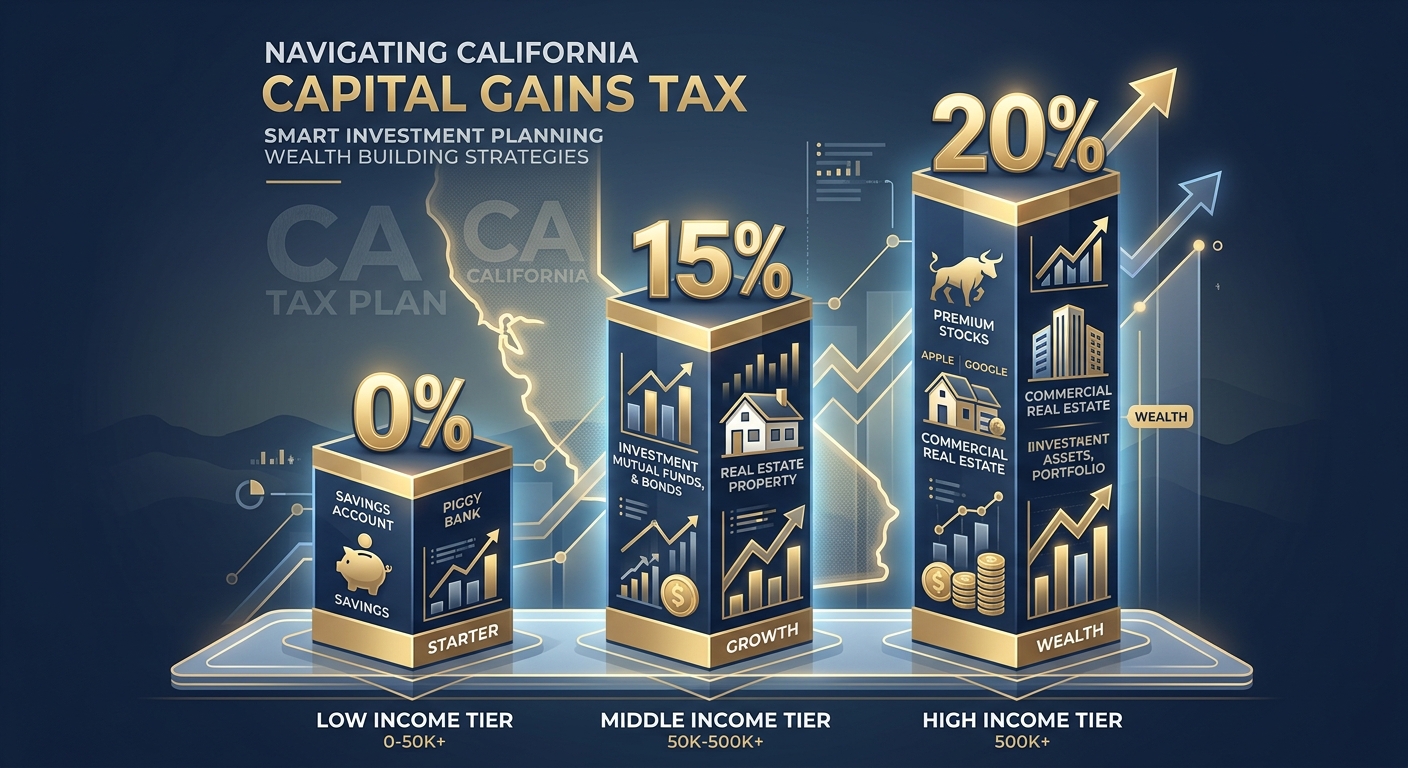
The rate on long term capital gains for 2026 is either 0%, 15%, or 20% at the federal level, determined by your taxable income and filing status. California residents also pay state tax on capital gains at ordinary income rates, up to 13.3% for high earners, creating a combined top rate exceeding 33% when you include the 3.8% Net Investment Income Tax.
How Long-Term Capital Gains Rates Are Determined in 2026
Long-term capital gains apply to assets you’ve held for more than one year before selling. This includes stocks, bonds, mutual funds, real estate investment properties, cryptocurrency, and collectibles. The federal government taxes these profits at preferential rates lower than ordinary income, but the exact percentage depends on your total taxable income for the year.
The IRS uses three rate tiers: 0%, 15%, and 20%. Your filing status and where your taxable income falls within those brackets determine which rate applies to your gains. Unlike ordinary income tax brackets, which apply different rates to different portions of your income, the capital gains rate applies uniformly to all your qualifying gains once you reach a threshold.
2026 Federal Long-Term Capital Gains Tax Brackets
For tax year 2026, the income thresholds that determine your capital gains rate are:
| Filing Status | 0% Rate Threshold | 15% Rate Threshold | 20% Rate Threshold |
|---|---|---|---|
| Single | Up to $47,025 | $47,026 to $518,900 | Over $518,900 |
| Married Filing Jointly | Up to $94,050 | $94,051 to $583,750 | Over $583,750 |
| Married Filing Separately | Up to $47,025 | $47,026 to $291,850 | Over $291,850 |
| Head of Household | Up to $63,000 | $63,001 to $551,350 | Over $551,350 |
These thresholds are indexed to inflation annually. If your taxable income stays within the 0% bracket, you pay zero federal tax on qualifying long-term capital gains. Cross into the 15% bracket and every dollar of long-term gain gets taxed at 15%. Reach the 20% threshold and the entire gain amount is subject to the top rate.
What Counts as Taxable Income for Capital Gains Purposes
The IRS calculates your capital gains bracket using your total taxable income, which includes wages, self-employment income, interest, dividends, retirement distributions, and the capital gains themselves. This creates a critical planning point: A large capital gain can push you from the 0% bracket into the 15% bracket, or from 15% into 20%, in a single year.
For example, a married couple filing jointly with $80,000 in W-2 income and $50,000 in long-term stock gains has $130,000 in total taxable income. The first $14,050 of their gain stays in the 0% bracket ($94,050 threshold minus $80,000 W-2 income), but the remaining $35,950 gets taxed at 15%, resulting in $5,392 in federal capital gains tax.
California State Tax on Capital Gains: The Second Layer
California does not offer preferential treatment for long-term capital gains. The state taxes all capital gains as ordinary income, using the same progressive rate structure that applies to wages and business income. For 2026, California’s top marginal rate is 13.3% for taxable income over $1 million for married couples filing jointly and over $677,275 for single filers.
This creates a stacked tax burden. A high-income California investor selling a rental property faces:
- 20% federal long-term capital gains rate
- 13.3% California state tax on the gain
- 3.8% Net Investment Income Tax (NIIT) if modified adjusted gross income exceeds $200,000 for single filers or $250,000 for married filing jointly
Combined, that’s a total tax rate of 37.1% on long-term investment profits. On a $200,000 gain, the total tax bill approaches $74,200.
When the Net Investment Income Tax Applies
The NIIT is a 3.8% surtax introduced under the Affordable Care Act. It applies to the lesser of your net investment income or the amount by which your modified adjusted gross income (MAGI) exceeds the threshold for your filing status. Investment income includes interest, dividends, capital gains, rental income, and passive business income.
The NIIT thresholds for 2026 are:
- $200,000 for single filers
- $250,000 for married filing jointly
- $125,000 for married filing separately
If you’re a single filer with $220,000 MAGI and $50,000 in capital gains, the NIIT applies to $20,000 (the amount over the $200,000 threshold), resulting in $760 in additional tax. If your investment income is lower than the excess MAGI, the tax applies only to the investment income amount.
For strategic guidance on minimizing investment taxes, explore our tax planning services tailored to high-income earners and investors.
Real-World Scenarios: How Capital Gains Rates Impact Different Taxpayers
Scenario 1: Retired Couple in the 0% Bracket
James and Linda are both 68, fully retired, and living on Social Security and investment withdrawals. Their Social Security is partially taxable, resulting in $35,000 of taxable income. They want to sell $40,000 worth of stock they’ve held for five years.
Their total taxable income would be $75,000 ($35,000 base income + $40,000 capital gain). Since this falls below the $94,050 threshold for married filing jointly, they pay 0% federal tax on the entire $40,000 gain. California residents would still owe state tax, but federal liability is zero. If they live in a no-income-tax state like Nevada or Texas, they keep the full $40,000.
Tax savings vs. ordinary income treatment: If that $40,000 were taxed as ordinary income at a 12% federal rate, they’d owe $4,800. The 0% capital gains rate saves them the entire amount.
Scenario 2: Tech Employee with RSU Gains and Stock Sales
Marcus is a single software engineer in San Francisco earning $160,000 in W-2 income. He sold shares of Apple stock he purchased three years ago, realizing a $60,000 long-term capital gain. His total taxable income is $220,000.
Federal capital gains tax: 15% on $60,000 = $9,000. California state tax at an approximate 9.3% marginal rate = $5,580. NIIT applies because his MAGI exceeds $200,000 by $20,000, but his investment income ($60,000) is higher, so the tax applies to the $20,000 excess: 3.8% x $20,000 = $760.
Total tax on the $60,000 gain: $15,340, or an effective rate of 25.6%.
If Marcus had spread the stock sale across two years ($30,000 per year), he could have avoided triggering the NIIT in the first year and reduced California’s marginal rate impact, saving approximately $2,100.
Scenario 3: Real Estate Investor Selling Rental Property
Angela owns a rental duplex in San Diego she purchased in 2018 for $500,000. She sells it in 2026 for $750,000. After accounting for depreciation recapture (taxed at 25% federally), her long-term capital gain is $180,000. She’s married filing jointly with $220,000 in other income, putting her total taxable income at $400,000.
Federal long-term capital gains tax: 15% on $180,000 = $27,000. California tax: 13.3% on $180,000 = $23,940. NIIT: 3.8% on $150,000 (the amount over the $250,000 threshold) = $5,700.
Total tax on the $180,000 gain: $56,640, leaving her with $123,360 after tax.
If Angela had used a 1031 exchange to defer the gain by purchasing a replacement property, she could have postponed the entire $56,640 tax bill and reinvested the full proceeds. Alternatively, she could have used a cost segregation study to accelerate depreciation deductions in earlier years, offsetting other income and lowering her effective tax rate on the eventual sale.
KDA Case Study: Real Estate Investor
David, a 52-year-old real estate investor in Los Angeles, came to KDA in early 2026 planning to sell three rental properties. His combined W-2 income and rental income was $280,000, and the planned sales would generate $420,000 in long-term capital gains. He assumed he’d pay 15% federal and roughly 9% California tax and hadn’t considered the Net Investment Income Tax or timing strategies.
Our team ran projections showing his total tax liability at over $160,000 if he sold all three properties in one year. We recommended:
- Selling two properties in 2026 and one in 2027 to reduce NIIT exposure
- Using a 1031 exchange on the largest property to defer $220,000 of the gain
- Offsetting $35,000 of gains with tax-loss harvesting on underperforming stocks
The result: David’s 2026 tax bill dropped to $71,400, saving him $88,600 in year one. His effective rate on the recognized gains fell from 38% to 23.8%. He paid our firm $4,200 for the planning work, resulting in a first-year ROI of 21x.
Ready to see how we can help you? Explore more success stories on our case studies page to discover proven strategies that have saved our clients thousands in taxes.
Strategies to Lower Your Effective Capital Gains Tax Rate
1. Harvest Losses to Offset Gains
Tax-loss harvesting involves selling investments that have declined in value to generate capital losses, which offset capital gains dollar-for-dollar. You can deduct up to $3,000 in excess losses against ordinary income each year, and carry forward any remaining losses indefinitely.
If you have $50,000 in long-term gains and $20,000 in losses from underperforming stocks, your net taxable gain is only $30,000. At a 15% rate, this saves you $3,000 in federal tax alone.
2. Time Asset Sales Across Multiple Years
Spreading large gains over two or more tax years can keep you in a lower bracket, avoid NIIT, and reduce California’s marginal rate impact. Instead of selling $300,000 worth of stock in one year, consider selling $150,000 in December 2026 and $150,000 in January 2027.
This is especially valuable if you’re near a bracket threshold. A couple with $90,000 in taxable income can realize $4,000 in gains tax-free at the 0% rate. Taking a $50,000 gain pushes them entirely into the 15% bracket. By splitting the sale, they preserve some 0% treatment.
3. Use the 0% Bracket Strategically in Retirement
Retirees with low taxable income can deliberately “fill up” the 0% capital gains bracket each year by selling appreciated assets. For 2026, a married couple can have up to $94,050 in taxable income and still pay zero federal tax on long-term gains within that threshold.
If Social Security and pension income total $50,000, they can realize up to $44,050 in capital gains tax-free. Over 10 years, that’s $440,500 in tax-free gain realization.
4. Donate Appreciated Assets to Charity
Donating stock or real estate directly to a qualified charity allows you to deduct the fair market value and avoid paying capital gains tax on the appreciation. If you donate $20,000 of stock you bought for $5,000, you get a $20,000 charitable deduction and avoid tax on the $15,000 gain.
For California taxpayers in the top bracket, this strategy saves 20% federal + 13.3% state + 3.8% NIIT = 37.1% on the gain, plus provides a deduction worth up to 37% federally and 13.3% in California.
5. Consider a 1031 Exchange for Investment Real Estate
Section 1031 of the Internal Revenue Code allows you to defer capital gains tax on the sale of investment or business property if you reinvest the proceeds into a like-kind replacement property within strict timelines. You must identify potential replacement properties within 45 days of sale and close within 180 days.
1031 exchanges do not eliminate the tax; they defer it until you eventually sell the replacement property without doing another exchange. However, if you hold the property until death, your heirs receive a stepped-up basis, effectively erasing the deferred gain permanently.
This strategy is particularly powerful in California, where avoiding 13.3% state tax on a $500,000 gain saves $66,500 immediately.
Special Situations and Edge Cases
Qualified Small Business Stock Exclusion
If you invested in qualified small business stock (QSBS) under Section 1202, you may exclude up to 100% of the gain from federal tax, subject to the greater of $10 million or 10 times your basis. The stock must be from a C corporation with gross assets under $50 million at issuance, and you must hold it for at least five years.
California does not conform to the federal QSBS exclusion, so state tax still applies. A $5 million QSBS gain would be federally tax-free but subject to $665,000 in California tax.
Collectibles and Alternative Assets
Gains from collectibles such as art, antiques, gems, stamps, and coins are taxed at a maximum 28% federal rate, regardless of holding period. Cryptocurrency held over one year is taxed as property at standard long-term capital gains rates (0%, 15%, or 20%).
Part-Year California Residency
If you move out of California mid-year, you’re taxed as a part-year resident. California taxes all income earned while you were a resident, plus California-source income earned after you leave (such as rental income from California properties or gains on California real estate). Timing a major asset sale to occur after establishing residency in a no-income-tax state can save 13.3% on the entire gain.
Married Filing Separately Considerations
Married couples filing separately face a capital gains rate threshold of only $47,025 for the 0% bracket and $291,850 for the 15% bracket. In most cases, filing separately increases overall tax liability, but it may make sense if one spouse has significant medical expenses, student loan payments under an income-driven plan, or separation/divorce circumstances.
What Happens If You Miss This?
Failing to plan around capital gains rates can cost you tens of thousands of dollars in avoidable taxes. Selling all your appreciated assets in one high-income year pushes you into the 20% federal bracket, triggers the 3.8% NIIT, and maximizes California’s 13.3% hit. On a $300,000 gain, poor timing results in $111,300 in taxes instead of $75,000 spread over two years, a $36,300 penalty for lack of strategy.
Missing the 1031 exchange timelines means losing the deferral permanently. Forgetting to harvest losses leaves free tax savings on the table. Not understanding the 0% bracket wastes opportunities to realize gains tax-free during low-income years.
Common Mistakes and Red Flag Alerts
Red Flag Alert: Assuming All Investment Sales Are Taxed the Same
Short-term capital gains (assets held one year or less) are taxed as ordinary income at rates up to 37% federally, plus state tax. Selling stock after 11 months instead of waiting one more month can double or triple your tax rate. Always verify your holding period before selling.
Red Flag Alert: Ignoring the Wash Sale Rule
If you sell a stock at a loss and repurchase the same or substantially identical security within 30 days before or after the sale, the IRS disallows the loss under the wash sale rule. Your loss gets added to the basis of the repurchased shares, deferring the tax benefit. To avoid this, wait 31 days or buy a similar but not identical investment.
Red Flag Alert: Not Tracking Your Basis Correctly
Your basis in an asset determines your taxable gain. For stocks, this includes purchase price plus reinvested dividends and commissions. For real estate, it includes purchase price, closing costs, and capital improvements, minus depreciation taken. Failing to track improvements or reinvested dividends inflates your reported gain and increases taxes unnecessarily.
Pro Tip: Use Specific Identification for Stock Sales
If you’ve purchased shares of the same stock at different times and prices, you can choose which shares to sell by using specific identification. Selling the highest-cost shares minimizes your gain. For example, if you own 100 shares purchased at $50 and 100 shares purchased at $80, selling the $80 shares when the stock is at $100 results in a $20 per share gain instead of $50.
California-Specific Considerations
California’s refusal to conform to many federal tax provisions creates unique planning challenges. The state does not recognize the federal QSBS exclusion, does not allow deferral of gains through Opportunity Zone investments in the same way as federal law, and taxes all capital gains as ordinary income.
For high earners considering relocation, the difference is dramatic. A $1 million long-term capital gain taxed in California costs $133,000 in state tax. The same gain realized as a resident of Nevada, Texas, Florida, or Washington costs zero in state tax. This has driven significant migration of wealthy investors and retirees to no-income-tax states, particularly following the 2025 wildfires and proposed wealth taxes.
However, California aggressively audits taxpayers who claim to have moved out of state. The Franchise Tax Board examines driver’s licenses, voter registration, property ownership, bank accounts, gym memberships, doctor visits, and days physically present in California to determine residency status. If you maintain a home in California and spend more than nine months there, you may still be considered a resident regardless of your claimed domicile.
How to Report Long-Term Capital Gains
You report capital gains and losses on IRS Form 8949, Sales and Other Dispositions of Capital Assets, and summarize them on Schedule D, which attaches to your Form 1040. Your brokerage or investment platform will send you Form 1099-B showing proceeds from sales, and in many cases, your cost basis.
For each transaction, report:
- Description of property sold
- Date acquired
- Date sold
- Proceeds (sales price)
- Cost basis (purchase price plus adjustments)
- Gain or loss (proceeds minus basis)
Form 8949 separates short-term and long-term transactions. The totals flow to Schedule D, which calculates your net capital gain or loss and determines the tax using the capital gains rate tables.
For real estate, you’ll also need to account for depreciation recapture on Form 4797 if the property was used as a rental or business asset. Depreciation taken or allowable is taxed at a maximum 25% federal rate before the remaining gain is taxed at long-term capital gains rates.
Ready to Reduce Your Tax Bill?
KDA Inc. specializes in strategic tax planning for business owners, S Corps, LLCs, and high-net-worth individuals. Book a personalized consultation and walk away with a clear plan.
Frequently Asked Questions
Do I pay capital gains tax if I reinvest the proceeds?
In most cases, yes. Simply reinvesting the money does not defer the tax. The gain is taxable in the year you sell, regardless of what you do with the proceeds. The exceptions are 1031 exchanges for real estate and Opportunity Zone reinvestments under specific conditions.
Can I offset long-term gains with short-term losses?
Yes. Capital losses offset capital gains regardless of holding period. Short-term losses first offset short-term gains, and long-term losses first offset long-term gains. Any remaining loss of either type can offset the other type. If total losses exceed total gains, you can deduct up to $3,000 against ordinary income and carry forward the rest.
Does the step-up in basis apply to all inherited assets?
Yes, with limited exceptions. When you inherit property, your basis is generally the fair market value on the date of the decedent’s death. This “stepped-up basis” eliminates all unrealized gains that existed during the decedent’s lifetime. If your parent bought stock for $10,000 and it’s worth $200,000 at death, you inherit it with a $200,000 basis and owe no tax on the prior appreciation if you sell immediately.
Bottom Line
The rate on long term capital gains in 2026 ranges from 0% to 20% federally, with California adding up to 13.3% and the NIIT adding another 3.8% for high earners. Understanding the income thresholds, planning the timing of asset sales, harvesting losses, and using strategies like 1031 exchanges and charitable donations can cut your effective tax rate in half or more. The difference between reactive selling and strategic planning is often $20,000 to $100,000 in tax savings on a single transaction.
This information is current as of 4/15/2026. Tax laws change frequently. Verify updates with the IRS or FTB if reading this later.
Stop Overpaying on Investment Gains
If you’re sitting on appreciated stock, planning to sell rental property, or wondering whether your investment exit strategy is costing you thousands, let’s fix that. Book a personalized tax strategy session with our team and get a clear plan to minimize capital gains tax, time your sales strategically, and keep more of what you’ve earned. Click here to book your consultation now.



