
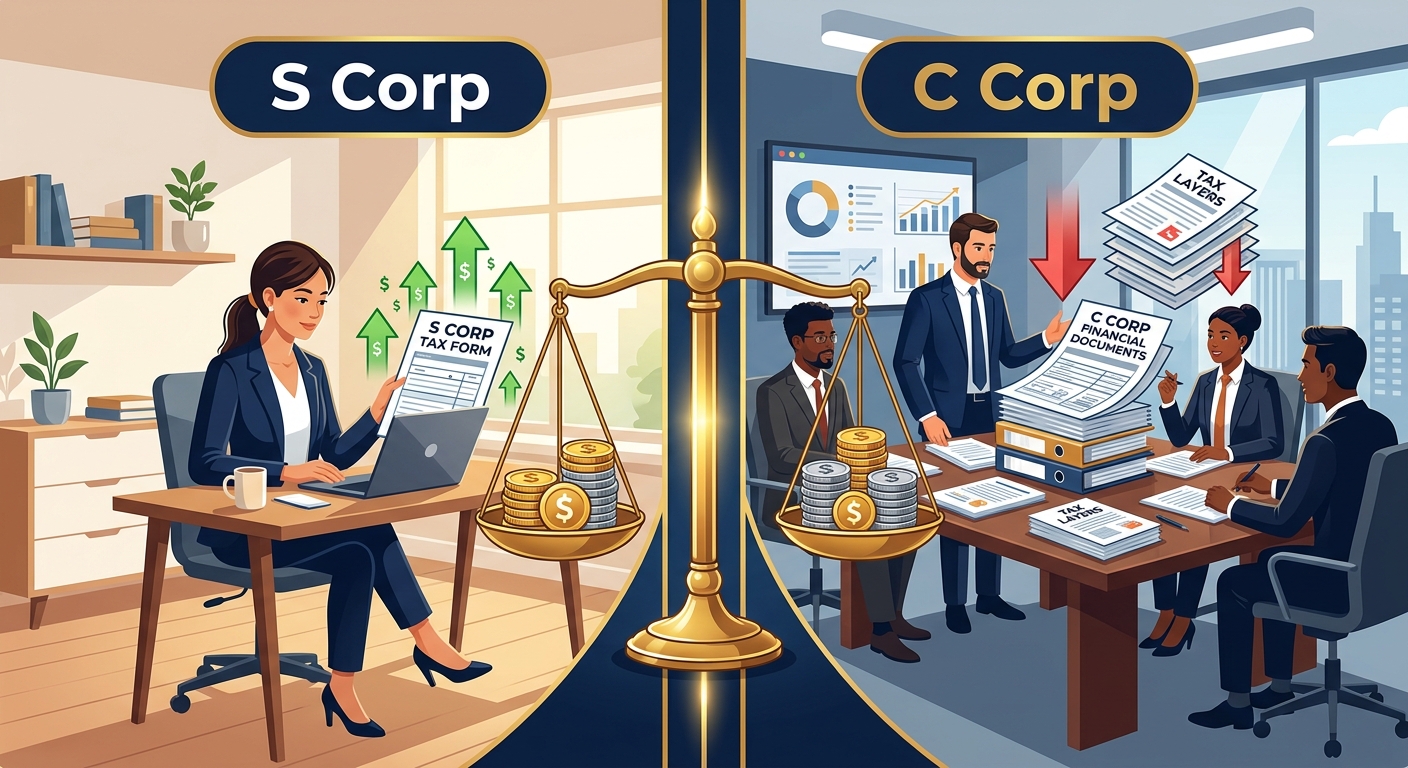
Most California Business Owners Pick the Wrong Entity and Never Recover the Money
A business owner in Riverside pulls $200,000 in profit through a C Corporation and pays $94,200 in combined federal and California taxes. Another business owner in Sacramento pulls the same $200,000 through an S Corporation and pays $53,900. Same revenue, same expenses, same zip code. The difference is $40,300 in one year, and it starts with understanding the real pros and cons of S Corp and C Corp structures before you file a single form.
That gap is not a rounding error. Over five years, it compounds into $200,000 or more in lost wealth, missed retirement contributions, and delayed growth. And the worst part is that most owners pick their entity based on a Google search, a friend’s recommendation, or whatever their attorney set up when the business was three months old.
This information is current as of April 15, 2026. Tax laws change frequently. Verify updates with the IRS or FTB if reading this later.
Quick Answer
An S Corporation avoids double taxation, qualifies for the 20% QBI deduction under IRC Section 199A, and saves California owners $8,000 to $40,000+ annually on self-employment tax through salary-distribution splitting. A C Corporation pays entity-level tax at 21% federally plus 8.84% in California, then shareholders pay a second layer of tax on dividends. The C Corp only wins in narrow scenarios: raising venture capital with multiple share classes, pursuing QSBS under Section 1202, or retaining 100% of profits indefinitely. For most California business owners earning $80,000 to $400,000 in profit, the S Corp is the better structure.
The Pros and Cons of S Corp and C Corp Structures in Plain English
Before you can evaluate which entity fits your business, you need to understand what each structure actually does to your tax bill. The names sound similar but the mechanics are completely different.
What an S Corporation Does
An S Corporation is a tax election, not a business entity. You form an LLC or corporation with the state, then file Form 2553 with the IRS to elect S Corp status. Once approved, the company’s profit passes through to your personal tax return on Schedule K-1. You pay tax once at your individual rate.
Here is where the savings live: you split your income into two buckets. Bucket one is your W-2 salary, which is subject to Social Security and Medicare taxes (15.3% combined). Bucket two is the remaining profit distributed to you, which is not subject to those payroll taxes. On $200,000 of profit with a $90,000 reasonable salary, you save roughly $16,830 in self-employment tax compared to a sole proprietorship or single-member LLC.
S Corps also qualify for the Qualified Business Income (QBI) deduction under IRC Section 199A, which knocks 20% off your qualified income before calculating federal tax. The One Big Beautiful Bill Act (OBBBA) made this deduction permanent, which means S Corp owners can count on this benefit going forward without sunset anxiety.
What a C Corporation Does
A C Corporation is the default classification when you incorporate with your state. The entity pays its own tax at a flat 21% federal rate. When you distribute profits as dividends, you pay a second layer of tax at qualified dividend rates (0%, 15%, or 20% depending on your income bracket, plus the 3.8% Net Investment Income Tax if applicable).
This double-taxation structure means the effective tax rate on $200,000 of C Corp profit can reach 47.1% or higher in California. The entity pays $42,000 federal (21%) plus $17,680 California franchise tax (8.84%), leaving $140,320 available for distribution. You then pay another $21,048 to $33,376 in federal and state dividend taxes on that distribution.
Want to see exactly how different entity structures affect your bottom line? Run your numbers through this small business tax calculator to estimate the real cost of each structure.
Five S Corp Advantages California Business Owners Should Know
The pros and cons of S Corp and C Corp elections become clearest when you map them to real California tax scenarios. Many business owners operating in the state face a unique combination of federal and state tax layers that make the S Corp advantage especially pronounced.
Advantage 1: No Double Taxation
The S Corp’s single layer of taxation is its biggest structural advantage. Profit flows to your personal return, gets taxed once, and stays in your pocket. The C Corp’s double layer creates a compounding drag that grows worse as your profit increases.
At $100,000 profit, the double taxation gap is roughly $16,500 per year. At $200,000, it balloons to $31,800 or more. At $350,000, the gap can exceed $51,000 annually. This is not theoretical money. It is cash that either stays in your business or goes to the IRS and the FTB.
Advantage 2: Self-Employment Tax Savings Through Salary-Distribution Split
When you operate as a sole proprietor or standard LLC, every dollar of net profit is subject to the 15.3% self-employment tax (12.4% Social Security up to the wage base of $176,100 in 2026, plus 2.9% Medicare on all income, plus 0.9% Additional Medicare Tax above $200,000).
An S Corp lets you pay yourself a reasonable salary and take the remaining profit as a distribution not subject to payroll taxes. On $150,000 of net profit with a $70,000 salary, you save approximately $12,240 in payroll taxes compared to an LLC filing on Schedule C.
Advantage 3: Permanent QBI Deduction Under OBBBA
The QBI deduction under IRC Section 199A allows S Corp owners to deduct up to 20% of qualified business income from their taxable income. On $200,000 of qualifying S Corp income, that is a $40,000 reduction in taxable income, saving roughly $8,800 to $14,800 in federal tax depending on your bracket.
C Corporation shareholders do not qualify for this deduction. The OBBBA made the QBI deduction permanent, removing the previous 2025 sunset under the Tax Cuts and Jobs Act. This permanence makes the S Corp advantage more predictable and valuable for long-term planning.
Advantage 4: California AB 150 PTE Election
S Corporations and other pass-through entities in California can make the Pass-Through Entity (PTE) tax election under AB 150, paying a 9.3% entity-level tax that generates a dollar-for-dollar federal tax credit for owners. This effectively bypasses the OBBBA’s $40,000 SALT deduction cap (increased from the prior $10,000 cap).
A C Corporation cannot make the PTE election. On $200,000 of S Corp income, the PTE election can save $6,500 or more annually in federal taxes by converting a capped state tax deduction into an uncapped federal credit. For a deeper understanding of how S Corp tax strategy works in California, read our comprehensive S Corp tax guide.
Advantage 5: Simplified Distributions Without Dividend Rules
S Corp distributions come from the Accumulated Adjustments Account (AAA) and are generally tax-free to the extent of your stock basis. You already paid tax on the income when it flowed through to your K-1. This means you can pull money out of your S Corp without triggering additional tax, provided you have sufficient basis tracked on Form 7203.
C Corp distributions follow a stricter ordering: dividends from Earnings and Profits (E&P) are taxable, then return of basis, then capital gains. The additional compliance burden and tax cost make extracting cash from a C Corp more expensive and more complicated.
Four C Corp Advantages That Actually Matter
The C Corporation is not always the wrong answer. In specific situations, its structure creates legitimate advantages that an S Corp cannot replicate. The key is knowing whether your situation fits these narrow windows.
Advantage 1: Unlimited Shareholders and Multiple Stock Classes
S Corps are limited to 100 shareholders, all of whom must be U.S. citizens or resident aliens (with limited exceptions for certain trusts and estates). S Corps can issue only one class of stock, which means all shareholders receive the same economic rights per share.
C Corps face none of these limitations. They can issue preferred stock, common stock, convertible notes, and other instruments that venture capitalists and institutional investors require. If you are raising outside capital from a VC firm, the C Corp is almost always the required structure.
Advantage 2: QSBS Exclusion Under Section 1202
Qualified Small Business Stock (QSBS) under IRC Section 1202 allows shareholders to exclude up to $10 million (or 10 times their basis) in capital gains when they sell C Corp stock held for at least five years. The corporation must be a domestic C Corp with aggregate gross assets under $50 million at issuance.
This is a massive advantage for founders planning an exit. On a $10 million gain, the QSBS exclusion saves $2,380,000 in federal capital gains tax (at the 23.8% rate). S Corp stock does not qualify for QSBS. If your business is on a trajectory toward a $5 million+ exit in five or more years, the C Corp’s QSBS benefit may outweigh the annual double-taxation cost.
Advantage 3: Retained Earnings at a Flat 21% Rate
C Corps can retain profits inside the entity at a flat 21% federal rate. If your individual marginal rate is 37% plus California’s 13.3%, parking profits in a C Corp creates a deferral advantage. You pay 21% now instead of 50.3% now.
The catch: the accumulated earnings tax under IRC Section 531 applies a 20% penalty on accumulated taxable income above $250,000 (or $150,000 for personal service corporations) that the IRS deems unnecessary for business operations. So this strategy only works if you can demonstrate legitimate business needs for the retained capital, such as planned expansion, equipment purchases, or acquisition reserves.
Advantage 4: Fringe Benefits for Shareholder-Employees
C Corp shareholder-employees who own more than 2% of the stock can receive certain tax-free fringe benefits, including employer-paid health insurance premiums, group term life insurance up to $50,000, and dependent care assistance up to $5,000 annually. The corporation deducts these benefits, and the employee excludes them from income.
S Corp shareholders who own more than 2% do not receive the same treatment. Their health insurance premiums are included in W-2 income (though deductible on Form 1040 as an above-the-line deduction under IRC Section 162(l)). The net difference is often $2,000 to $4,500 per year, which is real but rarely enough to justify the double-taxation cost of staying a C Corp.
The Five Costliest Mistakes When Weighing Pros and Cons of S Corp and C Corp
Choosing the wrong entity is expensive. But choosing the right entity and executing it poorly costs even more. Here are the five mistakes that drain California business owners of thousands every year.
Mistake 1: Defaulting to C Corp Because Your Attorney Set It Up That Way
Many attorneys form corporations without discussing the S Corp election because entity formation and tax classification are separate decisions. You file Articles of Incorporation with the California Secretary of State, and by default, you are a C Corp. Unless someone files Form 2553 with the IRS by March 15 of the desired effective year, you remain a C Corp indefinitely.
A business owner earning $150,000 in profit who stays a C Corp by default pays roughly $24,700 more per year than they would as an S Corp. Over three years, that is $74,100 in unnecessary taxes before the owner even realizes the mistake.
Mistake 2: Setting an Unreasonable S Corp Salary
The IRS requires S Corp owner-employees to take a “reasonable salary” before distributing remaining profits. Some owners set their salary at $20,000 on $200,000 of revenue, which invites audit scrutiny under IRS S Corp Compensation guidance. Others set it too high, eliminating the payroll tax savings entirely.
The sweet spot depends on industry norms, comparable wages, and what the business can justify. A reasonable salary typically falls between 40% and 60% of net profit for most service-based businesses.
Mistake 3: Ignoring California’s Bonus Depreciation Nonconformity
California does not conform to federal 100% bonus depreciation under Revenue and Taxation Code Sections 17250 and 24356. The OBBBA restored 100% bonus depreciation at the federal level permanently, but California still limits you to its own depreciation schedules and a $25,000 Section 179 cap (compared to the new federal $2.5 million limit). This creates a dual-schedule tracking requirement that many owners miss, resulting in incorrect state returns and potential FTB penalties.
Mistake 4: Failing to Make the AB 150 PTE Election in Year One
The PTE election must be made by June 15 of the tax year (or the original return due date, whichever is earlier). Missing this deadline means your S Corp owners lose the SALT cap bypass for the entire year. On $200,000 of pass-through income, that is $6,500 or more in federal tax savings that vanishes because of a missed checkbox.
Mistake 5: Not Tracking Shareholder Basis on Form 7203
The IRS made Form 7203 (S Corporation Shareholder Stock and Debt Basis Limitations) mandatory starting in 2021. Every S Corp shareholder must track their stock basis and debt basis annually. Failure to maintain accurate basis records can result in distributions being reclassified as taxable capital gains, loss limitations that surprise you at year-end, and audit adjustments that generate penalties and interest.
S Corp vs C Corp: Side-by-Side Tax Comparison for California Business Owners
Numbers cut through the noise better than any explanation. Here is what each structure costs at three profit levels for a California business owner filing as a single filer with no other income sources.
| Factor | S Corp ($100K Profit) | C Corp ($100K Profit) | S Corp ($200K Profit) | C Corp ($200K Profit) | S Corp ($350K Profit) | C Corp ($350K Profit) |
|---|---|---|---|---|---|---|
| Federal Entity Tax | $0 | $21,000 | $0 | $42,000 | $0 | $73,500 |
| CA Franchise Tax | $1,500 | $8,840 | $3,000 | $17,680 | $5,250 | $30,940 |
| Federal Individual Tax | $14,768 | $8,421 | $33,244 | $16,848 | $68,950 | $33,070 |
| CA Individual Tax | $5,804 | $3,310 | $14,920 | $8,520 | $30,156 | $15,520 |
| QBI Deduction Savings | ($4,400) | $0 | ($8,800) | $0 | ($14,000) | $0 |
| Total Tax Burden | $17,672 | $41,571 | $42,364 | $85,048 | $90,356 | $153,030 |
| Annual S Corp Advantage | $23,899 | $42,684 | $62,674 | |||
These calculations assume the S Corp owner takes a reasonable salary of 45% of net profit, makes the AB 150 PTE election, claims the full QBI deduction, and files as a single filer. The C Corp figures include qualified dividend treatment on distributions. Actual results vary based on filing status, other income sources, and deduction strategies.
Our entity formation services help California business owners select and implement the right structure from day one, avoiding the costly default-entity trap.
When the C Corp Wins: Three Scenarios Where the Math Flips
Despite the S Corp’s clear advantage for most California business owners, the C Corp legitimately wins in three specific situations. Picking the wrong structure in these cases costs just as much as the reverse.
Scenario 1: Venture Capital and Institutional Funding
If you are raising money from venture capital firms, angel investors, or institutional funds, you need a C Corp. These investors require preferred stock, anti-dilution provisions, liquidation preferences, and other instruments that S Corp stock class restrictions prohibit. Trying to restructure from S Corp to C Corp mid-fundraise adds legal costs, delays closings, and signals inexperience to investors.
Scenario 2: QSBS Exit Planning Over Five Years
If you are building a business with a realistic path to a $5 million or larger exit in more than five years, the QSBS exclusion under Section 1202 can save millions. A founder who sells C Corp stock after five years for $10 million can exclude the entire gain from federal tax, saving $2,380,000. No S Corp strategy produces that magnitude of savings at exit, even accounting for years of double taxation.
The break-even calculation is straightforward: if your annual double-taxation cost is $40,000 and you hold for seven years, that is $280,000 in extra taxes paid as a C Corp. If your QSBS exclusion at exit saves $2,380,000, you are $2,100,000 ahead. But if your exit never materializes or falls below $1 million, you paid the extra tax for nothing.
Scenario 3: Full Profit Retention With Legitimate Business Purpose
If your business genuinely needs to retain 100% of profits for expansion, equipment, hiring, or acquisitions, the C Corp’s 21% flat rate creates a deferral advantage over the S Corp’s pass-through rate that can reach 50.3% in California. The key word is “legitimate.” The accumulated earnings tax under IRC Section 531 penalizes retention without documented business need, adding a 20% penalty on top of the 21% rate.
OBBBA Permanent Changes That Shift the Pros and Cons of S Corp and C Corp
The One Big Beautiful Bill Act (OBBBA) made several changes permanent that directly affect the entity comparison for California business owners in 2026 and beyond.
Permanent QBI Deduction
The 20% QBI deduction under Section 199A is now permanent. This widens the gap between S Corp and C Corp taxation because only pass-through entities qualify. At $200,000 of qualified income, this saves S Corp owners approximately $8,800 annually in perpetuity.
100% Bonus Depreciation Restored
Federal bonus depreciation is back to 100% permanently. S Corp and C Corp owners both benefit federally, but the S Corp advantage compounds because deductions flow through and reduce self-employment and income tax simultaneously. California does not conform, maintaining its own depreciation schedule.
$40,000 SALT Cap
The SALT deduction cap increased from $10,000 to $40,000 under OBBBA. S Corp owners can bypass this entirely through the AB 150 PTE election. C Corp owners cannot make this election, making the $40,000 cap their ceiling for state tax deductions.
$2.5 Million Section 179 Limit
The Section 179 expensing limit doubled to $2.5 million. Business owners in both entity types can expense qualifying assets in the year of purchase. However, California limits Section 179 to $25,000 under R&TC 17255, creating a significant gap for heavy equipment purchasers.
KDA Case Study: Sacramento E-Commerce Owner Recovers $43,800 in Year One
Marcus ran a growing e-commerce business through a C Corporation his attorney formed in 2022. By 2025, the business was generating $240,000 in annual profit. Marcus was pulling $120,000 in salary and leaving the rest in the corporation, paying 21% federal plus 8.84% California franchise tax at the entity level, plus personal tax on his salary.
When Marcus came to KDA, he had never heard of the S Corp election, the QBI deduction, or the AB 150 PTE election. His total tax burden for 2025 was $108,400.
KDA implemented a four-part restructuring strategy:
- S Corp Election via Form 2553: Filed by March 15, 2026 for immediate effect, eliminating the 8.84% franchise tax in favor of 1.5%
- Salary-Distribution Optimization: Set reasonable salary at $95,000 with $145,000 in distributions, saving $15,840 in payroll taxes
- QBI Deduction Activation: Claimed 20% deduction on $145,000 of qualified income, reducing federal tax by $10,440
- AB 150 PTE Election: Filed by June 15, generating a $13,485 federal credit that bypassed the $40,000 SALT cap
Marcus paid KDA $5,800 for the full restructuring, which included entity conversion, payroll setup, and amended California filings. His projected 2026 tax bill dropped from $108,400 to $64,600, saving $43,800 in year one. That is a 7.6x return on investment, with projected five-year savings exceeding $219,000.
Ready to see how we can help you? Explore more success stories on our case studies page to discover proven strategies that have saved our clients thousands in taxes.
How to Decide: S Corp or C Corp Decision Framework
Stop guessing. Use this decision framework based on your actual business situation.
Choose S Corp if:
- Your annual profit exceeds $60,000
- You have 100 or fewer U.S.-citizen shareholders
- You do not need multiple stock classes
- You want to minimize your annual tax burden
- You plan to take money out of the business regularly
- You operate in California and want AB 150 PTE election access
Choose C Corp if:
- You are raising venture capital or institutional funding
- You are planning a $5 million+ exit in more than five years and qualify for QSBS
- You need to retain 100% of profits with documented business purpose
- You have foreign shareholders or need multiple stock classes
- Your fringe benefit savings exceed the double-taxation cost (rare)
Reassess your structure if:
- You chose C Corp three or more years ago without running the numbers
- Your profit has increased significantly since formation
- Your VC fundraising plans did not materialize
- You are extracting most profits as dividends
Eight Steps to Convert From C Corp to S Corp in California
If the numbers tell you the S Corp is the right move, here is the step-by-step conversion process.
- Verify Eligibility: Confirm 100 or fewer U.S.-citizen/resident shareholders, one class of stock, and no ineligible shareholder types
- File Form 2553: Submit to the IRS by March 15 for current-year effect. All shareholders must consent with signatures
- Address Built-In Gains Tax: Under IRC Section 1374, any appreciated assets held at conversion date trigger BIG tax if sold within five years. Document fair market values at the conversion date
- Manage AE&P: Distribute accumulated C Corp earnings and profits before or during the first S Corp year using the IRC 1371(e) distribution window to avoid future dividend treatment
- Set Reasonable Salary: Establish payroll with a defensible W-2 salary before the first S Corp distribution
- File California Form 100S: California requires a separate S Corp return in addition to the federal Form 1120-S. Pay the 1.5% franchise tax instead of 8.84%
- Make AB 150 PTE Election: File the election by June 15 to activate the SALT cap bypass for the first S Corp year
- Track Basis on Form 7203: Begin maintaining shareholder basis records from day one of S Corp status
Ready to Reduce Your Tax Bill?
KDA Inc. specializes in strategic tax planning for business owners, S Corps, LLCs, and high-net-worth individuals. Book a personalized consultation and walk away with a clear plan.
Frequently Asked Questions About S Corp and C Corp Structures
Can I Be Both an S Corp and a C Corp?
No. A corporation can only have one tax classification at a time with the IRS. You are either taxed as a C Corp (default) or an S Corp (elected via Form 2553). However, an S Corp can own a C Corp subsidiary, creating a dual-entity structure that combines benefits of both. See IRS Form 1120-S instructions for subsidiary ownership rules.
How Long Does the S Corp Election Take to Process?
The IRS typically processes Form 2553 within 60 days. You will receive a CP261 confirmation letter once approved. If you do not hear back within 60 days, call the IRS Business and Specialty Tax Line at (800) 829-4933 to confirm receipt.
What If I Missed the March 15 Deadline?
You can file a late S Corp election under Rev. Proc. 2013-30 if you meet three conditions: you intended to be classified as an S Corp, you have reasonable cause for the late filing, and you file within three years and 75 days of the intended effective date. Attach a reasonable cause statement to Form 2553 and file all returns consistent with S Corp treatment.
Does California Automatically Recognize My Federal S Corp Election?
No. California requires a separate filing. When you file your first California Form 100S, the FTB recognizes your S Corp status. However, you must also pay the $800 minimum franchise tax and the 1.5% net income tax. The S Corp election does not eliminate the California franchise tax; it reduces the rate from 8.84% to 1.5%.
Can I Switch Back to a C Corp Later?
Yes, but the IRS imposes a five-year waiting period under IRC Section 1362(g) before you can re-elect S Corp status after a revocation. This means switching back and forth is not a viable short-term strategy. Plan your entity structure for at least a five-year horizon before committing to a change.
Will My S Corp Election Trigger an Audit?
The election itself does not trigger an audit. However, the IRS does cross-reference Form 2553 filings with subsequent returns to verify reasonable salary compliance, consistent treatment, and proper distribution reporting. Setting an unreasonably low salary is the number-one audit trigger for S Corp owners.
Key Takeaway: The pros and cons of S Corp and C Corp structures are not abstract concepts. They translate directly into thousands of dollars per year in tax savings or overpayment. Run the numbers for your specific income level, growth plans, and exit timeline before committing to either structure.
“The IRS does not reward you for picking the popular entity. It rewards you for picking the right one.”
Book Your Entity Strategy Session
If you are operating as a C Corp and suspect you are overpaying, or if you are forming a new business and want to get the entity right from day one, stop guessing and get the math. Book a personalized consultation with our strategy team and walk away with a clear, dollar-specific comparison for your exact situation. Click here to book your consultation now.



