
Most Business Owners Pick the Wrong Entity and Overpay by $20,000 or More Every Year
Here is what nobody tells you when you file your Articles of Incorporation: the entity box you check on that form determines how much of your hard-earned profit the IRS and California Franchise Tax Board will take from you for the next decade. And if you get it wrong, the penalty is not a fine or a letter. It is a slow, invisible drain on your income that compounds every single year. Understanding the pros and cons of C Corp vs S Corp is not an academic exercise. It is the single most consequential tax decision most business owners will ever make.
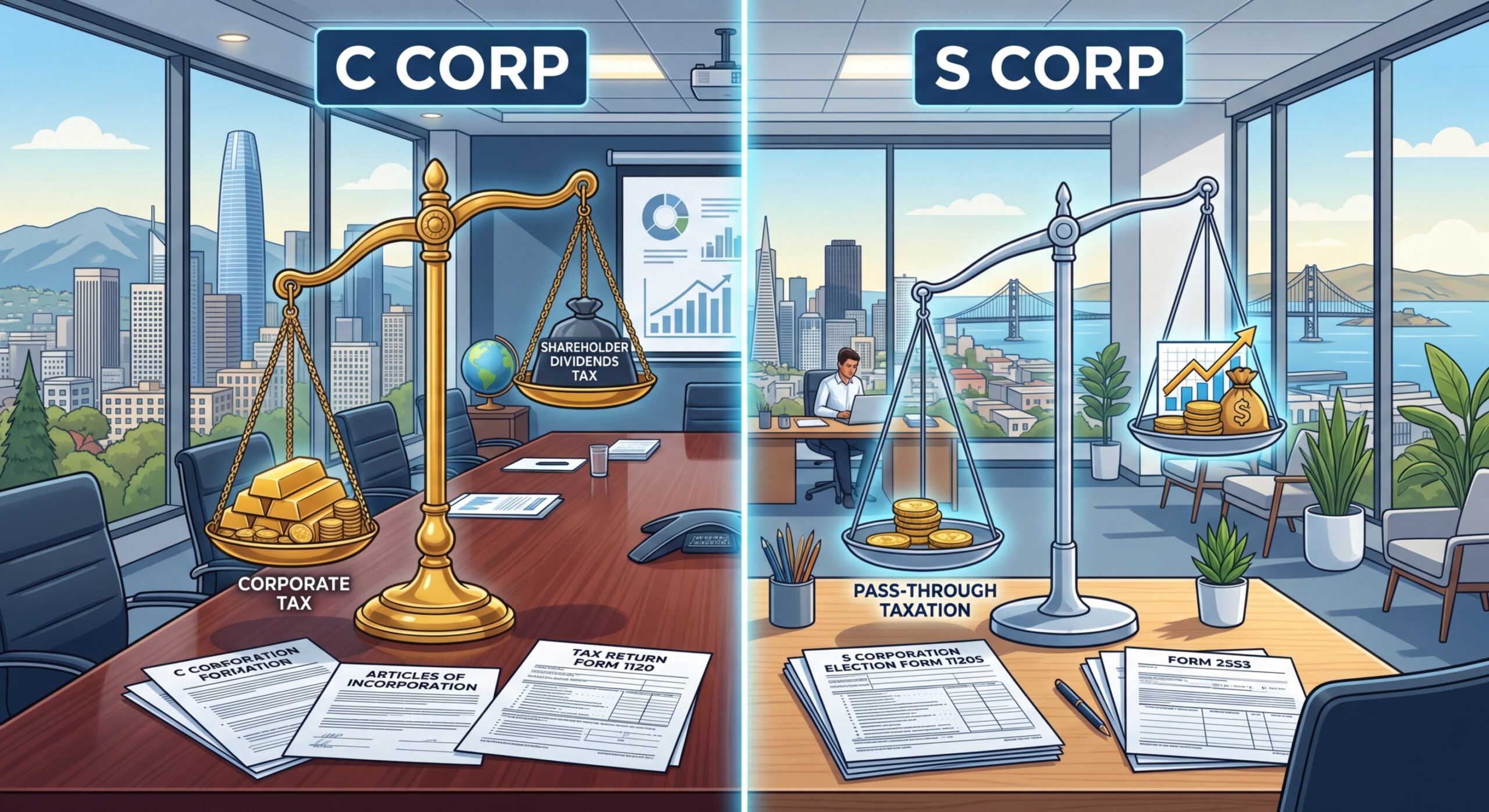
A C Corporation (C Corp) is taxed as a separate entity under Subchapter C of the Internal Revenue Code. The corporation pays federal corporate income tax at a flat 21% rate on its profits, and shareholders pay a second layer of tax when those profits are distributed as dividends. An S Corporation (S Corp) is a pass-through entity under Subchapter S, meaning profits flow directly to the shareholders’ personal tax returns and are taxed only once. Both structures offer liability protection, but the tax consequences could not be more different.
Quick Answer
For most small to mid-size business owners earning between $60,000 and $500,000 in annual profit, the S Corp wins on total tax burden by $12,000 to $45,000 per year because it eliminates double taxation, reduces self-employment tax, and unlocks the 20% Qualified Business Income (QBI) deduction. The C Corp makes sense only in narrow situations: when you need multiple stock classes for venture capital, plan to retain large amounts of earnings at the 21% rate, or qualify for the Section 1202 Qualified Small Business Stock (QSBS) exclusion worth up to $10 million in tax-free capital gains.
The Pros and Cons of C Corp vs S Corp: A Side-by-Side Breakdown
Before diving into strategy, you need a clear picture of what each entity actually gives you and what it costs. The table below summarizes the core differences that drive every dollar of tax impact.
| Factor | C Corp | S Corp |
|---|---|---|
| Federal Tax Rate on Profits | 21% flat corporate rate | 0% at entity level; taxed on owner’s personal return (10%-37%) |
| Double Taxation | Yes. Corporate tax + shareholder dividend tax (up to 23.8%) | No. Single layer of tax |
| Self-Employment Tax | Not applicable (owners are employees) | Only on reasonable salary; distributions are SE-tax-free |
| QBI Deduction (Section 199A) | Not eligible | Up to 20% deduction on qualified income |
| California Franchise Tax | 8.84% of net income | 1.5% of net income ($800 minimum) |
| Shareholder Restrictions | None. Any number, any type | Max 100 shareholders, US citizens/residents only, one stock class |
| Stock Classes | Unlimited (common, preferred, etc.) | One class only (voting differences allowed) |
| Retained Earnings Flexibility | Can retain earnings at 21% rate | All income taxed to shareholders regardless of distribution |
| QSBS Exclusion (Section 1202) | Eligible for up to $10M tax-free gain | Not eligible |
| AB 150 PTE Election (California) | Not eligible | Eligible. Generates $3K-$15K+ in federal SALT savings |
That table tells the structural story. But numbers tell the real story. Let us walk through what actually happens to $200,000 in business profit under each structure.
C Corp: The Double Taxation Math on $200,000 in Profit
Your C Corp earns $200,000 in net profit. The corporation pays 21% federal tax, leaving $158,000. California adds its 8.84% franchise tax on the full $200,000, costing another $17,680. If you distribute the remaining $140,320 as qualified dividends, you owe 20% federal dividend tax ($28,064) plus the 3.8% Net Investment Income Tax ($5,332) plus California’s 13.3% on the dividend ($18,663). Total combined tax burden: approximately $92,739. Effective rate: roughly 46.4%.
S Corp: The Pass-Through Math on $200,000 in Profit
Your S Corp earns the same $200,000. You pay yourself a reasonable salary of $80,000. The remaining $120,000 passes through as a distribution, free of self-employment tax. You claim the 20% QBI deduction on qualified income, reducing taxable business income by approximately $24,000. California charges its 1.5% franchise tax on net income ($3,000 versus the C Corp’s $17,680). Your total combined federal and state tax burden lands around $52,300. Effective rate: roughly 26.2%.
The difference: approximately $40,439 per year. Over five years, that gap exceeds $200,000. If you want to see exactly how these numbers play out for your specific income level, plug your profit into this small business tax calculator to estimate your total tax bill under each structure.
The Five Biggest Advantages of the S Corp (And Why Most Owners Choose It)
Advantage 1: Elimination of Double Taxation
This is the headline benefit and the reason S Corps exist. Every dollar your C Corp distributes gets taxed twice: once at the corporate level and once on the shareholder’s personal return. The S Corp eliminates that second layer entirely. For a California business owner distributing $150,000 annually, that single structural difference saves between $22,000 and $35,000 per year depending on your personal tax bracket.
Advantage 2: Self-Employment Tax Savings on Distributions
When you operate as a sole proprietor or single-member LLC, you pay 15.3% self-employment tax (Social Security at 12.4% plus Medicare at 2.9%) on every dollar of net profit up to the Social Security wage base ($176,100 for 2025, as referenced in IRS Publication 15). The S Corp splits your income into salary (subject to payroll tax) and distributions (not subject to SE tax). On $200,000 in profit with an $80,000 salary, you save approximately $18,360 in self-employment taxes annually. Many business owners overlook this savings because their prior accountant never modeled it.
Advantage 3: The Permanent 20% QBI Deduction
The One Big Beautiful Bill Act (OBBBA), signed into law on July 4, 2025, made the Section 199A Qualified Business Income deduction permanent. Previously set to expire after 2025 under the Tax Cuts and Jobs Act (TCJA), this deduction now permanently reduces taxable S Corp income by up to 20%. On $200,000 in qualified business income, that is a $40,000 reduction in taxable income, saving approximately $8,800 to $14,800 in federal taxes depending on your bracket. C Corps are completely ineligible for this deduction.
Advantage 4: California’s AB 150 PTE Election
California’s Pass-Through Entity (PTE) elective tax under AB 150 allows S Corps to pay a 9.3% entity-level state tax and receive a corresponding federal tax deduction. This effectively creates a workaround for the SALT deduction cap (now permanently set at $40,000 for married filing jointly under OBBBA, up from $10,000 under TCJA). For an S Corp with $200,000 in pass-through income, the PTE election can generate $3,000 to $15,000 in additional federal tax savings. C Corps cannot make this election.
Advantage 5: Lower California Franchise Tax Rate
California taxes C Corps at 8.84% of net income. S Corps pay just 1.5% of net income, with an $800 minimum. On $200,000 in profit, that rate differential alone saves $14,680 at the state level. That savings compounds every year the business operates.
The Four Scenarios Where a C Corp Actually Wins
The S Corp dominates for most small and mid-size business owners. But the C Corp is not always the wrong answer. Here are the four specific situations where the pros and cons of C Corp vs S Corp tip in favor of the C Corp.
Scenario 1: You Are Raising Venture Capital
Venture capital firms require preferred stock classes, convertible notes, and flexible equity structures. S Corps are limited to a single class of stock (though voting right differences are permitted). If you are raising institutional money, you need a C Corp. Period. The structural limitations of the S Corp make it incompatible with standard VC deal terms.
Scenario 2: You Qualify for the Section 1202 QSBS Exclusion
Section 1202 of the Internal Revenue Code allows founders of qualifying C Corps to exclude up to $10 million (or 10 times their basis, whichever is greater) in capital gains when they sell their stock after holding it for at least five years. For a founder selling a company for $15 million, this could mean $10 million in completely tax-free gains, saving roughly $2.38 million in federal taxes alone. S Corps are categorically ineligible for QSBS treatment. If you are building a company you plan to sell for $5 million or more, the QSBS exclusion deserves serious analysis. For a deeper dive into S Corp strategy and when it makes sense over C Corp, see our comprehensive S Corp tax strategy guide.
Scenario 3: You Want to Retain Earnings at a Lower Rate
The flat 21% federal corporate tax rate can be advantageous if you plan to retain large amounts of profit inside the company for reinvestment rather than distributing it to shareholders. An S Corp shareholder in the 37% bracket pays personal income tax on all pass-through income, even if no distribution is made. If you consistently reinvest $300,000 or more annually and do not need personal distributions, the C Corp’s 21% rate on retained earnings can save $48,000 or more per year in deferred taxes. Just remember: that tax savings evaporates the moment you distribute those retained earnings as dividends.
Scenario 4: You Need Multiple Stock Classes for Employee Equity
Complex employee equity programs involving stock options, phantom stock, or multiple tiers of ownership generally require a C Corp structure. S Corps cannot issue incentive stock options (ISOs) that receive preferential tax treatment, and the single-class-of-stock rule limits creative compensation structures. If attracting top talent through equity is central to your growth strategy, a C Corp gives you tools the S Corp simply cannot.
The Five Costliest Mistakes Business Owners Make When Choosing Between C Corp and S Corp
Mistake 1: Choosing a C Corp “Because It Sounds More Professional”
This happens more often than any tax professional wants to admit. A business owner files as a C Corp because it feels more established or because an attorney recommended it without analyzing the tax consequences. There is nothing more professional about paying an extra $25,000 to $40,000 in annual taxes. Your clients do not see your entity classification. The IRS does.
Mistake 2: Ignoring the Reasonable Salary Requirement
S Corp owners must pay themselves a “reasonable salary” for the services they perform. Setting that salary too low triggers IRS scrutiny and potential reclassification of distributions as wages, retroactively adding payroll taxes plus penalties and interest. The IRS uses industry benchmarks, geographic data, and comparable compensation studies to determine reasonableness. For a marketing consultant in Los Angeles generating $180,000 in profit, a $40,000 salary is almost certainly too low. A defensible salary might land between $70,000 and $90,000 based on Bureau of Labor Statistics data for that role and market. See IRS guidance on paying yourself for the foundational rules.
Mistake 3: Forgetting About California’s Built-In Gains Tax
If you convert from a C Corp to an S Corp, California imposes a built-in gains (BIG) tax on appreciated assets sold within five years of conversion. The federal BIG tax mirrors the corporate rate at 21%, and California adds its 1.5% S Corp tax on top. If your C Corp holds $500,000 in appreciated inventory or real estate at the time of conversion, selling those assets within the five-year window could trigger a $112,500 federal BIG tax bill that no one budgeted for.
Mistake 4: Missing the Form 2553 Deadline
To elect S Corp status, you must file IRS Form 2553 by March 15 of the tax year you want the election to take effect (or within 75 days of forming a new entity). Miss that deadline, and you are stuck as a C Corp for the entire tax year. On $200,000 in profit, that missed deadline costs you roughly $40,000 in excess taxes. Late election relief exists under Revenue Procedure 2013-30, but it requires demonstrating “reasonable cause” and is not guaranteed. Our entity formation services include deadline tracking to make sure this never happens.
Mistake 5: Failing to Model the Full Five-Year Tax Impact
Most business owners compare C Corp versus S Corp taxes for a single year. That is like choosing a mortgage based on one monthly payment without looking at the total interest over 30 years. The S Corp advantage compounds: annual SE tax savings, annual QBI deduction savings, annual California franchise tax differential, and annual PTE election savings all stack on top of each other. Over five years on $200,000 in annual profit, the cumulative S Corp advantage typically exceeds $180,000 to $220,000 for California business owners.
KDA Case Study: Sacramento Marketing Agency Owner Saves $31,400 by Switching From C Corp to S Corp
Rachel operated a digital marketing agency in Sacramento structured as a C Corp for three years. Her CPA at the time set it up that way because “most real companies are C Corps.” Her agency generated $240,000 in annual net profit. After corporate tax (21% federal plus 8.84% California), dividend taxes, and the NIIT, Rachel was paying approximately $108,000 in total annual taxes, an effective rate of 45%.
KDA restructured Rachel’s entity as an S Corp with a reasonable salary of $95,000. The remaining $145,000 passed through as distributions, free of self-employment tax. Rachel claimed the 20% QBI deduction, reducing her taxable business income by $29,000. KDA filed the AB 150 PTE election, generating an additional $8,200 in federal savings by deducting state taxes above the SALT cap. Her California franchise tax dropped from $21,216 (8.84% of $240,000) to $3,600 (1.5% of $240,000), saving $17,616 at the state level alone.
Total first-year tax savings: $31,400. Total first-year KDA fees: $4,800 (entity restructuring, S Corp election filing, payroll setup, and tax preparation). First-year ROI: 6.5x. Over three years, Rachel will save approximately $94,200 in taxes she would have paid had she stayed in the C Corp structure.
Ready to see how we can help you? Explore more success stories on our case studies page to discover proven strategies that have saved our clients thousands in taxes.
What About the OBBBA Changes for 2025 and Beyond?
The One Big Beautiful Bill Act (OBBBA), signed July 4, 2025, introduced several changes that shift the pros and cons of C Corp vs S Corp calculation even further in the S Corp’s favor for most business owners.
Permanent QBI Deduction
The 20% QBI deduction under Section 199A is now permanent. This was previously scheduled to expire after December 31, 2025. S Corp owners can now plan around this deduction indefinitely, making the S Corp’s long-term tax advantage more reliable than ever. C Corps remain ineligible.
Permanent 100% Bonus Depreciation
OBBBA restored 100% first-year bonus depreciation for qualifying property placed in service after January 20, 2025. This benefits both C Corps and S Corps equally at the federal level, but California still does not conform to bonus depreciation, capping its benefit at $25,000 under Section 179. S Corp owners in California must maintain dual depreciation schedules to comply with FTB requirements.
Increased SALT Cap at $40,000
The SALT deduction cap increased from $10,000 to $40,000 for married filing jointly ($20,000 for married filing separately). While this helps C Corp owner-employees somewhat, S Corp owners using the AB 150 PTE election already bypass the SALT cap entirely, making the increased cap less impactful for S Corp structures that are already optimized.
Section 179 Increase to $2.5 Million
The Section 179 expensing limit jumped to $2.5 million with a phaseout beginning at $4 million for property placed in service in tax years beginning after December 31, 2024. This benefits both entity types, but the S Corp’s lower California franchise tax rate means more of those savings stay in the owner’s pocket.
Do I Need to Change My Entity Structure Right Now?
Not necessarily. The right answer depends on your specific income level, growth trajectory, and exit strategy. Here is a decision framework that covers the most common scenarios.
Stay as a C Corp If:
- You are actively raising or plan to raise venture capital within the next 24 months
- You qualify for the Section 1202 QSBS exclusion and plan to hold stock for 5+ years before selling
- You consistently retain $300,000 or more in annual earnings for reinvestment with no plans to distribute
- You need multiple stock classes for complex employee equity compensation
- Your company has significant tax credit carryforwards that offset the corporate tax rate
Convert to an S Corp If:
- Your annual net profit exceeds $60,000 and you distribute most of your earnings
- You want to eliminate double taxation on distributed profits
- You want access to the permanent 20% QBI deduction
- You operate in California and want to reduce your franchise tax rate from 8.84% to 1.5%
- You want to leverage the AB 150 PTE election for additional federal tax savings
- You have 100 or fewer shareholders who are all US citizens or residents
Stay Where You Are and Model It First If:
- Your profit is between $40,000 and $60,000 (the savings may not justify the compliance costs)
- You have significant appreciated assets that would trigger the built-in gains tax on conversion
- You are considering selling your business within the next two years (timing the conversion with an exit requires careful planning)
- You are unsure whether your salary would pass the “reasonable compensation” test
Will Choosing the Wrong Entity Trigger an Audit?
The entity choice itself does not trigger an audit. But the downstream consequences of a poorly structured entity absolutely do. The IRS flags S Corp returns where shareholder salary appears disproportionately low relative to distributions. If your S Corp shows $180,000 in distributions and $30,000 in W-2 wages, that ratio raises red flags. The IRS has won multiple court cases reclassifying distributions as wages, adding back payroll taxes, penalties, and interest.
On the C Corp side, the IRS watches for accumulated earnings beyond what the business reasonably needs. The accumulated earnings tax under IRC Section 531 imposes a 20% penalty tax on earnings retained beyond $250,000 (or $150,000 for certain personal service corporations) that the IRS determines were accumulated to avoid dividend taxation. If your C Corp has $800,000 in retained earnings and no documented business purpose for keeping that cash, expect questions.
California’s FTB also audits entity-level compliance. S Corps that fail to file Form 100S, miss the $800 minimum franchise tax payment, or incorrectly calculate the 1.5% tax on net income face penalties starting at $2,000 and escalating with repeat noncompliance.
Can I Switch From C Corp to S Corp Mid-Year?
Technically, no. The S Corp election under Form 2553 takes effect at the beginning of a tax year. If you file Form 2553 by March 15, 2026, the election is effective for the entire 2026 tax year. If you miss that deadline, you can still file for the 2027 tax year. The IRS does allow late election relief under Revenue Procedure 2013-30 if you can demonstrate that you intended to make the election on time and had reasonable cause for the delay. Common accepted reasons include reliance on a tax professional who failed to file, administrative oversight with documentation, or misunderstanding of the filing deadline. The late relief must be filed within 3 years and 75 days of the intended effective date.
California requires a separate filing. When you file Form 2553 with the IRS, you must also notify the FTB by filing Form 100S for the first S Corp tax year. Failure to coordinate federal and state elections can create a split-year situation where you are an S Corp federally but a C Corp for California purposes, doubling your compliance burden and creating significant tax exposure.
Ready to Reduce Your Tax Bill?
KDA Inc. specializes in strategic tax planning for business owners, S Corps, LLCs, and high-net-worth individuals. Book a personalized consultation and walk away with a clear plan.
Frequently Asked Questions
Can a Single Owner Have a C Corp or S Corp?
Yes. Both structures allow a single shareholder. A single-member LLC can elect S Corp taxation by filing Form 2553, and a single shareholder can incorporate as either a C Corp or S Corp. The choice comes down to the same tax analysis: if you are distributing profits and earning above $60,000, the S Corp almost always wins on total tax burden.
What Happens to My S Corp If I Add a Foreign Shareholder?
Your S Corp election terminates immediately. S Corps are limited to US citizens and resident aliens as shareholders. If you add a non-resident alien as a shareholder, even briefly, the election is automatically revoked as of the date the ineligible shareholder was added. The corporation reverts to C Corp status, and the IRS imposes a five-year waiting period before you can re-elect. This is one of the most expensive mistakes in entity planning.
Is There a Minimum Income to Benefit From S Corp Status?
There is no official IRS minimum, but the practical breakeven point for most California business owners is around $50,000 to $60,000 in annual net profit. Below that threshold, the compliance costs of S Corp status (payroll processing, additional tax filings, reasonable salary requirements) may exceed the tax savings. Above $60,000, the self-employment tax savings and QBI deduction typically generate enough value to justify the added complexity.
Does the S Corp Protect Me From Lawsuits the Same Way a C Corp Does?
Yes. Both S Corps and C Corps provide the same liability protection under state law. The corporate veil shields your personal assets from business debts and lawsuits as long as you maintain corporate formalities: separate bank accounts, documented board meetings, proper capitalization, and avoidance of commingling personal and business funds. The tax election (S vs. C) does not affect your liability protection in any way.
This information is current as of 3/27/2026. Tax laws change frequently. Verify updates with the IRS or FTB if reading this later.
“The IRS does not care which entity sounds more impressive on your business card. It cares which one you checked on the form. And that single checkbox determines whether you keep 74 cents or 54 cents of every dollar your business earns.”
Book Your C Corp vs S Corp Strategy Session
If you are operating as a C Corp and suspect you are overpaying by tens of thousands of dollars every year, stop guessing and get the math done. Book a personalized consultation with the KDA strategy team and we will model your exact tax burden under both structures, identify every available deduction and election, and build you a conversion roadmap that saves real money starting this tax year. Click here to book your consultation now.


