
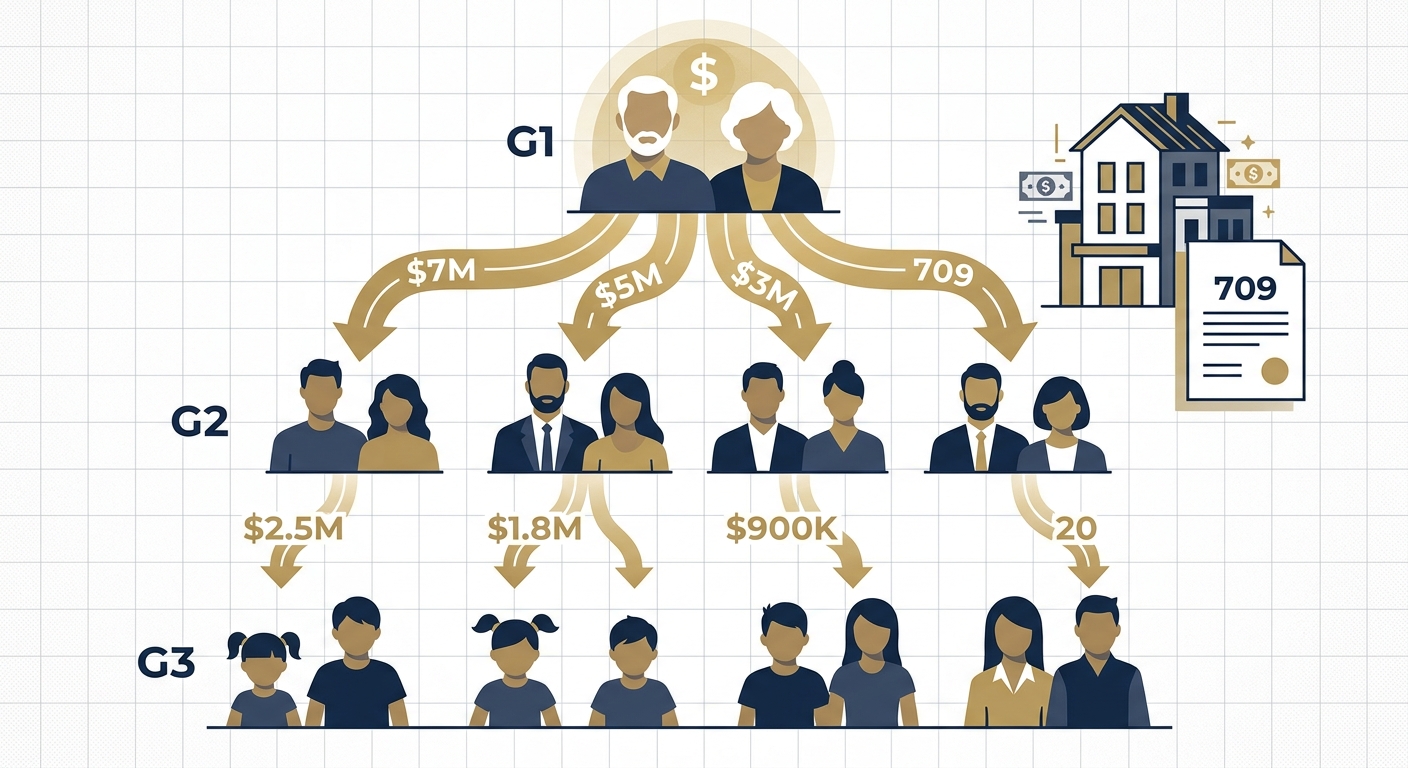
Most people believe the IRS taxes them the moment they hand a family member a check. They picture a $50,000 gift to a son buying his first rental property triggering an immediate tax bill. That fear keeps money frozen inside estates for decades while heirs struggle through the exact years they need capital most. The truth runs the opposite direction. For 2026, the max gifting amount 2026 rules let you move substantial wealth to family every single year without paying one dollar of gift tax and, in most cases, without even filing a form. The people who lose money on gifting are not the ones who give too much. They are the ones who give without understanding which transfers count against the annual exclusion, which ones do not, and which ones quietly consume a lifetime exemption they could have preserved.
Quick Answer: What Is the Max Gifting Amount 2026?
For calendar year 2026, you can give $19,000 per recipient without using any portion of your lifetime gift and estate tax exemption and without filing a gift tax return. A married couple who elects gift splitting can transfer $38,000 per recipient. There is no limit on how many recipients you choose. Gift ten people and you have moved $190,000 as a single donor or $380,000 as a couple, all outside the tax system entirely.
Above that threshold, you still owe nothing in most cases. You file IRS Form 709, the United States Gift (and Generation-Skipping Transfer) Tax Return, and the excess reduces your lifetime exemption, which sits at $15 million per person for 2026, up from $13.99 million in 2025. A married couple therefore controls roughly $30 million in combined lifetime transfer capacity before gift tax rates apply.
Key Takeaway: The $19,000 annual exclusion is a per-recipient, per-year reset. Unused exclusion does not carry forward. Every December 31 that passes without gifting is capacity permanently gone.
Understanding How the Max Gifting Amount 2026 Actually Works
Two separate systems govern gifts, and confusing them is where most taxpayers go wrong.
System One: The Annual Exclusion
The annual exclusion is the amount you can give any single person in a calendar year with zero reporting and zero tax consequence. For 2026 that number is $19,000. It is indexed to inflation in $1,000 increments, which is why it held steady from 2025 rather than climbing.
The exclusion is calculated per donor and per recipient. That structure creates enormous flexibility. A grandparent with four grandchildren gives $19,000 to each and has moved $76,000. Add a spouse who does the same and the family has transferred $152,000 in one calendar year with no Form 709 and no exemption used.
System Two: The Lifetime Exemption
The lifetime exemption is a cumulative bucket covering gifts during life plus your estate at death. For 2026 it is $15 million per individual. Gifts exceeding the annual exclusion do not generate tax. They generate a reporting obligation and draw down this bucket. Only after you exhaust $15 million does the 40% federal gift tax rate engage.
This distinction matters more than any other concept in gifting. A client who gives a $200,000 down payment to a daughter has not created a tax bill. They have created a Form 709 filing requirement and reduced their remaining exemption by $181,000. Nothing is owed. Nothing is lost economically unless the estate later exceeds the remaining exemption.
What Does Not Count Against Either System
Several transfer categories sit completely outside gift tax rules. These are the strategies that separate informed planning from guesswork:
- Direct tuition payments made to an educational institution, unlimited in amount, under the qualified transfer exclusion
- Direct medical payments made to a provider on behalf of another person, unlimited in amount
- Transfers to a U.S. citizen spouse, unlimited under the marital deduction
- Political contributions and gifts to qualifying charities
The word “direct” carries the entire weight here. Write a $60,000 check to a private university for your grandson’s tuition and it is not a gift for tax purposes. Write the same $60,000 to your grandson so he can pay tuition himself and you have made a $60,000 gift with $41,000 reportable on Form 709.
Pro Tip: Pay tuition and medical bills directly to the institution, then use the full $19,000 annual exclusion separately for cash the family member can actually spend. You get both benefits in the same year.
Strategic Gifting for Real Estate Investors and Property Owners
Gifting real property introduces variables that cash gifts never present, and this is where the max gifting amount 2026 rules get genuinely interesting for anyone holding appreciated assets.
The Carryover Basis Problem
When you gift property during life, the recipient takes your cost basis, meaning the original purchase price adjusted for improvements and depreciation. When property passes at death, the heir generally receives a stepped-up basis equal to fair market value on the date of death.
The math is unforgiving. Consider a duplex purchased in 2004 for $310,000, now worth $890,000, with $185,000 of accumulated depreciation. Basis sits at $125,000. Gift it to a child today and that child inherits a $765,000 embedded gain. If they sell, they face capital gains tax plus depreciation recapture at 25%. Hold the same property until death and the heir’s basis resets to $890,000. Sell immediately and the tax is roughly zero.
Red Flag Alert: Gifting highly appreciated real estate to save estate tax when your estate sits below $15 million is one of the most expensive mistakes in family wealth transfer. You trade a zero-tax step-up for a fully taxable carryover basis and gain nothing. Run the estate tax exposure calculation before transferring any appreciated asset.
Fractional Interest Gifting and Valuation Discounts
For estates that genuinely face exposure, gifting fractional interests in real estate through an LLC or family limited partnership allows for valuation discounts. A 20% non-controlling interest in a property-holding LLC is worth less than 20% of the underlying real estate because the holder cannot force a sale or control distributions.
Appraisers commonly support discounts in the 15% to 35% range depending on the operating agreement terms. A $19,000 gift of LLC units might therefore transfer $24,000 to $28,000 of underlying property value. Over a decade with multiple recipients, that arbitrage compounds meaningfully.
This structure requires a defensible qualified appraisal, a genuine operating agreement, and actual respect for entity formalities. Investors evaluating whether fractional gifting fits their portfolio should work through the numbers alongside professional tax planning services before executing transfers, because the IRS scrutinizes discount claims aggressively and a failed valuation position converts a clean gift into an audit exposure.
Gifting Rental Property Cash Flow Instead of the Asset
A frequently overlooked alternative preserves the step-up while still moving money. Keep title to the rental property. Gift the annual cash flow. If a fourplex generates $46,000 in net distributions, gift $19,000 to each of two adult children and retain $8,000. The property basis stays intact for eventual step-up, the income shifts to family members who may sit in lower brackets, and no Form 709 is required.
Key Takeaway: Gift income, not appreciated assets, when your estate is below the $15 million exemption. Gift assets when you are above it and the estate tax exposure exceeds the capital gains cost.
KDA Case Study: High-Net-Worth Real Estate Investor
A KDA client we will call Marcus, age 68, held a California rental portfolio of six properties with a combined fair market value of $8.4 million and an aggregate adjusted basis of $2.1 million. Combined with retirement accounts and a primary residence, his taxable estate reached $11.9 million. He is a widower with three adult children and seven grandchildren.
Marcus arrived convinced he needed to transfer two rental properties to his children immediately to reduce estate exposure. His prior preparer had drafted deeds. Had he executed them, he would have transferred approximately $2.8 million of value with roughly $2.1 million of embedded gain and permanently destroyed the step-up on those assets.
Our analysis showed his estate sat $3.1 million below the $15 million exemption. Federal estate tax exposure was zero. The proposed gifting would have created an unnecessary future capital gains liability of approximately $567,000 across the two properties, factoring in a 23.8% federal rate on appreciation, 25% depreciation recapture on $340,000, and California’s 13.3% top rate.
The strategy we implemented instead: annual exclusion gifting of cash and marketable securities to all ten family members at $19,000 each, moving $190,000 per year with no Form 709. Direct tuition payments of $118,000 annually to two universities on behalf of grandchildren, entirely outside gift tax. Real estate held until death for full step-up.
First-year result: $308,000 transferred to family, zero gift tax, zero Form 709 filings, step-up preserved on the entire portfolio, and $567,000 of projected capital gains liability avoided. Professional fees for the analysis and implementation were $9,500, producing a first-year documented benefit exceeding 59 times the investment when the avoided gain is counted.
Ready to see how we can help you? Explore more success stories on our case studies page to discover proven strategies that have saved our clients thousands in taxes.
Comparing Your Gifting Options Side by Side
Transfer Method Comparison
| Method | 2026 Limit | Form 709 Required | Basis Treatment |
|---|---|---|---|
| Annual exclusion cash gift | $19,000 per recipient | No | Carryover |
| Gift splitting (married) | $38,000 per recipient | Yes, to elect | Carryover |
| Direct tuition payment | Unlimited | No | Not applicable |
| Direct medical payment | Unlimited | No | Not applicable |
| 529 plan five-year election | $95,000 per recipient | Yes | Carryover |
| Gift to U.S. citizen spouse | Unlimited | No | Carryover |
| Transfer at death | $15 million exemption | Estate return | Stepped up |
Decision Framework: Should You Gift Now or Hold Until Death?
Gift now, if:
- Your total estate exceeds $15 million as a single person or $30 million as a couple
- The asset has minimal appreciation relative to basis
- The asset is expected to appreciate rapidly, moving future growth outside your estate
- You hold cash, cash equivalents, or securities near cost basis
- The recipient needs capital during a specific life window such as a home purchase or business launch
Hold until death, if:
- Your estate sits comfortably below the exemption
- The asset carries substantial unrealized gain or accumulated depreciation
- You may need the asset or its income for your own support
- The recipient would likely sell shortly after receiving it
The Reporting Mistakes That Trigger IRS Attention
Mistake One: Assuming No Tax Means No Filing
A gift of $45,000 to one person in 2026 creates no tax liability. It absolutely creates a filing requirement. Form 709 is due April 15, 2027, and follows your personal extension if you file one. The statute of limitations on a gift only begins running once the return is filed and the gift is adequately disclosed. Skip the filing and the IRS can challenge the valuation of that transfer indefinitely.
The agency received roughly 300,000 gift tax returns in fiscal 2025 against a population of millions of taxpayers making reportable gifts. Compliance is thin, and the exposure sits with the donor’s estate years later when nobody remembers the details.
Mistake Two: Undocumented Loans That Become Gifts
Advancing $150,000 to a child for a rental property purchase and calling it a loan without a promissory note, a stated interest rate meeting the applicable federal rate, and an actual repayment history invites recharacterization. The IRS treats it as a completed gift. Worse, if you forgive payments informally each year, each forgiveness is a separate gift.
Document loans with a written note, charge at least the applicable federal rate published monthly by Treasury, and maintain a payment ledger. See IRS Publication 550 for imputed interest rules on below-market loans.
Mistake Three: Adding a Child to Title
Adding an adult child to the deed of a $700,000 property as a joint tenant is a completed gift of half the value, $350,000, with $331,000 reportable. People do this constantly for probate avoidance without recognizing the gift tax and basis consequences. A revocable trust accomplishes the same probate goal with none of the gift tax fallout.
Mistake Four: Missing the Gift Splitting Election
Married couples cannot simply assume gift splitting applies. If one spouse writes a $38,000 check from an individual account, that is a $38,000 gift from one donor unless both spouses affirmatively consent to split gifts on a timely filed Form 709. The cleaner approach is two separate $19,000 checks from separate accounts, which requires no election and no filing at all.
California-Specific Considerations for 2026
California imposes no state gift tax and no state estate tax as of 2026. That fact leads many California residents to assume gifting carries no state-level consequence. Three issues say otherwise.
Proposition 13 Reassessment Risk
Gifting real property to a child can trigger reassessment to current market value under the rules narrowed by Proposition 19. The parent-child exclusion now applies only to a primary residence where the child makes it their principal residence, and only up to the assessed value plus $1 million. Rental and commercial property transfers generally lose the base year value entirely.
A rental property with an assessed value of $290,000 and market value of $1.1 million currently carries roughly $3,200 in annual property tax. Gift it to a child and reassessment pushes that to approximately $12,100 per year. That is $8,900 in new annual cost, indexed upward, forever. Twenty years of that exceeds $200,000 in present value terms.
California Income Tax on Recipients
Shifting rental income to California family members does not escape the state’s 13.3% top marginal rate if those recipients also live in California. The strategy works when recipients sit in lower brackets. It does not work when everyone occupies the same bracket. Investors weighing income-shifting should model the actual bracket differential, and running scenarios through a capital gains tax calculator helps clarify what a sale would actually cost before any transfer decision is made.
Proposition 40 and the 2026 Wealth Tax Ballot Measure
California voters will decide in November 2026 on Proposition 40, which would impose a one-time 5% tax on individuals and trusts with net worth of $1 billion or more, measured as of December 31, 2026. The measure includes anti-avoidance provisions targeting transfers made primarily to reduce measured net worth, and charitable gifts would still count toward the wealth calculation. Taxpayers anywhere near that threshold should not treat gifting as a reliable reduction tool without specialized counsel.
Step-by-Step: Executing Annual Exclusion Gifts Correctly
- List every intended recipient including children, children-in-law, grandchildren, and any other individuals. Each one carries a separate $19,000 allowance. Takes 15 minutes.
- Decide the asset for each gift. Prioritize cash and low-basis-gap securities. Exclude highly appreciated real estate unless estate tax exposure justifies it. Takes one hour with a basis schedule.
- Confirm the transfer date and clearance. A check must be deposited and cleared by December 31 to count for that calendar year. Checks mailed December 29 routinely fall into the wrong year.
- Use separate accounts for married couples. Two individual checks of $19,000 each avoid the gift splitting election and the associated Form 709 entirely.
- Pay tuition and medical bills directly. Send funds to the institution, never to the family member. Keep the invoice and the payment confirmation together.
- Document everything. Retain bank records, transfer confirmations, appraisals for non-cash gifts, and a simple annual gifting log listing recipient, date, amount, and asset.
- File Form 709 if any single recipient exceeded $19,000 from you, or if you are electing gift splitting or a 529 five-year spread. Due April 15, 2027.
Special Situations Most Guidance Skips
Gifts to Non-Citizen Spouses
The unlimited marital deduction requires a U.S. citizen spouse. Gifts to a non-citizen spouse are capped at an annual exclusion of $194,000 for 2026. Anything above draws on the lifetime exemption. Couples with mixed citizenship status frequently miss this and create unreported transfers.
The 529 Plan Five-Year Election
You can front-load five years of annual exclusion gifts into a 529 education account, contributing $95,000 per beneficiary in 2026 and electing to spread it ratably over five years on Form 709. If you die within the five-year window, the unused portion returns to your estate. Making additional gifts to that beneficiary during those years pushes you above the exclusion.
Trump Accounts and Revenue Procedure 2026-25
Contributions to the new Trump Accounts raised a technical gift tax question because funds locked until age 18 could be classified as future interests, which do not qualify for the annual exclusion. Revenue Procedure 2026-25 created a safe harbor treating qualifying cash contributions as present-interest gifts covered by the $19,000 exclusion. The safe harbor requires that you be an individual, contribute cash rather than property, make contributions before the year the child turns 18, keep total gifts to that child under $19,000, and not otherwise file a gift tax return that year.
Gifts of Business Interests to Active Family Members
Transferring S corporation shares or LLC units to a child who works in the business layers gift valuation on top of reasonable compensation issues. A discounted gift of units alongside artificially low wages invites the IRS to recharacterize the arrangement. Business owners pursuing this should coordinate the gift valuation and the compensation study together, not separately.
Ready to Reduce Your Tax Bill?
KDA Inc. specializes in strategic tax planning for business owners, S Corps, LLCs, and high-net-worth individuals. Book a personalized consultation and walk away with a clear plan.
Frequently Asked Questions
Does the Recipient Pay Tax on a Gift?
No. Gift tax is a donor-side tax in the United States. A person who receives $500,000 as a gift reports nothing on their Form 1040 and owes no income tax on the receipt. They do inherit the donor’s basis, so tax appears later if they sell an appreciated asset.
Can I Gift More Than $19,000 Without Paying Tax?
Yes, and this is the single most misunderstood point in gift planning. Exceeding $19,000 requires filing Form 709 but generates no tax until your cumulative lifetime gifts exceed $15 million. A $400,000 gift in 2026 costs you a filing and $381,000 of exemption. It costs you nothing in cash.
What Happens to the Exemption After 2026?
The $15 million exemption was made permanent and indexed for inflation under current law rather than reverting as previously scheduled. Permanent in tax legislation means until Congress changes it. Families with estates above the threshold should not assume the current level is guaranteed a decade out, but the immediate cliff that drove urgent 2025 planning no longer exists.
Should I Gift Property or Sell It to a Family Member?
An installment sale to a family member at fair market value with a note bearing the applicable federal rate transfers the asset without using exclusion or exemption, freezes the value for estate purposes, and creates an income stream you may need. The tradeoff is that you recognize capital gain on the sale. For an asset expected to appreciate substantially, the freeze often outweighs the current gain recognition.
Do I Need to File Form 709 If I Gift Exactly $19,000?
No. Gifts at or below the annual exclusion require no return. The filing threshold begins at $19,001 to any single recipient from any single donor during calendar year 2026.
The Bottom Line on 2026 Gifting
The annual exclusion is the most underused tool in family wealth transfer, not because it is complicated but because it is boring. Nineteen thousand dollars per person does not sound like a strategy. Multiply it across ten recipients, add direct tuition and medical payments, run it for fifteen years, and a family moves several million dollars entirely outside the tax system with no returns filed and no exemption consumed.
What destroys value is not gifting too little. It is gifting the wrong assets. Handing appreciated California rental property to children when your estate sits below the exemption trades a free basis step-up for a six-figure capital gains bill and a Proposition 19 reassessment that compounds annually. Get the asset selection right and the strategy runs itself.
Every family with meaningful assets should have a written annual gifting plan reviewed each fall, not each December when checks cannot clear in time.
This information is current as of 7/31/2026. Tax laws change frequently. Verify updates with the IRS or FTB if reading this later.
Book Your Tax Strategy Session
If you own appreciated real estate or hold assets you plan to pass to family, the difference between gifting the right asset and the wrong one is often six figures in avoidable capital gains and reassessed property tax. We build gifting plans that preserve your basis step-up, protect your Proposition 13 assessment where possible, and move maximum value to your family every calendar year. Click here to book your consultation now.



