
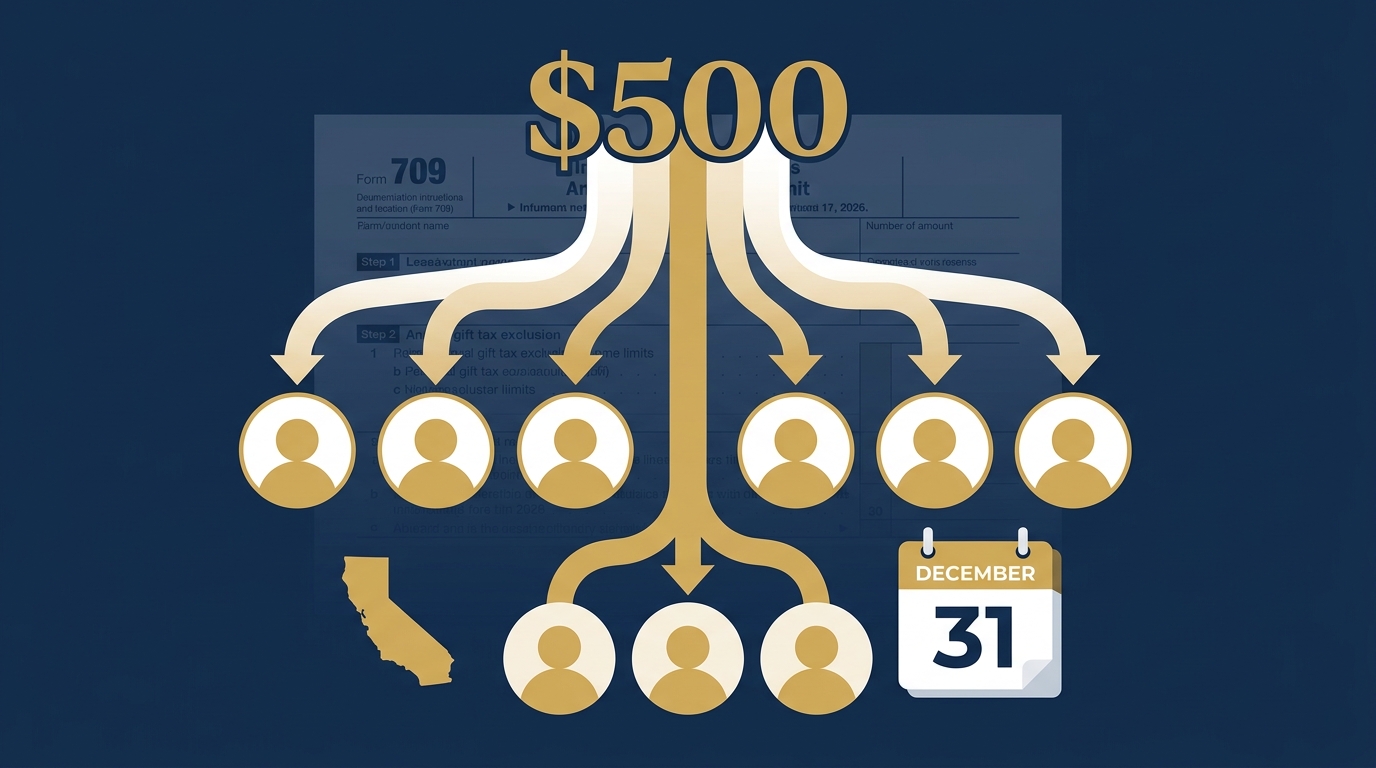
Most people hear the words “gift tax” and immediately assume they are about to owe the IRS money for helping their kids buy a house. That fear costs American families real dollars every year, because it stops them from moving wealth out of their estate while they are alive and while the rules are generous. The truth runs in the opposite direction. The max gifting amount 2026 rules are among the most taxpayer friendly transfer provisions in the entire code, and for the overwhelming majority of families, gifting produces zero tax owed, zero tax due at filing, and a permanently smaller taxable estate.
The confusion comes from mixing up two separate numbers that do two completely different jobs. One is the annual exclusion. The other is the lifetime exemption. They interact, but they are not the same thing, and understanding the difference is what separates families who transfer millions tax free from families who leave a nine figure estate exposed to a forty percent tax.
Quick Answer: What Is the Max Gifting Amount 2026?
For 2026, the annual gift tax exclusion is $19,000 per recipient per year. A married couple electing to split gifts can give $38,000 per recipient per year. Above that, gifts reduce your lifetime exemption, which sits at roughly $15 million per individual for 2026 following the permanent increase enacted under the One Big Beautiful Bill Act. Almost no one pays actual gift tax. You simply file a return and track the number.
Key Takeaway: Giving $19,000 to each of your three children and each of their spouses in 2026 moves $114,000 out of your taxable estate without filing anything and without using a single dollar of lifetime exemption.
The Two Numbers That Control Everything
Before you can plan around the max gifting amount 2026, you need to understand the architecture. The federal transfer tax system has two layers, and they stack.
Layer One: The Annual Exclusion
The annual gift tax exclusion is the amount you can give to any single person in a calendar year without any reporting requirement and without touching your lifetime exemption. For 2026, that figure is $19,000. It is indexed to inflation and rounds in $1,000 increments, which is why it sat at $18,000 for 2024, moved to $19,000 for 2025, and holds at $19,000 for 2026.
The critical word in that sentence is “person.” This is not a total annual cap. It is a per recipient cap. If you have four children, six grandchildren, and two sons in law, you have twelve separate $19,000 buckets available to you every single year. That is $228,000 leaving your estate annually, and your spouse can match it dollar for dollar.
Layer Two: The Lifetime Exemption
The lifetime gift and estate tax exemption is the cumulative amount you can transfer above the annual exclusion, either during life or at death, before any actual tax is owed. Under the tax legislation signed in 2025, this figure was made permanent at $15 million per individual starting in 2026, indexed for inflation going forward. A married couple therefore controls roughly $30 million of combined exemption.
Here is the part that surprises people. Exceeding the annual exclusion does not trigger a tax bill. It triggers a form. You file Form 709, the United States Gift and Generation Skipping Transfer Tax Return, report the excess, and that excess is subtracted from your lifetime exemption. Tax is only owed once you have burned through the entire $15 million. At that point the rate is forty percent.
Comparison Table: Annual Exclusion vs Lifetime Exemption
| Factor | Annual Exclusion | Lifetime Exemption |
|---|---|---|
| 2026 Amount | $19,000 per recipient | ~$15 million per person |
| Resets | Every January 1 | Never, cumulative |
| Form 709 Required | No | Yes |
| Tax Owed | None | None until exhausted |
| Married Couple | $38,000 per recipient | ~$30 million combined |
| Applies To | Unlimited recipients | Aggregate lifetime total |
Bottom Line: The annual exclusion is a use it or lose it faucet. The lifetime exemption is a reservoir. Drain the faucet first every year before you ever touch the reservoir.
KDA Case Study: High Net Worth Family Moves $1.9 Million Off the Estate Sheet
A Southern California couple, both 68, came to us in early 2026 with a combined net worth of $38 million. The bulk sat in a commercial real estate portfolio, a closely held operating company, and a taxable brokerage account. Their prior advisor had told them “you are under the exemption, do nothing.” That advice was costing them roughly $400,000 per year in future estate tax exposure because the portfolio was appreciating at about seven percent annually inside their estate.
Their exposure was real. At $38 million against a combined exemption near $30 million, they were already $8 million over the line. At the forty percent rate, that is a projected $3.2 million federal estate tax, and the number grows every year the assets appreciate.
What we implemented across 2026: annual exclusion gifts of $38,000 per recipient to four children, three spouses, and seven grandchildren, totaling $532,000 with zero Form 709 impact. We layered in direct tuition payments of $186,000 to three universities under the qualified transfer exclusion, again with no exemption used. We then executed a $1.2 million gift of non voting LLC units into an irrevocable trust, applying a defensible valuation discount that reported at roughly $912,000 against their lifetime exemption.
Total value removed from the taxable estate in year one: approximately $1.9 million. Future estate tax avoided at the forty percent rate on that transfer plus its projected appreciation over their remaining life expectancy: an estimated $1.4 million. Their engagement fee for the planning, valuation coordination, trust drafting support, and Form 709 preparation was $28,500. That is roughly a 49x return measured against projected estate tax avoided.
Ready to see how we can help you? Explore more success stories on our case studies page to discover proven strategies that have saved our clients thousands in taxes.
Gifts That Do Not Count Against the Max Gifting Amount 2026 at All
This is where most families leave money on the table. There are entire categories of transfers that are invisible to the gift tax system. They do not use your annual exclusion. They do not use your lifetime exemption. They are unlimited.
Direct Medical Payments
Under Internal Revenue Code Section 2503(e), any amount you pay directly to a medical provider on behalf of another person is excluded entirely. Not capped at $19,000. Unlimited. If your father needs a $240,000 surgery and you wire the hospital directly, that is a $240,000 transfer out of your estate with no gift tax consequence whatsoever.
The word “directly” carries all the weight. Write the check to the hospital. Not to your father. If the money passes through his hands first, it becomes an ordinary gift subject to the $19,000 annual limit, and the excess eats your exemption.
Direct Tuition Payments
Same rule, same statute. Tuition paid directly to a qualifying educational institution is unlimited and excluded. This covers private elementary school, boarding school, undergraduate, graduate, and professional programs.
What it does not cover: room and board, books, meal plans, supplies, travel, or a laptop. Those are ordinary gifts. A grandparent paying $62,000 in tuition directly to a university and separately handing the grandchild $19,000 for housing and living expenses has moved $81,000 in one year using zero lifetime exemption. Coordinating this correctly is exactly the kind of sequencing our tax planning services map out before the calendar year closes.
Transfers to a U.S. Citizen Spouse
The unlimited marital deduction means transfers between spouses who are both U.S. citizens carry no gift tax consequence in any amount. A caution though: if your spouse is not a U.S. citizen, the unlimited deduction does not apply. Instead a separate, much higher annual exclusion applies to non citizen spouses, which for 2026 sits around $194,000. Get this wrong and you create a taxable gift where you assumed there was none.
Qualified Charitable Transfers
Gifts to qualifying 501(c)(3) organizations are fully deductible for gift tax purposes with no ceiling. Note that the income tax charitable deduction has its own separate percentage of AGI limits, and those two systems do not share rules. Do not conflate them.
The Five Step Annual Gifting Process
Executing on the max gifting amount 2026 is not complicated, but sequence and documentation matter enormously if the estate is ever examined.
- Build your recipient roster by January. List every child, grandchild, in law, niece, nephew, and non family recipient. There is no relationship requirement for the annual exclusion. Anyone counts. Time required: one hour.
- Confirm spousal gift splitting intent. If one spouse holds the assets but you want to use both exclusions, you must file Form 709 and formally elect gift splitting even though no tax is owed. Both spouses must consent on the return.
- Transfer by separate, traceable payments. One check or wire per recipient. Never one lump payment to a household. Write the recipient name on the memo line. Time required: one afternoon.
- Complete transfers before December 31. A check mailed on December 30 but not deposited until January 4 can be treated as a next year gift under the relation back doctrine. Wire transfers in December remove the ambiguity entirely.
- File Form 709 by April 15 if required. Required if any single recipient received more than $19,000, if you split gifts with a spouse, or if you gifted a future interest. Extending your 1040 with Form 4868 automatically extends Form 709.
Red Flag Alert: The Mistakes That Undo Your Gifting Plan
Red Flag Alert: Gifting appreciated stock to a low bracket family member without checking their situation can backfire. Gifts carry over your original cost basis. Assets inherited at death receive a stepped up basis to fair market value. If you gift a stock position you bought at $40,000 that is now worth $190,000, your recipient inherits the $40,000 basis and a $150,000 embedded capital gain. Had they received it at your death, the gain would have vanished. Gift cash or high basis assets and hold the deeply appreciated low basis positions until death.
Other frequent failures we correct in client files:
- Treating the exclusion as a household number. It is per person, both giver and recipient. Two parents gifting to two children creates four separate $19,000 exclusions, not one.
- Gifting future interests. The annual exclusion only applies to gifts of a present interest. Money placed into a trust with no immediate access rights does not qualify unless the trust includes Crummey withdrawal provisions. Skip the Crummey notices and you have used exemption you thought you preserved.
- Paying tuition to the student instead of the school. Kills the unlimited exclusion instantly.
- Assuming no tax means no filing. Form 709 is an information return in most cases. Failing to file starts no statute of limitations, which means the IRS can revisit the valuation of that gift decades later.
- Forgetting the generation skipping transfer tax. Gifts to grandchildren implicate a separate GST tax with its own exemption. It is allocated automatically in many cases, but not all.
Pro Tip: Front load January gifting. A gift made January 5 has an extra eleven months of appreciation occurring outside your estate compared to a gift made December 28.
Should You Gift Now or Wait? A Decision Framework
Yes, gift aggressively in 2026, if:
- Your combined estate exceeds $25 million and is appreciating faster than four percent annually
- You own assets likely to appreciate sharply, such as pre IPO equity or entitlement stage real estate
- You hold interests that support legitimate valuation discounts for lack of control or marketability
- Your recipients are financially mature and the transfer will not create dependency
- You have sufficient liquidity to fund your own retirement for thirty plus years without the gifted assets
No, slow down and use only annual exclusions, if:
- Your total estate is under $12 million and unlikely to double
- Your primary assets are deeply appreciated with very low basis and step up matters more than removal
- You need the assets for long term care or income
- A recipient is in an unstable marriage, has creditor exposure, or has substance issues
- Your wealth is illiquid and concentrated in an operating business you still control
California Specific Considerations
California has no state gift tax and no state estate tax. That is genuinely good news, and it means a California resident planning around the max gifting amount 2026 only has to navigate the federal system.
That said, three California realities change the math:
Proposition 19 changed property transfers permanently. Before 2021, parents could transfer a primary residence to children and pass along the original Prop 13 assessed value with essentially no cap, plus up to $1 million of assessed value on other properties. Prop 19 gutted that. Now the parent child exclusion applies only if the child makes the property their principal residence within one year, and even then, only the first $1 million of appreciation above the assessed value is protected. Gift a $2.6 million rental to your daughter and the county reassesses it at full market value. Property tax at roughly 1.1 percent jumps from perhaps $6,000 to $28,600 annually. You saved federal estate tax and created a permanent $22,600 annual property tax increase.
Community property creates automatic splitting. Gifts of community property assets are treated as made one half by each spouse without any gift splitting election. This simplifies things, but it also means a unilateral gift by one spouse of community assets may require the other spouse’s consent to be valid.
Full double step up at first death. In community property states, the entire community property asset receives a basis adjustment when the first spouse dies, not just the decedent’s half. For a couple holding highly appreciated California real estate, holding rather than gifting can be dramatically more valuable than the estate tax savings from a lifetime transfer.
What Happens If You Get This Wrong?
The consequences are not immediate, which is exactly why they are dangerous. Nothing bad happens in the year of the mistake. It surfaces at death, during an estate examination, often fifteen or twenty years later, when the people who could explain the transaction are gone.
Failing to file a required Form 709 means the statute of limitations never begins running on that gift. Normally the IRS has three years to challenge a reported gift valuation. Unreported, or reported without adequate disclosure, and the window stays open forever. An examiner can revalue a 2026 business interest gift in 2049 with no time bar. If the valuation is revised upward from $912,000 to $2.1 million, the additional $1.2 million comes out of the exemption available at death, and the shortfall is taxed at forty percent. That is $480,000 of tax created by paperwork.
Penalties compound the problem. The failure to file penalty runs five percent of tax due per month up to twenty five percent, and a valuation understatement penalty of twenty percent applies where the reported value is sixty five percent or less of the correct value, rising to forty percent for gross misstatements. Adequate disclosure on a properly prepared Form 709, including a qualified appraisal and a description of the valuation method, is what starts the clock and protects the family.
Ready to Reduce Your Tax Bill?
KDA Inc. specializes in strategic tax planning for business owners, S Corps, LLCs, and high-net-worth individuals. Book a personalized consultation and walk away with a clear plan.
Frequently Asked Questions
Do I owe tax if I give my child $50,000 in 2026?
No. You would file Form 709 reporting a $50,000 gift, apply the $19,000 annual exclusion, and report $31,000 against your lifetime exemption. Your remaining exemption becomes roughly $14,969,000. No cash is owed to the IRS. If married and you elect gift splitting, the $38,000 combined exclusion reduces the reportable amount to $12,000 total, $6,000 charged to each spouse.
Does the recipient pay income tax on a gift?
No. Gifts are not taxable income to the recipient under Section 102. They are not reported on a Form 1040 and no 1099 is issued. Any gift tax liability, in the rare case one exists, falls on the giver. The recipient does inherit the giver’s cost basis, so future capital gains on the gifted asset become the recipient’s responsibility.
Can I gift the full $15 million lifetime exemption now and will it be clawed back?
Treasury regulations finalized in 2019 confirmed there is no clawback. Gifts made while a higher exemption is in effect are not retroactively penalized if the exemption later decreases. With the exemption now permanent at approximately $15 million rather than scheduled to sunset, the urgency has eased, but the anti clawback protection remains valuable for anyone considering large transfers.
Does a 529 plan contribution count against the annual exclusion?
Yes, 529 contributions are completed gifts subject to the $19,000 limit. However, Section 529(c)(2)(B) permits five year front loading. You may contribute $95,000 in one year, or $190,000 as a married couple, and elect on Form 709 to treat it as spread across five years. You cannot make additional exclusion gifts to that same beneficiary during the five year window without consuming exemption.
What if I gift to someone who is not a family member?
The annual exclusion has no relationship requirement. You can gift $19,000 each to a friend, an employee, a neighbor, or a caregiver with the same treatment. One caution: transfers to employees may be recharacterized as compensation subject to payroll tax rather than treated as gifts, so document intent carefully.
This information is current as of 8/22/2026. Tax laws change frequently. Verify updates with the IRS or FTB if reading this later.
Three Takeaways Worth Repeating
- The $19,000 annual exclusion is per recipient, resets every January 1, and disappears forever if unused. A twelve recipient family can move $456,000 per year as a couple with zero filings.
- Direct tuition and medical payments are unlimited and completely outside the gift tax system, but only if paid straight to the institution.
- Not owing tax and not needing to file are different questions. Form 709 is what starts the statute of limitations and protects your heirs from a valuation fight twenty years from now.
The families who transfer the most wealth are rarely the ones with the most aggressive strategies. They are the ones who executed a simple plan consistently for twenty years while everyone else waited for the perfect moment.
Book Your Wealth Transfer Strategy Session
If your estate is approaching or exceeding the exemption threshold, every year you delay is a year of appreciation locked inside a taxable estate at a forty percent rate. Our advisory team builds multi year gifting calendars, coordinates valuation work for closely held interests, structures Crummey compliant trusts, and prepares defensible Form 709 filings that protect your family long after you are gone. Do not let a $19,000 annual exclusion go unused for another calendar year. Click here to book your consultation now.



