
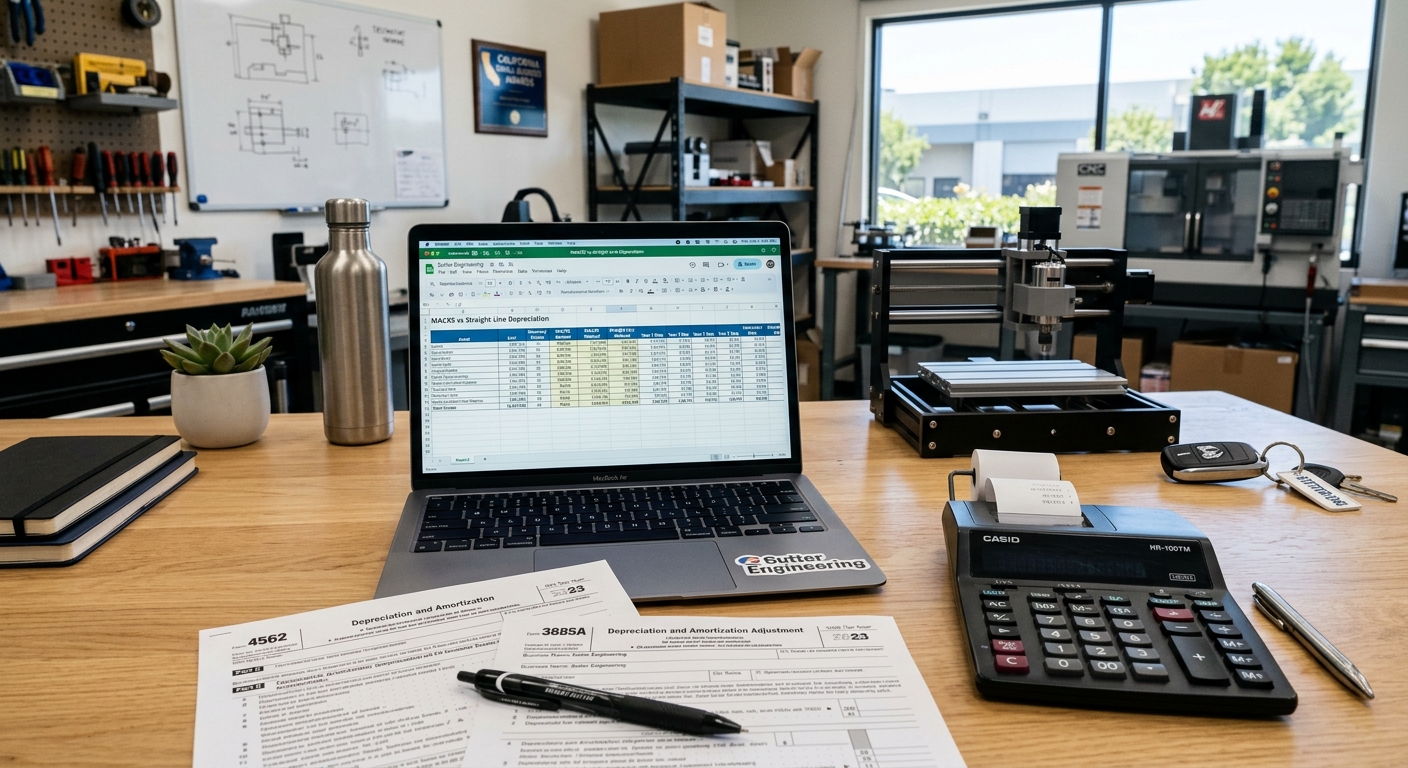
macrs depreciation vs depreciation 2025 california is one of those topics that looks like pure accountant-speak until you see the cash impact. I routinely meet California business owners who bought $120,000 of equipment, did “whatever the software picked,” and accidentally created a two-set-of-books mess: one depreciation story for the IRS and a totally different one for California. The result is predictable: wrong estimates, surprise tax bills, and lost deductions you cannot easily recover.
This information is current as of 5/6/2026. Tax laws change frequently. Verify updates with the IRS or FTB if reading this later.
Quick Answer: What changes when you choose MACRS vs straight-line?
If you use MACRS (Modified Accelerated Cost Recovery System), you usually deduct more of an asset’s cost earlier, which can reduce your taxable income sooner. If you use straight-line depreciation, you spread the deduction evenly over the asset’s recovery period. In California, you also have to account for California’s nonconformity to certain federal depreciation rules, which often means you track separate federal and California depreciation amounts and reconcile them on your state return.
What “MACRS” actually means (and why it is the default on federal returns)
Let’s translate the core idea before you make a tax decision you’ll live with for years.
MACRS is the IRS’s default depreciation system for most business assets. Depreciation is how you deduct the cost of an asset over time instead of all at once. MACRS typically accelerates deductions into earlier years using pre-set tables and conventions.
The legal authority is Internal Revenue Code Section 168. If you want the primary IRS reference, read IRS Publication 946 (it is the IRS’s guide to how you depreciate property, including MACRS, Section 179, and bonus depreciation). When you claim depreciation for business assets, you generally report it on IRS Form 4562.
Why this matters for cash flow
Depreciation is not just a bookkeeping concept. It is a timing lever. Timing is cash. If you can deduct $50,000 this year instead of $10,000, you may reduce your current-year tax bill, improve cash flow, and fund operations without borrowing.
Who this post is for
- LLC and S Corp owners buying equipment, vehicles, software, furniture, and leasehold improvements
- 1099 contractors buying tools, cameras, computers, and vehicles
- W-2 employees with side businesses (Schedule C) who are trying to claim legitimate deductions without triggering nonsense
- High-income California earners who need to avoid nasty surprises caused by federal and California differences
macrs depreciation vs depreciation 2025 california: what is different about California?
California often does not follow federal depreciation rules in the way business owners expect. In plain English: you can do everything “right” federally and still be wrong on your California return if you do not reconcile the differences.
Federal vs California: the two-schedule problem
Most of the pain comes from this: you may have one federal depreciation schedule and one California depreciation schedule. Your accounting file might be a third version. If you are not careful, your tax preparer will be forced to guess, and your estimates will be junk.
California has historically limited or disallowed certain federal accelerated depreciation benefits, which pushes taxpayers into state adjustments and separate calculations. The practical effect is simple: the deduction you take on your federal return might be larger than California allows in that same year, so California taxable income ends up higher than you expected.
What this looks like in dollars (realistic example)
Assume Marco runs a California S Corp doing light manufacturing. In 2025, he buys and places in service:
- $85,000 CNC machine (7-year property under typical federal class life)
- $12,000 laptop and software bundle (often 5-year for hardware, software treatment depends)
- $18,000 shop fixtures and tools (varies, often 7-year)
Total: $115,000 of assets.
Under a fast federal approach (MACRS plus other elections where available), Marco could claim a much larger deduction in year one than he would under straight-line. California may require a slower pattern. If Marco estimates his 2025 California tax based on his federal deduction, he can easily underpay by several thousand dollars and get hit with penalties and interest.
Key takeaway: The difference is not just “MACRS vs straight-line.” In California, it is “federal timing vs California timing.” That is why macrs depreciation vs depreciation 2025 california becomes a planning issue, not a theory issue.
Internal link plan execution (mid-article only)
If you are buying assets and running payroll, you are exactly the type of taxpayer we see in our work with business owners who need depreciation planning that matches both federal and California rules, not just one side of the return.
And if you want this done proactively rather than after-the-fact cleanup, our tax planning services are built around making these elections before year-end so you can set accurate estimated payments and avoid ugly surprises.
MACRS vs straight-line: the decision is not “which is better,” it is “which fits your tax reality”
Most competitors frame this as a generic comparison. That is not helpful. The strategist version is: the best method is the one that matches your income pattern, your financing, your California exposure, and your future plans.
When MACRS is usually the right default
MACRS tends to fit when you want deductions sooner and you expect to be in the same or higher bracket later. Common scenarios:
- Profitable LLC taxed as S Corp buying equipment to expand capacity
- 1099 consultant who had a high-income year and wants to reduce taxable income now
- High-income household where one spouse has W-2 income and the side business is strong
Example: Jasmine is a 1099 marketing consultant in Sacramento. She netted $160,000 on Schedule C in 2025 and bought $18,000 of computers, cameras, and production gear in Q4. If she uses accelerated depreciation, she may reduce her 2025 taxable income by thousands more than if she spreads it evenly, which can reduce both income tax and self-employment tax exposure depending on her full facts.
When straight-line is the smarter move
Straight-line is not “worse.” It is more predictable. It can be strategically better when:
- You expect a much higher-income year later and want deductions available later
- You are trying to stabilize income for lending, partner reporting, or future entity changes
- You have a California-heavy tax bill and want to reduce federal-state divergence
Example: Daniel owns an LLC taxed as a partnership. In 2025, profits were low due to startup costs, but he expects a major contract in 2026. Spreading deductions more evenly might be more useful than burning them when they cannot reduce much tax.
A comparison table you can actually use
| Decision Factor | MACRS (accelerated) | Straight-line |
|---|---|---|
| Year 1 tax reduction | Usually higher | Usually lower |
| Future-year deductions | Usually lower later | Even each year |
| Cash flow impact | Front-loaded benefit | Stable benefit |
| California mismatch risk | Often higher | Often lower |
| Best for | High-profit years | Smoothing income |
Step-by-step: how depreciation actually gets claimed on your tax return
If you cannot explain this process, you cannot manage it. Depreciation errors are one of the easiest ways to quietly ruin your books and create IRS and FTB problems later.
Step 1: Identify whether the purchase is an “asset” or an expense
In plain English: an asset is something you use for more than one year, like machinery, computers, or furniture. Many assets cannot be deducted as a regular expense immediately; they have to be depreciated unless you use elections that allow faster write-offs.
Step 2: Determine the “placed in service” date
Placed in service means the asset is ready and available for use in your business, not when you ordered it. That date affects which year you can start depreciation. Publication 946 covers this concept.
Step 3: Choose your depreciation approach (and elections) for federal
Common federal levers include:
- MACRS depreciation under IRC Section 168
- Section 179 expensing (an election to expense qualifying property, subject to limits)
- Bonus depreciation (if available and applicable for the tax year and property type)
You report these choices on Form 4562. See Form 4562 instructions and downloads and IRS Publication 946 for the governing framework.
Step 4: Build California adjustments (do not guess)
For California, you often need to compute a separate depreciation figure and then reconcile the difference on the state return. For many business owners, the cleanest operational method is:
- Maintain a depreciation schedule in your tax file that shows federal basis, federal method, and federal deductions by year
- Maintain a second schedule for California basis, California method, and California deductions by year
- Track the cumulative difference so you know when California “catches up” later
Step 5: Update estimates based on the actual election, not your gut feel
Depreciation changes taxable income. That changes estimated taxes. If you bought a $60,000 vehicle and claimed a huge federal deduction, but California disallowed part of it, your California estimates need to reflect the state reality.
Pro Tip
Pro Tip: If you buy assets late in the year, do not assume you “missed” the deduction. The placed-in-service date, conventions, and elections matter more than the purchase date.
Common mistake that triggers messy fixes: mixing depreciation methods without documentation
This is the section most blogs gloss over. Here is the blunt truth: depreciation is easy to screw up, and the cleanup is expensive.
The most common failure pattern we see
- Owner buys equipment and books it as an expense in QuickBooks
- Tax software creates an asset schedule anyway, using MACRS
- California requires different treatment, but nobody tracks it
- Next year, the owner sells the asset or trades it in and cannot compute gain or recapture correctly
Why the IRS cares
Depreciation affects gain on sale and can trigger depreciation recapture (in plain English: some of your “gain” is taxed as ordinary income rather than capital gain). Publication 946 explains the framework, and the concept is tied to asset disposition rules. If your schedule is wrong, your reported gain can be wrong, which is an audit magnet.
Red Flag Alert: “We will fix it next year” is usually a lie
If your depreciation schedule is wrong in year one, it compounds. Fixing it later can require Form 3115 (Application for Change in Accounting Method) in some cases, which is not DIY territory. The cheapest fix is getting it right when the asset is placed in service.
What if I financed the equipment? Does depreciation change?
Financing does not change the depreciation basis by itself. If you buy a $90,000 machine and put $10,000 down, you generally depreciate the full purchase price (assuming the asset is used for business and you own it). The loan payment is not the deduction. The depreciation is.
Example with numbers: financed purchase
Let’s say Priya owns an S Corp and buys a $70,000 piece of equipment with $5,000 down and a 60-month loan. Depreciation is based on $70,000 (plus certain costs), not the $5,000 down payment. If she uses an accelerated method, she might deduct a large portion early. Her loan payments are split between principal and interest; the interest portion may be deductible as a business expense depending on limitations (see IRS Publication 535 for general business expense rules).
Why this matters for California planning
Because California may not match the federal depreciation timing, Priya might have a lower federal tax bill and a higher California tax bill in the same year. That is a cash flow trap if she only budgets based on federal.
KDA Case Study: California S Corp owner fixes a two-schedule depreciation mess
Anthony owns a profitable California S Corp doing specialty fabrication. In 2024 and 2025, he bought about $240,000 of equipment and vehicles. His previous preparer claimed aggressive federal depreciation and never built a clean California schedule. On paper, it looked like Anthony had “huge write-offs.” In real life, his California taxable income stayed high, his estimated payments were short, and he got a surprise balance due plus underpayment penalties.
KDA rebuilt his fixed asset ledger, tied every asset to an invoice, verified each placed-in-service date, and corrected the federal MACRS elections on Form 4562. Then we created a California-specific depreciation schedule and mapped the annual differences so his California projections were accurate. We also implemented a quarterly estimate cadence that matched the real federal and state timing.
Result: in the first year after cleanup and planning, Anthony avoided about $11,300 in avoidable penalties and interest and improved cash flow planning by preventing a repeat. He paid $3,900 for the engagement, for a 2.9x first-year return, before counting the long-term benefit of clean asset disposition reporting.
Ready to see how we can help you? Explore more success stories on our case studies page to discover proven strategies that have saved our clients thousands in taxes.
How to decide in 10 minutes: a practical framework for business owners
If you want a clean decision without overthinking, use this framework. It is not theory. It is what we use in real planning conversations.
Choose MACRS when these are true
- You expect profit this year and want cash flow now
- You can handle California differences (separate schedule, proper estimates)
- You are not trying to “show” higher income for a loan this year
Choose straight-line when these are true
- Your income is volatile and you want predictability
- You expect higher profit later and want deductions later
- You want to minimize federal vs California mismatch
Special situations and edge cases competitors avoid
- Entity changes: If you are switching from Schedule C to an S Corp election, depreciation tracking must survive the transition cleanly.
- Mixed-use assets: Vehicles and computers that are part personal, part business can create recapture and substantiation issues.
- Disposition planning: If you plan to sell or trade in equipment within 12 to 24 months, depreciation method and timing can change the gain/recapture profile materially.
Key takeaway: The best method is the one you can document and forecast, not the one that looks best in year one on a software preview screen.
Will this trigger an audit? What the IRS actually cares about
Depreciation itself is normal. What triggers scrutiny is sloppy behavior: inconsistent records, missing invoices, and deductions that do not match your business reality.
Audit triggers we see in the real world
- Big depreciation deduction with minimal revenue
- Luxury vehicle deductions without mileage logs
- Assets deducted that were never placed in service
- Dispositions reported with no basis support
For documentation standards, Publication 946 and related IRS guidance are the right starting point. For general expense substantiation, Publication 535 is also helpful.
How to be boring (in a good way)
- Keep invoices and proof of payment
- Document placed-in-service dates
- Maintain a fixed asset schedule that ties to the tax return
- Track business use percentages for mixed-use property
Ready to Reduce Your Tax Bill?
KDA Inc. specializes in strategic tax planning for business owners, S Corps, LLCs, and high-net-worth individuals. Book a personalized consultation and walk away with a clear plan.
FAQ: depreciation questions California taxpayers keep asking
Do I have to use MACRS?
For most business property on the federal return, MACRS is the default. You can elect straight-line in many cases, but you need to do it intentionally and document it. Publication 946 explains when and how.
Can I switch from MACRS to straight-line later?
Sometimes, but switching depreciation methods can be treated as a change in accounting method, which can require filing Form 3115. That is why you want to choose correctly up front and keep clean schedules.
What if I already expensed the purchase in QuickBooks?
Your books are not your tax return. If an item should be capitalized and depreciated, your tax preparer can correct it on the return, but you should also clean up the books so next year does not become guesswork.
Do W-2 employees get depreciation deductions?
Not for unreimbursed employee expenses on the federal return in most cases, because those deductions were suspended for employees under current law. But if you have a legitimate side business (Schedule C), depreciation can apply to business assets used for that business.
How does depreciation affect selling the asset later?
Depreciation reduces your basis (your remaining cost in the asset). When you sell it, the lower basis can increase your reported gain. Some gain may be “recapture” taxed at ordinary rates depending on the asset type and facts.
What records do I need to support depreciation?
At minimum: invoice, proof of payment, placed-in-service date, business use percentage if mixed-use, and a fixed asset schedule that ties to Form 4562. Publication 946 provides the IRS framework.
Bottom line: stop letting software choose your strategy for you
The punchline of macrs depreciation vs depreciation 2025 california is simple: your depreciation method is a tax strategy choice, and California makes it a two-layer decision. If you choose the method without tracking, you will mis-estimate, mis-report, or both.
Mic drop sentence: The IRS is not hiding depreciation rules, but California will absolutely punish you for ignoring the state side of the schedule.
Book Your Tax Strategy Session
If you are buying equipment, vehicles, or tools and you are not 100% sure your depreciation method is mapped correctly for federal and California, you are risking a surprise tax bill and expensive cleanup later. Book a personalized consultation and we will build a clean asset plan, confirm your elections, and set accurate estimates so you keep more cash without gambling on compliance. Click here to book your consultation now.
Direct link to this blog: https://kdainc.com/?p=99999



