
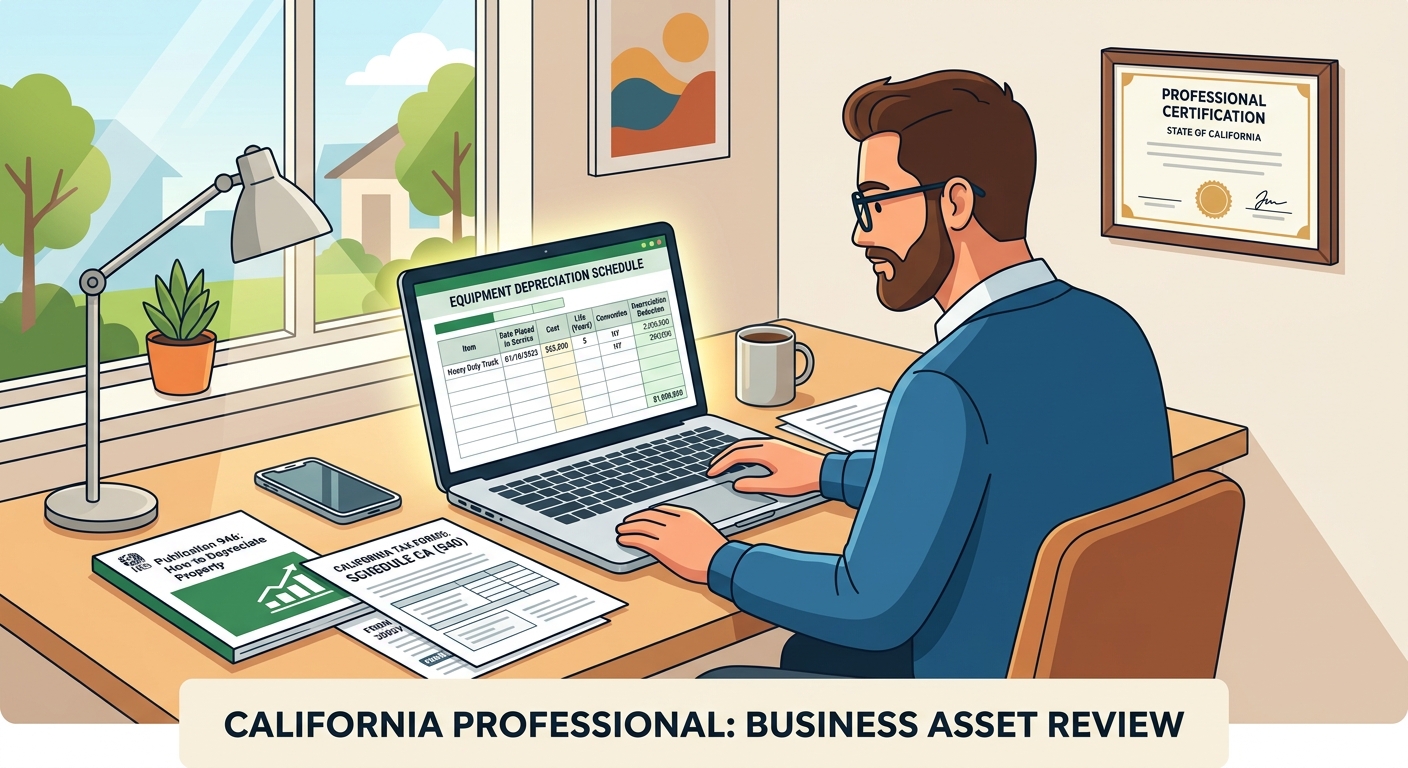
Many self employed Californians are buying laptops, cameras, vehicles, and equipment, then getting only a fraction of the tax benefit they could. The rules feel buried in IRS jargon, and California adds a second layer of complexity. That confusion is exactly where money is lost.
If you are filing Schedule C or running a single member LLC, macrs depreciation for self employed 2024 california is one of the biggest levers you control. Used correctly, it can turn a twenty thousand dollar equipment purchase into thousands of dollars of tax savings. Used wrong, it can create ugly IRS and Franchise Tax Board adjustments years later.
This information is current as of 7/12/2026. Tax laws change often, so verify details with the IRS, the California Franchise Tax Board, or a qualified advisor before you file.
Quick Answer
For the 2024 tax year, most self employed Californians use the federal Modified Accelerated Cost Recovery System, or MACRS, to depreciate business assets over set recovery periods like five or seven years. Federally, you may also use Section 179 expensing and limited bonus depreciation to write off more up front. California generally allows MACRS style depreciation but does not follow federal bonus depreciation and uses tighter Section 179 limits, so your federal and California numbers often differ.
How MACRS Depreciation Works For Self Employed Californians
MACRS is the default federal depreciation system for most tangible business property. It tells you how many years you must spread the cost over, and which percentage to deduct each year. The core rules are laid out in IRS Publication 946.
For a typical self employed professional in California, MACRS usually applies to items like:
- Computers and office equipment, usually five year property
- Cameras, tools, and machinery, usually five or seven year property
- Office furniture, usually seven year property
- Business vehicles, generally five year property
Under MACRS, you do not just divide by the number of years. The IRS provides percentage tables that front load more of the deduction into the early years. For example, a five year asset under the standard 200 percent declining balance method with a half year convention typically gives you 20 percent in year one, 32 percent in year two, and so on.
If you are a solo consultant or freelancer, you are still treated as a business for this purpose. Many self employed taxpayers miss this and simply expense everything, which the IRS can challenge if the items should be capitalized and depreciated instead.
Example: Laptop Purchase In 2024
Assume you are a self employed graphic designer in Los Angeles and you buy a three thousand dollar laptop in March 2024. If you use straight MACRS five year depreciation and no Section 179 or bonus, your federal deduction might look like this:
- Year one: 20 percent of three thousand equals six hundred dollars
- Year two: 32 percent equals nine hundred sixty dollars
- Year three: 19.2 percent equals five hundred seventy six dollars
- Remaining years: balance spread over years four through six
If you are in a combined federal and California marginal rate of 32 percent, that six hundred dollar year one deduction alone reduces your tax by roughly one hundred ninety two dollars. Over the full recovery period you eventually deduct the entire three thousand dollars, just not all in year one.
Where Section 179 And Bonus Depreciation Fit In
On your federal return, you may choose to claim Section 179 expensing or bonus depreciation instead of waiting for MACRS to play out over several years. Section 179 lets you elect to expense all or part of the cost immediately, subject to income and investment limits explained in IRS Publication 535. Bonus depreciation allows an extra first year deduction for certain new or used property placed in service during the year, although the percentage is phasing down from prior years.
This is where California starts to diverge. California generally does not follow federal bonus depreciation and uses much smaller Section 179 limits, so aggressive federal write offs often have to be tracked separately for California. For a deeper overview of how depreciation fits into the bigger California planning picture, many business owners review our California business owner tax strategy hub before they decide which approach to use.
Pro Tip: If you expect your income to grow sharply over the next few years, it can make sense to hold some depreciation for those higher bracket years instead of expensing everything upfront.
Federal vs California Depreciation Rules In 2024
Most self employed people discover the federal California mismatch when their software suddenly shows two different depreciation numbers. That mismatch is normal. The key is understanding what causes it so you can plan deliberately instead of being surprised.
Federal Treatment In 2024
At the federal level for 2024, you have three main levers for most tangible business property:
- Regular MACRS depreciation, usually five or seven year schedules
- Section 179 expensing for eligible property, up to high federal limits if you have enough income
- Bonus depreciation, which still applies to many assets placed in service during the year, although at a reduced percentage compared with the recent 100 percent era
You decide each year whether to rely on MACRS only, combine MACRS with Section 179, or layer bonus depreciation on top. That choice is made on your federal return asset by asset.
California Treatment In 2024
California usually starts with your federal asset cost but then ignores federal bonus depreciation and applies its own Section 179 limitations. That means your California depreciation deduction can be significantly smaller in year one, with the difference spreading into later years.
At a high level for 2024:
- California allows MACRS style recovery for many assets, but it often requires slower methods or longer lives than federal rules
- California Section 179 limits are much lower than federal, so you may not be able to expense the full cost at the state level even if federal allows it
- California does not conform to federal bonus depreciation rules, so any bonus you claim federally becomes an adjustment on your California return
The Franchise Tax Board explains these differences for business filers in various schedules and publications on ftb.ca.gov. If your software is not tracking separate California depreciation automatically, you risk either overstating or understating your California deductions.
Red Flag Alert: If your federal depreciation on a single asset is much larger than your California deduction in year one and your preparer cannot show you the reconciliation, that is a sign you need a cleaner fixed asset schedule.
Example: Five Year Equipment, Federal vs California
Suppose you buy twenty thousand dollars of qualifying equipment for your sole proprietorship in 2024. Federally you elect Section 179 to write off the entire twenty thousand dollars in year one, since your income supports it. At a 32 percent combined marginal rate, that could cut your federal tax bill by about six thousand four hundred dollars for the year.
California, by contrast, may allow only a fraction of that cost under its Section 179 limit, with the rest recovered over several years using MACRS. Your California tax savings year one might be only one or two thousand dollars. Over several years California will generally let you recover the entire cost, but the timing is very different.
Working with a firm that understands both sides ensures your depreciation strategy is designed, not accidental. Strategic year by year choices like this are exactly where dedicated tax planning services earn their keep for self employed professionals.
If you want to get a rough feel for how a change in your deduction might affect your total tax bill, you can plug your profit numbers into this small business tax calculator and see how different deduction levels change your estimated liability.
Step by Step: Building A Depreciation Schedule That Survives Audit
A solid depreciation schedule does two things. It captures every dollar you are entitled to, and it is clean enough that an IRS or FTB agent can follow it without getting confused. Here is a practical way to build that schedule for 2024.
Step 1: List Every Capital Asset Separately
Start with a list of all items that should be capitalized, not simply expensed. This usually includes any single item that costs more than a few hundred dollars and that will last more than one year. Examples include computers, cameras, machinery, furniture, and vehicles.
For each item, record:
- Description
- Date placed in service, not just purchase date
- Total cost including tax, shipping, and installation
- Whether it is used 100 percent for business or partly personal
Step 2: Assign A Class Life And Method
Using the tables in IRS Publication 946, determine whether the asset is three, five, seven, or fifteen year property, and whether it uses the 200 percent or 150 percent declining balance method. Most small business and self employed assets fall into the five or seven year categories.
Note that certain property, such as listed vehicles used partly for personal driving, has stricter limits and record keeping requirements. If your vehicle is in play, you may also want to review IRS guidance on business use of autos.
Step 3: Decide On Section 179 And Bonus For Each Asset
Next, decide whether you want to elect Section 179, bonus depreciation, or neither for each item on your federal return. This is where planning with a professional matters. In a low income year you may not be able to use a large Section 179 deduction, and unused amounts cannot always be carried forward in the way regular MACRS deductions can.
For California, you may have to elect a different pattern or accept that certain federal choices will not carry through. Your software or spreadsheet should track both sets of numbers so you can make clean adjustments on Schedule CA and related forms.
Step 4: Track Federal And California Columns Separately
Create a two column schedule for each asset, with federal cost, method, life, and year by year depreciation on one side and California s version on the other. You can build this in a spreadsheet or inside accounting software, but it must reconcile back to your tax return each year.
Bottom line: the IRS and FTB do not care what software you use. They care that your numbers can be traced back to real invoices and to the rules in Publications 946 and 535.
Common MACRS Mistakes That Cost Self Employed Californians Money
Most errors we see on self employed returns are not exotic. They are simple process failures that compound over time.
Expensing Assets That Should Be Capitalized
The first mistake is treating large equipment as a regular office supply. The IRS does allow a de minimis safe harbor for low cost items, but many returns stretch that concept too far. Expensing a four thousand dollar computer instead of capitalizing it may not catch up with you the first year, but if you get audited three years later the agent may reclassify multiple years at once.
Ignoring California Differences
The second mistake is assuming California automatically follows federal choices. It does not. If you claim heavy bonus depreciation on a vehicle federally and then copy the same deduction onto your California return, you are overstating your California expense. That is the kind of pattern that can draw Franchise Tax Board attention.
Losing Track Of Asset Disposals
The third mistake is failing to track when you sell, trade in, or scrap an asset. If your schedule still shows a five thousand dollar truck that you sold two years ago, your future depreciation will be wrong and any gain on sale may never have been reported.
Key Takeaway: The strongest defense in an audit is clean documentation. A depreciation schedule that lists each asset, life, method, and change in status makes it much easier to defend your numbers and, in some cases, to negotiate a smaller adjustment.
KDA Case Study: Self Employed Videographer Fixes Depreciation And Saves Big
Jordan is a self employed videographer in San Diego with roughly one hundred eighty thousand dollars of gross revenue and about eighty five thousand dollars of net profit in 2023. He had been buying cameras, lenses, lighting rigs, and a van for years, but his prior preparer simply expensed whatever the software allowed and guessed at the rest. His 2023 return showed less than ten thousand dollars of depreciation on more than sixty thousand dollars of gear purchases.
When Jordan came to KDA, we rebuilt his fixed asset schedule for the prior three open years. We pulled invoices from camera shops, online retailers, and vehicle purchase documents, then grouped everything into proper MACRS lives. We corrected several assets that had been double counted, moved others from expense to capital asset status, and recalculated federal and California depreciation separately.
On the amended returns, Jordan picked up more than twenty eight thousand dollars of additional federal depreciation and about sixteen thousand dollars of additional California depreciation across the three years. At his combined marginal rates, that translated to roughly thirteen thousand dollars of total tax reduction. Our fee for the clean up and strategic plan going forward was forty five hundred dollars, so he saw almost a three times first year return, plus a much cleaner balance sheet for future years.
Just as important, Jordan left with a clear process. Every new asset now gets added to his MACRS schedule the month it goes into service, with a separate line for federal and California. That discipline means his 2024 and 2025 returns should be far easier to defend if the IRS or FTB ever comes asking questions.
Ready to see how we can help you? Explore more success stories on our case studies page to discover proven strategies that have saved our clients thousands in taxes.
Will Aggressive Depreciation Trigger An IRS Or FTB Audit
Many self employed Californians worry that using heavy Section 179 or bonus depreciation will automatically put a target on their back. The reality is more nuanced. The IRS flags returns based on patterns that do not fit your industry or income level, not simply because you used a legal deduction.
If your depreciation jumps from five thousand dollars one year to fifty thousand dollars the next but your revenue stays flat, that can look odd. If your vehicle deduction is large relative to revenue, that can also draw attention. On the California side, claiming federal style bonus depreciation without the required state adjustment is a straightforward error the Franchise Tax Board s systems can see.
Red Flag Alert: If your depreciation deductions are large compared with your gross income and you have no fixed asset schedule, you are relying on luck. Building that schedule now is far cheaper than scrambling during an audit.
How To Protect Yourself If You Are Using Big Write Offs
There are three simple protections any self employed person can put in place:
- Keep purchase invoices and proof of payment for every capital asset
- Maintain mileage logs and usage notes for vehicles and mixed use equipment
- Reconcile your depreciation schedule to your tax return every year and note big changes
Often the clients who suffer the worst in audits are not the ones who used aggressive deductions but the ones who used them without records. Clean documentation paired with conservative California treatment goes a long way toward keeping both agencies comfortable.
Ready to Reduce Your Tax Bill?
KDA Inc. specializes in strategic tax planning for business owners, S Corps, LLCs, and high-net-worth individuals. Book a personalized consultation and walk away with a clear plan.
Fast Tax Facts And FAQs On MACRS For 2024
How Do I Know If Something Should Be Depreciated Or Expensed
In general, items you use up within a year, like printer ink or basic supplies, can usually be expensed. Items that last longer than a year and cost more than a few hundred dollars are often better treated as assets and depreciated under MACRS or expensed under Section 179 if you qualify. According to IRS Publication 535, you must capitalize amounts paid to acquire or improve a long lived asset, subject to specific safe harbors.
Can I Use MACRS If I File On Schedule C Instead Of Having An LLC
Yes. MACRS applies to property used in a trade or business or held for the production of income. If you are a sole proprietor reporting on Schedule C, you are still running a business in the eyes of the IRS. Whether you are a contractor, designer, consultant, or rideshare driver, you can claim depreciation on qualifying assets as long as you have proper records.
What Happens If I Realize I Have Been Depreciating Wrongly
If you discover that prior returns used the wrong recovery period or method, or that assets were never depreciated at all, you have options. In some cases you can fix recent years with amended returns. In other cases you may file a change in accounting method using Form 3115 to catch up missed depreciation with a one time adjustment. The rules are technical, so this is a good moment to bring in a professional advisor rather than guessing.
Do I Need Special Software To Track MACRS
No, but you do need a system. Many self employed business owners use a spreadsheet that lists each asset, date placed in service, cost, class life, and method. Others use bookkeeping software with a fixed asset module. The important thing is that your schedule ties to your return and that you can show the math if the IRS or FTB asks.
Book Your Tax Strategy Session
If you are self employed in California and unsure whether your current approach to MACRS, Section 179, and California adjustments is costing you thousands of dollars a year, it is time to get clarity. A focused strategy session can reveal missed deductions, fix weak documentation, and map out a depreciation plan that fits both federal and California rules for 2024 and beyond. Click here to book your consultation now.



