
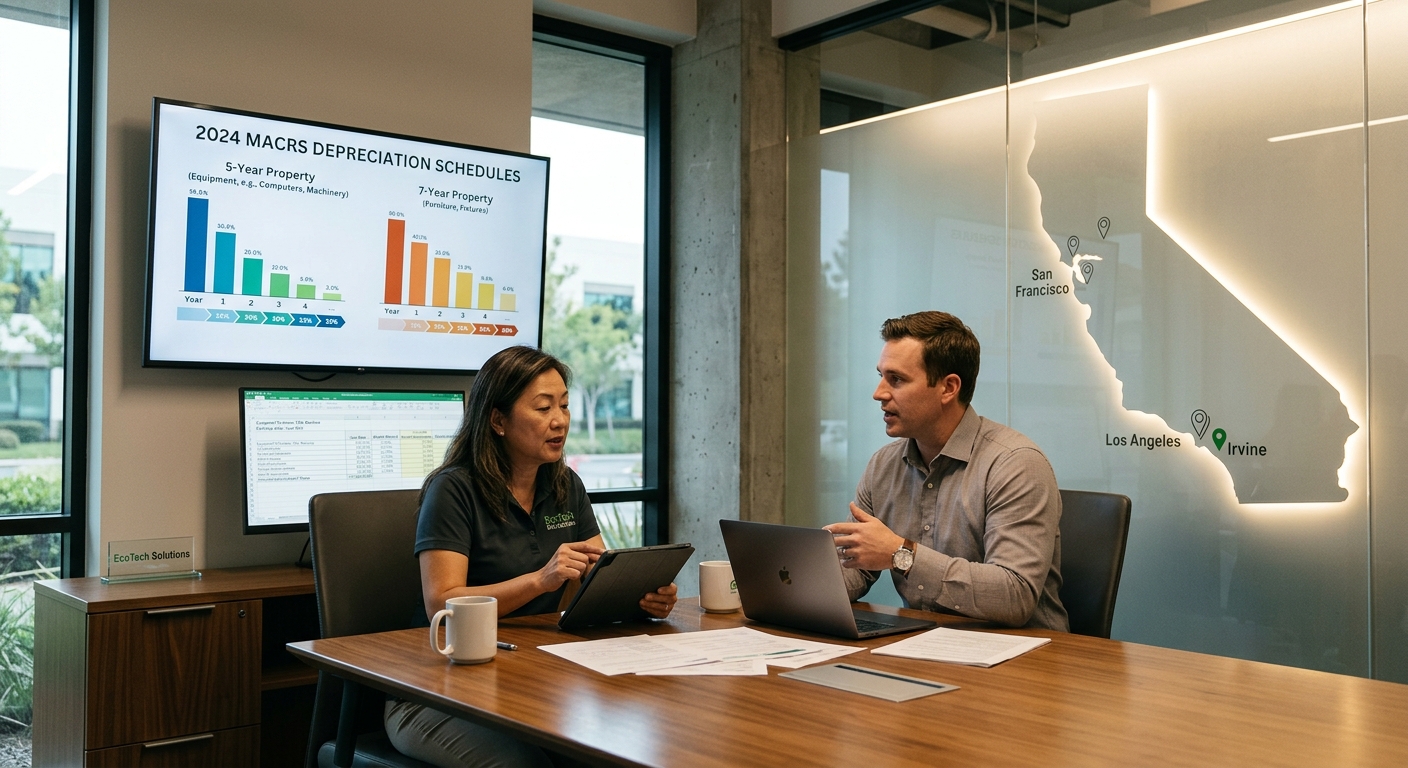
Most California business owners are burning cash without realizing it because they treat depreciation as a bookkeeping formality instead of a strategic lever. The 2024 rules for **macrs depreciation 2024 california** quietly decide whether that new $120,000 truck or $350,000 machine turns into real tax savings this year or gets dripped out over a decade.
Used correctly, MACRS can free up tens of thousands of dollars in cash flow in a single year. Used poorly, it locks you into higher tax bills, weak cash positions, and a constant scramble for working capital.
Quick Answer
For the 2024 tax year, most California business assets are depreciated using the federal Modified Accelerated Cost Recovery System (MACRS). Federal rules allow aggressive first year write offs through Section 179 and bonus depreciation, while California largely conforms to MACRS recovery periods but significantly limits bonus depreciation and certain expensing at the state level. The practical result: you may get a big federal deduction in year one, but a slower California deduction over time, which you need to plan for in your cash flow and estimated tax payments.
This information is current as of 6/3/2026. Tax laws change frequently. Verify updates with the IRS or California Franchise Tax Board (FTB) if you are reading this later.
How MACRS Works For 2024 Business Purchases
Before you decide how to write off a big equipment purchase, you need to understand what MACRS actually is in practice, not in textbook language.
Plain English definition
MACRS stands for Modified Accelerated Cost Recovery System. It is the set of IRS rules that tells you how fast you can deduct the cost of long term business assets. Instead of deducting the full cost in one year, MACRS spreads it over a “recovery period” but front loads more of the deduction into the early years.
For example, a $50,000 work truck used 100 percent for business usually falls into the 5 year MACRS class. Under straight line depreciation you would deduct $10,000 per year for five years. Under MACRS, you might deduct around $10,000 in year 1, $16,000 in year 2, $9,600 in year 3, and so on. The exact pattern comes from the IRS MACRS tables in IRS Publication 946.
Key MACRS concepts that matter in 2024
- Class life – Most equipment and vehicles are 5 year property; computers and some tech are also 5 year; furniture and many improvements are 7 year; commercial buildings are 39 year; residential rentals are 27.5 year.
- Convention – In many cases you use the half year convention, which assumes assets are placed in service in the middle of the year. Large asset purchases can trigger the mid quarter convention, which changes the percentages.
- Method – Most personal property uses 200 percent declining balance switching to straight line. Real property uses straight line only.
MACRS is the baseline system. Then you layer on top two accelerators: Section 179 expensing and bonus depreciation under Section 168(k).
Section 179 and bonus depreciation in 2024
At the federal level for 2024:
- Section 179 generally lets you elect to expense up to a seven figure dollar limit of qualifying property placed in service during the year, subject to income and phase out thresholds. See the current year numbers in Publication 946.
- Bonus depreciation under Section 168(k) allows an additional first year deduction for new or used qualifying property, with the percentage set by statute for each year. Recent law phases this down from 100 percent to lower percentages.
For federal purposes, the combination of Section 179, bonus, and MACRS gives you a lot of flexibility to pull deductions forward or spread them out. California does not always follow that acceleration, which is where many owners get surprised.
If you are an LLC or corporation with multiple revenue streams and significant equipment, it is worth reviewing how depreciation fits into your broader structure, not in isolation. Our services for business owners are built around that bigger picture, not just single year write offs.
Federal vs California Depreciation: Where They Split
The phrase macrs depreciation 2024 california hides a frustrating truth: for many assets, your federal and California returns will not match, even though you are looking at the same truck, machine, or software.
Big picture differences
In broad strokes:
- The IRS allows accelerated deductions through both Section 179 and bonus depreciation, using MACRS recovery periods as a base.
- California generally follows MACRS lives and methods but does not fully conform to federal bonus depreciation and imposes tighter limits on Section 179 expensing.
- That creates “add back” adjustments on your California return where you reverse some federal deductions and then recover them over several years.
Example: A construction company buys $300,000 of heavy equipment in 2024. Federally, between Section 179 and bonus depreciation, it may deduct the full $300,000 that year, turning a $250,000 profit into a book loss and wiping out federal tax. On the California return, a large chunk of that immediate write off is disallowed. The equipment might be depreciated over 5 or 7 years instead. So the owner still writes a large check to the Franchise Tax Board in April, even though the federal bill is close to zero.
Why this matters for planning
If your marginal combined federal and California rate is around 35 percent, that $300,000 full federal write off is worth roughly $105,000 in cash savings. But if California only allows $60,000 of depreciation in year one at a 9.3 percent state rate, you save just $5,580 on the state side and carry the rest into future years.
That timing gap is the core planning issue. You need to know not just whether you get the deduction, but when and on which return. That is particularly important for California based tax planning strategies, where we often blend entity choices, depreciation timing, and owner compensation into one integrated plan.
KDA Case Study: California Contractor Uses MACRS to Fix a Cash Crunch
Consider a real world example of how deliberate planning around macrs depreciation 2024 california rules can change the outcome.
“Luis” runs a small C corporation general contracting firm in the Central Valley with $1.8 million in annual revenue and about $250,000 in pretax profit. In mid 2024 he financed $420,000 of new equipment: two trucks, a skid steer, and specialized concrete tools. His prior accountant booked everything using basic 5 year MACRS with no coordinated strategy.
On his draft federal return, Luis showed about $90,000 of first year depreciation and a taxable profit of $160,000. At a blended federal and California rate approaching 34 percent, that meant around $54,000 of income tax, while he was already tight on cash from equipment payments and slow paying clients.
When Luis came to KDA, we rebuilt the 2024 depreciation schedules. Federally, we selectively applied Section 179 to the lower value assets and used available bonus depreciation on the higher value items, increasing first year federal depreciation from about $90,000 to just over $310,000. That pushed his federal taxable income close to zero.
On the California side, we tracked the state’s limitations and created a reconciliation schedule so the add backs were clear. California depreciation remained around $95,000, leaving him with taxable state income of about $155,000, but we also adjusted his officer compensation and timing of certain expenses to smooth that liability into more manageable quarterly payments.
The net result: about $45,000 of federal tax avoided in year one, roughly $9,000 of California tax deferred, and, more importantly, a clear three year cash flow map. Luis paid our firm just under $5,000 for the planning and implementation work and recovered that cost in the first year alone, with ongoing benefits in future years as MACRS deductions continued.
Ready to see how we can help you? Explore more success stories on our case studies page to discover proven strategies that have saved our clients thousands in taxes.
Choosing Between Section 179, Bonus, and Regular MACRS
Business owners often ask which tool they should use: Section 179, bonus depreciation, or just plain MACRS. The truth is you rarely pick only one. The right blend depends on profit levels, future income expectations, and your California exposure.
Step 1: Forecast your next three years
If your income is spiky, dropping all possible depreciation into year one can backfire. You might wipe out a moderate income year and then be stuck with minimal deductions in a record profit year.
Example: A real estate development LLC in Los Angeles expects $300,000 profit in 2024 but projects $700,000 in 2025 when a big project finishes. If they use Section 179 and bonus to fully expense $400,000 of 2024 equipment, they may push 2024 taxable income near zero but have very little depreciation left in 2025, exactly when their bracket jumps. In that situation, we often cap first year deductions and intentionally leave MACRS in place for later years.
Step 2: Model California separately
No matter how attractive the federal deduction looks, you need a separate California projection.
- Calculate federal taxable income with your proposed depreciation mix.
- Recalculate California taxable income, applying state limits and MACRS adjustments.
- Compare the two cash tax outcomes over at least three years instead of only the current year.
In many of our California business owner projects, the optimized answer is not the one that gives the biggest federal deduction this year. Instead it is the one that flattens combined tax payments while preserving reasonable financial statements for lenders.
To see quickly how shifting income between years changes your total liability, run a rough scenario through a general tax bracket calculator and then refine it with a detailed plan.
Step 3: Document elections the right way
All of these choices become real only when you make the right elections on your return. Section 179 requires a formal election. Bonus depreciation elections and revocations must be handled exactly as described in the regulations under Section 168(k). The IRS spells out the mechanics in Publication 946 and various revenue procedures.
California requires consistent treatment and clean documentation in case of FTB review. During an audit, being able to present clear schedules and election statements often makes the difference between a quick closure and months of back and forth.
Common MACRS Mistakes That Cost California Owners Money
Using macrs depreciation 2024 california rules well is mostly about avoiding unforced errors. Here are traps we routinely clean up.
Red Flag Alert: Treating all assets as 5 year property
Shoving every purchase into a single 5 year MACRS bucket may simplify your spreadsheet but can overstate or understate deductions and trigger problems in an audit. Leasehold improvements, HVAC systems, roofs, and certain land improvements have different recovery periods and may qualify for specialized treatment.
A detailed fixed asset schedule with correct class lives is basic hygiene. According to IRS Publication 534, misclassifying property can require amended returns and recomputation of depreciation, often with interest.
Ignoring the mid quarter convention
If more than 40 percent of your depreciable property (other than real estate) is placed in service during the last three months of the year, you must use the mid quarter convention instead of the half year convention. That changes the first year MACRS percentages and often reduces the deduction you thought you were getting.
We see many self prepared returns where the owner assumed the half year convention, artificially inflating year one depreciation. When corrected, it can retroactively increase taxable income and attract IRS attention.
Mixing personal and business use sloppily
Vehicles, phones, computers, and home office assets require especially careful tracking of personal use. If business use drops below certain thresholds, you may have to switch to straight line depreciation or recapture prior accelerated deductions. The IRS outlines these rules clearly in Publication 463.
For California owners, sloppy mileage logs or weak documentation are all the excuse the FTB needs to reclassify expenses and claw back deductions.
How Real Estate Investors Use MACRS Differently
MACRS for real estate looks tame next to equipment, but it still offers powerful opportunities when combined with cost segregation, especially for California investors.
Basic MACRS for rental property
Residential rental buildings are depreciated over 27.5 years using straight line and the mid month convention. Nonresidential commercial buildings use a 39 year life. That means a $1,000,000 small apartment building (excluding land) yields roughly $36,364 of depreciation per year.
For a high income investor in California facing a combined marginal rate near 45 percent, that single MACRS deduction could be worth about $16,000 in annual tax savings.
Cost segregation to reclassify components
A cost segregation study breaks out parts of the building that qualify as 5, 7, or 15 year property under MACRS instead of 27.5 or 39 years. Examples include certain electrical work dedicated to equipment, specialized plumbing, parking lots, and some interior finishes.
For a California investor buying a $3,000,000 mixed use building, a quality study might identify $400,000 to $600,000 of shorter life property. That accelerates depreciation into earlier years. Federally, you can often combine this with bonus depreciation. For California, you still get faster MACRS deductions, though bonus may be limited.
We frequently pair this approach with broader planning for landlords and developers. If your portfolio is growing, it is worth understanding how MACRS interacts with strategies covered in our real estate investor support services so you do not leave multi year savings on the table.
Will Aggressive MACRS Depreciation Trigger an Audit?
Many owners hesitate to use the full power of MACRS because they are convinced it will put a target on their back. The truth is more nuanced.
What the IRS actually looks for
The IRS is most concerned with:
- Depreciation claimed on assets that do not qualify as business property.
- Misclassified property lives that significantly accelerate deductions.
- Bonus or Section 179 claimed incorrectly.
- Vehicle and listed property with implausible business use percentages.
Using MACRS within the published tables, supported by invoices, service dates, and usage records, is routine. It is when your return mixes high depreciation with weak documentation that real risk appears.
California FTB focus areas
The California Franchise Tax Board tends to focus on:
- Large differences between federal and California depreciation.
- Unexplained additions or disposals of fixed assets.
- Schedule L balance sheets that do not reconcile with depreciation schedules.
- Industries with heavy equipment but slim profits, like trucking and construction.
We tell clients this: the IRS is not hiding MACRS write offs from you; they published the tables and rules. You just were never taught how to use them strategically.
Ready to Reduce Your Tax Bill?
KDA Inc. specializes in strategic tax planning for business owners, S Corps, LLCs, and high-net-worth individuals. Book a personalized consultation and walk away with a clear plan.
Frequently Asked Questions About MACRS in California
Can I use different MACRS methods for federal and California?
In practice you generally start from the same MACRS class life and method, then adjust for California’s specific conformity and limitation rules. You will often maintain separate depreciation schedules for federal and state, but you do not invent an entirely different system for California.
What happens when I sell an asset I depreciated under MACRS?
When you sell or dispose of depreciated property, part of the gain may be taxed as ordinary income instead of capital gain because of depreciation recapture. The rules depend on the property type and how much depreciation you claimed. See IRS Publication 544 for details. California generally follows the same framework but with its own tax rates.
Is MACRS mandatory?
For most depreciable business property placed in service after 1986, MACRS is the default system. You can elect out in some situations, but that is rarely optimal for small and mid size businesses. The real question is how aggressively you combine MACRS with other tools, not whether to use it at all.
How do I fix past year MACRS mistakes?
If depreciation was miscalculated in prior years, you may need to file an amended return or request a change in accounting method using Form 3115, depending on the severity and timing. The IRS explains this process in Publication 946. California may require corresponding adjustments on prior or current returns.
Bottom Line: Treat MACRS as a Strategy, Not Just a Form
MACRS is not just a table in your software. It is a timing tool that decides whether a $250,000 equipment investment lightens this year’s tax bill or drips savings into the 2030s. For California owners, the twist is that federal and state depreciation now live slightly different lives, and ignoring that gap can wreck your cash flow.
Handled well, macrs depreciation 2024 california rules can support equipment upgrades, real estate growth, and more predictable tax payments. Handled casually, they create surprise tax balances, lender frustration, and unnecessary audits.
Book Your Tax Strategy Session
If you are a California business owner planning major equipment or real estate purchases, you should not be guessing how MACRS, Section 179, and bonus depreciation will play out on your federal and state returns. Our team builds three to five year depreciation maps so you know exactly when deductions hit, how they affect cash, and what moves to make next. Click here to book your consultation now.



