
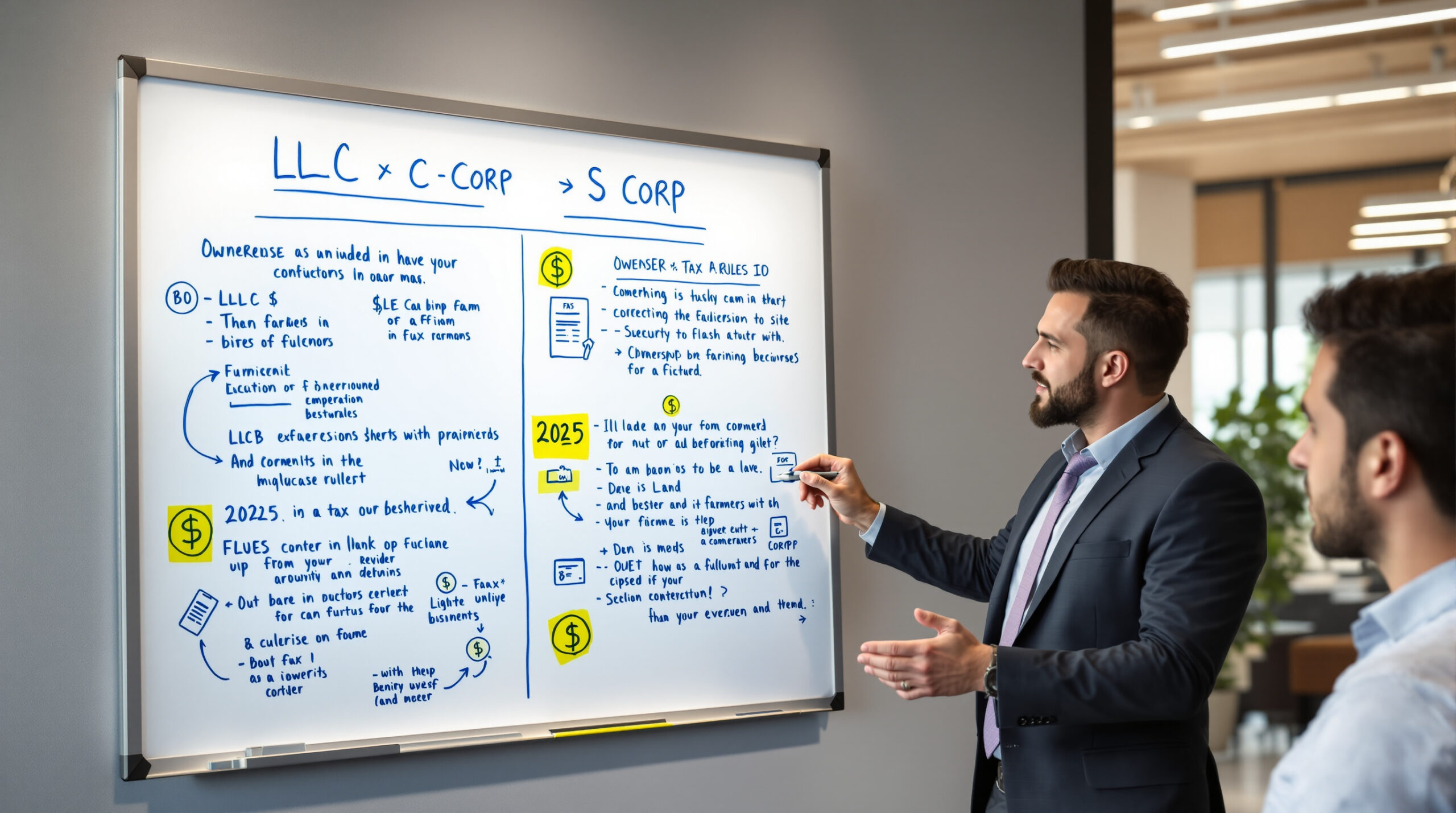
LLC vs C Corp vs S Corp: The Real $29,000 Difference in Entity Choice for 2025
LLC vs C Corp vs S Corp is not just a technical debate—it is the difference between bleeding cash to the IRS or building real wealth as a U.S. business owner, 1099 contractor, real estate investor, or high earner. Most advisors simplify it or hand you a checklist. The reality? Picking the wrong entity often costs Californians five figures each year—sometimes more—while the “right” path can put you in a permanent lower tax bracket and unlock legal savings you are not getting today.
For 2025, new federal and state rules, deduction phaseouts, and ever-tightening audit risk make this a life-or-death decision for your bottom line. Whether you made $100,000 as a consultant, $400,000 running an agency, or $1.2 million in real estate flips, your choice of entity dictates how much of that ends up in your hands versus the IRS or Franchise Tax Board.
Quick Answer
LLCs can offer flexibility, C Corps promise growth potential (but double taxation), and S Corps routinely save California business owners $10,000–$32,000+ per year—if salary, payroll, and compliance are nailed. Choosing the right entity structure is the single most important step for maximizing legal write-offs and avoiding audit red flags in 2025.
When you compare LLC vs C Corp vs S Corp, the biggest tax difference is how each structure treats profit. LLCs default to Schedule C treatment, meaning you pay both income tax and full 15.3% self-employment tax on net earnings. S Corps eliminate that tax on distributions, provided you document a reasonable salary under IRS Reg. §1.1366-2. C Corps remove self-employment tax entirely, but expose you to double taxation under IRC §301 when profits are distributed as dividends.
LLC: Flexibility and Simple Setup (But Missed Savings for Many)
The Limited Liability Company (LLC) is the standard starting point for most small businesses, freelancers, landlords, and consultants. Why? It can be set up quickly with the Secretary of State, requires just an Operating Agreement, and limits your personal liability if you get sued. For tax purposes, a single-member LLC is usually treated as a sole proprietorship—meaning all profit flows to your personal return (Schedule C), and you pay both income tax and self-employment tax (Social Security and Medicare) on every dollar earned.
- Setup Cost: $800/year California minimum tax, $70+ state filing fees
- Tax Forms: IRS Schedule C (Form 1040); CA Form 568
- Main Pros: Simple, flexible, shields personal assets, allows multiple owners
- Main Cons: No built-in payroll, all profit subject to self-employment tax, generally no 199A optimization
Example: If you earn $175,000 net as a 1099 consultant through an LLC, you will pay roughly $26,775 in federal self-employment taxes (see IRS Schedule SE instructions)—on top of federal and state income taxes. For many, this is a $10,000–$18,000 mistake per year just in payroll taxes.
S Corp: The Payroll Loophole That Slashes IRS and CA Tax in 2025
An S Corporation (“Subchapter S”) is not a separate entity, but a tax election you file (via IRS Form 2553 and CA Form 100S) for your LLC or corporation. The key difference: S Corps allow you to split your business income into “salary” (which you pay yourself, and pay payroll taxes on) and “profit distribution” (which flows through to owners, but is not subject to self-employment tax).
- Setup Cost: Similar state fees plus $800/year CA tax, plus payroll setup costs
- Tax Forms: IRS Form 1120S; CA Form 100S; salary reported via W-2; distributions on K-1
- Main Pros: Can save $10,000–$32,000/year on Social Security and Medicare taxes; 199A deduction eligibility up to 20% of profit (if qualified); audit-tested structure
- Main Cons: Mandatory payroll and “reasonable salary”; tight compliance; potential for CA S Corp tax minimums and 1.5% state tax on net income; still must file S Corp election on time
For high-earning business owners, S Corp status is absolutely the most powerful way to cut self-employment taxes—provided you run an actual payroll and set documented reasonable compensation. For instance, a marketing agency owner with $300,000 net income can pay herself a $120,000 salary (IRS required level) and take out the remaining $180,000 as profit distributions—saving approximately $21,960 in self-employment tax for 2025 compared to LLC or sole proprietor status.
If you’re an LLC owner looking for deeper entity optimization—including payroll and 2553 filing support—our entity formation services provide legal setup and ongoing compliance.
What About 199A and Pass-Through Deduction?
The S Corp unlocks access to the Section 199A Qualified Business Income deduction for many owners, letting you write off up to 20% of business profit on federal taxes (subject to complex phaseouts). For a profitable S Corp owner, this alone adds another $8,000 to $22,000/year in tax savings (see IRS Publication 535).
C Corp: The Growth Machine (and Double Taxation Trap)
C Corporation (C Corp) structures are the default for large firms, startups raising capital, or companies wanting to go public. They are a separate legal and tax entity, filing their own IRS Form 1120 and paying tax at a federal flat rate of 21% (plus California’s 8.84% corporate tax). C Corps can offer fringe benefits (health insurance, retirement matching, stock options) and are attractive to venture capitalists or foreign investors.
- Setup Cost: $800+/year minimum CA franchise tax, state filing fees, legal setup $1,000–$5,000+
- Tax Forms: IRS Form 1120; CA Form 100; W-2s for employees, 1099s as needed
- Main Pros: Full fringe benefits, unlimited investors, preferred by VCs, easier to go public
- Main Cons: Double taxation (corporation pays tax, then dividends are taxed to shareholder), higher compliance costs, less efficient for most small businesses
For example, if your C Corp makes $1,000,000 profit in 2025, pays $210,000 federal tax and $88,400 CA tax, and then pays shareholder dividends, the IRS taxes you again on that payout (up to 23.8% for high earners per IRS Publication 542), resulting in much higher overall tax paid—sometimes $390,000+ on that same million-dollar profit.
For detailed S Corp and C Corp comparison, review our complete S Corp tax strategy guide for 2025.
KDA Case Study: Tech Consultant Finds $29,700 in Hidden Savings—Swapping LLC for S Corp
“Denise” came to KDA in December 2024 as a senior product consultant, running $320,000 through a solo California LLC. She’d been told the structure was “simple and safe,” but was losing $28,000–$32,000 in self-employment and CA taxes annually and facing scrutiny on deductions. We restructured her business into an S Corp, set her up with compliant payroll at $140,000, and formalized her profit draws to $180,000. This move immediately cut her payroll taxes by $21,996 and unlocked a $13,200 Section 199A deduction in 2025, while also allowing pre-tax health and retirement deductions through payroll. Cost? $3,200 for KDA’s compliance overhaul and ongoing payroll. ROI? 10x the first year—and Denise has a clean audit trail the IRS cannot touch.
Ready to see how we can help you? Explore more success stories on our case studies page to discover proven strategies that have saved our clients thousands in taxes.

Pro Tip: Compliance Essentials for 2025 Entity Selection
The IRS has increased audits of S Corps and LLCs who lack proper documentation or pay “unreasonably low” salary to owner-employees. Any structure you choose requires:
- Operating Agreement or Bylaws: Even single-member LLCs need a written document
- Timely Elections: File IRS Form 2553 (S Corp) within 75 days
- Payroll Setup: Issue W-2s; remit payroll taxes quarterly
- Minutes & Corporate Records: For C Corp or S Corp, keep annual meeting notes—even if solo
- State Forms: CA Form 568 (LLC), CA Form 100, 100S (C or S Corp)
If you botch just one of these, the IRS can revoke your entity status—costing you five-figure tax breaks and exposing you to back taxes and penalties. For full-service support and peace of mind, our tax prep and filing services simplify multi-entity compliance—year-round.
Common Mistake: Sticking With LLC or Sole Proprietor After $100K Net
Too many California business owners and 1099 earners believe LLC status is the endgame. Here is the reality: the moment your net business income hits $100,000–$120,000, an S Corp often saves more than it costs—especially if your profit after reasonable salary exceeds $60,000. Waiting until “next year” costs thousands you will never recover. The IRS rarely notifies you to upgrade—you must act before your first big year. Not sure if you qualify? See our business owner resource page.
Does It Ever Make Sense to Stick With a C Corp?
In a few scenarios, yes: if you plan to seek VC funding, offer ISOs/ESPPs to employees, or keep profits inside the company for rapid reinvestment, C Corp may be the best path. On the other hand, for solo consultants, service providers, and real estate investors, double taxation usually kills the benefit fast.
Follow-Up Questions: Entity Choice FAQ for 2025
What if I Missed the S Corp Election Deadline?
If you missed filing IRS Form 2553 on time, the IRS may grant late relief if you act quickly. Penalties for late payroll or misclassified income can reach $5,000+ per year. Fixing it now prevents nightmare audits or years of excess tax. Here is the IRS guidance on S Corp elections.
Can Real Estate Investors Benefit From S Corps?
S Corps are usually not the best choice for buy-and-hold rental investors, but can be powerful for high-volume flippers or agents generating self-employment income. For $200,000 profit flippers, entity selection can make a $24,000+ tax difference. Explore our real estate tax strategies for a deep dive.
Do All Owners Have to Be U.S. Citizens?
S Corps require all shareholders to be U.S. persons (citizens or resident aliens). LLCs and C Corps have no such restriction—so international founders are better served with LLC or C Corp structures.
Will This Structure Trigger an Audit?
Entity changes do not guarantee an audit, but sudden payroll splits or large new deductions always warrant careful compliance and documentation. According to the IRS business startup guide, documenting salary, minutes, and elections is your audit firewall.
Book Your Entity Strategy Deep Dive
If you are earning six or seven figures and feeling the tax pinch, entity selection is not a paperwork issue—it is a bottom-line strategy. Do not let sunk-cost bias keep you overpaying. Book a session with our entity strategy pros today, walk away with a clear plan, and lock in your 2025 savings. Click here to secure your entity consultation now.


