
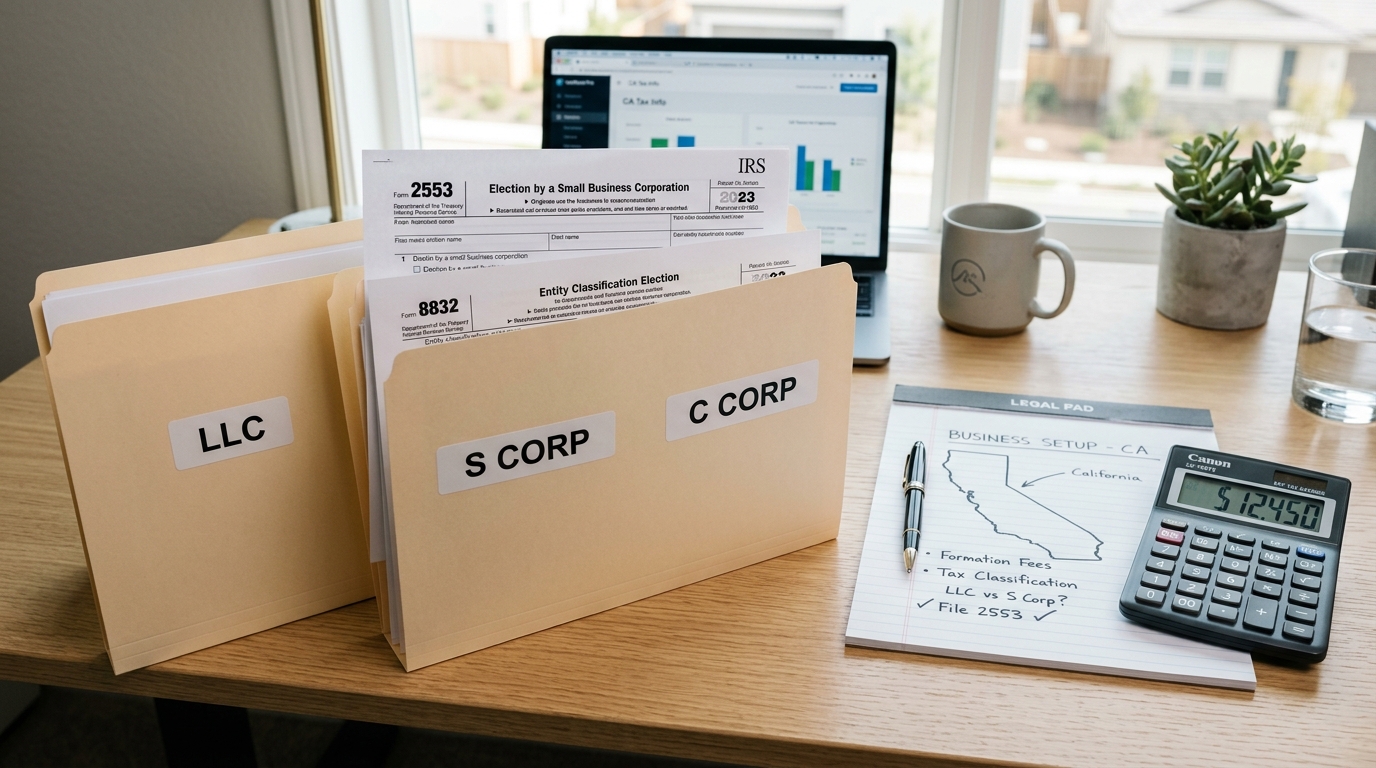
Meta description (145–155 characters): LLC is s corp or c corp? Learn the only documents that prove it, the tax costs of guessing, and the IRS forms that fix it fast.
This information is current as of 5/11/2026. Tax laws change frequently. Verify updates with the IRS or FTB if reading this later.
Most people think the IRS has a simple switch that says “LLC = S Corp” or “LLC = C Corp.” It doesn’t. An LLC is a state legal wrapper, not a federal tax type. The IRS taxes your LLC based on elections and defaults. If you don’t know which one you’re in, you can overpay, underpay, or file the wrong return and find out when a notice shows up.
If you’ve ever asked llc is s corp or c corp while staring at a 1099, a bank application, or your CPA’s organizer, this post is the clean answer: what determines the classification, how to prove it, and how to fix it when it’s wrong.
Quick Answer: What “LLC Is S Corp or C Corp” Really Means
An LLC is not automatically an S Corp or C Corp. By default, a single-member LLC is taxed like a sole proprietorship (Schedule C) and a multi-member LLC is taxed like a partnership (Form 1065). An LLC becomes taxed as a corporation only if it files an election with the IRS, typically Form 8832, and it becomes taxed as an S corporation only if it files Form 2553 (and qualifies).
How the IRS Actually Classifies an LLC (Defaults vs Elections)
Here’s the strategist view: the fastest way to answer “llc is s corp or c corp” is to separate state law from federal tax law.
State law: LLC is your liability shield and ownership rules
Your LLC exists because you filed it with California (or another state). That controls:
- Who owns it and how profits are split (operating agreement)
- Liability protection and business formalities
- What your business is called and who can sign contracts
None of that automatically determines whether the IRS taxes you as a sole proprietor, partnership, S corporation, or C corporation.
Federal law: LLC tax status is driven by default rules and elections
The IRS uses “check-the-box” rules to classify entities. In plain English: if you don’t elect corporate status, you get a default classification. If you want corporate taxation, you file elections. (See Form 8832 instructions for the election mechanics.)
Default classification rules (what happens if you do nothing)
- Single-member LLC (SMLLC): default is “disregarded entity,” reported on Schedule C (or Schedule E/F depending on activity).
- Multi-member LLC: default is partnership, filed on Form 1065 with K-1s.
Key takeaway: if you never filed Form 2553 or Form 8832, you are almost certainly not an S Corp or C Corp for federal tax. The “llc is s corp or c corp” question is usually answered by “neither, you are Schedule C or partnership.”
Election rules (how an LLC becomes taxed as a corporation)
An LLC can elect to be taxed as a corporation by filing Form 8832. After that, it’s treated as a C corporation unless it separately elects S corporation treatment.
To become an S corporation for tax purposes, the entity must meet S corp eligibility rules and file Form 2553. Many LLC owners skip the corporate election and file Form 2553 directly. Practically, the IRS accepts that approach for eligible LLCs electing S treatment.
What this looks like in dollars (why classification matters)
Consider Jordan, a 1099 consultant in California with $200,000 of net business profit (after expenses).
- If Jordan stays default (Schedule C), self-employment tax applies broadly, and it’s common to see $10,000 to $18,000 of avoidable payroll-type tax depending on wage base interaction and deductions.
- If Jordan runs an S Corp correctly with a reasonable salary of $100,000 and $100,000 distributions, payroll taxes apply to salary but not distributions, often creating a five-figure savings opportunity.
- If Jordan accidentally files as a C Corp or operates like one without planning, they can create dividend double-tax exposure on distributions and lose flexibility.
That’s why “llc is s corp or c corp” isn’t trivia. It changes your filing, your payroll, and your total tax drag.
The Only 7 Documents That Prove Your LLC’s Tax Status
You cannot rely on what your Secretary of State website says, what your bank calls you, or what QuickBooks lists in settings. You prove tax status with tax documents.
1) IRS acceptance letter for Form 2553 (S Corp election)
If your LLC is taxed as an S Corp, there should be an IRS acceptance notice (CP261) confirming the S election. If you do not have it, request it. Don’t guess.
2) A stamped or acknowledged Form 2553 (or proof of timely filing)
Your file should include the Form 2553 you submitted, with signatures and election effective date. If your tax pro filed it, ask for a copy.
3) IRS Form 8832 (Entity Classification Election), if you elected corporate status
Form 8832 is the document that turns your LLC into a corporation for federal tax. If it exists, it should be in your permanent tax file.
4) The last two years of business returns
- Form 1120-S means S Corp taxation.
- Form 1120 means C Corp taxation.
- Schedule C inside your 1040 often means default SMLLC.
- Form 1065 often means partnership taxation.
If you don’t have copies, pull them from your preparer or request IRS transcripts.
5) IRS transcripts that reflect the entity return type
The IRS can provide business account transcripts showing what was filed. This is often the cleanest proof for lenders and for new accountants inheriting your file.
6) Payroll filings (only if S Corp or C Corp with wages)
If your LLC is taxed as an S Corp and you are taking owner wages, you should see:
- Quarterly payroll returns (Form 941)
- Annual federal unemployment return (Form 940)
- Form W-2 issued to the owner-employee
No payroll evidence is a common sign that someone is “calling it an S Corp” without running a real S Corp.
7) California filings that match the federal classification
California has its own layer. If you are an LLC taxed as an S Corp, you typically also deal with California’s S corporation return and California-specific filings. If you are a plain LLC, you may have an LLC return and fee. The mismatch is a huge red flag.
Pro Tip: If you’re a business owner and the “llc is s corp or c corp” confusion is slowing you down, it’s usually a bookkeeping and compliance problem first. Clean books, clean returns, clean status. Our bookkeeping and payroll team fixes the documentation layer that makes the tax layer defensible.
A Simple Decision Tree to Stop Guessing
This is the diagnostic you can run in five minutes.
Step 1: What did you file last year?
- If you filed Form 1120-S: your LLC is taxed as an S Corp.
- If you filed Form 1120: your LLC is taxed as a C Corp.
- If you filed Schedule C: likely a disregarded entity.
- If you filed Form 1065: likely a partnership.
Step 2: Did you ever sign and file Form 2553?
If yes, confirm acceptance. If no, you are not an S Corp no matter what your logo says.
Step 3: Did you ever file Form 8832?
If yes, you may be in C Corp land unless you also filed Form 2553 and were accepted.
Step 4: Are you running payroll?
If your LLC is taxed as an S Corp and you are actively working in the business, you generally need reasonable compensation as wages. The IRS expects this and has litigated it. A famous reminder is Watson v. Commissioner (T.C. Memo 2012-167), where the court recharacterized distributions as wages when the salary was unreasonably low.
Step 5: Does California agree with your federal story?
California compliance does not automatically mirror federal elections. If you are operating in California, you need to confirm franchise tax, LLC fee, and any PTE (pass-through entity) elections are aligned.
Key takeaway: “llc is s corp or c corp” is answered by what you filed and what elections were accepted, not what you intended.
California Layer: The Franchise Tax and LLC Fee Can Expose You
California adds a second cost to getting your classification wrong: state-level fees and minimum taxes that don’t care about your intentions.
California LLC fee vs S Corp tax (why your classification changes the state bill)
California imposes an annual $800 minimum franchise tax on many entities. LLCs can also face an additional LLC fee based on total income, which surprises new owners because it is not based on profit. S corporations have different rules and a tax based on net income (with a minimum tax).
If you “think” you’re an S Corp but California has you as an LLC, you can end up paying both compliance costs and penalties to clean it up.
AB 150 PTE election (SALT cap bypass) only works if your entity is real
For many California owners, the pass-through entity tax election can create a state tax credit mechanism to help bypass the federal SALT limitation. But it requires correct entity filings and timelines. If you’re fuzzy on whether “llc is s corp or c corp,” you’re not ready to rely on advanced moves until the foundation is fixed.
Red Flag Alert: California notices often start with mismatched entity returns
One of the most common notice triggers is inconsistency between federal entity classification and California returns, payroll accounts, and 1099 reporting. The fastest way to invite an FTB headache is to run payroll under one entity story and file returns under another.
What If My Accountant Told Me I’m an S Corp, But I Don’t Have the Election?
This happens more than most owners want to admit. There are three common reasons:
- They intended to file the election but didn’t, or it was rejected.
- They filed it but you never got the acceptance letter, and no one confirmed it.
- You are operating like an S Corp operationally (payroll, distributions) but filing like something else.
How to cleanly verify without drama
- Request copies of Form 2553, Form 8832, and any IRS acceptance notices.
- Pull your last filed return and confirm the form type.
- Order IRS transcripts for the entity if the file is incomplete.
- Check payroll filings for consistency with an S Corp story.
What if you discover you are not an S Corp?
Then you have a planning decision, not a panic. Depending on timing, you may be able to file for late election relief under IRS procedures if you qualify. The important part is that you stop acting like something you are not. Filing the wrong returns compounds the problem.
Key takeaway: The IRS does not care what your email signature says. The IRS cares what elections were filed and what returns you submitted.
KDA Case Study: 1099 Consultant Fixes “Phantom S Corp” and Saves $14,700
Erica is a California-based UX consultant paid on 1099s. She formed an LLC, and a prior preparer told her she was “an S Corp now” because it would save self-employment tax. The problem was simple and expensive: no one could produce an accepted Form 2553, and her last return was filed on Schedule C. Meanwhile, she had been taking “distributions” and skipping estimated payments because she thought payroll was optional.
KDA rebuilt the file from the ground up. We pulled transcripts, confirmed there was no valid S election, and then designed a compliant transition: election filing, payroll setup, and a compensation plan that matched her market pay. For the following tax year, Erica ran $220,000 in profit with a $115,000 reasonable salary. The shift reduced payroll-type tax exposure and improved her estimated tax accuracy, producing an estimated first-year net tax savings of $14,700 while reducing notice risk.
Fees were $4,200 for the cleanup, election support, and payroll implementation, producing a 3.5x first-year ROI, plus a clear compliance trail for her mortgage application.
Ready to see how we can help you? Explore more success stories on our case studies page to discover proven strategies that have saved our clients thousands in taxes.
Step-by-Step: How to Fix Your LLC Tax Status (Without Triggering a Mess)
If you’re stuck on “llc is s corp or c corp,” the fix is usually a sequence, not a single form.
Step 1: Freeze the story you’re telling (bank, payroll, invoices)
Make a list of where your entity type appears:
- W-9s you provide to clients
- Bank accounts and loan applications
- Payroll provider setup
- Contracts and invoices
If these are inconsistent, you’re setting yourself up for a mismatch notice later.
Step 2: Pull the last two returns and match them to elections
Your tax return is your classification footprint. If you filed 1120-S but never ran payroll, that is a strategic problem. If you filed Schedule C but thought you were an S Corp, that is an election problem.
Step 3: Decide what you want going forward (default, S Corp, or C Corp)
Most owner-operators choosing between S Corp and C Corp are really deciding between:
- Payroll tax planning and pass-through simplicity (often S Corp)
- Retaining earnings and potentially qualifying for QSBS (sometimes C Corp, with a separate California reality check)
If you are a typical service business throwing off $120,000 to $400,000 in owner profit, the “llc is s corp or c corp” decision often comes down to payroll taxes, reasonable compensation, and your distribution habits.
Step 4: Implement elections correctly
- Elect S Corp: file Form 2553 (and meet eligibility).
- Elect corporate status: file Form 8832 if needed.
Don’t ignore effective dates. A great election filed at the wrong time is just paperwork.
Step 5: Implement the operating system (books, payroll, distributions)
A real S Corp is not just an election. It’s an operating system:
- Monthly bookkeeping close
- Payroll cadence
- Shareholder distributions tracked properly
- Basis tracking (especially if you take distributions)
If you want a fast estimate of how entity profit and taxes might shake out, you can run a rough scenario through a small business tax calculator before you decide what questions to bring to your tax pro.
Step 6: Align California filings
California does not forgive “I didn’t know.” Make sure you have the correct accounts and returns set up. That includes minimum taxes, entity returns, and PTE elections if you’re using them.
Key takeaway: Fixing “llc is s corp or c corp” usually takes 30 to 60 days if you have decent records, and longer if your books are messy or prior returns are inconsistent.
Common Mistakes That Create IRS and FTB Problems
This is where most competitor articles stay vague. Here’s the blunt list of what actually causes pain.
Mistake 1: Thinking your EIN letter shows S Corp status
Your EIN confirmation letter does not prove S Corp election. It proves you got an EIN.
Mistake 2: Filing Form 1120-S without a valid election
If you file the wrong return type, you can cause processing delays, penalties, and a messy clean-up with amended returns or late relief requests.
Mistake 3: Taking “distributions” before understanding what they are
In an S Corp, distributions are not wages. In a Schedule C business, owner draws are not distributions. The labels matter because they change payroll tax treatment and how you document payments.
Mistake 4: Skipping reasonable compensation
The IRS expects S Corp owner-employees to be paid a reasonable salary for services. Underpaying wages and overpaying distributions is a common audit adjustment area. Start with market pay and document it. The IRS discusses employment tax fundamentals in Publication 15 (Circular E).
Mistake 5: Confusing an LLC taxed as S Corp with an actual corporation
Your legal entity can still be an LLC even if you are taxed as an S Corp. That’s fine. The danger is when owners stop maintaining the LLC’s operating agreement, member records, and signature authority because they think they “became a corporation.” You didn’t. You changed your tax treatment.
Mic drop: The IRS isn’t hiding your entity classification; your paperwork is.
Do I Need to Change My LLC to a Corporation to Be Taxed as an S Corp?
No. In many cases, you can keep the LLC legal structure and elect S corporation tax treatment. The “llc is s corp or c corp” confusion comes from mixing legal structure and tax status.
When keeping the LLC wrapper is a good idea
- You like the operating agreement flexibility
- You want simpler state-level maintenance
- You already have contracts and licenses in the LLC name
When converting to a corporation might be worth it
- You’re raising venture capital or issuing multiple equity classes (S Corps cannot have multiple classes of stock under IRC Section 1361)
- You need a more corporate governance structure for partners and investors
Special Situations and Edge Cases Competitors Skip
Most articles ignore these. They matter.
Edge case 1: Real estate rentals inside an LLC
Rental income is often reported on Schedule E. Many real estate investors use LLCs for liability reasons, but the tax classification question “llc is s corp or c corp” can be the wrong question if the activity is passive rental. The strategy focus becomes depreciation, passive loss limits, and entity layering, not payroll taxes.
If you’re actively investing, you’ll get more relevant guidance on our real estate investor tax page where we focus on the rules that actually move the needle for landlords and flippers.
Edge case 2: High-income W-2 with an LLC side business
W-2 income can push you into higher marginal brackets and phaseouts. If your side LLC throws off $60,000 of profit, an S Corp might save payroll taxes, but the math should include retirement plan options, QBI deduction limits, and whether you can support a reasonable salary.
Edge case 3: Multi-state owners and nexus
Your LLC can be taxed one way federally, but you might owe filings in multiple states based on where you work or where customers are located. Don’t let the “llc is s corp or c corp” decision blind you to registration and withholding issues.
Ready to Reduce Your Tax Bill?
KDA Inc. specializes in strategic tax planning for business owners, S Corps, LLCs, and high-net-worth individuals. Book a personalized consultation and walk away with a clear plan.
FAQ: Fast Answers to the Questions People Ask Next
How do I know if my LLC is taxed as an S Corp?
You should have an accepted Form 2553 (often evidenced by IRS CP261), and you should be filing Form 1120-S each year with payroll filings if you work in the business.
Can an LLC be taxed as a C Corp?
Yes. File Form 8832 to elect corporate treatment, then file Form 1120. Remember that paying money out to owners can create dividend treatment and double taxation.
Can I change my LLC’s tax status mid-year?
Effective dates are limited and rule-driven. Some elections are effective at the start of a tax year, and late relief may be available in certain cases. Don’t assume you can “flip a switch” in June and have it count for the whole year.
Do banks and clients care if my LLC is taxed as S Corp or C Corp?
They care whether your documentation is consistent. Underwriting and vendor compliance often require a return copy, EIN, and W-9 that matches. Inconsistency is what kills deals.
Will fixing this trigger an audit?
Fixing mismatches and filing correctly generally reduces risk. The bigger risk is continuing to file the wrong return type or running an S Corp without payroll.
Book Your Tax Strategy Session
If you’re still unsure whether your “llc is s corp or c corp” situation is costing you $5,000 a year or $25,000 a year, don’t keep guessing. We’ll review your filed returns, confirm elections, and map the cleanest path forward for payroll, California compliance, and tax savings. Book a personalized strategy session here: book your consultation now.
Direct blog link: https://kdainc.com/llc-is-s-corp-or-c-corp/



