
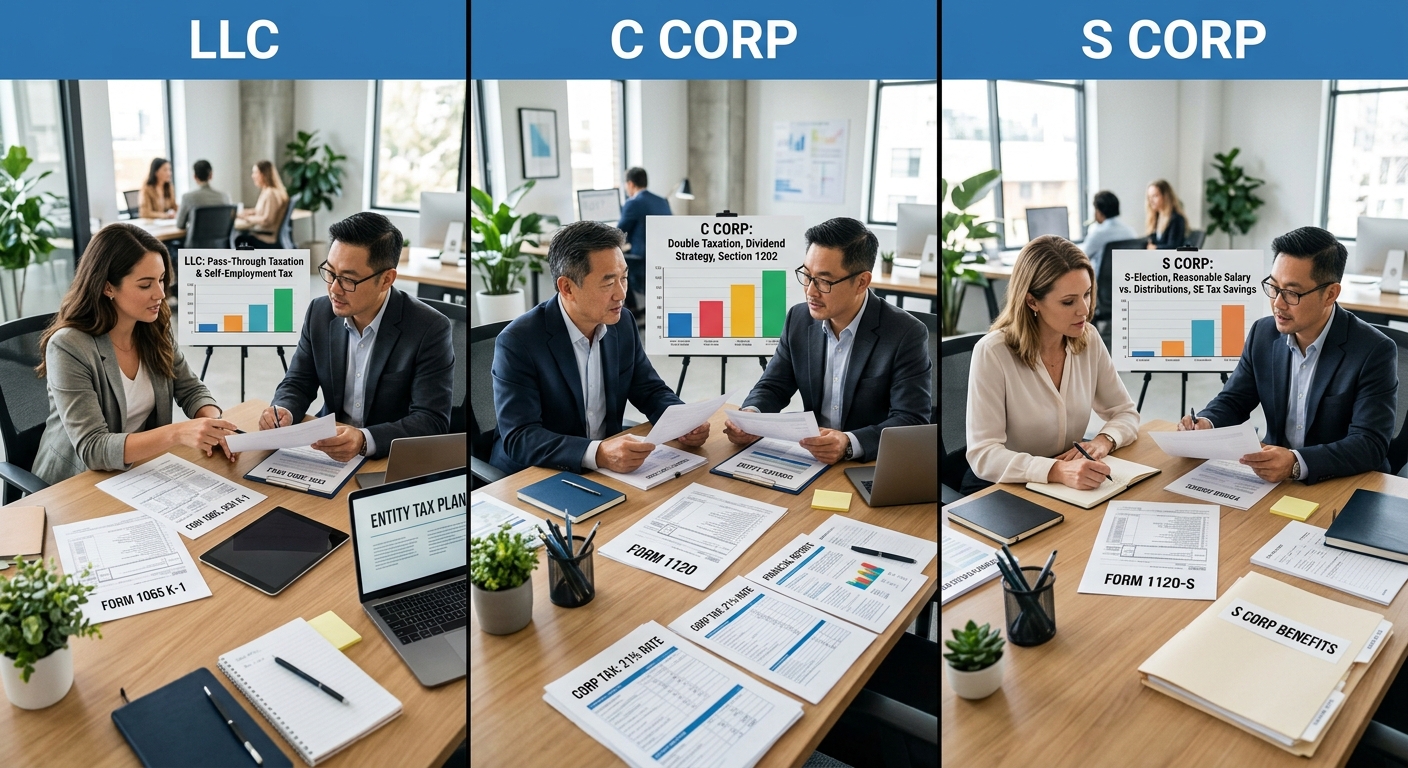
Most business owners pick an entity structure once and then never revisit it. Years later, they wonder why their friend with similar income is paying $12,000 less in taxes each year. The gap usually comes down to one decision: whether they stayed with an LLC, moved to a C corporation, or elected S corporation status.
This article breaks down how llc c corp or s cororp choices really affect your tax bill, cash flow, and audit risk so you can stop guessing and start using the IRS rulebook to your advantage.
Quick Answer: How These Entities Actually Tax Your Profits
If you strip away the legal jargon, there are only three main ways your business profit gets taxed:
- LLC (default tax status): Profit usually passes through to you and is hit with both income tax and self-employment tax.
- C corporation: The company pays a flat corporate tax, then you pay tax again on dividends. This is classic double taxation.
- S corporation: Profit passes through, but only your salary is subject to payroll tax. Remaining profit often escapes self-employment tax.
The right choice depends on your profit level, how much cash you need personally, and whether you plan to scale or sell. According to IRS Publication 535, the tax treatment of expenses is broadly similar, but how the net income is taxed varies dramatically.
Understanding the Core Differences Between LLC, C Corp, and S Corp
Legally, an LLC is a flexible state law entity. For tax, the IRS lets you treat it as a sole proprietorship, partnership, C corporation, or S corporation, depending on elections you file. That is why comparing llc c corp or s cororp options can be confusing. You are really comparing tax treatments more than labels on your Secretary of State paperwork.
Default Tax Treatment for a Single-Member LLC
If you form a single-member LLC and do nothing else, the IRS ignores the LLC for tax purposes. You report all income and expenses on Schedule C of your Form 1040 as a sole proprietor. You pay:
- Regular federal and state income tax on net profit
- Self-employment tax (Social Security and Medicare) at 15.3 percent on most or all of that profit
For example, if your single-member LLC earns $150,000 after expenses, you could see over $22,000 in self-employment tax alone before income tax even starts.
Multi-Member LLC: Partnership by Default
A multi-member LLC is taxed as a partnership by default and files Form 1065. The business does not pay income tax itself. Instead, the partners receive a Schedule K-1 reporting their share of profit. They then pay income tax and, in many cases, self-employment tax on that share. Detailed partnership rules appear in IRS Publication 541.
C Corporation: Flat Corporate Tax but Double Taxation Risk
A C corporation is a separate taxpaying entity that files Form 1120. The company pays corporate tax on profit, and shareholders pay tax again when they receive dividends. If your corporation earns $200,000 and pays out $100,000 in dividends, you can see why planners call this double taxation. It can still be the right option for startups that plan to raise capital or eventually go public, but it is often inefficient for a solo owner pulling out most of the profit each year.
S Corporation: Pass-Through with Payroll Split
An S corporation files Form 1120-S. Profit passes through to the shareholders, who report it on their personal returns. The key difference from an LLC default is how employment taxes work. Shareholders who work in the business must take a reasonable salary, which is subject to payroll taxes, but remaining profit distributions generally are not.
When business owners compare llc c corp or s cororp choices, they are often trying to decide if avoiding self-employment tax on a slice of their profit outweighs the cost and complexity of running S corp payroll.
When an LLC Taxed as a Sole Proprietor or Partnership Still Makes Sense
Despite the buzz around S corporations, a plain LLC can still be the right move, especially in the early years.
Lower Profit Levels and Simplicity
If your business profit is under roughly $60,000–$80,000 per year, the tax savings from an S corporation may not justify the added costs of payroll, separate tax filings, and bookkeeping. A Schedule C filer might pay $9,000 in self-employment tax on $60,000 of profit, but they avoid hundreds of dollars per year in payroll filings and S corp returns.
For many self-employed professionals in their first couple of years, focusing on revenue and simple recordkeeping is more valuable than squeezing out every last dollar of tax savings. That changes as profit stabilizes and grows.
Leveraging the Qualified Business Income Deduction
Many LLC owners qualify for the Qualified Business Income deduction, also called the QBI deduction. This can allow a deduction of up to 20 percent of qualified business income from pass-through entities subject to limitations. Both LLCs and S corporations can potentially benefit, but the calculation interacts with wages and taxable income limits. The underlying rules come from Section 199A of the Internal Revenue Code and are summarized in IRS guidance on the 20 percent deduction.
If your taxable income is below the Section 199A thresholds, staying with a simple LLC structure while you grow may still deliver strong tax efficiency without additional paperwork.
Why Many Owners Eventually Elect S Corp Status
Once Schedule C or partnership profit moves past roughly $80,000–$100,000, the self-employment tax bill begins to dwarf the incremental complexity of S corporation compliance. At that point, it is worth running numbers with a professional to model whether electing S corp status on top of your existing LLC provides net savings.
How S Corporations Cut Self-Employment Tax for LLC Owners
For a profitable LLC owner asking whether to stick with llc c corp or s cororp, S corporation taxation usually wins the comparison. The reason is straightforward: it allows you to split your income into salary (taxed like wages) and distributions (generally not subject to self-employment tax).
Reasonable Compensation: The Non-Negotiable Rule
The IRS requires S corporation shareholder-employees to take reasonable compensation for the work they perform. That salary is subject to Social Security and Medicare tax just like any other W-2 wage. You cannot pay yourself $20,000 on a business that nets $300,000 and expect to sail through an audit.
Reasonableness depends on industry, duties, hours, and market pay. IRS enforcement in this area references Internal Revenue Manual guidance on S corporation compensation. A realistic range might be 40–60 percent of profit as salary for many service businesses, but the right number is highly fact specific.
Side-by-Side Example: LLC vs S Corp at $200,000 Profit
Consider Maria, a consultant in California with $200,000 net profit before owner pay. Compare two scenarios:
- Scenario 1: Single-member LLC on Schedule C
Maria pays income tax plus self-employment tax on the full $200,000. Self-employment tax alone is roughly $28,000, partially offset by a deduction. - Scenario 2: LLC electing S corporation status
Maria pays herself a $110,000 salary and takes $90,000 as an S corp distribution. Payroll tax applies only to the $110,000. That may cut combined Social Security and Medicare tax by $10,000–$12,000 in a single year.
Income tax on the total $200,000 remains based on her bracket, but shifting a portion of income out of the self-employment tax base is where the S corporation shines.
Administrative Costs You Must Factor In
S corp status is not free money. To do it correctly, you need:
- Regular payroll with proper withholdings and filings
- Form 1120-S filing each year
- Clean, separate books for the entity
- Time and fees to monitor compensation levels as profit changes
Many bookkeeping and payroll service packages bundle this work, but costs can easily run $2,000–$4,000 per year. Your tax savings needs to comfortably exceed that to justify the structure.
If you want to quantify the overall tax impact of your current structure, running your income through a small business tax calculator can help frame the decision before a deeper strategy session.
Where C Corporations Still Make Sense
In discussions of llc c corp or s cororp structures, C corporations often get dismissed as tax traps because of double taxation. In reality, they can be powerful tools in the right context.
Retained Earnings and Reinvestment Strategy
If your plan is to reinvest most profits back into the business for growth instead of distributing them, C corporation status can make sense. The company pays corporate tax on profits it keeps, but shareholders do not owe tax on undistributed earnings.
For example, a real estate operating company or technology startup might leave $500,000 per year in the business to fund expansion. In that case, the corporate-level tax might be acceptable given the reinvestment strategy and other planning options.
Attracting Investors and Equity Compensation
Many institutional investors prefer or require C corporation structures, especially for high-growth startups that may go public or get acquired. Stock option plans and complex cap tables are often simpler with a C corporation framework. The tradeoff is that owners must plan carefully for eventual dividends or liquidity events to manage the second layer of tax.
International and Multi-Entity Structures
Once you introduce foreign ownership, multiple classes of shares, or complex profit-sharing, the simplicity of S corporations disappears. C corporations do not have the same shareholder and class restrictions S corps do. If your long-term plan involves raising capital, issuing preferred stock, or building a multi-entity structure for real estate or operating companies, C corp status may be the right long-term vehicle, while an LLC or S corp might be a better fit for earlier phases.
For business owners in that situation, a coordinated plan that includes premium advisory services is more important than any one entity label.
Red Flag Alert: Common Entity Mistakes That Trigger IRS Attention
Certain patterns show up repeatedly in IRS exams of closely held businesses. They usually involve sloppiness in how owners handle the line between personal and business finances, or how they treat compensation.
Paying No Salary in an S Corporation
One of the fastest ways to attract IRS scrutiny is to run an S corporation with substantial profit and pay yourself no W-2 wages. If your S corp earns $250,000 and you distribute all of it as shareholder draws, expect an agent to argue that most of that amount should have been treated as payroll, with back taxes and penalties to match.
Using the Wrong Form or Missing Elections
Owners who jump from llc c corp or s cororp without filing the correct forms often end up misreporting income.
- To elect S corporation status, you must file Form 2553 on time.
- To have an LLC taxed as a corporation, you file Form 8832.
- Partnerships must file Form 1065 and issue Schedule K-1 to partners.
Missing these steps creates a mismatch between how income is reported and how it should be taxed, which can spiral into notices and penalties. The IRS gives some late election relief, but relying on relief instead of planning is a risky habit.
Commingling Funds and Weak Documentation
Regardless of structure, mixing personal and business accounts undermines your position in an audit and can undercut legal protections. Paying your mortgage directly from an LLC account or using a corporate card for personal vacations invites challenges to deductions and, in serious cases, questions about whether the entity should be respected at all.
Will an S Corp or C Corp Automatically Reduce Audit Risk?
Many owners believe that forming a corporation somehow makes the IRS ignore them. It does not. The Service selects returns based on patterns of income, deductions, and mismatches in information reporting. Overstated expenses on a Schedule C can raise red flags, but so can unreasonably low officer compensation in an S corporation or large related-party transactions in a C corporation.
KDA Case Study: LLC Owner Restructures and Cuts Self-Employment Tax
Consider David, a 42-year-old marketing consultant in California who had been operating a single-member LLC and reporting on Schedule C for five years. His net profit had climbed steadily and hit $210,000 in the most recent year. He was frustrated that despite strong revenue, his take-home pay felt squeezed by taxes.
When David came to KDA, we ran a full comparison across llc c corp or s cororp options. He was not planning to raise outside capital or reinvest most of his profits, so a C corporation did not fit his goals. Instead, we modeled what would happen if his LLC elected to be taxed as an S corporation starting the following tax year.
We set a reasonable salary of $120,000 based on his role, experience, and industry benchmarks, with the remaining $90,000 treated as S corp distributions. After factoring in payroll tax, unemployment insurance, additional tax prep costs, and ongoing business owner advisory support, David still saved approximately $11,800 in self-employment and payroll taxes in the first year alone. His total fees for setup, payroll, and S corp returns were just under $3,500, delivering a first-year ROI of more than 3 to 1, with similar savings expected in future years.
Ready to see how we can help you? Explore more success stories on our case studies page to discover proven strategies that have saved our clients thousands in taxes.
How Real Estate Investors Should Think About LLC, C Corp, and S Corp Choices
Real estate adds another layer to the llc c corp or s cororp conversation because of how depreciation, passive losses, and capital gains work.
Holding Rentals in an LLC Taxed as a Partnership
Most long-term rental properties are best held in an LLC taxed as a partnership or disregarded entity. Pass-through treatment preserves long-term capital gain rates on sale and allows depreciation and other expenses to flow directly to the owners. Putting rentals in a C corporation can trap appreciation and convert favorable capital gains into less favorable corporate and dividend taxation.
Using an S Corporation for Real Estate Activities
S corporations can be useful for active real estate businesses such as brokerages, flipping operations, or property management companies. In those cases, owners can sometimes reduce self-employment tax on part of the profit similarly to other service businesses. However, holding appreciating real estate in an S corporation is usually a bad idea because getting property out of the corporation later often triggers tax.
Real estate investors balancing professional fees, rental income, and flips often benefit from a multi-entity structure designed with both tax and asset protection in mind. Specialized support from our real estate investor team can help coordinate that structure with your long-term goals.
Where to Start If You Are Unsure About Changing Your Entity
Choosing among llc c corp or s cororp options is not about chasing a trendy structure. It is about matching your business cash flow and long-term plan to tax rules that reward specific patterns of income and reinvestment.
Clarify Your Profit Level and Growth Trajectory
Before you touch an IRS form, document your last two to three years of net profit and realistic expectations for the next two. A solo consultant at $90,000 of profit and flat growth will reach different conclusions than an e-commerce owner scaling from $150,000 to $400,000 over the next three years.
Model at Least Three Scenarios
With clean numbers in hand, a good advisor will run side-by-side projections showing:
- Staying as an LLC default filer
- Electing S corporation status
- In select cases, restructuring into a C corporation with a plan to manage distributions
The goal is not just lowest tax this year, but best after-tax cash in your pocket over a three- to five-year window, while keeping audit risk manageable. Our tax planning services are built around exactly this kind of multi-year modeling.
Do Not Forget California and Other State-Level Rules
For California owners, every structure comes with its own state quirks. LLCs pay an annual fee based on gross receipts once income exceeds certain thresholds, plus the minimum franchise tax. S corporations and C corporations pay different state-level taxes and fees. Before you assume an S corp will save you a set dollar amount at the federal level, layer in how your state treats each entity. Failing to do that is one of the easiest ways to be disappointed when your final tax bill arrives.
This information is current as of 7/10/2026. Tax laws change frequently. Verify updates with the IRS or your state taxing authority if you are reading this later.
Fast Tax Fact: How to Use IRS Publications to Double-Check Advice
Any time you receive guidance about llc c corp or s cororp strategies, it should map back to the IRS source material. Key references include:
- IRS Publication 535 for business expenses and deductions
- IRS Publication 541 for partnership rules
- IRS Publication 542 for corporate taxation
- Form 2553 instructions for S corporation elections
- Form 8832 instructions for entity classification elections
Cross-checking advice against these sources helps you avoid trendy but unsupported strategies that may not survive an audit.
Ready to Reduce Your Tax Bill?
KDA Inc. specializes in strategic tax planning for business owners, S Corps, LLCs, and high-net-worth individuals. Book a personalized consultation and walk away with a clear plan.
Key FAQs on LLC, C Corp, and S Corp Choices
What profit level makes an S corporation worth it?
There is no single threshold, but once consistent profit exceeds roughly $80,000–$100,000, S corporation status often becomes attractive for service businesses where the owner actively works in the company. Below that range, the savings may not outweigh payroll and compliance costs. A tailored projection is the only way to know for sure.
Can I switch from LLC to S corp mid-year?
You can elect S corporation status partway through the year if you meet the timing rules in the Form 2553 instructions, but partial-year elections can complicate bookkeeping and reporting. Many owners prefer to time an election to the start of a new tax year when practical.
Is there any reason not to elect S corp if I qualify?
Yes. If your income is volatile, your profit highly dependent on a few contracts, or you expect to take on investors who do not qualify as S corp shareholders, locking into S corporation status can backfire. The key is to align entity choice with your realistic operational and capital plans, not just last year’s tax bill.
Book Your Tax Strategy Session
If you are unsure whether your current structure is costing you thousands in unnecessary tax, it is time to run the numbers with a professional. A focused review of your llc c corp or s cororp options can uncover real savings and reduce your audit exposure. Book a personalized consultation with our strategy team and leave with a clear, written game plan. Click here to book your consultation now.



